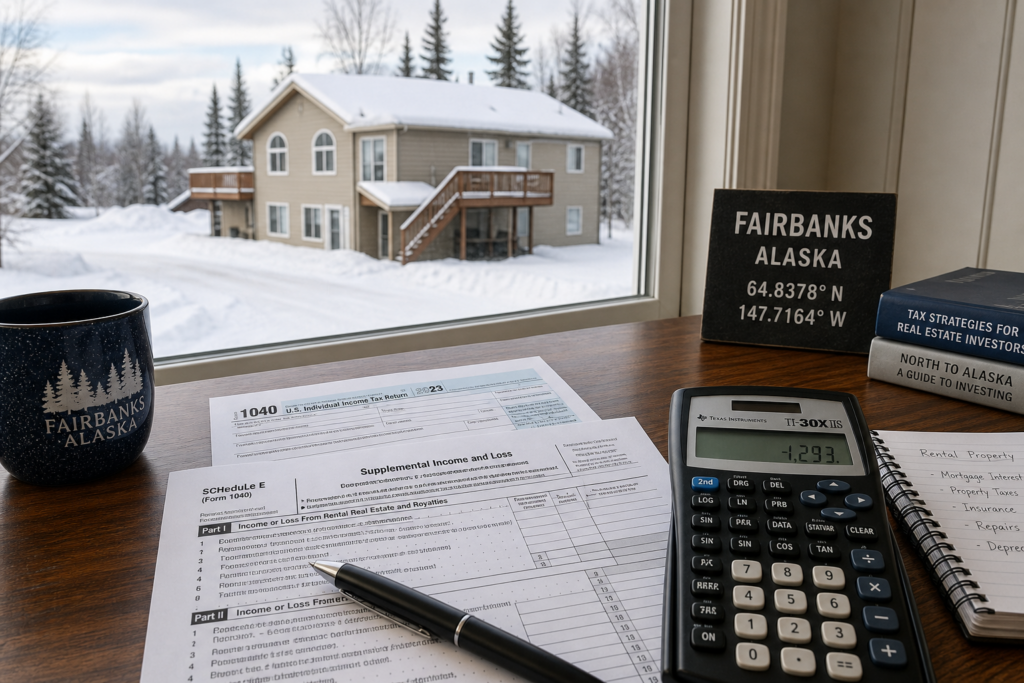
Complete Guide to Fairbanks Schedule E Tax Help for 2026: Maximize Your Rental Property Deductions
Complete Guide to Fairbanks Schedule E Tax Help for 2026: Maximize Your Rental Property Deductions
Whether you own rental property in Fairbanks or across Alaska, mastering Schedule E tax reporting is essential for maximizing your deductions and minimizing your tax liability for the 2026 tax year. This comprehensive guide to Fairbanks Schedule E help covers everything real estate investors need to know about reporting rental income, claiming depreciation deductions, navigating passive activity loss limitations, and leveraging the 2026 bonus depreciation benefits that can transform your bottom line. If you’re new to rental property investment or managing multiple properties, understanding Schedule E is non-negotiable for your tax strategy.
Table of Contents
- Key Takeaways
- What Is Schedule E and Why Does It Matter for Fairbanks Investors?
- How Do You Report Rental Income on Schedule E for 2026?
- What Are the Deductible Expenses on Schedule E?
- How Can You Claim 100% Bonus Depreciation in 2026?
- Understanding Passive Activity Loss Limitations
- Distinguishing Between Rental and Personal Use Days
- Next Steps
- Frequently Asked Questions
Key Takeaways
- Schedule E is the official IRS form for reporting all rental income and losses from investment properties in Fairbanks.
- For 2026, qualified rental properties placed in service after January 19, 2025, qualify for 100% bonus depreciation.
- Passive activity loss limitations cap annual deductions at $25,000 unless you’re a real estate professional.
- Alaska has no state income tax, but federal Schedule E rules apply to all Fairbanks rental property investors.
- Properly allocating rental days versus personal use days determines your deductibility of expenses and losses.
What Is Schedule E and Why Does It Matter for Fairbanks Investors?
Quick Answer: Schedule E is the IRS form where you report all rental income, expenses, and losses from investment properties. It directly impacts your federal tax liability for the 2026 tax year.
Schedule E, titled “Supplemental Income or Loss,” is a critical tax form for any Fairbanks real estate investor managing rental properties. Unlike the standard 1040 form, Schedule E provides a detailed accounting mechanism for reporting rental income sources, itemizing deductible expenses, and calculating net rental income or loss. For the 2026 tax year, filing Schedule E accurately ensures you’re claiming every legitimate deduction while maintaining full compliance with IRS requirements.
The form functions as a dedicated accounting ledger specifically designed for rental property operations. Whether you’re managing a single Fairbanks rental property or a portfolio of residential or commercial investments, Schedule E consolidates all rental activity on one page, making it easier for the IRS to audit your returns and for you to track profitability. The form asks for specific information about each property, including rental days, personal use days, and a detailed expense breakdown.
Why Alaska Investors Must File Schedule E
Alaska residents benefit from having no state income tax, but this doesn’t exempt you from federal tax obligations. In fact, Fairbanks investors face additional considerations because the lack of state tax incentives means your federal deductions become even more valuable. Schedule E is required if you have any rental income, regardless of whether the property is located in Alaska or elsewhere. For 2026, the IRS requires all rental activity to be reported on Schedule E unless you’ve elected to use a different reporting method.
Pro Tip: Alaska’s lack of state income tax means every federal deduction you claim on Schedule E saves you federal dollars. Maximize your deductions and leverage the 100% bonus depreciation benefit available in 2026 for properties placed in service after January 19, 2025.
Without proper Schedule E documentation, the IRS may disallow your deductions entirely, resulting in significant additional tax liability. Moreover, filing Schedule E demonstrates good faith compliance with tax law, reducing audit risk for other parts of your return. For serious Fairbanks real estate investors, Schedule E isn’t just a requirement—it’s a strategic tool for optimizing your tax position.
How Do You Report Rental Income on Schedule E for 2026?
Quick Answer: Report gross rental income on Schedule E line 3, including all rents collected from tenants. Deduct expenses on designated lines to calculate your net rental income for the 2026 tax year.
For the 2026 tax year, reporting rental income on Schedule E begins with a comprehensive accounting of all monies received from tenants. This includes not only base rent but also security deposits, late fees, parking charges, and any other payments directly tied to tenant occupancy. The key principle is that any amount you receive for the right to use your property must be reported as income on Schedule E.
In Fairbanks, where seasonal demand for rental properties can fluctuate significantly, it’s critical to maintain detailed rental records for the entire year. Document the rental rate per month, the number of days each unit was rented, and any gaps in occupancy. This documentation becomes essential if the IRS questions your Schedule E filing or if you need to support your depreciation calculations.
Income Reporting Requirements for Different Property Types
Fairbanks investors managing different types of rental properties face slightly different reporting obligations. Residential rentals (apartments, single-family homes, condos) follow standard Schedule E rules. Commercial properties have similar reporting requirements but may qualify for different depreciation schedules. Short-term rentals (like Airbnb properties rented fewer than 15 days annually) have specialized rules that affect both income reporting and expense deductibility.
When you receive security deposits from tenants, they typically don’t count as immediate income on Schedule E because they’re held in trust and will be returned. However, if you use any portion of a security deposit to cover tenant damage or unpaid rent, that amount becomes taxable income in the year you apply it. This distinction is crucial for accurate Schedule E reporting in 2026.
What Are the Deductible Expenses on Schedule E?
Quick Answer: Schedule E allows deductions for mortgage interest, property taxes, insurance, repairs, utilities, maintenance, property management fees, and depreciation on your rental property investments for 2026.
The power of Schedule E comes from the extensive list of deductible expenses you can claim against your rental income. For Fairbanks investors, understanding which expenses qualify and how to document them properly can mean the difference between breaking even and generating significant tax losses to offset other income. The 2026 tax year offers multiple opportunities to reduce your taxable income through legitimate rental property expense deductions.
Your calculator tool can help you estimate potential tax savings from various deduction strategies. Our Small Business Tax Calculator allows you to model different expense scenarios and see how they impact your overall tax liability when using Schedule E reporting.
Mortgage Interest and Property Tax Deductions
For rental properties in Fairbanks, mortgage interest is 100% deductible on Schedule E, unlike the $750,000 acquisition debt cap that applies to personal residences. This makes rental property financing more tax-efficient than financing your primary residence. Property taxes on rental properties are also fully deductible on Schedule E with no limitations—a significant advantage for Alaska property owners managing investment portfolios.
Document these expenses by maintaining copies of your annual mortgage statements and property tax assessments. For the 2026 tax year, create separate files for each property to ensure you’re allocating expenses correctly if you manage multiple Fairbanks rentals. Property tax deductions on rental properties face none of the $40,000 state and local tax (SALT) caps that limit deductions on primary residences.
Repairs, Maintenance, and Operating Expenses
Schedule E permits deductions for all ordinary and necessary expenses incurred to maintain your rental property. In Fairbanks, where harsh winter conditions create specific maintenance demands, you can deduct snow removal, pipe insulation, weatherproofing, roof repairs, and furnace maintenance as rental property expenses. The key distinction is that repairs maintain the property’s existing condition, while capital improvements that add value or extend the property’s useful life must be depreciated rather than expensed immediately.
- Property management company fees or virtual assistant services for tenant coordination
- Homeowners association (HOA) fees, if applicable to your rental units
- Utilities you pay directly (water, trash, internet, if included in lease)
- Advertising for tenant recruitment and lease renewals
- Pest control, yard maintenance, and grounds keeping services
Pro Tip: Keep detailed receipts and invoices for all rental property expenses. For 2026, take photos of repairs and save contractor estimates. If the IRS audits your Schedule E, documentation is your defense against disallowed deductions.
How Can You Claim 100% Bonus Depreciation in 2026?
 Free Tax Write-Off Finder
Quick Answer: Under 2026 tax law (Section 168(k) guidance), rental properties placed in service after January 19, 2025, qualify for 100% bonus depreciation, allowing you to deduct the entire building cost immediately instead of over 27.5 years.
One of the most powerful tools in the 2026 tax code for Fairbanks real estate investors is 100% bonus depreciation, available on qualifying rental properties placed in service after January 19, 2025. This benefit allows you to deduct the entire cost of qualifying property improvements in the year they’re placed in service, rather than spreading the deduction over 27.5 years using standard MACRS depreciation. For investors acquiring or significantly improving Fairbanks properties in 2026, this can generate six-figure tax deductions on Schedule E.
The benefit applies to tangible property used in a rental real estate business, including building systems, fixtures, and component parts. However, the timing rules are precise. Construction must begin after January 19, 2025, and before January 1, 2029. The property must be placed in service after July 4, 2025, and before January 1, 2031. Missing any of these deadlines can eliminate the entire deduction, so Fairbanks investors must verify their timeline carefully.
Cost Segregation Studies: Maximizing Depreciation Benefits
For Fairbanks rental property acquisitions in 2026, a cost segregation study can dramatically increase your available depreciation deductions on Schedule E. A cost segregation study separates components of your rental property into categories with different depreciation schedules. Roofing, parking lots, landscaping, and certain building systems can depreciate over 15 years instead of 27.5 years. With bonus depreciation available in 2026, a proper cost segregation study can unlock immediate deductions for these components.
The alignment between your purchase agreement, tax return filing, and depreciation schedules is critical. All three documents must show consistent asset classifications and valuation amounts. If they conflict, the IRS may challenge your Schedule E depreciation deductions during an audit. Professional preparation is essential to defend your position.
Standard Depreciation Rules When Bonus Depreciation Doesn’t Apply
For Fairbanks rental properties placed in service before January 19, 2025, or after December 31, 2030, standard MACRS depreciation applies. Buildings depreciate over 27.5 years for residential properties and 39 years for commercial properties. Appliances, furniture, and other tangible property may have shorter depreciation periods. While less aggressive than bonus depreciation, these deductions still reduce your Schedule E taxable income significantly over time.
| Property Type | Depreciation Period | 2026 Bonus Depreciation Eligible |
|---|---|---|
| Residential Rental Building | 27.5 years | 100% if placed in service after Jan 19, 2025 |
| Commercial Rental Building | 39 years | 100% if placed in service after Jan 19, 2025 |
| Land (non-depreciable) | Not applicable | Not eligible |
| Appliances/Fixtures | 5-15 years | 100% if placed in service after Jan 19, 2025 |
Understanding Passive Activity Loss Limitations
Quick Answer: For 2026, passive activity loss limits cap deductions at $25,000 per year unless you qualify as a real estate professional. Excess losses carry forward to future years but don’t reduce your current year income.
The passive activity loss (PAL) rules represent the biggest potential limitation on Schedule E deductions for Fairbanks real estate investors. Under these rules, losses from rental real estate activities are classified as “passive” losses, meaning they cannot offset active income like wages, salaries, or self-employment income on your tax return. Instead, they’re limited to $25,000 per year for taxpayers with modified adjusted gross income (MAGI) below $100,000.
For every $1 of MAGI above $100,000, the $25,000 deduction limit is reduced by $0.50. This means taxpayers with MAGI of $150,000 or more have no annual passive activity loss deduction available under the general rule. Any unused losses carry forward to future years, becoming available when you sell the property or if you qualify as a real estate professional.
The Real Estate Professional Exception
Fairbanks investors who qualify as “real estate professionals” under IRS regulations can avoid passive activity loss limitations entirely. To qualify, you must spend more than 750 hours per year in real estate business activities (including rental property management) and ensure that real estate activity constitutes more than 50% of your overall professional activity. Additionally, you must “materially participate” in the rental real estate activity, which generally means active, ongoing involvement in management decisions.
If you meet these requirements and make the appropriate election on Schedule E, your rental property losses can offset other income without limitation. This can generate five-figure tax savings for Fairbanks investors with substantial rental portfolios. However, the IRS scrutinizes real estate professional claims carefully, so documentation of your 750+ hours and material participation is essential if audited.
Distinguishing Between Rental and Personal Use Days
Quick Answer: Properties rented fewer than 15 days annually aren’t treated as rentals on Schedule E. Properties with mixed use (owner plus tenant) are classified based on personal use days versus rental days, which determines deductibility.
For Fairbanks investors managing vacation properties, seasonal rentals, or properties you occasionally use personally, the distinction between rental days and personal use days directly impacts Schedule E reporting. A single day spent in the property for personal use (visiting, vacationing, or repairs) counts as a personal use day for this calculation. This classification determines whether the property is treated as a rental, a personal residence, or something in between.
The 15-Day Rental Threshold
Properties rented for fewer than 15 days per year don’t qualify for rental treatment on Schedule E. Instead, they’re treated as personal residences. This means rental income is not reported on Schedule E, and rental expenses cannot be deducted. However, if the property qualifies as your primary residence, you can still deduct mortgage interest and property taxes as itemized deductions on Schedule A (subject to applicable limits). For Fairbanks investors with vacation cabins or seasonal rental properties, this threshold is critical to understand.
If you rent a property for exactly 15 days at fair market value, it’s treated as a rental property on Schedule E. You can report income and expenses proportionally. For example, a property rented 100 days annually with 20 personal use days means 100/120 (83.3%) of expenses are deductible on Schedule E, while the remaining 16.7% may be deductible on Schedule A if you itemize.
The Personal Use Test for Rental Properties
Even if a property is rented more than 15 days annually, its classification changes if personal use exceeds the greater of 14 days or 10% of the days rented at fair rental value. Under this rule, a property rented 200 days annually can only have 20 personal use days (10% of 200) without triggering personal residence classification. Exceeding this threshold limits your ability to deduct losses on Schedule E.
| Scenario | Rental Days | Personal Use Days | Classification |
|---|---|---|---|
| Fairbanks summer cabin | 10 days | 5 days | Personal residence (not rental) |
| Apartment complex | 300 days | 5 days | Rental (Schedule E) |
| Vacation property | 100 days | 30 days | Personal residence (exceeds 10% threshold) |
Did You Know? Time spent working on rental property repairs counts as personal use time for classification purposes. This means spending even one afternoon fixing a leaky roof triggers personal use day classification, potentially affecting your Schedule E deductibility.
Next Steps
Now that you understand Schedule E requirements for 2026, take these actionable steps to optimize your rental property taxes:
- Gather all 2026 rental income documentation, including tenant payment records and lease agreements.
- Compile complete expense records with receipts, invoices, and contractor statements for repairs and maintenance.
- Calculate rental days and personal use days for each property to determine correct classification under the personal use rules.
- Review your MAGI to determine passive activity loss limitation impact and explore real estate professional qualification if applicable.
- If you acquired or improved rental properties after January 19, 2025, consult a tax preparation professional near you in Alaska about 100% bonus depreciation strategy.

Uncle Kam in Action: How Sarah Maximized Her Fairbanks Rental Portfolio Tax Savings
Sarah, a Fairbanks business owner, purchased three rental properties in 2025 totaling $1.2 million in combined value. She correctly classified all three as rental properties under Schedule E rules, but she was concerned about her passive activity loss limitation. Sarah’s business income exceeded $250,000 MAGI, which eliminated her $25,000 PAL deduction entirely.
However, Sarah documented her real estate professional status: she spent 1,200 hours during 2025 managing properties, handling tenant issues, and overseeing renovations. Real estate activities comprised 65% of her professional time. By filing Form 8949 with her Schedule E and making a proper material participation election, she converted her $180,000 in rental losses into fully deductible amounts.
Sarah also commissioned a cost segregation study on her properties placed in service during 2025. The study identified $320,000 in components eligible for 15-year depreciation instead of 27.5-year depreciation. Combined with the 100% bonus depreciation available for property improvements made after January 19, 2025, Sarah claimed $450,000 in depreciation deductions on her 2026 Schedule E—reducing her federal taxable income by that amount.
The Result: Sarah’s 2026 tax liability was reduced by approximately $180,000 through proper Schedule E reporting, real estate professional qualification, and strategic depreciation planning. Her investment in professional tax preparation paid for itself many times over, while ensuring full IRS compliance for her rental property portfolio.
Frequently Asked Questions
Can I Deduct Losses From Rental Properties Against My Salary Income?
Not unless you qualify as a real estate professional. For most Fairbanks investors, rental losses are classified as passive activity losses, limited to $25,000 annually if your MAGI is below $100,000. If you’re employed as a teacher or accountant earning $150,000, your rental losses cannot offset that salary income on your Schedule E. Instead, they carry forward until you sell the property or achieve real estate professional status.
What Happens to Depreciation When I Sell My Fairbanks Rental Property?
When you sell, you recapture all depreciation claimed on Schedule E over the years you owned the property. This recapture is taxed at 25% federal rate, higher than your ordinary income rate. Additionally, you’ll recognize capital gain on any appreciation above your adjusted basis. These sale proceeds are reported on Schedule D (Capital Gains and Losses), not Schedule E. Planning your sale carefully with a tax professional is essential to minimize this recapture tax.
How Do I Document Personal Use Days for Schedule E Classification?
Maintain a detailed calendar tracking every day the property was rented and every day you used it personally. Include visits for repairs, vacations, or even brief check-in visits. Take dated photos of rental activity and keep tenant receipts. If audited, the IRS will ask for contemporaneous documentation proving your claimed rental days and personal use days. Without this evidence, your Schedule E classification can be challenged.
Can I Claim Home Office Deductions on Schedule E?
If you maintain an office in your home dedicated to managing your rental properties, you can claim a home office deduction. This deduction goes on Schedule C (if you’re self-employed) or Schedule E (if managing rentals is your primary business). The deduction covers a proportional share of rent, utilities, insurance, and depreciation for the office space. Document your office square footage versus total home square footage, and track the hours spent there managing rental activities.
What’s the Difference Between Capital Improvements and Repairs on Schedule E?
Repairs maintain your property’s current condition and are fully deductible on Schedule E in the year incurred. Capital improvements add value, prolong useful life, or adapt property for new purposes. A new roof is typically a capital improvement depreciable over its useful life, while patching an existing roof is a repair. The IRS applies a “return to original condition” test: if the expense returns property to its original condition without improving it, it’s likely a repair.
Does Alaska’s Lack of State Income Tax Affect Schedule E Reporting?
No—Schedule E is a federal form, and federal tax rules apply regardless of state residence. Alaska’s no state income tax advantage means every federal deduction you claim has maximum value. You won’t file any Alaska state income tax return, but you must still complete Schedule E for federal purposes. This actually benefits Fairbanks investors because state and local tax limitations that affect other states don’t apply to you.
Should I Elect Out of Bonus Depreciation to Preserve Deductions?
Rarely. Bonus depreciation accelerates deductions from future years to your current tax year. If you’re in a high tax bracket in 2026, bonus depreciation may push you into a passive activity loss limitation. However, most Fairbanks investors benefit from taking bonus depreciation when eligible. Consult with a tax professional to model scenarios for your specific situation before making this election on Schedule E.
What Documentation Should I Keep for Schedule E Audit Protection?
Maintain the purchase agreement, deed, title insurance, and closing statement for each property. Keep all mortgage statements, property tax bills, and insurance policies. Document repairs with invoices, photos, and canceled checks. For personal use days, maintain a calendar. Save tenant leases, payment records, and eviction notices if applicable. Keep records for at least seven years after filing your return. If audited, these documents support every figure on your Schedule E and demonstrate good faith compliance.
Mastering Schedule E in 2026 transforms your Fairbanks rental property investment from a tax nightmare into a strategic wealth-building tool. By understanding reporting requirements, claiming all legitimate deductions, leveraging 100% bonus depreciation, and properly structuring your real estate activities, you can dramatically reduce your tax liability while maintaining full IRS compliance.
Related Resources
- Expert Tax Strategy Planning for Real Estate Investors
- Comprehensive Real Estate Investor Tax Solutions
- Entity Structuring for Rental Property Portfolios
- Alaska Tax Preparation Services and Professional Guidance
Last updated: June, 2026
This information is current as of 6/8/2026. Tax laws change frequently. Verify updates with the IRS or consult with a tax professional if reading this later.

