
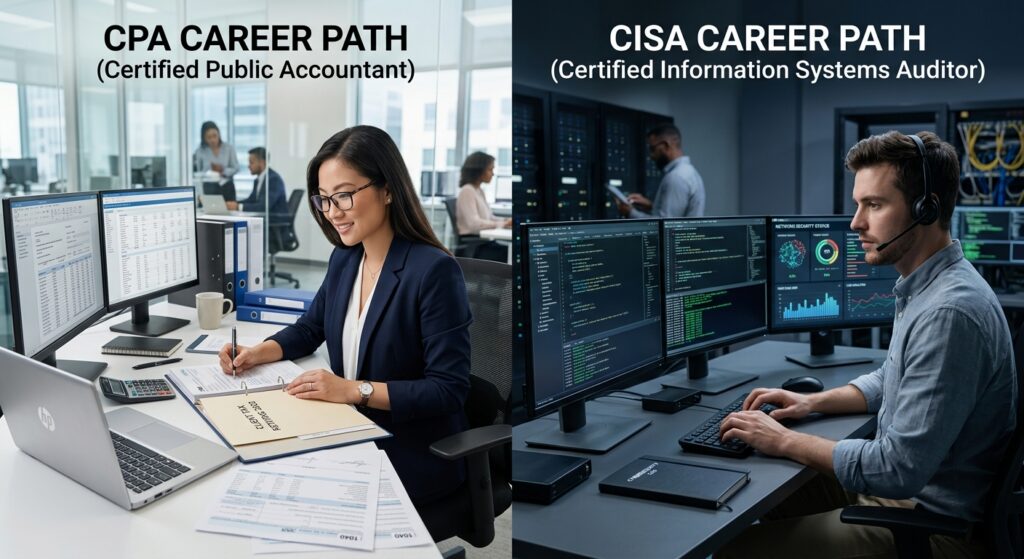
CISA Certification vs CPA: Which Path for Tax Professionals in 2026?
As tax professionals navigate 2026, the choice between CISA certification vs CPA represents a strategic career decision. Both credentials open distinct paths. The CPA remains the gold standard for tax advisory and financial reporting. Meanwhile, CISA (Certified Information Systems Auditor) addresses the surging demand for cybersecurity expertise. For tax pros, understanding which certification aligns with your practice goals is essential.
Table of Contents
Used by 2,400+ tax professionals
- Key Takeaways
- What Is CISA Certification and Who Needs It?
- What Is the CPA Credential and Why It Matters?
- How Do CISA Certification vs CPA Requirements Compare?
- What Are the Salary Differences Between CISA and CPA?
- Which Certification Should Tax Professionals Choose?
- Can You Hold Both CISA and CPA Certifications?
- Uncle Kam in Action: CPA Adds Cybersecurity Advisory
- Next Steps
- Frequently Asked Questions
- Related Resources

Key Takeaways
- The CPA credential focuses on accounting, tax, and audit. CISA specializes in IT systems auditing and cybersecurity.
- For 2026, CPAs earn an average of $95,358. Credentialed professionals see 10-15% higher compensation than non-certified peers.
- Cybersecurity job demand grew 11% in 2026. Over 500,000 positions remain unfilled nationwide.
- Tax professionals can leverage both credentials to offer comprehensive advisory services combining tax strategy and data security.
- The choice depends on practice goals: traditional tax advisory favors CPA; cybersecurity consulting favors CISA.
What Is CISA Certification and Who Needs It?
Quick Answer: CISA (Certified Information Systems Auditor) is a globally recognized credential for IT audit and cybersecurity professionals. It validates expertise in auditing, controlling, and securing information systems.
The CISA certification, administered by ISACA, targets professionals who audit and monitor IT systems. For 2026, the certification addresses critical skills in cybersecurity, risk management, and compliance. Tax professionals increasingly encounter clients facing data breaches and cyber threats. Understanding IT audit principles helps tax advisors identify vulnerabilities in client systems that could compromise financial data.
Core CISA Competencies
CISA certification covers five domains. Each addresses essential aspects of IT audit and security:
- Information Systems Auditing Process – planning, executing, and reporting on IT audits
- Governance and Management of IT – aligning IT strategy with business objectives
- Information Systems Acquisition, Development, and Implementation – ensuring secure system design
- Information Systems Operations and Business Resilience – maintaining system availability and disaster recovery
- Protection of Information Assets – implementing security controls and compliance frameworks
Why Tax Professionals Consider CISA
The intersection of tax advisory and cybersecurity grows more relevant each year. As of May 2026, cybersecurity job postings increased 11% year-over-year. Demand far exceeds supply. Tax practices that integrate cybersecurity consulting differentiate themselves from competitors. They provide comprehensive risk management that protects both financial and digital assets.
For example, a CPA firm might discover a client’s payroll system lacks adequate access controls. This creates both tax compliance risks and data security vulnerabilities. A professional with CISA expertise can identify these gaps and recommend solutions. This integrated approach strengthens client relationships and generates additional revenue streams.
Pro Tip: In 2026, cybersecurity roles grew even as AI disrupted other professions. Tax pros with cybersecurity skills command premium rates.
CISA Job Market Demand in 2026
The cybersecurity talent shortage intensified throughout 2026. According to workforce research from CyberSeek, over 500,000 cybersecurity positions were posted during the 2024-25 period. This represents a 12% increase. Executive search firms report they turn away clients due to insufficient qualified candidates. Professionals holding CISA certification find themselves in high demand across industries.
For tax professionals, this translates to opportunity. Firms that can offer both tax strategy and cybersecurity assessment create a unique value proposition. Small and mid-sized businesses especially need this integrated expertise. They lack dedicated IT security staff yet face sophisticated cyber threats.
What Is the CPA Credential and Why It Matters?
Quick Answer: The Certified Public Accountant (CPA) is the premier credential for accounting professionals. It authorizes individuals to provide attest services and represent clients before the IRS.
The CPA credential remains the gold standard in accounting. For 2026, it continues to be essential for business owners seeking trusted financial advisors. The credential requires extensive education, examination, and experience. State boards regulate CPA licensure, ensuring high professional standards.
What CPAs Do
CPAs perform a wide range of services. These include tax preparation, financial statement audits, forensic accounting, and business consulting. Only CPAs can issue audit opinions on financial statements. This statutory authority makes the credential indispensable for many practice areas.
- Tax Planning and Preparation – developing strategies to minimize tax liability
- Audit and Assurance – providing independent verification of financial statements
- Financial Reporting – ensuring compliance with GAAP and regulatory standards
- Business Advisory – offering strategic guidance on operations, mergers, and acquisitions
- Representation – advocating for clients in IRS disputes and audits
CPA Career Trajectory
The CPA path typically begins with public accounting. Entry-level professionals gain experience in tax or audit. After several years, many transition to industry roles, government positions, or private practice. The credential opens doors at every career stage.
According to the Bureau of Labor Statistics, the median annual wage for accountants and auditors reached $81,680 in May 2024. However, CPAs earn significantly more. The credential premium ranges from 10-15% above non-certified accountants. For 2026, the average CPA salary stands at $95,358.
The Value Proposition for Tax Professionals
For professionals focused on tax strategy, the CPA remains essential. It provides credibility with clients and regulators. It also grants practice rights unavailable to non-CPAs. Most states require CPA licensure for tax return preparation at scale.
The American Institute of CPAs continues to advocate for the profession. In 2026, the organization focuses on AI adoption, talent development, and expanding the profession’s relevance. These initiatives help CPAs stay competitive in a rapidly evolving marketplace.
Did You Know: CPAs at firms with 200+ employees average $110,700 annually. Those at firms with 10 or fewer employees average $73,700. Firm size significantly impacts compensation.
How Do CISA Certification vs CPA Requirements Compare?
Quick Answer: CPA requires 150 credit hours, four exam sections, and one year of experience. CISA requires passing one exam and five years of relevant IT audit experience.
Understanding the requirements helps candidates plan their certification path. Each credential demands significant investment of time and resources. However, the specific requirements differ substantially.
CPA Requirements for 2026
The CPA credential requires extensive education. Candidates must complete 150 credit hours of college coursework. This typically includes a bachelor’s degree plus 30 additional credits. Requirements vary by state, but most mandate specific accounting and business courses.
For 2026, aspiring CPAs face new financial challenges. Effective July 1, 2026, the Department of Education caps federal student loans for most graduate students at $20,500 per year. This impacts professionals pursuing the additional 30 credits needed for CPA licensure. However, accounting programs classified as professional degrees may qualify for higher loan limits.
The CPA Exam consists of four sections:
- Auditing and Attestation (AUD)
- Financial Accounting and Reporting (FAR)
- Regulation (REG) – covers tax and business law
- Business Environment and Concepts (BEC)
Candidates must pass all four sections within 18 months. After passing the exam, most states require one year of supervised experience. This experience must be verified by a licensed CPA.
CISA Requirements for 2026
The CISA certification follows a different model. Candidates take a single comprehensive exam covering the five domains discussed earlier. The exam is computer-based and available year-round. Registration is continuous through ISACA.
After passing the exam, candidates must demonstrate five years of work experience in information systems auditing, control, or security. ISACA offers substitutions and waivers. For example, one year of information systems experience can substitute for one year of work experience. Candidates have five years from passing the exam to apply for certification.
CISA does not require specific educational credentials. This makes it accessible to professionals who developed IT audit expertise through work rather than formal education. However, the exam is challenging. It requires deep understanding of audit methodologies and IT controls.
Comparative Analysis: Education and Experience
The table below compares key requirements for CISA certification vs CPA:
| Requirement | CPA | CISA |
|---|---|---|
| Education | 150 credit hours (Bachelor’s + 30) | No specific requirement |
| Exam Sections | Four sections (AUD, FAR, REG, BEC) | One comprehensive exam |
| Work Experience | 1 year (varies by state) | 5 years in IT audit/security |
| Continuing Education | 40 hours annually (typical) | 20 hours annually minimum |
| License Authority | State boards of accountancy | ISACA (global) |
For tax professionals, the CPA path is more familiar. However, CISA offers flexibility. Professionals can pursue CISA while working full-time in IT audit roles. The single exam format concentrates study efforts.
What Are the Salary Differences Between CISA and CPA?

Quick Answer: For 2026, CPAs average $95,358 annually. CISA holders earn comparable salaries. Both credentials command premium compensation over non-certified professionals.
Compensation varies based on experience, industry, and geography. Both credentials significantly boost earning potential. According to ZipRecruiter, professionals holding both CPA and CISA credentials averaged $95,358 in 2026.
CPA Salary Trends for 2026
CPA compensation reflects several factors. Firm size matters significantly. CPAs at firms with 200+ employees average $110,700 annually. Those at smaller firms with 10 or fewer employees average $73,700. This $37,000 gap stems from organizational scale and client base.
Experience drives the largest compensation jumps. Early-career CPAs with under two years of experience typically earn in the low $60,000 range. Mid-career professionals with the CPA credential earn $75,000-$110,000. Senior roles, including audit managers and compliance directors, command $113,500-$164,750.
According to Surgent’s 2026 data, credentialed professionals overall earn approximately 21% more than those without professional designations. The CPA credential consistently correlates with higher compensation. The AICPA reports CPAs earn 10-15% more on average than non-certified accountants.
CISA Salary Benchmarks
CISA holders work across various roles. These include IT auditors, security analysts, compliance managers, and chief information security officers (CISOs). Salaries vary by position and industry.
Entry-level IT audit positions start around $60,000-$70,000. Mid-level professionals with CISA certification earn $80,000-$120,000. Senior roles, including audit managers and directors, reach $90,000-$152,000. Chief Audit Executives and CISOs command $150,000-$250,000+.
The cybersecurity talent shortage amplifies CISA value. As reported by The New York Times, demand for cybersecurity executives surged in 2026. Firms seeking candidates with breach response experience and code review skills struggle to fill positions. CISA certification signals competence in these critical areas.
Dual Credential Premium
Professionals holding both CPA and CISA credentials occupy a rare niche. They combine financial expertise with cybersecurity knowledge. This dual competency enables comprehensive risk assessment. Firms increasingly value this integrated perspective.
Dual-credential holders can command premium compensation. They often work in specialized roles such as IT audit directors at public accounting firms, internal audit leaders at technology companies, or forensic accounting specialists investigating data breaches.
| Career Stage | CPA Salary Range | CISA Salary Range |
|---|---|---|
| Entry-Level (0-2 years) | $60,000-$70,000 | $60,000-$70,000 |
| Mid-Level (3-7 years) | $75,000-$110,000 | $80,000-$120,000 |
| Senior (8-15 years) | $110,000-$165,000 | $90,000-$152,000 |
| Executive (15+ years) | $165,000-$300,000+ | $150,000-$250,000+ |
Both credentials offer strong ROI. The choice depends more on career goals than compensation potential. Tax professionals focused on client advisory typically prioritize the CPA. Those interested in IT systems and cybersecurity gravitate toward CISA.
Which Certification Should Tax Professionals Choose?
Quick Answer: Choose CPA if tax advisory and financial reporting are your primary focus. Choose CISA if cybersecurity and IT systems audit interest you more.
The decision hinges on practice goals and career vision. Most tax professionals default to the CPA. It remains essential for traditional practice areas. However, the cybersecurity skills represented by CISA certification grow increasingly valuable.
When to Choose CPA
The CPA credential suits professionals who want to provide comprehensive tax preparation and filing services. It’s essential if you plan to:
- Represent clients before the IRS
- Perform audits or attest services
- Work in public accounting at a CPA firm
- Serve high-net-worth individuals or real estate investors with complex tax needs
- Build a practice around strategic tax planning and entity structuring
The CPA provides statutory authority and market recognition unmatched by other credentials. For self-employed professionals and business owners, the CPA designation signals expertise and professionalism.
When to Choose CISA
CISA certification makes sense if you want to specialize in IT audit and cybersecurity. Consider this path if you:
- Work with clients who face significant cybersecurity risks
- Want to assess IT controls and data security frameworks
- Focus on technology companies or financial services firms
- Plan to expand your practice into cybersecurity consulting
- Enjoy technical problem-solving and systems analysis
The demand for cybersecurity expertise creates opportunity. Tax professionals with CISA certification can offer services most competitors cannot. This differentiation builds competitive advantage.
The Strategic Integration Approach
Forward-thinking tax professionals recognize the convergence. Financial data security and tax compliance increasingly overlap. A data breach can create tax reporting complications. Weak IT controls can lead to compliance failures.
Firms that combine tax expertise with cybersecurity assessment deliver comprehensive value. They identify risks other advisors miss. This integrated approach resonates with clients who understand that digital threats pose financial consequences.
For many tax professionals, the answer isn’t either/or. It’s how to incorporate cybersecurity awareness into existing practice. This might mean partnering with CISA-certified professionals, referring clients for IT audits, or pursuing continuing education in cybersecurity basics.
Uncle Kam in Action: CPA Firm Adds Cybersecurity Advisory
Client Profile: Sarah Chen, CPA and owner of a 15-person accounting firm in Portland, Oregon. Her firm generated $2.3 million in annual revenue, primarily from tax preparation and business advisory services.
The Challenge: Sarah noticed clients increasingly asking about data security. Several had experienced phishing attempts. One client suffered a ransomware attack that encrypted financial records. Sarah realized her firm lacked expertise to address these concerns. She considered partnering with an IT consultant but worried about quality control and client experience.
The Uncle Kam Solution: Sarah attended an Uncle Kam strategy session exploring how tax professionals can integrate cybersecurity services. The session introduced frameworks for assessing client data security risks without requiring full CISA certification. Uncle Kam recommended a phased approach. First, add basic cybersecurity assessment as part of annual tax planning reviews. Second, partner with CISA-certified professionals for deeper engagements. Third, support one team member pursuing CISA certification.
Sarah implemented the strategy. She invested $12,000 in cybersecurity training for her team. One senior associate began studying for CISA certification. The firm added a cybersecurity assessment module to their annual client review process. This 30-minute evaluation identified basic vulnerabilities in client systems. When deeper issues surfaced, Sarah referred clients to CISA-certified partners, earning referral fees.
The Results: Within 18 months, Sarah’s firm generated $184,000 in additional revenue from cybersecurity-related services. This included assessment fees, referral income, and expanded advisory engagements. More importantly, client retention improved. Clients appreciated the holistic risk management approach. Three clients who had considered changing firms renewed their engagements citing the enhanced service offering.
Investment vs. Return: Sarah invested $12,000 in training and $8,000 in CISA exam preparation for her associate. The first-year ROI exceeded 8x. By year two, as the associate completed CISA certification, the firm projected $300,000 in cybersecurity advisory revenue.
Sarah credits Uncle Kam’s framework for helping her identify the opportunity and execute strategically. The phased approach minimized risk while maximizing client value. Learn more about how Uncle Kam helps tax professionals expand their service offerings at Uncle Kam Client Results.
Next Steps
After comparing CISA certification vs CPA, take these actions to advance your professional development:
- Assess your career goals and client needs to determine which credential aligns with your practice vision
- Review the official CISA requirements and CPA licensure rules for your state
- Calculate the ROI of each certification based on your market and service model
- Explore how tax planning software with unlimited assessments can help you demonstrate value regardless of certification path
- Book a strategy session at Uncle Kam to discuss integrating cybersecurity services into your tax practice
Frequently Asked Questions
Can a CPA perform IT audits without CISA certification?
Yes, but with limitations. CPAs can assess IT controls relevant to financial statement audits. However, comprehensive IT systems audits require specialized expertise. CISA certification signals competence in this domain. Many firms partner with CISA holders for complex IT audit work.
Does CISA certification qualify someone to prepare tax returns?
No. CISA focuses on IT audit and security. It doesn’t authorize tax return preparation. The IRS requires specific credentials for paid tax preparers. CPAs, Enrolled Agents, and attorneys can prepare returns. CISA holders without these credentials cannot provide tax services.
How long does it take to obtain both CPA and CISA certifications?
Typically 5-7 years. Most professionals complete CPA first (3-4 years including education and experience). Then they pursue CISA (2-3 years including exam and experience requirements). The timeline varies based on educational background and work experience.
Is CISA certification worth it for tax professionals?
It depends on your practice focus. If you serve clients with significant cybersecurity risks, CISA adds value. It enables you to assess IT controls and identify data security vulnerabilities. For traditional tax preparation practices, CPA alone typically suffices.
What’s the cost difference between CISA and CPA certification?
CPA requires 150 credit hours of education, costing $30,000-$60,000. CISA has no specific education requirement. The exam and certification fees total approximately $1,000-$2,000. However, CISA requires five years of relevant experience, which has opportunity cost.
Can CISA certification help CPAs attract new clients?
Absolutely. As of 2026, cybersecurity concerns dominate business owner priorities. CPAs who offer integrated financial and cybersecurity advisory services differentiate themselves. The dual credential signals comprehensive risk management expertise. This attracts clients seeking holistic guidance.
Which credential is harder: CISA or CPA?
Both are challenging. The CPA Exam has four sections and lower pass rates. It requires extensive accounting knowledge. CISA has one comprehensive exam focusing on IT audit. The difficulty depends on your background. Accountants typically find CPA more accessible. IT professionals find CISA more natural.
Related Resources
- Advanced Tax Strategy Services for CPAs
- Business Solutions: Integrating Technology and Tax Advisory
- The MERNA Method for Comprehensive Tax Planning
- Complete Tax Planning Guides for Professionals
Last updated: May, 2026
This information is current as of 5/26/2026. Tax laws change frequently. Verify updates with the IRS or relevant certification bodies if reading this later.

