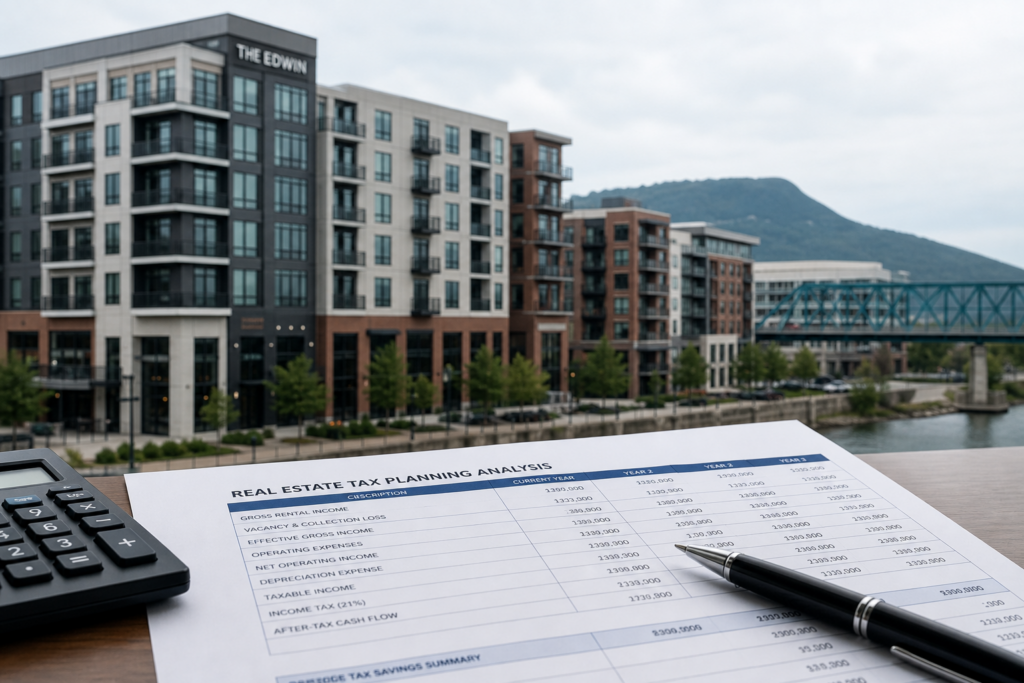
Chattanooga Real Estate Tax Deduction & PILOT Program Audit: 2026 Complete Guide
Chattanooga Real Estate Tax Deduction & PILOT Program Audit: 2026 Complete Guide
For real estate investors and developers in Tennessee, understanding how Chattanooga’s tax preparation strategies work with the PILOT program has become essential for maximizing 2026 deductions and staying audit-ready. The Chattanooga PILOT (Payment in Lieu of Taxes) program represents a significant shift in property taxation, offering developers substantial tax breaks while changing how depreciation and deductions work for real estate investments. This guide walks you through every aspect of the chattanooga real estate tax deduction audit landscape, ensuring you understand both the opportunities and compliance requirements.
Table of Contents
- Key Takeaways
- What Is Chattanooga’s PILOT Program and How Does It Affect Your Property Taxes?
- How Does the PILOT Program Change Your Tax Deductions?
- Can You Still Claim Depreciation on PILOT Properties?
- What Records Do You Need for a Chattanooga Real Estate Tax Deduction Audit?
- Audit Checklist for Properties Under Chattanooga’s PILOT Program
- Frequently Asked Questions
- Next Steps
Key Takeaways
- Chattanooga’s PILOT program provides 15-year property tax abatements for projects with 10+ affordable housing units.
- The 2026 PILOT program won the Ivory Prize as a national housing innovation model without federal subsidies.
- Properties under PILOT still qualify for depreciation deductions on buildings and improvements.
- PILOT payments are NOT deductible as business expenses; only actual property taxes paid are deductible.
- Proper documentation is essential for audit defense; maintain PILOT agreements, tax bills, and payment records.
What Is Chattanooga’s PILOT Program and How Does It Affect Your Property Taxes?
Quick Answer: Chattanooga’s PILOT program offers developers a 15-year property tax abatement when they include affordable housing units in projects with 10+ rental units, reducing tax burden while keeping housing affordable.
Chattanooga’s Payment in Lieu of Taxes (PILOT) program is a groundbreaking local tax incentive that addresses housing affordability without relying on federal subsidies. Approved in 2026, this innovative tool allows developers to receive significant property tax discounts in exchange for including affordable housing units in their projects. The program operates on a simple principle: developers commit to providing below-market rental housing, and the city reduces their property tax obligations for 15 years.
Unlike traditional tax credits that require federal funding, the Chattanooga PILOT program leverages local tax authority to incentivize private development. The program works by allowing developers to make reduced “payments in lieu of taxes” rather than paying standard property taxes. A developer might operate a property that would normally generate $9,000 in annual property taxes but under PILOT, the same property generates $363,000 annually through the reduced payment structure — still significantly less than market-rate tax obligations, but substantially more than if there were no program at all.
How PILOT Works in Practice
- Developers apply for PILOT status by proposing rental housing projects with 10+ units.
- Projects must designate affordable units at 60% or 80% of area median income (AMI).
- Chattanooga approves the PILOT agreement based on affordability commitment level.
- For 15 years, the developer pays reduced PILOT amount instead of standard property taxes.
- After 15 years, the property returns to normal property tax assessment.
Why PILOT Won the Ivory Prize
Chattanooga’s PILOT program received recognition as a winner of the Ivory Prize, a national housing innovation competition run by the University of Utah’s affiliate, Ivory Innovations. The program earned this distinction because it accomplishes affordable housing goals without direct government subsidies or federal funding. Instead, it creatively uses local tax authority to align private developer incentives with public housing goals. This model is designed to be replicable by other cities facing similar housing affordability challenges.
Chattanooga’s first PILOT-approved project is a 278-unit downtown housing development that secured approval in October 2025. When complete, 42 units will be designated as affordable at either 60% or 80% of the area’s median income, providing workforce housing while generating sustainable tax revenue for the city.
Pro Tip: The Chattanooga tax preparation near me in Tennessee specialists can help you model exactly how PILOT impacts your specific project, including depreciation calculations and 15-year tax impact forecasting.
How Does the PILOT Program Change Your Tax Deductions?
Quick Answer: PILOT changes what you report as deductible property taxes, but you can still claim standard business deductions for operating expenses and depreciation on building components.
Understanding how the PILOT program affects your tax deductions is critical for 2026 audit preparation. The most important distinction to understand is this: the PILOT payment amount is NOT deductible as a business expense. Instead, only the actual property taxes you pay are deductible. This is a crucial distinction that trips up many real estate investors who assume all payments to the tax assessor are deductible.
What IS Deductible on PILOT Properties
- Actual property taxes paid (typically minimal under PILOT for 15 years).
- Building depreciation (straight-line depreciation of the structure and improvements).
- Cost segregation opportunities on building components.
- Mortgage interest paid on the property loan.
- Operating expenses (maintenance, utilities, insurance, management fees).
- Repairs and improvements (within Section 179 and bonus depreciation rules).
What Is NOT Deductible
The PILOT payment amount itself is considered a voluntary payment arrangement, not a deductible business expense. The IRS distinguishes between property taxes (deductible) and payments made under alternative tax arrangements (generally not deductible). You cannot deduct PILOT as an expense even though you’re making regular payments to the city. This is a critical distinction for audit defense. Your accountant should show PILOT payments as a capital allocation (toward property ownership) rather than as a deductible expense.
However, if your property falls under PILOT and you’re paying actual property taxes on other portions or components, those actual taxes remain fully deductible. The key is accurate documentation showing what portion is PILOT payment versus actual tax.
Can You Still Claim Depreciation on PILOT Properties?
Quick Answer: Yes, absolutely. PILOT status does not affect depreciation eligibility. You can claim standard 27.5-year residential depreciation on the building, plus bonus depreciation and cost segregation on qualifying components.
Depreciation is one of the most powerful tax benefits for real estate investors, and PILOT status does not diminish this advantage. In fact, the tax savings from depreciation deductions often make PILOT projects even more attractive financially. For 2026, depreciation works exactly as it does for non-PILOT properties: you deduct a portion of the building’s value annually, creating paper losses that offset rental income.
For residential rental properties like those under Chattanooga’s PILOT program, the standard depreciation period is 27.5 years using the straight-line method. On a $2 million building, you would deduct approximately $72,727 annually ($2 million divided by 27.5 years). This deduction reduces your taxable income dollar-for-dollar, even though you haven’t actually spent the money in cash.
Bonus Depreciation and Cost Segregation
For 2026, qualified property owners can accelerate depreciation using Section 179 expensing and 100% bonus depreciation on qualifying property. Additionally, cost segregation studies allow you to reclassify components of your building (flooring, roof, land improvements, parking lots) into shorter depreciation periods, dramatically accelerating tax deductions in the first few years.
On a Chattanooga PILOT property, a cost segregation study might identify $200,000 in personal property (carpet, fixtures, mechanical systems) that can be depreciated over 5-7 years instead of 27.5 years. This accelerates your deductions, creating larger tax losses in early years when you need them most to shelter PILOT project income.
Pro Tip: Perform a cost segregation study within the first year of owning a PILOT property to maximize 2026 deductions. The study typically costs $3,000-$8,000 but can generate $50,000+ in accelerated depreciation deductions, paying for itself many times over.
What Records Do You Need for a Chattanooga Real Estate Tax Deduction Audit?
 Free Tax Write-Off Finder
Quick Answer: For PILOT properties, maintain the original PILOT agreement, annual PILOT payment statements, property appraisals, cost segregation study, depreciation schedules, and proof of operating expenses for seven years.
IRS audits of real estate investments have increased significantly in 2026, especially for properties with substantial tax deductions like depreciation and cost segregation. The key to surviving an audit of your chattanooga real estate tax deduction claims is comprehensive, organized documentation. The IRS wants to see proof that you followed the rules, claimed only allowable deductions, and maintained supporting evidence.
PILOT-Specific Documentation
- PILOT Agreement: The original signed PILOT agreement from Chattanooga showing the affordability commitments and PILOT payment formula.
- Annual PILOT Statements: Year-by-year PILOT payment amounts, showing how the payment was calculated (this proves PILOT vs. actual taxes).
- Property Tax Assessments: The city’s property tax assessment showing the appraised value and how much property tax would have been paid without PILOT.
- Proof of Payment: Bank statements, canceled checks, or payment confirmations showing PILOT payments were made timely.
- Affordable Housing Documentation: Proof that the property maintains the required percentage of affordable units (lease agreements, rent rolls, tenant income verifications).
Standard Real Estate Documentation
Beyond PILOT-specific records, maintain standard real estate investment documentation that proves your deduction claims:
- Property purchase documents (deed, settlement statement, purchase agreement).
- Professional property appraisals (obtained at purchase and periodically updated).
- Cost segregation study with detailed component breakdown and depreciation schedules.
- Depreciation worksheets showing the calculation of annual depreciation deductions claimed.
- Mortgage documents and loan statements (for interest deduction verification).
- Operating expense documentation (invoices, receipts, credit card statements for maintenance, utilities, insurance, management fees).
- Rental agreements and payment records proving income reported on tax returns.
Audit Checklist for Properties Under Chattanooga’s PILOT Program
Quick Answer: Use this comprehensive checklist to prepare for IRS audit exposure on PILOT properties, covering documentation, deduction substantiation, and reporting accuracy.
| Audit Preparation Category | Documents/Proof Needed | Storage Method |
|---|---|---|
| PILOT Status Verification | Signed PILOT agreement, program overview, city approval letter | Physical folder + cloud backup |
| Tax Payment Documentation | Annual PILOT statements, property tax bills, payment receipts | Organized by year, scanned digital copies |
| Depreciation Support | Cost segregation study, depreciation worksheets, IRS Form 4562 | Linked to tax return, indexed by year |
| Property Valuation | Purchase appraisal, current market appraisals, comparable sales | Professional documents with appraiser credentials |
| Income & Expenses | Rental receipts, expense invoices, property manager reports | Monthly folders, reconciled to Schedule E |
| Affordable Housing Compliance | Tenant leases, income certifications, rent roll documentation | Secure file, HIPAA-compliant retention |
Step-by-Step Audit Preparation Process
- Organize by Tax Year: Create separate folders for each year you’ve owned the property, containing all relevant documents for that year.
- Cross-Reference Tax Returns: Match every deduction claimed on Schedule E to supporting documentation; if you can’t find proof, don’t claim it.
- Verify PILOT vs. Actual Taxes: Clearly show in your records which payments are PILOT amounts (not deductible) versus actual property taxes (deductible).
- Prepare Depreciation Schedule: Have your tax professional prepare a detailed depreciation schedule showing component values, useful lives, and annual deductions.
- Expense Reconciliation: Reconcile all business expenses to bank statements and credit card statements to prove they were actually paid.
- Affordable Housing Documentation: Maintain current tenant files showing they meet income requirements (60% or 80% AMI).
- Annual Review: Each January, review the prior year’s files to ensure everything is organized and complete before the statute of limitations expires.
Pro Tip: Consider working with a tax professional who specializes in real estate. For 2026, the cost of expert guidance (typically $1,500-$3,000) is modest compared to the risk of an IRS audit finding disallowed deductions. A CPA can ensure you’re claiming everything allowable and documenting properly for audit defense.

Uncle Kam in Action: Chattanooga Real Estate Investor Maximizes PILOT Deductions
Client Profile: Maya Rodriguez is a Tennessee real estate investor who acquired a 50-unit apartment complex in downtown Chattanooga in early 2026. The property qualified for PILOT status because she committed 15 units (30%) as affordable housing at 60% of area median income. Her total investment was $4.2 million, with the building valued at $3.5 million and land at $700,000.
The Challenge: Maya’s previous accountant treated the PILOT payments as a deductible business expense, which would trigger an audit flag with the IRS. Additionally, she had no cost segregation study to accelerate depreciation deductions, and her 2026 tax return showed only standard depreciation, leaving thousands in potential deductions on the table. Without proper planning, her PILOT project would actually generate significant tax liability rather than providing the tax shelter that makes the investment attractive.
The Uncle Kam Solution: Our team immediately commissioned a cost segregation study, which identified $580,000 in property components that could be depreciated over 5-7 years instead of 27.5 years. We reclassified the PILOT payments as capital allocation (not deductible expense) and properly documented the distinction between PILOT payments and actual property taxes. For 2026, we structured the deductions as follows:
- Standard building depreciation: $127,273 (27.5-year method on $3.5 million)
- Cost segregation bonus depreciation: $116,000 (first-year accelerated on personal property)
- Actual property taxes (minimal under PILOT): $2,100
- Operating expenses (insurance, maintenance, management): $187,500
- Mortgage interest: $142,000
- Total 2026 Deductions: $574,873
The Results: Maya’s property generated $385,000 in gross rental income during 2026. After deducting operating expenses and mortgage interest, she would normally have $55,500 in taxable income. However, with proper depreciation strategy, her 2026 tax loss from the property was $189,873 — sheltering nearly $190,000 of her other income from taxation. At her 32% effective tax rate (federal + Tennessee state), this represented $60,759 in tax savings. After paying for the cost segregation study ($6,500) and our tax advisory fee ($3,200), Maya achieved a net tax savings of $51,059 in year one — a 2,720% return on our advisory services. Additionally, she’s now properly documented for audit, with clear PILOT agreement on file and a professional cost segregation study supporting every depreciation deduction claimed.
Next Steps
If you own or are considering a PILOT property in Chattanooga for 2026, take these actions immediately:
- Review Your PILOT Agreement: Pull your PILOT agreement and understand exactly what percentage of your payments go toward PILOT (not deductible) versus actual taxes (deductible).
- Commission a Cost Segregation Study: If you purchased the property recently, a cost segregation study typically pays for itself in tax savings within the first year through accelerated depreciation.
- Audit-Proof Your Records: Spend 8-10 hours organizing all PILOT-related documents, tax bills, payment receipts, and operating expense documentation into a secure system you can access if audited.
- Consult a Real Estate Tax Specialist: Work with a professional who understands Chattanooga tax preparation services and can ensure you’re claiming every allowable deduction while staying audit-compliant for 2026.
Frequently Asked Questions
Is a PILOT payment tax-deductible as a business expense?
No. PILOT payments are not deductible as business expenses. The IRS treats PILOT payments as a form of capital allocation or payment arrangement, not as deductible property taxes. Only actual property taxes paid are deductible. This is a critical distinction that many real estate investors misunderstand, leading to audit problems. You should report PILOT payments separately from property taxes on your tax return and in your accounting records. If you’re currently deducting PILOT payments, consult a CPA immediately to amend prior years if necessary.
Can I deduct the actual property taxes paid on a PILOT property?
Yes, but only to the extent actual property taxes are paid. Many PILOT properties have minimal actual property taxes because the PILOT payment replaces standard taxation. The actual property tax component (if any) is fully deductible. For example, if you pay $150 in actual property taxes and $15,000 in PILOT payment, you can deduct only the $150. Your property tax bill and PILOT statement should clearly distinguish between these two components.
How long do I need to keep PILOT and property tax documentation?
Keep all PILOT agreements, annual PILOT statements, property tax bills, and payment documentation for at least seven years following the year of the deduction. Under current IRS rules, the standard statute of limitations for audits is three years, but it can extend to six years if substantial income is underreported. For PILOT properties with significant depreciation deductions, the audit risk is higher, so maintain records for the full seven-year period. Additionally, if you ever sell the property, maintain all documentation indefinitely to support your adjusted basis calculation for determining capital gains or losses.
Will maintaining affordable housing units affect my depreciation deductions?
No. The percentage of units designated as affordable does not affect your ability to claim depreciation on the building. Depreciation is a building-level deduction based on the asset’s cost basis and useful life, not on tenant income levels. You can claim the full building depreciation regardless of whether the units are at 60% AMI, 80% AMI, or market-rate. However, the affordable unit requirement is part of your PILOT agreement, so maintaining compliance is essential for audit defense — tenants must actually meet income thresholds or you risk losing PILOT status.
What happens to deductions when the 15-year PILOT period ends?
When the 15-year PILOT period expires, your property returns to standard property tax assessment. At that point, you’ll begin paying full property taxes, which become fully deductible. Your depreciation deductions continue as normal (you’re still depreciating the remaining useful life of the building). If you performed a cost segregation study, those components depreciate according to the study. The key planning point is that year 16 of ownership typically shows a significant jump in property tax expense, which should be anticipated in your long-term financial projections.
If I’m audited on my PILOT property, what should I do immediately?
First, do not respond to the IRS directly. Contact a tax professional (CPA or tax attorney) immediately. Second, gather all documentation listed in the audit checklist above and organize it chronologically. Third, clearly separate PILOT payments from actual property taxes in your documentation package. Fourth, ensure your depreciation schedule is professionally prepared and attached to your response. Fifth, be prepared to explain why PILOT payments are not deductible (they are capital allocation, not tax payments). Having a professional represent you significantly improves audit outcomes and reduces the risk of unfavorable adjustments. For PILOT properties, audit defense is critical because the IRS is specifically looking for taxpayers who misclassify PILOT payments as deductible expenses.
Should I file an amended return if I’ve been deducting PILOT payments?
Possibly, but this requires professional advice. If you’ve been incorrectly deducting PILOT payments in prior years, you have the option to file amended returns (Form 1040-X) to correct the issue. Filing amendments proactively shows good faith to the IRS and may reduce penalties if the agency discovers the error later. However, you’d owe back taxes and interest on the years amended. Consult a tax professional to analyze whether amendments make sense given your specific situation. For 2026 going forward, ensure PILOT payments are not deducted as business expenses.
This information is current as of June 1, 2026. Tax laws change frequently. Verify updates with the IRS or a Tennessee tax professional if reading this material later.
Related Resources
- IRS Form 4562: Depreciation and Amortization
- Uncle Kam Client Results: Real Real Estate Tax Savings Case Studies
- Complete Tax Guides for Real Estate Investors and Business Owners
Last updated: June, 2026

