
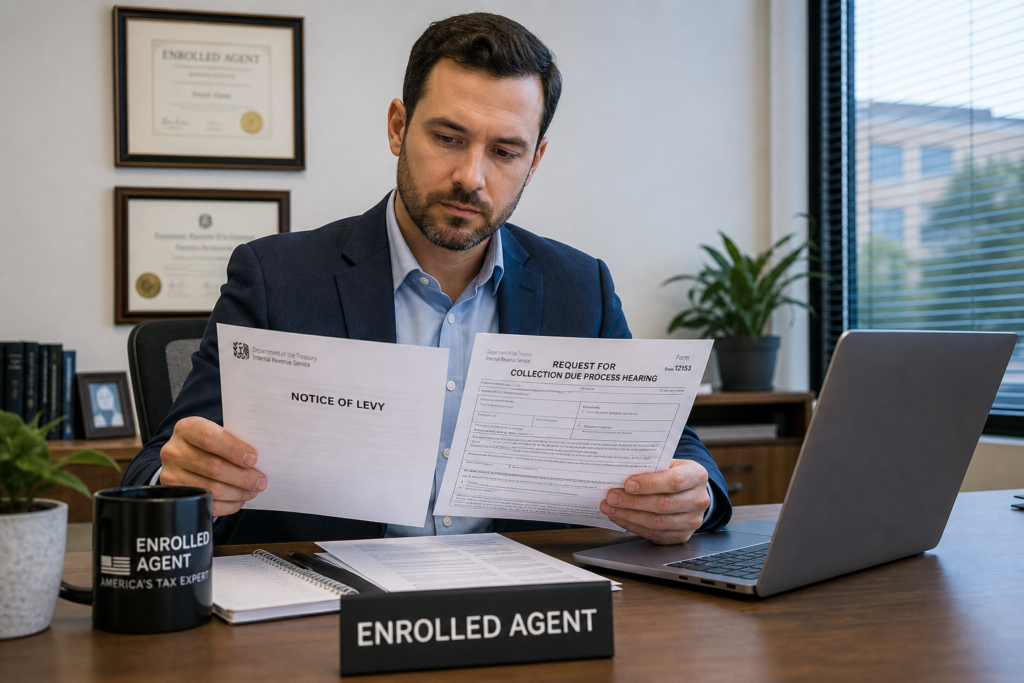
CDP Hearing to Stop IRS Levy: A CPA Guide 2026
This CDP hearing to stop IRS levy CPA guide gives tax pros a clear roadmap. When the IRS threatens to seize a client’s wages or bank account, a Collection Due Process (CDP) hearing is your strongest tool. It halts enforced collection fast. Moreover, it proves that Enrolled Agents and CPAs deliver real value in high-stakes representation work. If you serve clients in California, our San Diego tax advisor team handles these cases daily.
Table of Contents
- Key Takeaways
- What Is a CDP Hearing and Why Does It Matter?
- How Does a CDP Hearing Actually Stop a Levy?
- When Must You File Form 12153?
- What Can You Argue at a CDP Hearing?
- How Do EAs Win High-Value Representation Cases?
- Uncle Kam in Action
- Next Steps
- Related Resources
- Frequently Asked Questions

Key Takeaways
- A CDP hearing stops most IRS levy actions while your appeal is pending.
- You must file Form 12153 within 30 days of the levy notice.
- EAs have full authority to represent clients before IRS Appeals.
- Representation work commands premium fees and builds recurring revenue.
- Missing the 30-day window drops you to a weaker equivalent hearing.
What Is a CDP Hearing and Why Does It Matter?
Quick Answer: A Collection Due Process (CDP) hearing is a taxpayer’s right to appeal an IRS levy before the IRS Independent Office of Appeals. It pauses collection.
A CDP hearing gives your client one final, powerful review. Congress created it under Internal Revenue Code sections 6320 and 6330. The IRS must offer this right before it seizes wages, bank funds, or property. In short, it protects due process. Furthermore, it forces the IRS to justify its actions.
For the ambitious EA, this is a huge opportunity. Representation work sits at the top of the value ladder. Clients facing a levy feel real fear. Therefore, they pay premium fees for skilled help. Learn the process well, and you build a strong tax advisory relationship that lasts years.
Levy vs. Lien: Know the Difference
First, understand the two terms. A levy actually takes property. A lien is only a legal claim against property. In other words, a levy empties the bank account. Meanwhile, a lien simply flags the asset. Both trigger CDP rights, but the urgency differs. Levies demand fast action.
Who Hears the Case?
The IRS Independent Office of Appeals hears every CDP case. This office stays separate from collections. As a result, you get a fresh, neutral review. The settlement officer did not work the original case. You can read more on the IRS Appeals process page. This neutrality often helps your client.
Pro Tip: Always confirm your Form 2848 power of attorney is on file before you contact Appeals. It saves time.
How Does a CDP Hearing Actually Stop a Levy?
Quick Answer: A timely CDP request suspends levy action and the collection statute. The IRS cannot seize property while Appeals reviews the case.
This is the core of the CDP hearing to stop IRS levy CPA guide. When you file a timely request, the law suspends collection. The IRS must stop levy action right away. Consequently, your client’s paycheck and bank account stay safe during the review. This breathing room is priceless.
The suspension also pauses the collection statute expiration date, or CSED. Therefore, the clock stops during the appeal. This tradeoff matters for planning. However, the immediate protection from seizure usually outweighs the paused clock. Understanding the difference between a tax lien and levy for California clients helps you set proper expectations.
The Automatic Suspension Rule
Under IRC section 6330(e), a timely CDP request triggers an automatic hold. The IRS cannot proceed with the levy. This rule has one main exception. The IRS may still levy if collection is in jeopardy. Still, jeopardy levies are rare. Most clients get full protection.
Reversing a Levy Already in Place
Sometimes the levy already hit before you filed. Do not panic. You can still request the release of a wage or bank levy. The IRS often releases funds if the levy causes economic hardship. Point to IRC section 6343 for support. Act fast, because banks hold levied funds for only 21 days.
Pro Tip: For bank levies, the 21-day hold gives you a window. File and call the revenue officer immediately to seek release.
When Must You File Form 12153?
Quick Answer: You must file Form 12153 within 30 days of the IRS Final Notice of Intent to Levy. This deadline is strict.
Timing controls everything in these cases. The IRS sends a Letter 1058 or LT11 as the Final Notice of Intent to Levy. That notice starts the 30-day clock. You must file Form 12153, Request for a Collection Due Process Hearing, within that window. Miss it, and you lose key rights.
A timely request grants a true CDP hearing. It also preserves the right to appeal to the U.S. Tax Court. A late request only gets an equivalent hearing. That weaker option does not suspend the levy or grant Tax Court access. So watch the calendar closely.
CDP Hearing vs. Equivalent Hearing
| Feature | CDP Hearing | Equivalent Hearing |
|---|---|---|
| Filing deadline | Within 30 days | Within 1 year |
| Suspends levy | Yes | No |
| Tax Court appeal | Yes | No |
| Pauses CSED | Yes | No |
How to File Correctly
Send Form 12153 to the address on the levy notice. Do not send it to a random IRS office. Include the tax periods and the reasons for your request. In addition, attach your Form 2848. Keep proof of mailing. Certified mail with a return receipt protects your client if the IRS claims late filing.
Did You Know? The 30-day deadline uses the mailbox rule. A timely postmark counts, even if the IRS receives it later.
What Can You Argue at a CDP Hearing?

Quick Answer: You can propose collection alternatives, challenge the underlying liability, and raise spousal defenses. Alternatives usually win.
A CDP hearing is not just about stopping the levy. It is your chance to resolve the whole debt. The settlement officer wants a path forward. Therefore, you should arrive with a clear plan. The strongest cases present a concrete tax resolution strategy backed by financial data.
Collection Alternatives
Most cases resolve through a collection alternative. These give the client a realistic way to pay. Common options include:
- Installment agreements for monthly payments over time
- Offer in compromise to settle for less than owed
- Currently not collectible status for hardship cases
- Partial payment installment agreements when full pay fails
You must submit Form 433-A or 433-B to support most alternatives. Accurate financials drive the outcome. So gather bank statements, pay stubs, and expense records early.
Challenging the Underlying Liability
Sometimes the client disputes the tax itself. You may challenge the liability, but only in one situation. The client must not have received a notice of deficiency. They also must not have had a prior chance to dispute it. If that rule fits, you can attack the debt directly. Otherwise, focus on alternatives.
Pro Tip: Always request the client’s account transcripts first. They reveal what notices the IRS actually mailed.
How Do EAs Win High-Value Representation Cases?
Quick Answer: EAs win by mastering procedure, building strong financial cases, and pricing on value, not hours. Skill beats credentials here.
Here is the truth many EAs miss. In representation work, an Enrolled Agent has the exact same authority as a CPA or attorney. All three hold unlimited practice rights before the IRS. Therefore, the client’s fear about credentials fades fast when you deliver results. This is your chance to compete head-on.
Winning cases build a referral engine. Satisfied clients tell friends and business partners. As a result, your practice grows beyond simple tax prep. Position yourself as a strategist, not a form-filler. Ambitious EAs who serve business owners facing IRS action often triple their average fee. Learn how the Uncle Kam marketplace helps tax pros transition to advisory and land these engagements consistently.
Price on Value, Not Time
A levy on a $200,000 bank account is a crisis. The client will gladly pay a flat fee to solve it. Do not bill hourly for panic work. Instead, quote a project fee that reflects the stakes. Value pricing rewards your expertise. It also removes the client’s fear of a running clock.
Systematize Your Advisory Practice
Selling representation and delivering it are two different skills. You need a system that supports the full client lifecycle. A tax advisory operating system combines software, training, and lead flow. This lets you scale beyond word-of-mouth referrals. Ready to grow? Book a free strategy session with an Uncle Kam growth strategist today.
Did You Know? The Taxpayer Advocate Service can help when the IRS ignores a levy release request. See the Taxpayer Advocate resources.
Sample Fee ROI Breakdown
| Item | Amount |
|---|---|
| Client wage levy threatened | $4,500 per month |
| CDP flat representation fee | $3,500 |
| Levy funds protected | $54,000 per year |
| Client ROI on your fee | Over 15x |
Uncle Kam in Action: How an EA Saved a Contractor’s Business
Client Snapshot: Maria is an Enrolled Agent in San Diego. She joined the Uncle Kam network to grow her representation practice. Her client, Devon, runs a small HVAC contracting company.
Financial Profile: Devon’s business earned about $680,000 in annual revenue. However, he fell behind on payroll taxes during a slow year. The IRS issued a Final Notice of Intent to Levy his business bank account.
The Challenge: Devon panicked. A levy on his operating account would freeze payroll for eight employees. He also worried that an EA could not fight the IRS like a big law firm. Time was short. The 30-day deadline had only nine days left.
The Uncle Kam Solution: Maria acted fast. She filed Form 12153 by certified mail with two days to spare. This suspended the levy immediately. Next, she pulled account transcripts and built a full Form 433-B financial package. Then she proposed a partial payment installment agreement at the CDP hearing. She used the MERNA framework to map entity structure and cash flow.
The Results: The settlement officer accepted a manageable monthly plan. Devon kept his bank account and his crew. Maria charged a flat fee of $6,000 for the engagement. In return, she protected over $90,000 in operating funds from seizure. That is a first-year client ROI of roughly 15x. Furthermore, Devon referred three new clients within six months. See how the Uncle Kam platform equips tax pros with the AI software, MERNA certification, and warm leads to replicate wins like this.
Next Steps
Ready to add high-value representation to your practice? For clients in Southern California, our San Diego representation specialists can help. Take these steps now:
- Build a Form 12153 template and filing checklist today.
- Set flat-fee pricing for levy defense engagements.
- Explore our tax advisory services for scaling support.
- Book a free strategy session to get a personalized roadmap for growing your representation revenue.
The business of tax is shifting fast toward advisory and representation. Standalone tax prep faces commoditization and AI pressure every year. Now is the time to move up the value ladder. Apply to join the Uncle Kam network and get the complete system to launch or scale your advisory firm.
Related Resources
- Tax Strategy Services for Pros
- Self-Employed Tax Guidance
- The MERNA Method Explained
- More Tax Strategy Articles
Frequently Asked Questions
Can an Enrolled Agent file a CDP request?
Yes. Enrolled Agents hold unlimited practice rights before the IRS. They can file Form 12153 and represent clients at Appeals. An EA has the same authority as a CPA in this area.
What happens if I miss the 30-day deadline?
You lose the right to a full CDP hearing. However, you can still request an equivalent hearing within one year. That option does not suspend the levy or grant Tax Court access. So file on time whenever possible.
Does the levy stop right after I file?
Yes, in most cases. A timely CDP request suspends levy action by law. The IRS cannot seize property while Appeals reviews the case. Jeopardy levies are the rare exception.
How long does a CDP hearing take?
Timelines vary by case and IRS workload. Many cases resolve within several months. Complex cases with an offer in compromise can take longer. Verify current processing times at IRS.gov, since they shift each year.
Can I appeal a bad CDP decision?
Yes. A timely CDP hearing preserves the right to petition the U.S. Tax Court. You must file within 30 days of the Notice of Determination. This backstop protects your client’s due process rights.
This information is current as of 7/27/2026. Tax laws and IRS procedures change frequently. Verify current deadlines and processing times at the IRS Collection Due Process page if reading this later.
Last updated: July, 2026

