
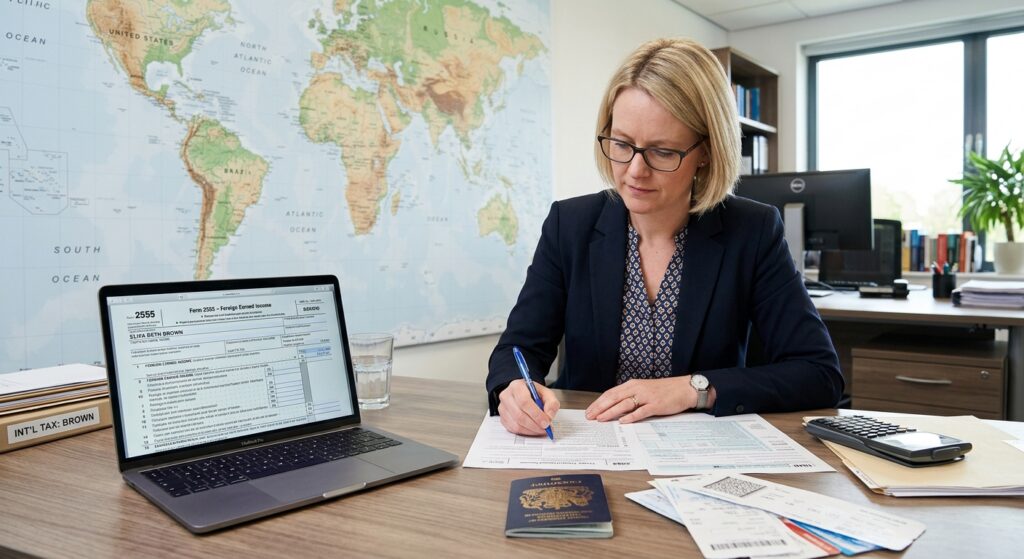
Bona Fide Residence Test vs Physical Presence Test: FEIE Advisory Guide for Tax Pros in 2026
For the 2026 tax year, tax professionals serving Americans abroad face a critical decision point. The bona fide residence test vs physical presence test FEIE comparison determines whether clients can exclude up to $131,000 in foreign earned income. As 5.5 million U.S. expats navigate complex filing requirements, tax advisors who master these qualification pathways unlock recurring, high-value advisory relationships. This guide equips solo practitioners and small firms with the strategic framework to reposition FEIE tax advisory services as premium offerings in 2026.
Table of Contents
Used by 2,400+ tax professionals
- Key Takeaways
- What Is the Core Difference Between These Two FEIE Tests?
- How Does the Bona Fide Residence Test Work in 2026?
- How Does the Physical Presence Test Work in 2026?
- Which Test Should Your Client Choose?
- What Are the Documentation Requirements for Each Test?
- What Are the Common Mistakes That Disqualify Expats?
- How Can Tax Pros Position This as Premium Advisory?
- Uncle Kam in Action: Digital Nomad FEIE Strategy
- Next Steps
- Frequently Asked Questions
- Related Resources
Key Takeaways
- The 2026 FEIE limit is $131,000, helping expats exclude foreign earned income from U.S. taxation
- Bona fide residence requires intent and full-year foreign residency under tax treaties
- Physical presence demands 330 days abroad during any consecutive 12-month period
- Tax pros can charge $3,500-$7,500 for comprehensive expat tax planning in 2026
- Form 2555 must align with the chosen test and supporting documentation
What Is the Core Difference Between These Two FEIE Tests?
Quick Answer: The bona fide residence test focuses on intent and establishing genuine foreign residency. The physical presence test counts actual days spent outside the U.S. regardless of intent.
The fundamental distinction between the bona fide residence test vs physical presence test FEIE qualification lies in what the IRS examines. The bona fide residence test evaluates whether your client has established true residency in a foreign country. This means intent matters. The IRS looks at visa status, ties to the foreign country, and the nature of the stay. Conversely, the physical presence test is purely mathematical. It counts days. If your client spends 330 full days outside the United States during any rolling 12-month period, they qualify.
For self-employed expats and digital nomads, this distinction creates strategic planning opportunities. A software consultant on a tourist visa in Portugal might not pass the bona fide test. However, they could easily satisfy the physical presence requirement. As a tax professional, understanding these nuances positions you to deliver year-round planning value rather than seasonal compliance work.
The Legal Framework Behind Each Test
The IRS Foreign Earned Income Exclusion rules originate from Internal Revenue Code Section 911. For the 2026 tax year, both tests remain valid pathways to FEIE qualification. The bona fide residence test requires an uninterrupted period that includes one full tax year. The physical presence test offers more flexibility with its 330-day requirement within any consecutive 12-month window.
Congress designed these dual pathways to accommodate different expatriate situations. Long-term residents working abroad under employment contracts typically use bona fide residence. Freelancers and location-independent professionals often find the physical presence test more practical. Understanding which pathway serves each client type becomes the foundation of your advisory value proposition.
Why This Matters for Your Advisory Practice
The American expat population continues growing. As of 2026, approximately 5.5 million U.S. citizens live abroad according to the Association of Americans Resident Overseas. Most need specialized tax planning strategies beyond basic return preparation. The FEIE represents substantial savings—up to $131,000 excluded from taxation means roughly $29,000 in federal tax savings for someone in the 22% bracket.
Pro Tip: Position FEIE planning as a multi-year engagement. Annual qualification reviews, treaty analysis, and state tax nexus planning create recurring revenue streams averaging $4,500 per client annually.
How Does the Bona Fide Residence Test Work in 2026?
Quick Answer: The bona fide residence test requires an uninterrupted period that includes one full tax year. Your client must establish genuine foreign residency with intent to remain indefinitely.
The bona fide residence test demands more than physical presence. The IRS evaluates intent through a facts-and-circumstances analysis. Your client must establish a residence in a foreign country and reside there for an uninterrupted period that includes an entire tax year. This means January 1 through December 31. Brief trips to the U.S. don’t break bona fide residence if the individual maintains their foreign home and intends to return.
Key Factors the IRS Examines
When determining bona fide residence status, the IRS considers multiple factors. None are individually determinative, but together they paint a picture of genuine foreign residency. Tax professionals should document each element carefully.
- Intent to remain in the foreign country indefinitely versus temporary assignment
- Nature and purpose of the trip abroad and expected duration
- Establishment of a permanent home and family presence in the foreign country
- Participation in the local community and social activities
- Economic ties including bank accounts, investments, and business interests
- Visa status and work permits demonstrating legal residency
- Statements made to foreign authorities about residence status
The Tax Treaty Advantage
The United States maintains income tax treaties with over 60 countries. These treaties often include residence provisions that support bona fide residence claims. However, there’s a critical trap. If your client claims treaty benefits as a resident of a foreign country for treaty purposes, they cannot simultaneously claim non-residence to avoid that country’s taxes. Consistency matters.
For example, a client working in Germany who files as a German tax resident and claims treaty benefits strengthens their bona fide residence position. Conversely, someone who maintains they’re just visiting Germany while claiming German residency for FEIE purposes creates an inconsistent position the IRS will challenge. This is where advisory expertise separates routine preparers from strategic planners.
When Bona Fide Residence Makes Sense
The bona fide residence test works best for clients with long-term foreign assignments. Corporate executives on three-year contracts, educators teaching abroad, or business owners establishing foreign operations benefit from this approach. Once established, bona fide residence continues even if your client makes brief trips home. They can spend more than 35 days in the U.S. annually without losing qualification.
| Client Profile | Best Test | Primary Reason |
|---|---|---|
| Corporate employee (2+ year contract) | Bona Fide Residence | Intent and work visa support long-term residency |
| Digital nomad (6-month stays) | Physical Presence | Frequent movement and tourist visas undermine intent |
| Business owner with foreign operations | Bona Fide Residence | Economic ties and permanent establishment support residency |
| Consultant with project-based travel | Physical Presence | Temporary stays and counting days provides certainty |
How Does the Physical Presence Test Work in 2026?
Quick Answer: The physical presence test requires your client to be physically present in a foreign country for 330 full days during any consecutive 12-month period. Intent doesn’t matter—only days count.
The physical presence test offers mathematical certainty. Your client must be physically present in one or more foreign countries for at least 330 full days during any period of 12 consecutive months. This translates to roughly 11 months abroad with 35 days available for U.S. visits. The 12-month period doesn’t need to align with the calendar year or tax year. You can select any consecutive 12-month window that maximizes your client’s exclusion.
Counting Days Correctly
The IRS defines a full day as a continuous 24-hour period beginning at midnight. Days spent traveling to or from the United States don’t count as days in a foreign country. However, travel days between foreign countries do count. This creates strategic opportunities for clients who frequently move between countries. A consultant who splits time between Singapore, Dubai, and London can count all those days toward the 330 requirement.
According to IRS Publication 54, your client must maintain meticulous records. Passport stamps provide the primary evidence. However, with electronic immigration systems becoming common, supplementary documentation matters. Hotel receipts, credit card statements showing foreign transactions, and work logs all support the day count. As a tax professional, implementing a tracking system for clients prevents qualification failures.
The Flexibility Advantage
The physical presence test offers flexibility that bona fide residence cannot match. Your client doesn’t need to establish intent or permanent residence. They can be on tourist visas, business trips, or temporary assignments. The only requirement is the day count. This makes the physical presence test ideal for freelancers, consultants, and location-independent professionals who move frequently.
Additionally, you can optimize the 12-month period annually. Suppose your client arrived overseas on March 15, 2025. You might choose a 12-month period from March 15, 2025 to March 14, 2026 for their 2025 return. Then select April 1, 2025 to March 31, 2026 for their 2026 return. This strategic period selection maximizes the exclusion across multiple tax years. This planning technique demonstrates sophisticated advisory work that justifies premium fees.
Pro Tip: Build a spreadsheet tracker for clients using the physical presence test. Track entry and exit dates, automatically calculate qualifying days, and project when they’ll hit the 330-day threshold. This tool becomes a value-added service that keeps clients engaged year-round.
Common Day-Counting Scenarios
Several scenarios create confusion when counting days. Understanding these prevents costly mistakes that disqualify your client.
- Travel days to the U.S. don’t count even if the flight departs from a foreign country
- Partial days in the U.S. (arriving or departing) count as U.S. days, not foreign days
- Days spent in international waters or airspace don’t count toward the 330 requirement
- Illness or family emergency trips to the U.S. still count against the 35-day buffer
- Days in U.S. territories like Puerto Rico or U.S. Virgin Islands count as U.S. days
Which Test Should Your Client Choose?
Quick Answer: Choose bona fide residence for long-term assignments with clear residency intent. Choose physical presence for flexible arrangements, short-term stays, or when intent evidence is weak.
The decision between the bona fide residence test vs physical presence test FEIE qualification depends on your client’s specific situation. As a tax professional, you must evaluate multiple factors. Work visa status, contract duration, family situation, and travel patterns all influence the optimal choice. Additionally, consider audit risk. The physical presence test offers objective, mathematical proof. The bona fide residence test relies on subjective intent, creating more audit exposure.
Decision Matrix for Tax Professionals
Use this framework when advising clients on test selection. Each factor should be weighted based on the client’s individual circumstances. However, visa status and intent documentation typically carry the most weight in audit situations.
| Factor | Favors Bona Fide | Favors Physical Presence |
|---|---|---|
| Contract Duration | Multi-year (2+ years) | Short-term or project-based |
| Visa Status | Work visa or permanent residence | Tourist visa or visa-free entry |
| Family Location | Family relocated abroad | Family remains in U.S. |
| U.S. Return Frequency | Infrequent (1-2 times yearly) | Frequent (monthly visits) |
| Housing Situation | Purchased or long-term lease abroad | Short-term rentals or hotels |
Can Clients Switch Between Tests?
Yes, clients can use different tests in different years. This flexibility creates planning opportunities. Suppose your client starts with a one-year contract in Japan. Use the physical presence test for year one. If they extend to a three-year assignment, switch to bona fide residence for years two and three. This approach provides audit protection in year one while capturing the flexibility benefits of bona fide residence later.
However, switching tests requires careful documentation. The IRS may question why the test changed. Your workpapers should clearly explain the change in circumstances. A new employment contract, visa upgrade, or family relocation provides sufficient justification. This documentation becomes critical during audits and demonstrates your diligence as the tax professional.
What Are the Documentation Requirements for Each Test?

Quick Answer: Bona fide residence requires visa documentation, foreign tax returns, and residency evidence. Physical presence needs detailed day logs with passport stamps and travel records.
Proper documentation separates successful FEIE claims from audit disasters. For the 2026 tax year, Form 2555 serves as the primary filing document. However, supporting documentation determines whether the IRS accepts the exclusion. Tax professionals should maintain comprehensive files for each client claiming FEIE benefits. This documentation protects both the client and your practice during examinations.
Bona Fide Residence Documentation Checklist
Building a bona fide residence file requires documenting intent and genuine foreign residency. Assemble these documents before filing. Missing documentation discovered during an audit creates credibility problems.
- Copy of work visa, residence permit, or permanent resident card from the foreign country
- Foreign country tax return showing filing as a resident for the full year
- Employment contract specifying assignment duration and location
- Lease agreement or property purchase documents for foreign home
- Bank statements from foreign financial institutions
- Utility bills, driver’s license, or vehicle registration from foreign country
- Statement of intention letter explaining long-term residency plans
- Evidence of community ties such as club memberships or volunteer activities
Physical Presence Documentation Checklist
The physical presence test demands precise day counting. Your documentation must prove 330 qualifying days. Any gaps or inconsistencies invite audit adjustments. Use our FEIE calculator for tax professionals to model different 12-month periods and identify the optimal qualifying period for your client’s 2026 situation.
- Complete passport copies showing all entry and exit stamps
- Day-by-day calendar log documenting location each day
- Flight itineraries and boarding passes for all international travel
- Hotel receipts and accommodation confirmations
- Credit card statements showing foreign transactions and locations
- Work logs or project records indicating foreign location
- Contemporaneous diary or journal entries noting daily locations
Pro Tip: Implement a quarterly documentation review system. Meet with FEIE clients every three months to verify their day count and documentation. This proactive approach prevents year-end qualification failures and demonstrates advisory value.
What Are the Common Mistakes That Disqualify Expats?
Quick Answer: Common mistakes include miscounting days, claiming the wrong test, inadequate documentation, and failing to meet the full-year requirement for bona fide residence.
Tax professionals must guard against predictable FEIE errors. These mistakes trigger audits and disallowances. The IRS has seen every variation, so documented compliance matters. Understanding these pitfalls positions you as the expert who prevents costly problems rather than simply preparing returns.
The Five Most Expensive FEIE Errors
- Starting bona fide residence mid-year: The test requires an uninterrupted period that includes one full tax year. Starting in June 2026 means no qualification until 2027.
- Miscounting partial days: The day you arrive in the U.S. counts as a U.S. day even if you land at 11:59 PM. Many clients lose qualification by five or fewer days.
- Claiming both FEIE and foreign tax credit on same income: You cannot double-dip. Choose the more beneficial treatment for each income category.
- Assuming tourist visa supports bona fide residence: Temporary visas undermine intent to remain indefinitely. The IRS knows this and targets these claims.
- Forgetting state tax filing obligations: Moving abroad doesn’t automatically break state residency. Many states require formal domicile termination procedures.
Audit Red Flags Tax Pros Must Avoid
Certain FEIE claims attract disproportionate IRS scrutiny. Understanding these patterns helps you structure defensible positions. When reviewing competitor websites, we’ve noticed few discuss these audit triggers, creating a knowledge gap you can fill for clients.
High-income individuals claiming the maximum $131,000 exclusion face elevated audit risk. The IRS questions whether all income qualifies as foreign earned income. Passive investment income, U.S.-source income, and certain fringe benefits don’t qualify. Additionally, couples splitting time between countries while each claiming separate foreign residency invite examination. The IRS evaluates family unit residency, not just individual claims.
How Can Tax Pros Position This as Premium Advisory?
Quick Answer: Package FEIE planning with treaty analysis, state tax termination, and quarterly monitoring. Price at $3,500-$7,500 annually for comprehensive expat advisory services.
The bona fide residence test vs physical presence test FEIE decision represents the entry point to ongoing advisory relationships. Solo practitioners and small firms competing with larger expat tax specialists need differentiation. Your advantage lies in proactive planning rather than reactive compliance. Transform FEIE qualification from a Form 2555 checkbox into a comprehensive cross-border tax strategy engagement.
The Advisory Service Stack
Build your expat advisory offering around multiple service layers. Each layer adds value and justifies premium pricing. This approach positions you beyond tax preparation into strategic planning territory.
- Pre-departure planning: Meet with clients before they move abroad. Evaluate FEIE eligibility, analyze treaty benefits, plan state tax termination, and set up tracking systems. Charge $2,000-$3,500.
- Quarterly monitoring: Review day counts, update documentation, adjust test selection if circumstances change. Build accountability and catch problems early. Charge $400-$600 per quarter.
- Annual tax return preparation: Prepare Form 1040, Form 2555, foreign bank account reporting, and state returns. Include audit protection provisions. Charge $1,500-$2,500.
- Treaty analysis and optimization: Evaluate U.S. tax treaties, foreign tax credit planning, and totalization agreements for Social Security. Charge $1,000-$1,500 per analysis.
- Repatriation planning: Help clients return to the U.S. tax efficiently. Address timing of foreign income, asset repatriation, and state re-establishment. Charge $2,500-$4,000.
Marketing Your Expat Practice
Position yourself as the cross-border specialist rather than a general practitioner. Create content that demonstrates expertise in FEIE planning. Write blog posts comparing the bona fide residence test vs physical presence test FEIE strategies. Develop case studies showing tax savings you’ve achieved for expat clients. Join digital nomad communities and expat forums where your ideal clients gather.
Consider partnering with immigration attorneys and global mobility consultants. These professionals work with Americans moving abroad who need tax guidance. Establish referral relationships where you provide complimentary FEIE education sessions for their clients. This positions you as the tax expert before clients even know they need services. For more strategies on building your advisory practice, explore our tax planning software with unlimited assessments designed specifically for tax professionals.
| Service Package | What’s Included | Typical Fee Range |
|---|---|---|
| Expat Essentials | Form 1040, Form 2555, FBAR filing, basic FEIE planning | $1,500-$2,000 |
| Strategic Expat | Above plus quarterly monitoring, treaty analysis, state tax termination | $3,500-$5,000 |
| Premium Cross-Border | Above plus entity structuring, foreign tax credit optimization, audit defense | $6,000-$8,500 |
Uncle Kam in Action: Digital Nomad FEIE Strategy Delivers $31,400 in Tax Savings
Sarah, a solo tax practitioner in Austin, Texas, wanted to expand beyond traditional 1040 preparation. She attended an Uncle Kam webinar on expat tax planning and saw the opportunity. Using the MERNA™ framework, Sarah identified digital nomads as her target niche. These location-independent professionals earn high income but often receive minimal tax guidance.
In March 2026, Sarah connected with Marcus, a software developer earning $180,000 annually while traveling through Southeast Asia. Marcus had been filing as a U.S. resident and paying full federal tax. He didn’t realize he could claim the FEIE. Sarah performed a comprehensive analysis comparing the bona fide residence test vs physical presence test FEIE options for Marcus’s situation.
Marcus spent time across Thailand, Vietnam, and Indonesia on tourist visas. He lacked the permanent residency necessary for bona fide residence. However, his passport stamps and travel logs showed he spent 348 days outside the U.S. in his optimal 12-month period. Sarah identified the physical presence test as the clear winner. She helped Marcus document his qualifying days and prepared Form 2555 excluding $131,000 of his income.
The Results: Marcus saved $31,400 in federal income tax for 2026. Sarah charged $4,500 for the initial analysis, planning, and return preparation—delivering a 7x first-year return on investment. Marcus signed a $3,200 annual retainer for ongoing quarterly monitoring and 2027 planning. Sarah now serves 14 digital nomad clients generating $52,000 in annual advisory revenue. She credits Uncle Kam’s training and strategy framework for transforming her practice from seasonal compliance work to year-round advisory engagements.
Sarah’s practice evolution demonstrates that specialization works. By mastering the bona fide residence test vs physical presence test FEIE decision, she created a defensible niche that larger firms overlook. Her clients value ongoing guidance over transactional return preparation. Most importantly, Sarah positioned herself as a strategic advisor rather than a commodity preparer.
Next Steps
Ready to transform your practice with expat tax advisory services? Start implementing these strategies immediately.
- Download the latest Form 2555 and instructions from IRS.gov to review 2026 requirements
- Create a bona fide residence test vs physical presence test comparison worksheet for client consultations
- Develop a day-tracking spreadsheet tool for physical presence test clients
- Join expat-focused online communities to build your referral network and expertise
- Schedule a strategy session at Uncle Kam to explore how tax planning software helps you scale expat advisory services
Frequently Asked Questions
Can a client use both tests in the same tax year?
No, you must choose one test per tax year. However, you can use different tests in different years. If circumstances change mid-year, evaluate which test provides better qualification. For 2026, select the test that maximizes the exclusion based on your client’s actual presence and intent documentation.
What happens if my client misses the 330-day requirement by just a few days?
They lose the entire FEIE for that period. There’s no partial credit or pro-ration. This harsh result underscores why quarterly monitoring matters. Track days continuously rather than discovering the shortfall at year-end. If a client will miss the threshold, strategic planning can shift the 12-month qualifying period to capture more exclusion.
Does working remotely for a U.S. company disqualify my client from FEIE?
No, the employer’s location doesn’t matter. Foreign earned income depends on where the services are performed, not who pays the salary. Your client performing work while physically present in France earns foreign income even if their employer is in California. However, ensure the Form W-2 properly reflects foreign work location. Document physical presence at the foreign work location meticulously.
Can my client claim FEIE while maintaining a home in the United States?
Yes for the physical presence test—it only counts days abroad. For bona fide residence, maintaining a U.S. home weakens but doesn’t automatically disqualify the claim. The IRS evaluates all facts and circumstances. If the foreign residence is clearly the primary home and the U.S. property is rarely used, bona fide residence remains viable. Document which residence serves as the tax home.
How does the $131,000 FEIE limit work for married couples?
Each spouse who qualifies can claim their own $131,000 exclusion in 2026. A qualifying married couple can exclude up to $262,000 of combined foreign earned income. However, each spouse must independently satisfy either the bona fide residence test or physical presence test. You cannot combine or transfer one spouse’s qualification to the other.
What if my client’s visa expires and they continue working in the foreign country?
For physical presence purposes, the visa status doesn’t affect day counting. Days abroad still count even with expired visa status. However, for bona fide residence, working illegally severely undermines the intent to establish lawful residency. The IRS will likely disallow bona fide residence claims during periods of illegal status. Advise clients to maintain proper visa status or use physical presence test during transition periods.
Should my client file a protective FEIE claim if they’re unsure about qualification?
Yes, filing Form 2555 protects the ability to claim FEIE later. If you discover additional qualifying days or documentation after filing, you can amend. However, if you don’t claim FEIE on the original return or timely-filed extension, you may lose the exclusion permanently. For 2026 returns, include Form 2555 with conservative estimates. Amend later if needed to maximize exclusion with better documentation.
Related Resources
- Tax Advisory Services for Cross-Border Clients
- Advanced Tax Planning Strategies
- Comprehensive Tax Planning Guides
- MERNA™ Tax Strategy Framework
- Tax Professional Success Stories
Last updated: May, 2026
This information is current as of 5/29/2026. Tax laws change frequently. Verify updates with the IRS or consult a tax professional if reading this later.

