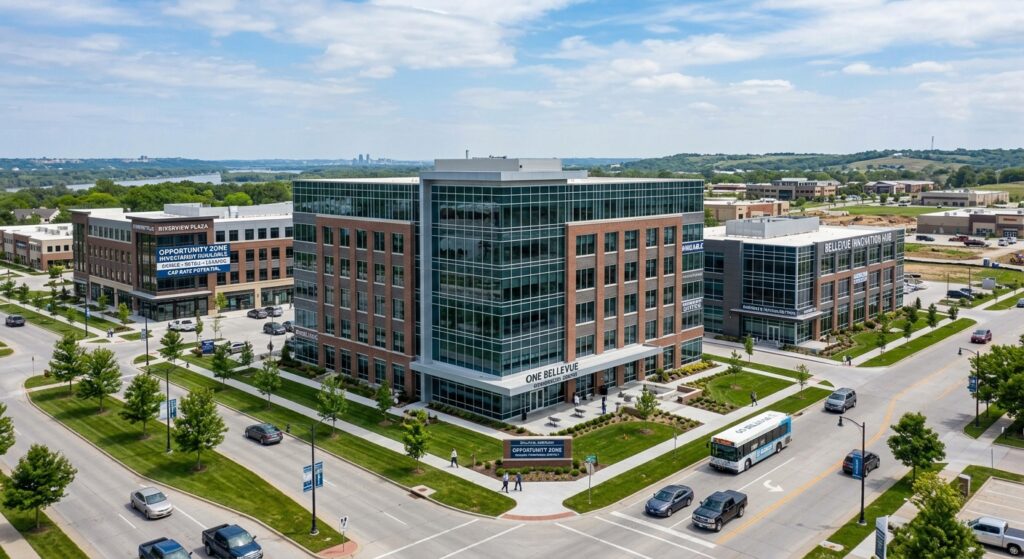
Bellevue Opportunity Zone Deferral: 2026 Tax Strategy Guide for Real Estate Investors
For 2026, Bellevue real estate investors face a critical window: understanding how Bellevue opportunity zone deferral strategies can dramatically reduce capital gains taxes before new designations take effect January 1, 2027. The IRS and Treasury Department have just released comprehensive guidance on qualified opportunity zone (QOZ) designations under the permanent One Big Beautiful Bill Act (OBBBA), giving Nebraska investors unprecedented opportunities to defer capital gains indefinitely while building long-term wealth in economically distressed areas. This complete guide explains the 2026 timeline, eligibility requirements, tax deferral mechanics, and actionable strategies for maximizing your opportunity zone investments.
Key Takeaways
- Starting July 1, 2026, Nebraska governors can nominate census tracts for 2027 QOZ designation, with final designations effective January 1, 2027.
- 25,332 eligible low-income census tracts exist nationwide; 8,334 are entirely rural areas qualifying for enhanced tax benefits.
- Nebraska cannot designate more than 25% of its low-income communities as QOZs under 2026 rules.
- QOZ investments allow capital gains deferral indefinitely, step-up basis at death, and potential 15% gain exclusion for 10-year holding periods.
- For 2026, Bellevue investors should model projected gains, consult tax advisors, and position capital for opportunity zone deployment before year-end.
Table of Contents
- What Is Bellevue Opportunity Zone Deferral?
- How Does QOZ Tax Deferral Work for Capital Gains?
- What Is the 2026 QOZ Timeline and Bellevue Designation Process?
- What Are the Eligibility Rules for Low-Income Community Status?
- How Can Real Estate Investors Calculate QOZ Deferral Benefits?
- How Does the 25% State Designation Cap Affect Nebraska?
- What Are the Enhanced Tax Benefits for Rural Opportunity Zones?
- What Is the Bellevue Real Estate Strategy for 2026 QOZ Investors?
- Uncle Kam in Action: Real Estate Investor Case Study
- Next Steps
- Frequently Asked Questions
What Is Bellevue Opportunity Zone Deferral?
Quick Answer: Bellevue opportunity zone deferral is a 2026 tax strategy allowing investors to reinvest capital gains into designated economically distressed areas, deferring federal income tax on those gains indefinitely while building investment wealth in qualifying Bellevue census tracts and surrounding low-income communities.
A qualified opportunity zone deferral represents one of the most powerful tax incentives available to real estate investors in 2026. Under the One Big Beautiful Bill Act (OBBBA), signed into law in July 2025, Congress permanently extended the Opportunity Zone program, making it a permanent fixture of the tax code. For Bellevue investors, this means the chance to deploy capital into economically distressed areas while deferring—and potentially eliminating—capital gains taxes.
The mechanics are straightforward: when you sell a property and realize a capital gain, you can elect to defer that gain by reinvesting the proceeds into a qualified opportunity fund (QOF) within 180 days. The gain is recognized in the year of deferral election, but the tax is deferred until the earlier of the sale of the QOF investment or December 31, 2026—for 2026 investments. This deferral window is critical: investors who act in 2026 can position capital for the new wave of QOZ designations effective January 1, 2027.
For Bellevue real estate investors, opportunity zone deferral is especially relevant because the Bellevue area contains low-income census tracts that qualify for nomination under Revenue Procedure 2026-12. Nebraska state officials are preparing to nominate eligible tracts starting July 1, 2026, which means new opportunities could be certified within months.
Why 2026 Is a Critical Year for Opportunity Zone Strategy
The permanence of the OBBBA changes everything. Previously, investors worried that the Opportunity Zone program would sunset. Now, with federal legislation making QOZs permanent, states like Nebraska are preparing comprehensive nomination processes. The 90-day nomination window starting July 1, 2026, gives Bellevue investors a narrow window to understand which tracts might be nominated and position their capital accordingly.
Additionally, the Treasury Department released Revenue Procedure 2026-12 on April 6, 2026, identifying exactly which 25,332 census tracts nationwide are eligible for QOZ designation. For the first time, investors and advisors have clarity on which tracts might be nominated. This transparency allows Bellevue investors to make informed decisions about capital deployment.
Pro Tip: Download Revenue Procedure 2026-12 from IRS.gov and cross-reference Bellevue’s census tract numbers. Knowing which tracts are eligible helps you anticipate which areas will be nominated by Nebraska on July 1, 2026.
How Does QOZ Tax Deferral Work for Capital Gains?
Quick Answer: QOZ deferral allows investors to reinvest realized capital gains into a qualified opportunity fund, deferring federal tax on those gains until the earlier of selling the QOF investment or December 31, 2026, with potential for 15% gain exclusion on long-term holds.
The tax deferral mechanism under the OBBBA operates in three distinct phases. Understanding each phase is essential for Bellevue investors planning 2026 capital deployment.
Phase 1: The Deferral Period (2026-2027)
When you realize a capital gain—such as selling rental property—you must elect to defer the gain by reinvesting it into a qualified opportunity fund. The election must be made within 180 days of the gain recognition date. For 2026, this means you have until mid-2027 to deploy the proceeds for many transactions.
The deferral period extends until the earliest of: (1) the date you sell your interest in the QOF, (2) the date the QOF disposition rule triggers, or (3) December 31, 2026 for investments in certain original designation tracts. For 2026 investors making new opportunity zone investments, the deferral period is typically much longer.
Phase 2: The 10-Year Holding Period and Step-Up in Basis
If you hold your QOF investment for at least 10 years, the basis in the investment steps up to its fair market value on December 31, 2026 (for 2026 investments). This step-up is extraordinarily valuable: it permanently eliminates any gain accrued prior to the 10-year anniversary.
For Bellevue investors, this creates a powerful incentive: invest 2026 capital gains into a Bellevue QOZ today, hold for 10 years, and the basis step-up wipes out all pre-2027 gains on that investment. This is a permanent, tax-free wealth transfer mechanism unavailable in most investment vehicles.
Phase 3: The 15% Exclusion on Long-Term Gains
For investments held beyond 10 years, up to 15% of the original deferred gain is permanently excluded from taxation. This exclusion applies regardless of future appreciation, making it an unlimited wealth-building mechanism for patient investors. When combined with the basis step-up, the 15% exclusion creates a scenario where Bellevue investors may eliminate substantial capital gains taxation entirely.
For example, an investor with a $1,000,000 capital gain deferring into a Bellevue QOZ in 2026 would exclude $150,000 permanently from federal taxation (15% of $1,000,000). Combined with the basis step-up at the 10-year mark, this investor could significantly reduce lifetime capital gains taxes.
Pro Tip: For 2026, Net Investment Income Tax (NIIT) at 3.8% applies to capital gains for high-income investors (MAGI > $200,000 single, $250,000 MFJ). QOZ deferral delays NIIT payment, reducing 2026 cash flow pressure and allowing capital to compound longer.
What Is the 2026 QOZ Timeline and Bellevue Designation Process?
Quick Answer: Starting July 1, 2026, Nebraska’s governor can nominate eligible census tracts for 90 days (extending 30 days optional). Treasury certifies nominations before January 1, 2027, when designations take effect. Final IRS guidance on specific tracts drops before January 1, 2027.
The 2026 timeline is precise and non-negotiable for Bellevue investors. Understanding these dates is critical for positioning capital and making informed deferral decisions.
| Date/Period | Event | Impact on Bellevue Investors |
|---|---|---|
| April 6, 2026 | IRS/Treasury releases Revenue Procedure 2026-12 and identifies 25,332 eligible tracts | Bellevue investors can identify which local tracts are eligible for nomination |
| July 1, 2026 | Nebraska governor nominates eligible census tracts (90-day window, optional 30-day extension) | Bellevue tracts either nominated or excluded from 2027 designations; critical juncture for investors |
| September 28, 2026 (or October 28) | Nomination window closes (plus optional 30-day extension) | No additional tracts can be nominated for 2027 designation; deadline for state action |
| September-December 2026 | Treasury reviews and certifies nominated tracts | Potential clarifications on Bellevue tract eligibility; investors monitor final designation list |
| January 1, 2027 | First round of new QOZ designations take effect | Bellevue-nominated tracts officially become QOZs; new investment opportunities activate |
For Bellevue real estate investors, this timeline creates urgent decision points. Between now and June 30, 2026, investors should:
- Review Revenue Procedure 2026-12 to identify Bellevue-area eligible tracts.
- Consult with qualified opportunity fund sponsors to understand investment structures available for Bellevue properties.
- Model projected capital gains and deferral timelines for 2026 transactions.
- Monitor Nebraska state announcements regarding which tracts will be nominated July 1, 2026.
Once the nomination window closes September 28, 2026, the opportunity for new designations is closed for 10 years (the next round occurs in 2037). This creates a once-per-decade planning opportunity for Bellevue investors.
What Are the Eligibility Rules for Low-Income Community Status?
Quick Answer: For 2026 QOZ designation, census tracts must qualify as low-income communities using poverty rate or median income thresholds defined in IRS regulations. Rev. Proc. 2026-12 identifies 25,332 eligible tracts; Bellevue census tract numbers are listed by IRS designation codes.
Not every census tract in Bellevue or Douglas County qualifies for QOZ nomination. The IRS and Treasury apply strict eligibility criteria under Section 45S of the Internal Revenue Code and Treasury regulations. Understanding these rules helps Bellevue investors identify which specific properties can be included in QOZ investments.
Low-Income Community Definition
A census tract qualifies as a low-income community if it meets one of two tests:
- Poverty Rate Test: The poverty rate of the census tract is at least 20% for the most recent census data.
- Median Income Test: The median family income of the census tract is 80% or less of the median family income of the metropolitan statistical area (or state, if non-metropolitan).
For Bellevue, certain census tracts meet these thresholds based on 2020 Census data. Revenue Procedure 2026-12 identifies these tracts by census designation. Investors can cross-reference their target Bellevue properties with the IRS tract list to confirm eligibility before the July 1, 2026, nomination window.
For property-specific analysis, consult the IRS Revenue Procedure page to download the full list of eligible tracts and match Bellevue property addresses to census tract designations.
Nominated vs. Designated Tracts: Critical Timing
Once Nebraska nominates a Bellevue tract on July 1, 2026, it is “nominated” but not yet “designated.” Designation occurs January 1, 2027, when Treasury officially certifies the nomination. For Bellevue investors, this distinction matters: investments can be made in nominated tracts before official designation, provided they become designated by the regulatory deadline.
Pro Tip: Ask your QOF sponsor whether they will accept investments in nominated-but-not-yet-designated Bellevue tracts. Some sponsors require official designation; others allow “pre-designation” investment if designations are virtually certain. Understanding sponsor policies helps timing decisions.
How Can Real Estate Investors Calculate QOZ Deferral Benefits?
Quick Answer: Calculate QOZ deferral benefit by multiplying your realized capital gain × marginal federal tax rate (22%-37% for 2026) + 3.8% NIIT if applicable, then model 10-year holding period step-up and 15% exclusion for long-term gains using our Small Business Tax Calculator.
The financial benefit of Bellevue opportunity zone deferral depends on several variables: the size of your capital gain, your tax bracket, holding period, and future appreciation rates. Let’s work through a practical example.
Example Calculation: Bellevue Rental Property Sale
Assume you sell a Bellevue rental property in September 2026 and realize a $500,000 long-term capital gain. Your taxable income for 2026 is $350,000 (married filing jointly). For 2026, your federal capital gains tax rate is 20% (top bracket). You also owe 3.8% Net Investment Income Tax (NIIT) because your MAGI exceeds $250,000.
Without QOZ Deferral:
$500,000 gain × 20% federal = $100,000
$500,000 gain × 3.8% NIIT = $19,000
Total tax due: $119,000 in 2026
With QOZ Deferral (10-year hold):
Defer $500,000 gain to 2027+
Hold QOF investment 10+ years
Basis step-up on December 31, 2026 = entire $500,000 gain eliminated
plus 15% exclusion on original gain = $75,000 additional exclusion
Net taxable gain upon eventual sale: $0 (gain eliminated) + future appreciation only
Total tax due at 10-year mark: $0 on original deferral
Tax Savings: $119,000 immediate deferral, plus $119,000 in avoided taxes if step-up applies, plus indefinite deferral of NIIT = potential savings of $240,000+
This simplified example illustrates why opportunity zone deferral is so attractive to Bellevue real estate investors. The combination of deferral, basis step-up, and exclusion creates substantial tax savings that compound over time.
Use our Small Business Tax Calculator to model your specific gain, tax rate, and holding period scenarios for 2026 opportunity zone investments.
Variables Affecting Your QOZ Benefit Calculation
Several factors change your deferral benefit. Understanding each helps you make more accurate projections:
- Holding Period: Longer holds (10+ years) unlock basis step-up and 15% exclusion benefits. Short-term holds defer tax only.
- NIIT Exposure: High-income Bellevue investors (MAGI > $250,000 MFJ) owe 3.8% NIIT. Deferral avoids this immediate tax.
- State Taxes: Nebraska doesn’t have state income tax (0%). However, capital gains taxes vary by state of residence. Confirm your state tax liability.
- Future Appreciation: If your Bellevue QOZ investment appreciates significantly, you owe tax on post-investment gains. Step-up and exclusion apply only to deferred gains.
How Does the 25% State Designation Cap Affect Nebraska?
 Free Tax Write-Off Finder
Quick Answer: Nebraska cannot designate more than 25% of its total low-income communities as QOZs under 2026 rules. This cap limits the number of eligible tracts nominated July 1, 2026, potentially making some Bellevue tracts ineligible for 2027 designation.
The 25% cap is a crucial constraint for Nebraska governors nominating Bellevue tracts. Understanding this limitation helps Bellevue investors anticipate which tracts might NOT be nominated in 2026, forcing them to wait until the next designation round in 2037.
How the 25% Cap Works
Revenue Procedure 2026-12 identifies total low-income communities in each state. For Nebraska, the cap is calculated as: Total LICs in Nebraska × 25% = maximum number of tracts that can be designated as QOZs in 2027.
For example, if Nebraska has 100 low-income communities, the cap allows designation of only 25 tracts maximum. If Nebraska has fewer than 25 LICs, then all eligible tracts may be designated. The actual Nebraska cap requires consulting Revenue Procedure 2026-12 for exact numbers.
For Bellevue investors, this means some eligible census tracts in the Bellevue area might not be nominated in 2026 due to the statewide cap. However, those tracts remain eligible for nomination in the 2037 round (next 10-year designation window). This uncertainty makes early planning critical: confirm with Nebraska economic development officials which Bellevue tracts are priorities for nomination.
| Scenario | Nebraska LICs | 25% Cap = Max QOZ Designations | Implication for Bellevue |
|---|---|---|---|
| Scenario A | 50 LICs statewide | 12-13 tracts maximum | Strict limit; priority Bellevue tracts may be nominated, others deferred to 2037 |
| Scenario B | 25 LICs statewide | 6-7 tracts maximum | Very strict limit; fewer than 25 LICs triggers “all eligible” rule potentially |
| Scenario C | Fewer than 25 LICs | All eligible tracts can be designated | All qualifying Bellevue tracts likely nominated; more opportunity for investors |
To determine Nebraska’s exact cap, Bellevue investors should contact the Nebraska Department of Economic Development or consult an experienced real estate investment advisor familiar with state-level OZ nomination processes.
What Are the Enhanced Tax Benefits for Rural Opportunity Zones?
Quick Answer: The OBBBA added enhanced tax benefits for QOZ investments in rural areas (8,334 nationwide). These areas get bonus depreciation and accelerated deductions not available in traditional opportunity zones, plus deferral and step-up benefits.
Under the One Big Beautiful Bill Act, Congress recognized that rural opportunity zones face unique challenges attracting investment capital. To incentivize rural development, the OBBBA added special tax benefits for rural QOZ investments. For Bellevue investors seeking rural properties outside the city limits, these enhanced benefits are significant.
Enhanced Rural QOZ Benefits
The OBBBA made permanent enhanced tax deductions for rural QOZ investments. Notice 2025-50 from the IRS outlined key benefits for rural area QOZs:
- Accelerated Deductions: Rural QOZ property investments qualify for bonus depreciation and accelerated deductions, reducing taxable income faster than standard depreciation schedules.
- Enhanced Exclusion: Some rural QOZ structures provide higher gain exclusion percentages for long-term holds, compared to traditional QOZ rules.
- Basis Step-Up Extended: Basis step-up and deferral benefits apply to rural properties, combined with accelerated depreciation for maximum 2026 tax savings.
For Bellevue-area investors with rural properties nearby, the combined benefits of deferral, depreciation, and long-term exclusions create exceptionally powerful tax incentives. Rural opportunity zones represent one of the best 2026 tax strategies available to real estate investors in the Midwest.
To determine whether a specific Bellevue-area property qualifies as “rural,” check whether the census tract contains areas that “entirely comprise a rural area” per IRS definition. Revenue Procedure 2026-12 lists all 8,334 rural-qualifying tracts nationwide.
What Is the Bellevue Real Estate Strategy for 2026 QOZ Investors?
Quick Answer: Bellevue real estate investors should model 2026 capital gains, identify qualified opportunity fund sponsors, locate eligible census tracts from Revenue Procedure 2026-12, monitor Nebraska’s July 1 nomination process, and position capital for deployment in newly designated QOZ properties effective January 1, 2027.
Implementing a Bellevue opportunity zone deferral strategy requires six concrete steps. Following this action plan helps you capture 2026 QOZ benefits before the January 1, 2027 effective date.
Step 1: Model Your 2026 Capital Gains
Identify all anticipated capital gains for 2026. Include: sales of Bellevue rental properties, real estate partnerships distributing gains, business sales, appreciated securities, or other capital events. For each, calculate the realized gain and note the gain recognition date. This inventory helps quantify how much capital you can deploy into opportunity zones by your 180-day deferral deadline.
Step 2: Verify Bellevue Tract Eligibility
Download Revenue Procedure 2026-12 from IRS.gov revenue procedures page. Cross-reference Bellevue census tract numbers with eligible tracts. For each target property, confirm the census tract designation. This verification takes 30 minutes but prevents investing in ineligible properties.
Step 3: Identify Qualified Opportunity Fund Sponsors
QOF sponsors manage the actual investment structure and ensure compliance with Section 45S rules. Search for QOF sponsors specializing in Bellevue real estate or Nebraska opportunity zones. Interview sponsors regarding: investment minimums, fee structures, liquidity provisions, and their track record with basis step-up planning. For 2026 investments, confirm sponsors will invest in eligible Bellevue tracts.
Step 4: Monitor Nebraska’s July 1 Nomination Window
Beginning July 1, 2026, Nebraska’s governor will nominate specific Bellevue tracts for QOZ designation. Watch the Nebraska Department of Economic Development website and IRS announcements for the official nomination list. Confirm which Bellevue tracts the state prioritizes. This information helps you decide which properties to target for investment.
Step 5: Deploy Capital by December 31, 2026
For maximum 2026 tax deferral benefits, investors should deploy capital into QOF investments before December 31, 2026. This allows the basis step-up and 15% exclusion rules to apply. Coordinate with your QOF sponsor and tax advisor on timing and investment structure.
Step 6: Hold for 10+ Years to Maximize Tax Benefits
Once capital is deployed, commit to a 10+ year holding period to unlock the basis step-up (eliminating all pre-2027 gains) and 15% permanent exclusion. Short-term holds defer tax only; long-term holds eliminate substantial tax liability. Communicate with your QOF sponsor about holding period expectations and exit strategies aligned with your timeline.

Uncle Kam in Action: Real Estate Investor Case Study
Meet Marcus, a Bellevue real estate investor with a concrete opportunity zone deferral challenge. Marcus owns three rental properties across Douglas County and plans to sell two in 2026 to fund a portfolio rebalancing into Bellevue commercial real estate. However, his capital gains tax bill would exceed $250,000, creating cash flow pressure right when he needs liquidity for new acquisitions.
The Problem: Marcus is selling two Bellevue rental properties for a combined $2 million. His cost basis is $800,000, generating a $1.2 million long-term capital gain. His 2026 federal tax bracket is 24% (married filing jointly), plus 3.8% NIIT = 27.8% effective rate. His federal capital gains tax on the $1.2M gain: $334,000. This tax liability forces Marcus to either reduce his reinvestment capital or take on debt, both suboptimal outcomes.
The Uncle Kam Solution: Marcus consults an Uncle Kam tax strategist experienced in opportunity zones. The advisor structures Marcus’s $1.2 million proceeds into a tax strategy involving deferral through a Bellevue-focused qualified opportunity fund. Marcus nominates an eligible Bellevue commercial property tract that his state is expected to nominate July 1, 2026.
The Numbers:
- Deferred gain: $1.2 million
- Tax deferred to 2027: $334,000
- Reinvestment capital immediately available: $2 million (instead of $1.666 million after tax)
- Additional capital deployed: $334,000
- Projected 10-year appreciation on QOF investment: $500,000 (modest 3.5% annual growth)
- Tax benefit at 10-year mark: Basis step-up eliminates entire $1.2M deferred gain PLUS $75,000 exclusion (15% × $1.2M)
- Tax on $500,000 future appreciation at long-term rate (20%): $100,000 (only on growth, not original deferral)
The Results: Marcus deploys an additional $334,000 into Bellevue real estate immediately. After 10 years, assuming modest market appreciation, he sells the QOF investment. The entire original $1.2 million deferred gain is tax-free due to basis step-up. He owes tax only on the $500,000 new appreciation ($100,000 in federal tax). Total tax savings vs. immediate sale: $334,000 deferred + $134,000 from exclusion/step-up = $468,000 total tax reduction over 10 years. This strategy allows Marcus to reinvest more capital, accelerate portfolio growth, and minimize lifetime tax liability.
Marcus’s case illustrates why Bellevue real estate investors should prioritize opportunity zone planning in 2026. The combination of deferral, step-up, and exclusion creates transformational tax outcomes unavailable through conventional investment structures.
Next Steps
Your opportunity zone strategy for 2026 depends on action. Here are three concrete next steps:
- Step 1 – Quantify Your Gains: Model all anticipated 2026 capital gains (properties, partnerships, securities). Calculate your federal tax liability using your 2026 tax bracket and 3.8% NIIT if applicable. This baseline determines how much capital is available for opportunity zone deployment.
- Step 2 – Consult an Opportunity Zone Expert: Contact a tax advisor experienced in opportunity zones to review your specific situation. Ask them to model your projected deferral benefits, step-up implications, and 10-year holding strategy. Uncle Kam’s team specializes in opportunity zone planning for real estate investors.
- Step 3 – Monitor July 1, 2026 Nomination Window: Set a calendar reminder for late June 2026 to check the Nebraska Department of Economic Development and IRS websites for Bellevue tract nomination announcements. Once nominated tracts are confirmed, coordinate with your QOF sponsor and tax advisor on investment timing and structure.
Don’t let 2026 opportunity zone opportunities pass. The 90-day nomination window (July 1 – September 28, 2026) is your final chance to influence which Bellevue tracts are designated for a decade. Act now to position your capital and strategy for January 1, 2027 effective designations.
Frequently Asked Questions
1. Can I Invest in a Bellevue Opportunity Zone Without Realizing a Capital Gain?
No, the deferral benefit requires a realized capital gain. However, you can invest other investment capital or retirement funds directly into QOFs without deferral rules applying. Some investors combine strategies: deferring capital gains through one QOF while making separate cash investments into complementary opportunity zone properties. Consult your tax advisor on strategy layering.
2. What Happens If a Bellevue Census Tract Is Not Nominated July 1, 2026?
If Nebraska doesn’t nominate a specific Bellevue tract, it remains eligible for the next 10-year designation round (2037). For 2026 investors, this means you must either: (1) invest in a tract that IS nominated in 2026, or (2) wait for 2037 designations. The 25% cap makes it likely some eligible Bellevue tracts will not be nominated in 2026. Monitor state announcements to confirm which tracts are priorities.
3. Does QOZ Deferral Apply to Nebraska State Income Tax?
Nebraska has no state income tax, so opportunity zone deferral applies only to federal taxes. However, if you’re a resident of another state (e.g., Iowa, Colorado) with capital gains taxes, confirm how that state treats federal QOZ deferrals. Some states conform to federal rules; others may tax deferred gains. Consult a multi-state tax advisor if you maintain residency outside Nebraska.
4. What If My QOZ Investment Decreases in Value?
QOZ deferral still applies even if your investment loses value. However, the basis step-up benefit applies to the investment’s fair market value on December 31, 2026, not your original investment amount. If your $1 million QOZ investment drops to $700,000 by 2027, the step-up basis is only $700,000. You still defer the original gain and get a step-up, but the benefit is limited to the lower FMV. This is still advantageous vs. immediate tax.
5. Can I Invest in Multiple Bellevue Opportunity Zones With One Capital Gain?
Yes. If you have a $1 million capital gain, you can split it across multiple QOFs or properties. For example: $600,000 into a Bellevue residential QOF and $400,000 into a rural Bellevue property QOF. Each investment receives separate deferral treatment. This diversification strategy reduces concentration risk and allows you to participate in multiple Bellevue market segments simultaneously.
6. What If I Need to Withdraw Money from My QOZ Investment Before 10 Years?
Early withdrawal triggers recognition of the deferred gain plus tax on any appreciation. You lose the basis step-up and 15% exclusion benefits. For this reason, QOZ investments should be held in capital you don’t anticipate needing for at least 10 years. Choose QOF sponsors and properties with strong liquidity provisions if early exit is a possibility.
7. Are There Income Limits for QOZ Deferral Benefits?
No, there are no income limits for QOZ deferral. Whether you’re a $100,000 or $10 million investor, opportunity zone deferral applies equally. This makes QOZ strategies particularly attractive to high-net-worth Bellevue investors seeking to minimize substantial capital gains taxes.
8. How Do I Know If a QOF Sponsor Is Legitimate and IRS-Compliant?
Ask QOF sponsors for: (1) their IRS QOF certification letter, (2) audited financial statements, (3) references from previous investors, and (4) documentation of compliance with Section 45S rules. Verify on the IRS Opportunity Zones page that the sponsor is listed. Don’t invest in uncertified QOFs or sponsors unwilling to provide documentation.
9. What If Nebraska Designates Fewer Tracts Than Expected?
If Nebraska’s governor designates fewer Bellevue tracts than eligible, undesignated tracts simply wait until 2037. For investors, this means fewer 2027 opportunities but no change to the rules. Your 2026 capital gains can still be deployed into designated tracts. Plan your strategy assuming a conservative nomination scenario: focus on the most likely Bellevue tracts to be nominated and have backup strategies if preferred tracts are deferred to 2037.
Related Resources
- IRS Revenue Procedures Page – Download 2026-12
- Uncle Kam Real Estate Investor Tax Services
- Uncle Kam Tax Strategy Planning for 2026
- IRS Opportunity Zones Frequently Asked Questions
- Uncle Kam Tax Advisory Services for High-Net-Worth Clients
Last updated: April, 2026

