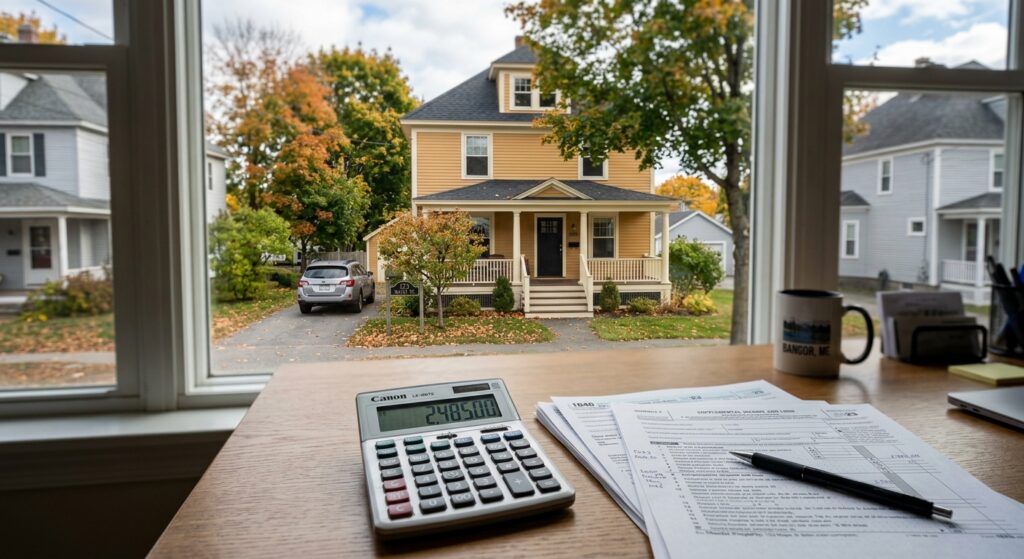
Bangor Rental Property Taxes: Complete 2026 Guide for Maine Landlords
Bangor Rental Property Taxes: Complete 2026 Guide for Maine Landlords
If you own rental property in Bangor, understanding Bangor rental property taxes is essential for maximizing your returns and minimizing your tax burden. For the 2026 tax year, landlords face a complex web of federal income tax obligations, Maine state requirements, and local property tax assessments. This guide breaks down everything you need to know.
Table of Contents
- Key Takeaways
- How Rental Property Is Taxed in Bangor, Maine
- Bangor Property Tax Basics for Rental Owners
- Reporting Bangor Rental Income on Your Tax Return
- Deductible Expenses and Depreciation for Bangor Rentals
- Example: Bangor Landlord Tax Scenario
- Entity Choice and Liability for Bangor Rental Owners
- Uncle Kam in Action
- Next Steps
- Frequently Asked Questions
Key Takeaways
- Bangor rental property income is taxed at federal, state, and local levels in 2026.
- Schedule E is used to report rental income and expenses to the IRS.
- Depreciation over 27.5 years significantly reduces taxable rental income.
- Proper entity structuring (LLC vs S Corp) can save thousands annually.
- Track all expenses: mortgage interest, maintenance, insurance, utilities, and management fees.
How Is Rental Property Taxed in Bangor, Maine?
Quick Answer: Bangor rental property faces three layers of taxation: federal income tax, Maine state income tax, and Bangor city property tax. You report federal income on Schedule E and pay taxes based on net rental income after deductions.
Rental property taxation in Bangor operates on multiple levels. Understanding these layers helps you plan strategically and avoid expensive mistakes. The first layer is federal income tax. You must report all rental income on Schedule E (Form 1040), and you pay tax on net income after eligible deductions. This applies to all property types: single-family homes, multi-unit buildings, and short-term rentals.
The second layer is Maine state income tax. Maine imposes a state income tax on rental income. Fortunately, Maine allows deductions similar to federal rules, so expenses reduce your Maine taxable income the same way they reduce federal taxable income.
The third layer is Bangor property tax. The City of Bangor assesses property taxes based on assessed value. These property taxes are also deductible as an expense against rental income, creating a tax benefit.
Pro Tip: Many Bangor landlords miss deductions they could claim. Track every dollar spent on repairs, maintenance, property management, insurance, and utilities. These directly reduce your taxable rental income.
Property Tax vs Income Tax – Key Differences
Property tax and income tax operate differently. Property tax is paid annually based on the assessed value of your Bangor property. Income tax is paid based on your net rental income (rental revenue minus expenses). It’s critical to understand this distinction.
| Tax Type | Based On | Deductible? |
|---|---|---|
| Bangor Property Tax | Assessed property value | Yes, fully deductible |
| Federal Income Tax | Net rental income | N/A (tax on net income) |
| Maine State Income Tax | Net rental income | N/A (tax on net income) |
Who This Guide Applies To
This guide is for anyone who owns rental property in Bangor, Maine and wants to understand their 2026 tax obligations. Whether you own a single-family rental, a multi-unit apartment building, or operate short-term rentals, these principles apply. Local owners and out-of-state owners face the same tax treatment.
What Are Bangor Property Tax Basics for Rental Owners?
Quick Answer: Bangor property tax is calculated by multiplying assessed value by the mill rate. Rental properties are assessed similarly to owner-occupied homes, though some tax benefits may differ. All property tax paid is deductible against rental income.
Bangor’s property tax system uses assessed value and a mill rate to calculate annual property taxes. The mill rate is expressed per $1,000 of assessed property value. For example, if your property is assessed at $300,000 and the mill rate is $18 per $1,000, your annual property tax is $5,400.
The City of Bangor assesses property value based on current market conditions and comparable sales. Property assessments are reviewed periodically to ensure accuracy. If you believe your property is over-assessed, you can file an appeal with the Maine Property Tax system.
How Bangor Calculates Property Tax
The Bangor property tax calculation is straightforward: Assessed Value × Mill Rate = Annual Property Tax. Understanding this formula helps you estimate your tax liability and plan your budget.
- Assessed value is determined by the City of Bangor assessor’s office based on property characteristics and market comparables.
- Mill rate is set annually by the City of Bangor based on municipal budget needs.
- For 2026, verify the current mill rate with the Bangor Assessor’s Office.
- All property taxes are fully deductible as a rental expense for federal tax purposes.
Property Tax Due Dates and Billing Cycles
Bangor typically bills property taxes on a fiscal year schedule. Most property taxes are due semi-annually (December and June), though exact dates vary. Contact the City of Bangor Tax Collector’s Office for specific 2026 due dates. Payment is essential to avoid penalties and potential tax liens.
Are Rental Properties Taxed Differently Than Owner-Occupied Homes?
Property tax assessment treats rental and owner-occupied properties similarly—both are assessed based on market value. However, some states offer tax exemptions or reductions for owner-occupied properties that don’t apply to rental properties. Maine’s approach focuses on fair market assessment regardless of occupancy type.
Pro Tip: Even though rental properties are assessed the same way, the tax deductibility is a significant advantage. Owner-occupants cannot deduct their property taxes against rental income because they don’t have rental income. Your property taxes reduce your taxable rental profit dollar-for-dollar.
How Do You Report Bangor Rental Income on Your Tax Return?
Quick Answer: All Bangor rental income is reported on Schedule E (Form 1040) filed with your federal tax return. You list gross rental income, then subtract all allowable expenses to calculate net income, which is your taxable rental profit.
Federal Income Tax Treatment (Schedule E Basics)
Schedule E is the IRS form for reporting rental income and expenses. You complete one Schedule E for each property you own. For 2026, the process remains unchanged: report all rental income, subtract eligible expenses, and report net profit or loss.
The beauty of Schedule E is that it allows you to claim numerous deductions that most people don’t realize. Every dollar of legitimate expense reduces your taxable income. For a $300,000 property generating $24,000 annually in rental income, strategic deduction-taking can dramatically reduce your tax liability.
Maine State Income Tax on Rental Income
Maine has a state income tax that applies to rental income. Fortunately, Maine allows the same deductions as federal tax, so your calculation is simplified. Your net rental income after deductions is subject to Maine’s progressive income tax rates. For 2026, Maine’s top rate is applied to high-income earners.
Maine also has a state estate tax, making real estate investment planning important for high-net-worth landlords. Consult a tax professional about estate tax implications if you own significant property.
Local Requirements for Short-Term Rentals
If you operate short-term rentals (Airbnb, VRBO, vacation rentals), Maine may require you to collect and remit occupancy tax (also called lodging tax). This varies by municipality. Check with the City of Bangor to determine requirements for your property. Additionally, short-term rental income is reported on Schedule E just like long-term rental income, but may face different expense treatment.
What Are Deductible Expenses and Depreciation for Bangor Rentals?
 Free Tax Write-Off Finder
Quick Answer: Common deductible expenses include mortgage interest, property tax, maintenance, repairs, insurance, utilities, property management fees, and advertising. Depreciation allows you to deduct the cost of the building (not land) over 27.5 years, creating significant tax savings.
Common Deductible Expenses for Bangor Rentals
The IRS allows deduction of all ordinary and necessary expenses to generate rental income. Here are the most common:
- Mortgage Interest: Only the interest portion of your mortgage payment is deductible (not principal).
- Property Tax: All Bangor property taxes are fully deductible.
- Insurance: Landlord/rental property insurance is deductible.
- Maintenance and Repairs: Paint, roof repairs, plumbing fixes, and routine upkeep are deductible.
- Utilities: If you pay for electricity, water, or heat, these are deductible.
- Property Management Fees: If you hire a manager, their fees are fully deductible.
- Advertising: Costs to advertise your rental (online listings, signs) are deductible.
- Travel: Travel to Bangor to manage your property is deductible.
Depreciation Rules for Residential Rental Property
Depreciation is one of the most powerful tax tools for rental property owners. The IRS allows you to deduct the cost of the building over 27.5 years, even though you’re not spending the money—it’s a non-cash deduction. This creates significant annual tax savings.
Here’s how it works: If your Bangor rental property cost $300,000 and the land accounts for $50,000, the depreciable basis is $250,000. Divided by 27.5 years, you can deduct approximately $9,091 annually. This deduction reduces your taxable rental income without any actual cash expense.
Important: Depreciation applies to the building cost, not the land. Land cannot be depreciated. When you purchase a rental property, have an appraiser allocate the purchase price between building and land for accurate depreciation calculations.
Pro Tip: Consider cost segregation studies for newer or renovated properties. This advanced strategy accelerates depreciation on certain building components, increasing annual deductions. While complex, it can generate substantial tax savings for higher-value properties.
Special Considerations for Multi-Unit vs Single-Family Rentals
The basic rules apply to both single-family and multi-unit properties, but multi-unit rentals (duplexes, apartment buildings) may have some unique considerations. Multi-unit buildings still depreciate over 27.5 years, and all deductions apply identically. The main difference is that complex multi-unit financials may benefit more from professional property management and accounting services, which are themselves deductible expenses.
Example: Bangor Landlord Tax Scenario for 2026
Quick Answer: A typical Bangor landlord with $24,000 annual rental income can reduce taxable income to under $10,000 through deductions and depreciation, dramatically reducing federal and state tax liability.
Sample Long-Term Rental: Income, Expenses, Property Tax
Let’s walk through a realistic example. Sarah owns a single-family home in Bangor that she rents for $2,000 monthly. Here’s her 2026 tax scenario:
Annual Rental Income: $2,000 × 12 months = $24,000
Expenses Sarah can deduct:
- Mortgage interest: $9,000
- Bangor property tax: $4,500
- Landlord insurance: $1,200
- Maintenance and repairs: $1,500
- Depreciation: $9,091
Total Deductions: $25,291
Net Rental Income (Taxable): $24,000 – $25,291 = -$1,291 (loss)
In this scenario, Sarah has a rental loss of $1,291 for 2026. This loss can offset other income (with limitations), potentially saving her $400-$500 in federal taxes depending on her tax bracket. This demonstrates the power of deductions and depreciation.
How Deductions and Depreciation Reduce Taxable Income
The example above shows the real impact. Without deductions, Sarah would owe tax on $24,000 of income. With deductions and depreciation, she has a loss. This isn’t about avoiding taxes illegally—it’s the proper application of tax law designed to encourage property investment and maintenance.
The key to maximizing this benefit is meticulous documentation. Keep receipts for all repairs and improvements. Track expenses in a spreadsheet or property management software. Use accounting software to organize expenses by category. When the IRS examines your return, documentation is your best defense.
What About Entity Choice and Liability for Bangor Rental Owners?
Quick Answer: You can own rental property personally or through an LLC. An LLC provides liability protection but may have slightly higher complexity. An S Corp election offers tax savings for higher-income properties but requires more administration.
Owning Property Personally vs Through an LLC
Many Bangor landlords own property in their individual name, which is the simplest approach. However, owning through an LLC provides liability protection. If a tenant is injured on the property and sues, the liability is contained to the LLC’s assets, protecting your personal assets.
The tax treatment is the same whether you own personally or through an LLC taxed as a sole proprietorship—you still file Schedule E and report net income. The LLC simply provides legal liability protection. For Bangor landlords with significant property value or liability concerns, this protection is often worth the modest additional filing cost.
When to Consider an LLC or S Corp
For most small landlords, an LLC taxed as a sole proprietorship is sufficient. However, if you own multiple properties or your rental income exceeds $100,000 annually, consider an S Corp election for your Bangor properties. An S Corp allows you to take a reasonable salary and distribute remaining profit, potentially saving on self-employment taxes.
Use our LLC vs S-Corp Tax Calculator for Bangor to estimate potential savings with an S Corp election.
Coordination with Bangor and Maine Requirements
Maine and Bangor require certain filings for LLC formation. File your Articles of Organization with the Maine Secretary of State. Maintain an EIN for the LLC, even if it’s taxed as a sole proprietorship. Keep corporate formalities (annual minutes, separate bank accounts) to preserve liability protection. A Bangor real estate tax professional can guide you through these requirements.

Uncle Kam in Action: Bangor Rental Property Success
Client Profile: Michael is a Bangor-area entrepreneur who owns three rental properties with a combined annual rental income of $72,000. He had been managing the properties personally without professional tax planning.
The Challenge: Michael was paying federal and Maine state income tax on approximately $50,000 of net rental income annually. At his tax bracket (22% federal + 8% Maine), he was paying roughly $15,000 per year in taxes. He suspected he was missing deductions but didn’t know how to optimize his structure.
The Uncle Kam Solution: We conducted a comprehensive rental property tax analysis. We identified $18,000 in missed expense deductions across the three properties (mainly maintenance and management costs he hadn’t documented). We also recommended S Corp elections for two of his properties to optimize self-employment tax. We restructured ownership through properly formed LLCs for liability protection.
The Results: In 2026, Michael’s taxable rental income dropped from $50,000 to $32,000 through proper deductions and depreciation. The S Corp elections saved an additional $2,400 in self-employment taxes. His total annual tax liability decreased by $8,200. Michael’s fee for this optimization was $1,200.
Return on Investment: Michael achieved 6.8x return on his $1,200 investment, saving $8,200 in taxes in the first year alone. With proper documentation and continued optimization, these savings will compound annually. Michael also gained liability protection and more defensible tax positions should he be audited.
Visit Uncle Kam Client Results to see similar success stories from Maine real estate investors.
Next Steps
Now that you understand Bangor rental property taxes, take these actions:
- Gather all 2026 rental income documentation (rental agreements, payments received).
- Compile all expense receipts and create a spreadsheet by category.
- Calculate your estimated annual property value for depreciation purposes.
- Consult with a tax preparation professional in Maine about entity optimization for your situation.
- Review Uncle Kam’s real estate investor tax strategies for additional optimization ideas.
Frequently Asked Questions
How much are property taxes on a rental property in Bangor?
Bangor property taxes depend on assessed value and the mill rate, which changes annually. For a $300,000 property, expect $4,500-$6,000 annually depending on the mill rate. Contact the Bangor Assessor’s Office for the current year’s mill rate and your property’s assessed value.
Can I deduct mortgage principal from my rental income?
No. Only the interest portion of your mortgage payment is deductible. Principal is a return of your capital investment and doesn’t reduce taxable income. However, as you pay down principal, you’re building equity in a depreciating asset—both are valuable benefits of real estate investment.
What’s the difference between a repair and a capital improvement?
Repairs (painting, fixing a leaky roof) are immediately deductible. Capital improvements (new roof, new HVAC system) must be depreciated over their useful life. The IRS distinguishes based on whether the expense restores property or improves it beyond original condition. Consult a tax professional for borderline cases.
What is depreciation and how does it help me?
Depreciation is a non-cash tax deduction allowing you to deduct the cost of your building over 27.5 years. For a $250,000 building, that’s roughly $9,091 annually—without spending any money. This deduction reduces your taxable rental income and can even create a loss in favorable years, though recapture rules apply when you sell the property.
Should I hire a property manager in Bangor, even though it costs money?
A property manager’s fee is fully deductible. If a manager costs 10% of rental income but saves you time and reduces vacancy, it’s often financially beneficial. Calculate the numbers: if management costs 10% ($2,400) but increases occupancy or allows you to raise rents, the ROI may be positive. Additionally, the management fee reduces your taxable income, creating tax savings.
This information is current as of May 17, 2026. Tax laws change frequently. Verify updates with the IRS or a Maine-licensed tax professional if reading this later.
Related Resources
- Entity Structuring for Real Estate Investors
- Complete Real Estate Investor Tax Strategies
- Year-Round Tax Planning for Property Owners
- Integrated Bookkeeping and Tax Solutions
- Ongoing Tax Advisory Services for Investors
Last updated: May, 2026

