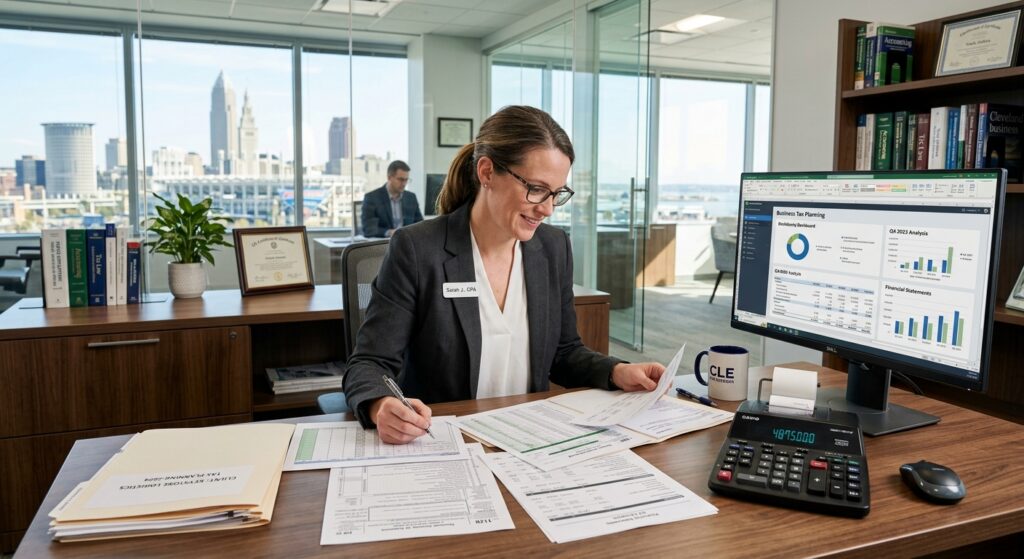
Average Cost of CPA in Cleveland 2026: Complete Pricing Guide for Business Owners
Average Cost of CPA in Cleveland 2026: Complete Pricing Guide for Business Owners
Finding the right CPA in Cleveland to help with your business taxes is one of the most important financial decisions you’ll make. For the 2026 tax year, understanding the average cost of CPA services in Cleveland will help you budget appropriately and avoid overpaying for professional tax guidance. Whether you’re a business owner, real estate investor, or self-employed professional, CPA costs vary significantly based on service type, complexity, and firm expertise.
Table of Contents
- Key Takeaways
- What Is the Average Cost of a CPA in Cleveland?
- What Are the Different CPA Service Pricing Models?
- What Factors Affect CPA Costs in Cleveland?
- What Are Service-Specific CPA Costs in 2026?
- What Is the ROI of Hiring a CPA in Cleveland?
- How Can You Save Money on CPA Services?
- How Do You Find and Evaluate CPAs in Cleveland?
- Uncle Kam in Action
- Next Steps
- Frequently Asked Questions
Key Takeaways
- Average CPA hourly rates in Cleveland range from $150 to $250 per hour in 2026.
- Flat fees and retainers may provide better value than hourly billing for recurring services.
- Tax preparation complexity, business structure, and industry specialization impact CPA costs.
- Strategic CPA hiring can save thousands annually in taxes and reduce audit risk.
What Is the Average Cost of a CPA in Cleveland?
Quick Answer: Most Cleveland CPAs charge between $150 and $250 per hour in 2026. However, individual tax preparation typically costs $800-$2,500, while business tax returns range from $1,500-$5,000 or more depending on complexity.
The average cost of CPA services in Cleveland for 2026 depends heavily on what type of service you need. For simple individual tax returns, expect to pay around $800 to $1,500. A self-employed freelancer with a Schedule C might pay $1,200 to $2,500. Small business owners with more complex tax situations—such as those managing multiple revenue streams or considering S Corp versus LLC entity structures—typically pay $2,000 to $5,000 or more annually.
In Cleveland specifically, the market for CPA services is competitive. The region has a strong business community with significant real estate investment activity and many self-employed professionals, which creates demand for specialized tax services. This competitive landscape helps keep rates reasonable compared to larger metropolitan areas like New York or Los Angeles.
Why CPA Costs Vary So Widely
The variation in CPA costs reflects the complexity of modern tax law. For 2026, the IRS continues to enforce regulations around the One, Big, Beautiful Bill Act (OBBBA), which made significant changes to tax reporting thresholds, charitable deductions, and entity structuring options. A CPA must stay current with these changes, and that expertise comes at a cost.
Additionally, the 2026 tax year brought new reporting requirements. The federal 1099-NEC threshold increased from $600 to $2,000 effective January 1, 2026. For business owners and self-employed professionals, this change affects how much income reporting complexity you might face—which influences CPA costs.
Regional CPA Costs in Ohio
Cleveland sits in the middle of Ohio’s CPA market pricing. Smaller rural areas of Ohio may have CPAs charging $100-$150 per hour, while Columbus (the state capital) and Cincinnati command rates similar to Cleveland. Tax preparation services in Ohio are generally more affordable than East Coast and West Coast markets, but rates have been increasing due to demand for specialized tax expertise.
What Are the Different CPA Service Pricing Models?
Quick Answer: CPAs in Cleveland use three main pricing models: hourly billing ($150-$250/hour), flat fees per service ($800-$5,000+), and annual retainers ($1,500-$10,000+). Each model has advantages depending on your needs and business structure.
Hourly Billing
Hourly billing is the most common CPA pricing model in Cleveland. Most firms charge $150 to $250 per hour for professional services, with junior CPAs on the lower end and partners with significant experience on the higher end. For a straightforward individual tax return, you might spend 4-6 hours, resulting in a $600-$1,500 cost. For business tax returns, hourly billing typically runs 15-30 hours, resulting in $2,250-$7,500.
The advantage of hourly billing is transparency—you pay for time spent. The disadvantage is unpredictability. If your tax situation becomes more complicated midway through the engagement, your costs can increase. This model works best if your tax return is relatively simple and you have excellent documentation.
Flat Fees
Many Cleveland CPAs now offer flat fees for common services. A basic individual tax return with W-2 income and standard deductions might be $800-$1,200 flat. A Schedule C self-employed return with deductions could be $1,500-$2,500 flat. A small business S Corp return might be $2,500-$4,500 flat. Real estate investor returns with rental properties and depreciation calculations are often $2,000-$5,000 flat.
Flat fees provide budget certainty, but they require the CPA to estimate effort accurately. Most reputable Cleveland firms build in a scope of work definition to prevent misunderstandings.
Pro Tip: When quoted a flat fee, ask what’s included. Does it cover one round of revisions? What about amended returns or IRS notices? Clarifying the scope prevents surprise costs later.
Annual Retainers
Business owners often benefit from annual retainers. A retainer establishes an ongoing relationship where you pay a fixed monthly or annual fee for various services. A basic retainer in Cleveland might be $200-$400 monthly ($2,400-$4,800 annually) for a small business. Mid-market businesses might pay $500-$1,500 monthly for more comprehensive advisory services including quarterly planning, bookkeeping oversight, and strategic tax planning.
Retainers encourage proactive tax planning rather than reactive compliance. By paying monthly, you can benefit from strategies like optimizing estimated quarterly tax payments, planning entity structures, and maximizing deductions throughout the year rather than discovering missed opportunities at tax filing time.
Comparing Pricing Models
| Pricing Model | Best For | Average Cost (2026) | Pros | Cons |
|---|---|---|---|---|
| Hourly Billing | Simple returns, one-time projects | $150-$250/hour | Transparent, flexible | Unpredictable total cost |
| Flat Fees | Standard tax returns, known scope | $800-$5,000 per service | Budget certainty, fair pricing | Less flexibility for complexity |
| Annual Retainers | Business owners, ongoing needs | $200-$1,500/month | Proactive planning, predictable | Requires minimum commitment |
What Factors Affect CPA Costs in Cleveland?
Quick Answer: Business complexity, multiple revenue streams, entity type (S Corp vs. LLC), documentation quality, industry specialization, and firm size all influence CPA costs in Cleveland for 2026.
Business Complexity and Multiple Income Streams
A W-2 employee with simple itemized deductions has a straightforward tax return. A business owner with an S Corp, rental properties, pass-through entities, and dividend income has a complex return. Each additional complexity layer—partnership interests, foreign accounts, capital gains, charitable contributions—adds 2-5 hours to tax return preparation. At $150-$250/hour, this translates to $300-$1,250 additional cost per complexity factor.
Entity Structure Decisions
If you’re considering S Corp versus LLC entity structuring, a CPA might need 5-15 hours for analysis and planning. Using our LLC vs S-Corp Tax Calculator for Bethesda can help you model scenarios, and your Cleveland CPA can provide personalized guidance. The decision involves reasonable compensation analysis, self-employment tax savings calculations, and entity election considerations under 2026 tax law.
Documentation Quality
Clients who provide organized records—categorized bank statements, expense receipts, and clear transaction documentation—reduce CPA time by 25-40%. Clients with disorganized records or missing documentation can double or triple preparation time. Better documentation directly translates to lower CPA costs.
Industry Specialization
CPAs who specialize in real estate investment, medical practices, construction, or other niche industries often charge more. However, specialized expertise can result in substantially higher tax savings. A real estate CPA familiar with cost segregation, depreciation optimization, and 1031 exchange strategies might charge 10-20% more than a generalist but save thousands in taxes.
Firm Size and Credential Level
Large firms in Cleveland often charge 20-40% more than solo practitioners or small partnerships. However, large firms may offer better technology, deeper expertise, and institutional knowledge. CPAs who are also tax attorneys or have additional certifications (CFF, ABV, CFP) typically command higher fees.
What Are Service-Specific CPA Costs in 2026?
Quick Answer: Tax preparation ranges from $800-$2,500 for individuals and $1,500-$5,000+ for small businesses. Bookkeeping, audit support, and advisory services each have distinct pricing in the 2026 market.
Individual Tax Preparation (Form 1040)
- Simple return (W-2 only): $400-$800
- Return with deductions: $800-$1,500
- Return with rental income: $1,200-$2,500
- Complex individual return: $2,000-$3,500
Self-Employed and Schedule C Tax Preparation
- Freelancer with basic expenses: $1,200-$2,000
- Self-employed with employees: $2,000-$3,500
- 1099 contractor with complex deductions: $1,500-$2,500
Small Business Tax Preparation
- S Corp or LLC (simple): $2,000-$3,500
- S Corp or LLC (moderate): $3,500-$5,000
- Multi-member LLC or partnership: $4,000-$7,000
- C Corporation: $4,500-$8,000
Bookkeeping Services
Many Cleveland CPAs also offer bookkeeping services. Monthly bookkeeping ranges from $200-$500 for simple businesses to $1,000-$3,000 for complex operations with multiple accounts and payroll. This is often bundled into retainer arrangements.
Audit Representation and IRS Correspondence
If the IRS audits your return, expect to pay $2,500-$10,000+ for representation, depending on complexity. A simple correspondence audit might be $1,500-$3,000. A field audit involving on-site examination could be $5,000-$15,000+. Having a CPA involved significantly improves outcomes and is worth the investment.
What Is the ROI of Hiring a CPA in Cleveland?
 Free Tax Write-Off Finder
Quick Answer: A quality CPA typically saves business owners 2-5 times their fee through tax optimization, deduction identification, entity planning, and audit mitigation. Most clients recoup their investment within months.
The actual return on investment for a Cleveland CPA depends on your business complexity and situation. Here’s how the math typically works:
Scenario 1: Self-Employed Professional ($100,000 annual income)
Without CPA: You might miss $8,000-$15,000 in legitimate business deductions, resulting in additional taxes of $2,000-$3,750 (at 25% effective rate). Self-employment tax on unreduced income costs an additional $2,000-$4,000.
With CPA: A CPA charges $1,500-$2,500 for tax preparation and optimization. By identifying deductions and optimizing entity structure (potentially recommending S Corp election), the CPA saves you $4,000-$8,000 in taxes annually. Your ROI: 160-430%.
Scenario 2: Small Business Owner ($250,000 business income)
Without CPA: You hire a bookkeeper ($200-$300/month) but lack strategic tax planning. You might overpay estimated quarterly taxes by $3,000-$5,000 and miss entity planning opportunities that could save $8,000-$15,000 annually.
With CPA: A $3,500-$5,000 annual retainer provides tax planning, optimized quarterly payments, and entity strategy. Combined savings: $10,000-$20,000 annually. Your ROI: 200-470%.
Did You Know? The AICPA estimates that small business owners save an average of $2,500-$5,000 annually just by optimizing deductions that they would otherwise miss. For business owners with multiple income streams or real estate investments, savings often exceed $10,000 annually.
How Can You Save Money on CPA Services?
Quick Answer: Organize documentation, provide clear records, use cloud-based bookkeeping, engage with CPAs early, and consider bundled retainers to reduce CPA costs in Cleveland by 20-40%.
Organize Your Records Year-Round
The biggest cost driver is disorganized records. If your CPA spends 10 hours categorizing expenses instead of 2 hours, your cost increases $1,200. Use accounting software like QuickBooks, Wave, or Xero throughout the year. Categorize expenses as you incur them. Provide clear documentation for major transactions.
Outsource Bookkeeping to Lower-Cost Providers
Instead of paying CPA rates ($150-$250/hour) for bookkeeping, hire a bookkeeper ($30-$75/hour) or use a virtual bookkeeping service. Many Cleveland CPAs recommend this approach. You pay for higher-value CPA work—tax planning, strategy, audit support—while bookkeeping is handled more efficiently.
Choose Flat Fees or Retainers Over Hourly
Flat fees and retainers incentivize CPAs to work efficiently. Hourly billing can result in higher costs if the CPA is less efficient. Flat fees also provide budget certainty, helping you plan financially.
Engage Early for Tax Planning
Meeting with your CPA in Q3 or Q4 allows for proactive tax planning. Reactive planning (after year-end) limits options. Early engagement often saves enough in taxes to offset planning costs several times over.
How Do You Find and Evaluate CPAs in Cleveland?
Quick Answer: Interview 3-5 Cleveland CPAs, verify credentials, ask about experience with your business type, review fee structures, and check references before committing.
Verify Credentials and Licensing
Ensure the CPA is licensed by the Ohio Accountancy Board. Look for credentials like CPA (Certified Public Accountant), which requires passing rigorous exams and continuing education. Additional certifications like Enrolled Agent (EA), Certified Financial Planner (CFP), or Certified Fraud Examiner (CFE) indicate specialized expertise.
Ask About Industry Experience
If you’re a real estate investor, ask if the CPA has real estate clients. If you own a medical practice, ask about healthcare experience. Industry expertise often translates to better tax strategies and faster service delivery.
Understand Fee Structures Clearly
Don’t accept vague fee quotes. Ask for a written engagement letter specifying exactly what’s included, what additional costs might apply, and how the CPA bills for extra work. This prevents surprise charges.
Check References
Ask the CPA for 2-3 client references. Call them and ask about responsiveness, quality of advice, and value provided. References are invaluable for assessing whether a CPA is right for you.

Uncle Kam in Action: Real Estate Investor Saves $12,000 Through Strategic CPA Planning
Client Profile: Sarah, a Cleveland-based real estate investor with three rental properties generating $180,000 in annual rental income, plus $45,000 in W-2 employment income. She had been preparing her own tax returns using tax software.
The Challenge: Sarah wasn’t confident about depreciation calculations, passive loss deductions, or whether her entity structure was optimal. She suspected she was overpaying taxes but didn’t know by how much. Her tax software flagged some issues she didn’t fully understand.
The Uncle Kam Solution: Sarah hired a Cleveland-based CPA specializing in real estate investment for a $2,500 tax preparation fee. The CPA conducted a comprehensive review including: (1) Cost segregation analysis on the rental properties, identifying $15,000 in accelerated depreciation, (2) Passive loss tracking and carryforward optimization, (3) Entity structure review (she was an individual; the CPA recommended an S Corp election for the W-2 income), (4) Quarterly tax planning to optimize estimated payments, (5) A retainer agreement for ongoing advisory at $400/month.
The Results: In the first year, the CPA saved Sarah: $4,500 through cost segregation deductions, $5,500 through S Corp salary optimization, $2,000 through corrected passive loss deductions, and $1,000 through improved estimated quarterly payments. Total first-year savings: $13,000. The CPA fee: $2,500 + $4,800 retainer = $7,300. Net first-year benefit: $5,700. In year two and beyond, with retainer-only fees of $4,800 annually and continued optimization strategies, Sarah continues saving thousands annually on taxes.
Key Takeaway: Sarah’s story is common. Real estate investors, business owners, and self-employed professionals often underestimate how much they can save through strategic CPA planning. The initial investment pays for itself quickly through tax optimization.
Next Steps
- Identify your specific tax needs: individual return, self-employed, business owner, real estate investor, or combination.
- Get fee quotes from 3-5 Cleveland-area CPAs that specialize in your situation.
- Organize your financial records and create a clear timeline of income and expenses for the 2026 tax year.
- Schedule consultations with your top 2-3 CPA candidates to discuss strategy and fees.
- Request a written engagement letter specifying services, fees, and deliverables before committing.
Frequently Asked Questions
How much does a CPA cost in Cleveland for a simple tax return?
For a simple 2026 return with just W-2 income and standard deductions, expect $400-$800. With some deductions, $800-$1,200. These rates reflect typical Cleveland CPA market pricing for straightforward individual returns.
Are CPA fees tax-deductible?
For self-employed individuals and business owners, CPA fees for business tax preparation are typically deductible as a business expense. For individuals filing personal returns, CPA fees were temporarily non-deductible but may become deductible again depending on 2026 OBBBA provisions. Consult with your CPA about your specific situation.
Should I choose a large CPA firm or a solo practitioner in Cleveland?
Large firms offer more resources and specialization but charge more. Solo practitioners offer personalized service and lower costs. Choose based on your needs. If you need specialized expertise (real estate, medical practice, complex entities), a firm might be worth the premium. For simpler needs, a solo CPA often provides excellent value.
How much should I budget for CPA services if I own a small business?
Budget $3,000-$6,000 annually for a small business with under $500,000 revenue. This typically covers tax preparation, quarterly bookkeeping support, and basic tax planning. If you need more advisory services, add $200-$500 monthly for a retainer arrangement.
Can I switch CPAs after working with one firm for years?
Absolutely. You can switch CPAs at any time. Request your prior tax returns and supporting documentation from your old firm. Your new CPA will handle the transition and can address any questions about prior-year items. Many business owners periodically shop around to ensure they’re getting competitive pricing.
What 2026 tax law changes should affect my CPA selection?
The One, Big, Beautiful Bill Act (OBBBA) made significant changes to entity structuring, charitable deductions, and reporting thresholds. Look for CPAs who are staying current with 2026 changes like the $2,000 1099-NEC threshold, expanded SECURE 2.0 retirement provisions, and new charitable deduction rules. Ask during your consultation what changes they’ve implemented for 2026.
Is it worth paying more for a CPA with a specific industry specialty?
For complex industries (real estate, medical practices, construction), specialized CPAs often provide 10-20% premium value through better tax strategies and industry insights. For simple W-2 situations or straightforward self-employment, specialty expertise is less valuable. Assess whether your situation justifies the premium and request references from clients in your industry.
How do I know if I’m getting a fair price from my current CPA?
Get 2-3 competitive quotes from other Cleveland CPAs. Ask similar questions about your situation and compare prices. If your current CPA is 30%+ higher with no clear justification, it might be time to negotiate or switch. Fair pricing in 2026 typically ranges from $150-$250/hour or flat fees matching our service pricing tables.
Related Resources
- IRS.gov Official Tax Resources
- Ohio Accountancy Board – Verify CPA Credentials
- Uncle Kam Tax Strategy Services
- Uncle Kam Client Results and Case Studies
- Comprehensive Tax Planning Guides
Last updated: May, 2026

