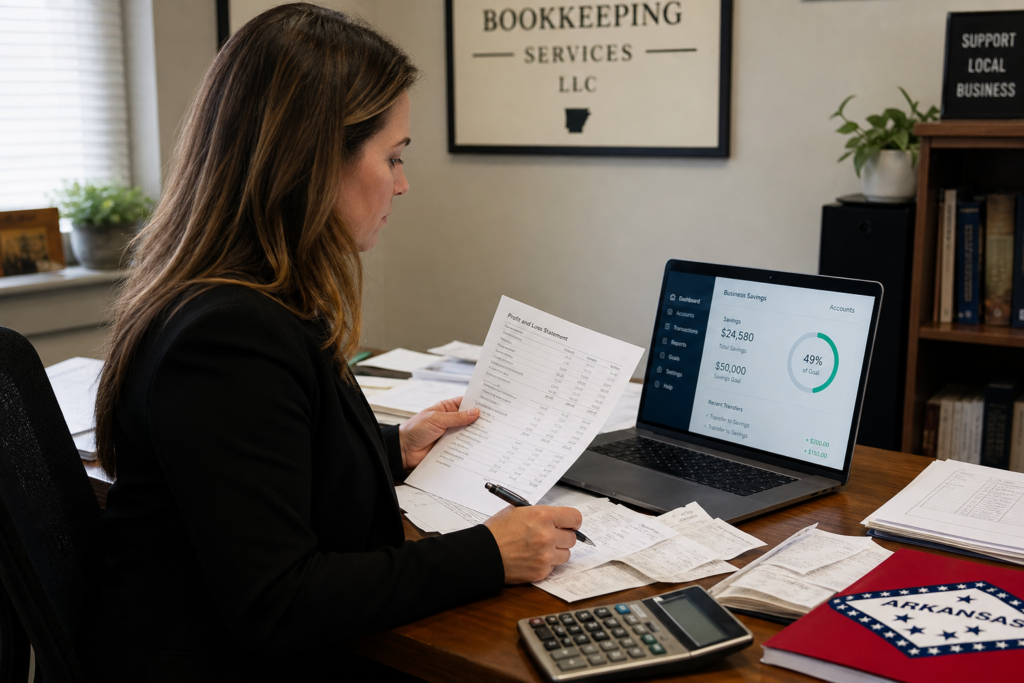
Arkansas Bookkeeping Services in 2026: Cut Waste, Save Taxes, and Run Like a Pro
Smart Arkansas bookkeeping services now do what the state itself is doing: cut waste and prove savings. In July 2026, Gov. Sarah Huckabee Sanders reported $118 million in verified savings through Arkansas Forward. That same discipline can transform your business. Clean books reveal hidden costs, unlock 2026 deductions, and lower your tax bill. Furthermore, they give you a real-time dashboard for smarter decisions. Here is how to make it happen.
Table of Contents
- Key Takeaways
- What Are Arkansas Bookkeeping Services?
- What Can Arkansas Businesses Learn From Arkansas Forward?
- How Do Arkansas Bookkeeping Services Lower Your 2026 Tax Bill?
- How Much Do Bookkeeping Services Cost in Arkansas?
- Who Needs Professional Bookkeeping in Arkansas?
- Uncle Kam in Action
- Next Steps
- Related Resources
- Frequently Asked Questions
Key Takeaways
- Arkansas bookkeeping services expose hidden waste and unlock 2026 tax deductions.
- The state’s Arkansas Forward program verified $118 million in savings by July 2026.
- Clean books support the permanent 20% QBI deduction under the 2026 tax code.
- Arkansas cut its top individual income tax rate to 3.9% for 2026.
- Good records help owners avoid IRS penalties and missed quarterly payments.
What Are Arkansas Bookkeeping Services?
Quick Answer: Arkansas bookkeeping services record, organize, and reconcile your financial transactions. As a result, you get accurate books, clean tax filings, and clear insight into cash flow.
Bookkeeping is the daily engine of your finances. It tracks every dollar in and out of your business. Moreover, it turns messy receipts into clean, reliable reports. Professional Arkansas bookkeeping services handle this work so you can focus on growth. They categorize expenses, reconcile bank accounts, and prepare monthly statements. Consequently, you always know where your money goes.
Many owners confuse bookkeeping with tax preparation. However, the two roles differ. Bookkeeping builds the foundation. Tax prep uses that foundation to file returns. Without clean books, tax filing becomes guesswork. Therefore, strong bookkeeping protects you from errors and audits alike. If you run a growing company, consider pairing bookkeeping with reliable business financial systems for full control.
Core Tasks a Bookkeeper Handles
A skilled bookkeeper covers many recurring duties. In addition, they flag problems before they grow. Common tasks include the following:
- Recording income and expenses accurately every week
- Reconciling bank and credit card statements monthly
- Tracking accounts payable and receivable
- Preparing profit and loss statements
- Organizing records for tax season and lenders
Why Arkansas Owners Need Local Support
Arkansas has its own tax rules and filing deadlines. For example, the state cut its top individual income tax rate to 3.9% for 2026. Local bookkeepers understand these state nuances. Furthermore, they align your records with both state and federal requirements. Working with a Tax Preparation Near Me in Arkansas team keeps your books and returns in sync. This coordination saves time and prevents costly mismatches.
Pro Tip: Reconcile bank accounts weekly, not monthly. Small errors compound fast when you wait too long.
What Can Arkansas Businesses Learn From Arkansas Forward?
Quick Answer: Arkansas Forward proves that tracking spending and cutting waste creates real savings. Businesses can copy this transparent, data-driven approach through disciplined bookkeeping.
In July 2026, the state announced $118 million in verified savings. This came through Arkansas Forward, a program built with consultant McKinsey & Co. According to Axios reporting on the initiative, the plan includes more than 300 initiatives across 15 departments. Officials cut unused phone lines and renegotiated vendor contracts. As a result, they captured savings equal to about $69 per taxpayer.
Your business faces the same pressures. Wasteful subscriptions, forgotten fees, and unfavorable contracts drain cash. However, you cannot fix what you cannot see. Clean books act as your own savings dashboard. Therefore, professional bookkeeping turns raw data into clear action items.
Three Waste-Cutting Lessons for Owners
The state’s playbook maps neatly onto small business finance. In addition, each lesson delivers measurable results. Apply these steps quickly:
- Audit every recurring charge for unused software and services
- Renegotiate vendor and supplier contracts each year
- Track spending by category to spot creeping costs
Direct Savings vs. Cost Avoidance
The state distinguished direct savings from cost avoidance. One example added $5.2 million in services at no extra cost. Your business benefits from the same mindset. Direct savings cut current spending immediately. Cost avoidance stops future increases before they hit. Consequently, both moves protect your margins. A dedicated tax advisory partner helps you spot both types across your books.
Did You Know? Arkansas Forward targets at least $300 million in savings by 2030. Businesses that track spending closely often trim 10% of overhead quickly.
How Do Arkansas Bookkeeping Services Lower Your 2026 Tax Bill?
Quick Answer: Clean books capture every deduction, support the 20% QBI deduction, and prove your numbers to the IRS. Therefore, you pay only what you truly owe.
Taxes reward good records. The permanent 20% qualified business income deduction survived under the current tax law. However, you must document income and expenses precisely to claim it. Missing receipts mean missing deductions. As a result, sloppy books quietly raise your tax bill every single year.
The IRS also expects clear support for business write-offs. According to official IRS recordkeeping guidance, you must keep records that back up your reported figures. Furthermore, self-employed owners face a 15.3% self-employment tax in 2026. That rate combines 12.4% for Social Security and 2.9% for Medicare. Accurate books help you plan for it.
Deductions Owners Often Miss
Poor tracking hides valuable deductions. In addition, rushed filings leave money on the table. Bookkeepers help you capture the following:
- Home office and mileage expenses
- Software, tools, and equipment purchases
- Retirement contributions and health accounts
- Professional fees and continuing education
A Simple 2026 Savings Example
Consider a Little Rock consultant earning $120,000 in net profit. With the 20% QBI deduction, she shields up to $24,000 from federal tax. Clean books make that deduction defensible. Moreover, they help her plan quarterly estimated payments to avoid penalties. Entity choice matters too. Wilmington-style entity comparisons apply anywhere, so run your numbers with our LLC vs S-Corp Tax Calculator for Winter Park to estimate 2026 savings.
Pro Tip: Track deductible expenses in real time. Reconstructing them at year-end almost always costs you money.
The table below compares key 2026 figures that affect Arkansas business owners.
| 2026 Tax Item | Rate or Amount | Why Books Matter |
|---|---|---|
| Self-employment tax | 15.3% | Plan quarterly payments accurately |
| Social Security wage base | $184,500 | Track wages against the cap |
| QBI deduction | 20% (permanent) | Document income to qualify |
| Arkansas top individual rate | 3.9% | Match state and federal records |
How Much Do Bookkeeping Services Cost in Arkansas?
 Free Tax Write-Off Finder
Quick Answer: Arkansas bookkeeping services vary by transaction volume and complexity. However, the tax savings and time recovered usually outweigh the monthly fee.
Cost depends on your business size and activity. A solo contractor pays less than a growing retailer. Furthermore, monthly volume drives pricing more than revenue alone. Many providers offer tiered plans that scale with you. Therefore, you pay for what you actually need each month.
Think about cost the way Arkansas Forward thinks about spending. The goal is return, not just price. Every dollar spent on clean books should return more in savings. As a result, bookkeeping becomes an investment, not an expense. Pairing books with proactive tax strategy planning multiplies that return.
Factors That Drive Your Price
Several factors shape your monthly quote. In addition, they help you compare providers fairly. Watch for these variables:
- Number of monthly transactions and accounts
- Payroll processing and contractor payments
- Sales tax filing across multiple locations
- Cleanup work for prior-year records
Measuring Return on Investment
Judge bookkeeping by results, not just cost. For instance, one caught deduction can cover months of fees. Fewer penalties and cleaner filings add further value. Moreover, better data helps you price jobs and cut waste. Consequently, most owners view good books as a profit center. You can review real outcomes on the Uncle Kam client results page.
Did You Know? The IRS can assess penalties for underpaid estimated taxes. Accurate books help you avoid these avoidable costs entirely.
Who Needs Professional Bookkeeping in Arkansas?
Quick Answer: Business owners, real estate investors, self-employed contractors, and high-net-worth individuals all benefit from professional Arkansas bookkeeping services in 2026.
Nearly every business gains from clean books. However, some owners need help sooner than others. Growth, complexity, and multiple accounts raise the stakes fast. Furthermore, investors and high earners face extra reporting demands. Professional support keeps everyone compliant and confident.
Business Owners and Self-Employed Pros
Small Arkansas business owners juggle many roles at once. As a result, bookkeeping often slips to the bottom of the list. Self-employed contractors face similar strain. They must track income, expenses, and quarterly taxes carefully. Our self-employed tax support resources help freelancers stay organized. Consequently, they claim every deduction and avoid surprise bills.
Real Estate Investors and High Earners
Property owners track rents, repairs, and depreciation across units. Therefore, accurate books protect their deductions and financing. High-net-worth individuals manage multiple entities and income streams. In addition, they need airtight records for advanced strategies. Both groups benefit from a coordinated tax filing and reporting process. This alignment reduces risk and stress at tax time.
Pro Tip: Separate business and personal accounts immediately. Mixed accounts create audit risk and messy, unreliable books.
The table below shows how different Arkansas clients use bookkeeping in 2026.
| Client Type | Top Bookkeeping Need | Main Benefit |
|---|---|---|
| Business owner | Expense tracking and payroll | Higher deductions |
| Self-employed | Quarterly tax planning | Fewer penalties |
| Real estate investor | Property-level records | Protected depreciation |
| High-net-worth | Multi-entity reporting | Cleaner compliance |

Uncle Kam in Action: A Fayetteville Contractor Cuts Waste and Taxes
Client Snapshot: Marcus runs a growing HVAC service company in Fayetteville, Arkansas. He works long hours and manages a small crew.
Financial Profile: His business generated $340,000 in revenue during the prior year. However, his books were disorganized and months behind.
The Challenge: Marcus missed deductions and overpaid taxes. In addition, he could not tell which service lines earned money. Unused software and duplicate vendor charges quietly drained his cash. He also faced a looming estimated tax penalty.
The Uncle Kam Solution: Our team rebuilt his books from the ground up. First, we reconciled every account and separated personal spending. Next, we applied the same waste-cutting logic behind Arkansas Forward. We audited recurring charges and flagged three unused subscriptions. Then we documented mileage, equipment, and home office expenses. Finally, we structured his 2026 quarterly payments around the 15.3% self-employment tax. We also confirmed his eligibility for the permanent 20% QBI deduction.
The Results: Marcus captured deductions he had missed for two years. Moreover, he stopped paying for services he never used.
- Tax Savings: $18,400 in combined federal and state savings
- Investment: $6,000 in annual bookkeeping and advisory fees
- First-Year ROI: Roughly 3x his investment
Marcus now reviews clean monthly reports like a personal savings dashboard. As a result, he prices jobs with confidence and sleeps better. You can explore similar outcomes on our documented client results. Clean books changed how he runs his entire company.
Next Steps
You can start cutting waste and saving taxes today. First, gather your recent statements and current bookkeeping files. Then, review your recurring charges for hidden waste. A local Arkansas tax and bookkeeping team can guide the cleanup. Take these actions now:
- Separate business and personal bank accounts immediately.
- Audit every subscription and vendor contract this month.
- Set aside funds for 2026 quarterly estimated taxes.
- Schedule a bookkeeping and entity structuring review.
This information is current as of 7/6/2026. Tax laws change frequently. Verify updates with the IRS or the Arkansas Department of Finance and Administration if reading this later.
Related Resources
- Business Bookkeeping and Financial Solutions
- Proactive Tax Strategy Services
- Tax Help for Real Estate Investors
- Free Tax Calculators and Tools
- Strategies for High-Net-Worth Clients
Frequently Asked Questions
Do Arkansas bookkeeping services also file my taxes?
Bookkeeping and tax filing are separate services. However, many firms offer both together. Clean books make filing faster and more accurate. Therefore, combining both services often saves you money.
How does the Arkansas Forward savings model apply to my business?
The state cut waste by tracking spending and renegotiating contracts. You can copy this exact approach. Clean books reveal your own wasteful charges. As a result, you capture savings just like the state did.
What is the self-employment tax rate for 2026?
The 2026 self-employment tax rate is 15.3%. This includes 12.4% for Social Security and 2.9% for Medicare. The Social Security portion applies up to $184,500 in 2026. Accurate books help you plan for it.
Can bookkeeping help me claim the 20% QBI deduction?
Yes, clean records support the permanent 20% QBI deduction. The IRS expects documented income and expenses. Therefore, organized books protect this valuable deduction. Poor records put it at risk.
How quickly can a bookkeeper clean up messy records?
Timelines depend on how far behind you are. Simple cleanups take a few weeks. However, multi-year backlogs take longer. Starting early always reduces stress and cost before tax deadlines.
Last updated: July, 2026

