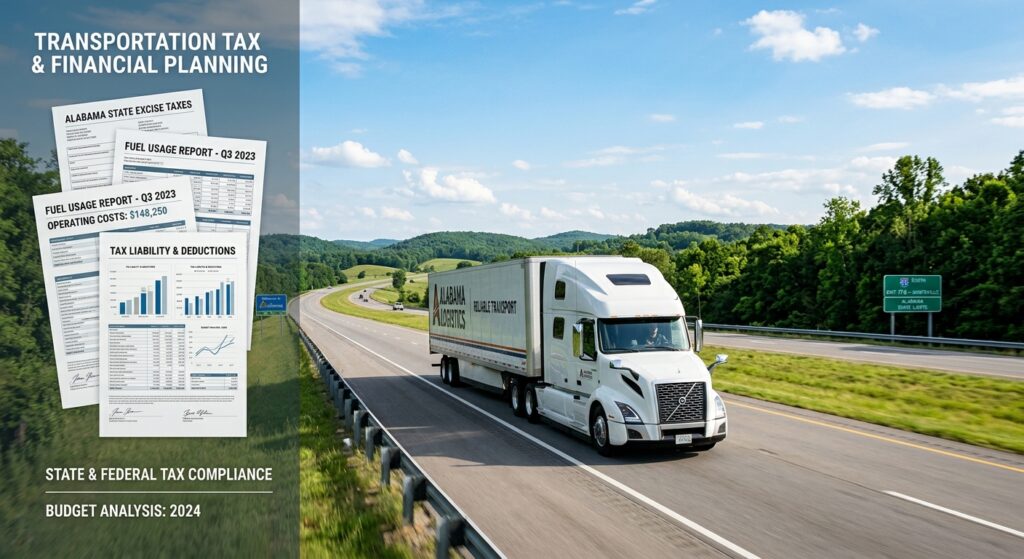
Alabama Trucking Industry Taxes 2026: Complete Tax Strategy Guide for Truck Owners
Running a truck in Alabama is expensive enough without overpaying taxes. Between fuel, maintenance, insurance, and long days on the road, most owners don’t have time to decode the tax code. This guide breaks down how Alabama trucking industry taxes work in 2026 and how owner-operators and small fleets can legally keep more of what they earn.
Key Takeaways for Alabama Truck Owners
- Most Alabama truckers are treated as self-employed and pay 15.3% self-employment tax on net profit, on top of federal and Alabama income tax.
- Biggest tax savers: fuel, repairs, insurance, depreciation, per‑diem/meals, and home office when eligible.
- If you expect to owe $1,000+ in federal tax, you must make quarterly estimated payments to avoid penalties.
- Earning roughly $60,000+ net? An S‑Corp election can often cut self-employment tax by thousands per year if structured correctly.
- Alabama trucking businesses must stay compliant with state registration, IFTA/IRP where applicable, and HVUT for heavy vehicles.
How Does Self-Employment Tax Work for Alabama Truckers in 2026?
If you’re an owner-operator or run your own small trucking business, the IRS generally treats you as self-employed. That means you pay both the “employee” and “employer” side of Social Security and Medicare through self-employment (SE) tax.
| Component | 2026 Rate | Notes |
|---|---|---|
| Social Security | 12.4% | Applies to net SE earnings up to the annual wage base. |
| Medicare | 2.9% | Applies to all net SE earnings (no cap). |
| Total SE Tax | 15.3% | On net profit from your trucking business. |
You calculate SE tax on Schedule SE using the net profit from Schedule C (or from a partnership K‑1). Half of the SE tax becomes an above-the-line deduction on Form 1040, which slightly reduces your federal income tax.
Quick Example
Assume your Alabama trucking business shows $70,000 net profit for 2026:
- SE tax: $70,000 × 15.3% ≈ $10,710
- Deductible half of SE tax: ≈ $5,355 reduces taxable income on Form 1040
That’s on top of federal income tax and Alabama income tax, which is why maximizing deductions is critical for truck owners.
Which Deductions Matter Most for Alabama Truck Owners?
You’re taxed on net profit, not gross revenue. Every legitimate business expense you document reduces both income tax and self-employment tax.
Common Trucking Deductions
- Fuel and DEF – Usually the largest single expense. Save every receipt or use card statements plus logs.
- Repairs & maintenance – Oil changes, tires, brakes, engine work, washes, roadside assistance.
- Insurance – Truck, trailer, cargo, liability, and business policies are deductible.
- Licenses & permits – CDL fees, tags, permits, and other regulatory costs.
- Depreciation or Section 179 – The cost of your tractor and trailer can be written off over time, or faster using bonus/179 if you qualify.
- Meals on the road – Typically 50% deductible, or per‑diem if you qualify as a long‑haul driver.
- Parking, tolls, scales – All directly related to your routes.
- Phone, internet, ELD, GPS – Deduct the business-use share of communication and tracking tools.
- Home office – If you dispatch, invoice, and manage the business from a dedicated space at home, a portion of your rent, utilities, and internet may be deductible.
Missing just a few of these categories can easily cost an Alabama owner-operator $3,000–$7,000 in extra tax each year.
Do Alabama Truckers Have to Pay Quarterly Estimated Taxes?
Yes, if after subtracting withholding (if any) and credits you expect to owe at least $1,000 in federal income and self-employment tax for the year, the IRS expects you to make quarterly estimated payments.
- Use Form 1040‑ES worksheets to estimate your yearly income and tax.
- Payments are generally due in April, June, September, and the following January.
- Pay online via IRS Direct Pay or EFTPS so you have a digital record.
If you underpay during the year, the IRS can charge underpayment penalties even if you pay everything by April filing time. Many Alabama truckers avoid this by setting aside a fixed percentage of each settlement into a separate tax savings account.
Should an Alabama Truck Owner Use an S‑Corp, LLC, or Stay a Sole Proprietor?
 Free Tax Write-Off Finder
The best structure depends on your income level and growth plans:
- Sole proprietor – Easiest and cheapest to run. You file Schedule C with your personal return. All net profit is subject to 15.3% SE tax.
- LLC taxed as sole proprietor – Adds legal liability protection at the state level but is taxed the same as a sole proprietor by default.
- LLC electing S‑Corp – Potentially major SE tax savings once net profit is high enough, but requires payroll and separate corporate tax filings.
With an S‑Corp, you pay yourself a reasonable salary (subject to payroll taxes) and take any extra profit as a distribution that is not subject to SE tax. For many profitable Alabama truckers, this structure can save several thousand dollars a year, but only when managed correctly and when income is high enough to justify additional costs.
If you’re consistently netting $60,000+ per year from trucking, it’s usually worth having a professional run the numbers and compare “stay as-is” versus “LLC + S‑Corp election.”
Alabama-Specific Issues for Trucking Taxes
On top of federal rules, Alabama adds its own layer of requirements:
- Alabama income tax – Your business profit flows to your personal Alabama return unless you are taxed as a C‑Corp.
- Business registration – Trucking businesses generally must register with the Alabama Department of Revenue and, where applicable, with the Alabama Secretary of State.
- IFTA & IRP – If you operate interstate and meet weight thresholds, you may need to register for fuel tax (IFTA) and apportioned registration (IRP).
- Federal Heavy Vehicle Use Tax (HVUT) – For vehicles 55,000 pounds or more GVW, Form 2290 and annual HVUT payment are required.
Because requirements can vary by county and by how your business is structured, many Alabama truck owners work with a professional who knows both Alabama tax preparation rules and the federal trucking rules.
Practical Steps to Cut Your 2026 Trucking Tax Bill
- Track every expense – Use an app, spreadsheet, or bookkeeping software. Categorize fuel, repairs, insurance, permits, and tolls as you go.
- Save receipts and statements – For at least three years after filing. Digital copies are fine if they’re clear and backed up.
- Plan quarterly – Review year‑to‑date profit each quarter, adjust estimated payments, and avoid surprises.
- Evaluate your entity – Once you’re consistently profitable, compare tax results as a sole proprietor vs. LLC vs. S‑Corp with a professional advisor.
- Use trucking‑savvy help – A preparer who understands per‑diem, IFTA, depreciation, and multi‑state rules is far more valuable than a generic tax shop.
If you’re based in Alabama and want a tailored review of your situation, you can connect with a specialist through Uncle Kam’s tax strategy services or their Alabama tax preparation team.

Frequently Asked Questions
1. Can I deduct my truck payment?
You can’t deduct the principal portion of the loan payment, but you can deduct the interest. The cost of the truck itself is recovered through depreciation (or Section 179/bonus depreciation, if you qualify). In practice, the combination of interest and depreciation often gets you close to the economic cost of owning the truck.
2. Are my trailer and tractor depreciated separately?
Yes. Each major asset (tractor, trailer, auxiliary equipment) normally gets its own depreciation schedule. That gives more accurate books and can help when you sell or trade equipment later.
3. How much of my phone and internet bill can I write off?
You can deduct the business‑use percentage. If your phone is used about 70% for dispatch, brokers, and customers and 30% personal, you can generally deduct 70% of that bill. Keep a reasonable estimate or brief log in case of questions.
4. What records should I keep to protect my deductions?
At minimum, keep fuel receipts, repair invoices, insurance statements, settlement statements, mileage logs (if applicable), and proof of major purchases. Scan or photograph receipts regularly and store them in the cloud so one lost glove box doesn’t cost you thousands of dollars in denied deductions later.
Tax rules can change after publication. Always verify current IRS and Alabama guidance or work with a qualified tax professional before making decisions.

