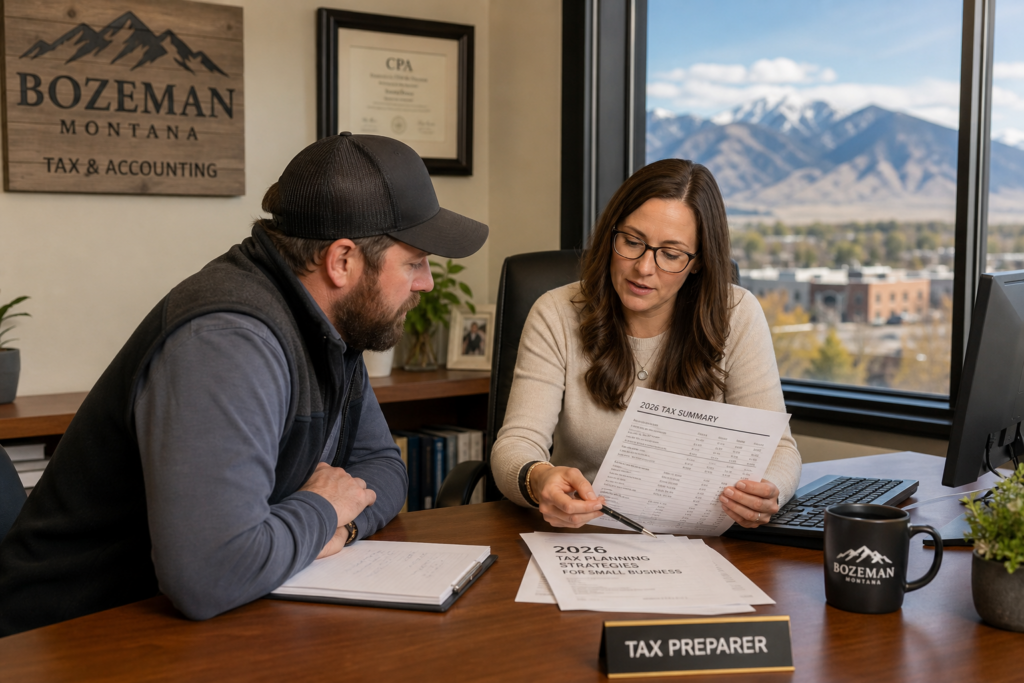
2026 Bozeman Montana Tax Preparation: Complete Guide for Individuals and Small Businesses
Navigating Bozeman Montana tax preparation for 2026 feels different this year. New federal rules from the One Big Beautiful Bill Act (OBBBA) reshaped many deductions and thresholds. Therefore, Bozeman residents, freelancers, and small business owners need clear guidance. This guide breaks down the 2026 changes, explains Montana state rules, and shows practical filing steps. As a result, you can prepare confidently and avoid costly surprises.
Table of Contents
- Key Takeaways
- What’s New for 2026 Taxes in Montana?
- How Do 2026 Tax Changes Affect Bozeman Taxpayers?
- How Do You Get Ready for 2026 Tax Filing in Bozeman?
- What Should You Look For in a Bozeman Tax Preparer?
- How Much Can Professional Tax Preparation Save You?
- Uncle Kam in Action
- Related Resources
- Next Steps
- Frequently Asked Questions
Key Takeaways
- The 2026 standard deduction rose to $32,200 for joint filers and $16,100 for singles.
- OBBBA raised the 1099-NEC and 1099-MISC threshold from $600 to $2,000.
- Montana taxes 2026 income using two brackets, topping out at 5.9%.
- Non-itemizers can now claim a charitable deduction up to $2,000 (joint).
- Proactive planning helps Bozeman taxpayers keep more of their income.
What’s New for 2026 Taxes in Montana?
Quick Answer: For 2026, OBBBA reshaped federal deductions and reporting rules. Meanwhile, Montana kept its two-bracket system topping at 5.9%.
The 2026 tax year brings major federal changes. The One Big Beautiful Bill Act took effect for many provisions on January 1, 2026. As a result, effective Bozeman Montana tax preparation now requires understanding both federal and state updates. Furthermore, these changes affect nearly every taxpayer in Gallatin County. Smart planning through a strong proactive tax strategy approach helps you avoid surprises.
First, the federal standard deduction increased for 2026. Joint filers now claim $32,200, while single filers claim $16,100. Consequently, fewer taxpayers will itemize. In addition, OBBBA introduced a below-the-line charitable deduction for non-itemizers. Single filers can deduct up to $1,000, and joint filers up to $2,000.
Key Federal Changes for 2026
Several OBBBA provisions matter for Bozeman filers. The IRS newsroom guidance confirms these updates. Moreover, many small businesses will feel the impact of the higher 1099 reporting thresholds. Here are the major changes to know:
- The 1099-NEC and 1099-MISC threshold rose from $600 to $2,000.
- The 1099-K threshold returned to $20,000 and 200 transactions.
- The dependent care assistance limit jumped to $7,500 from $5,000.
- The Child and Dependent Care Credit maximum rose to 50%.
- Section 179 expensing increased to a $2.5 million limit.
Montana State Tax Rules for 2026
Montana taxes individual income using two brackets for 2026. The lower rate sits at 4.7%, and the top rate reaches 5.9%. Additionally, Governor Gianforte has proposed a single flat rate beginning in 2027. However, that change is not yet law. Therefore, Bozeman residents should plan around the current two-bracket structure. You can confirm details with the Montana Department of Revenue.
Pro Tip: Montana has no general sales tax. Therefore, income and property taxes carry more weight for local planning.
Comparing 2025 and 2026 Key Figures
The table below shows how key numbers changed year over year. Notably, most figures increased for 2026.
| Item | 2025 (Prior Year) | 2026 |
|---|---|---|
| Standard Deduction (MFJ) | $30,000 | $32,200 |
| Standard Deduction (Single) | $15,000 | $16,100 |
| 1099-NEC Threshold | $600 | $2,000 |
| Dependent Care Assistance | $5,000 | $7,500 |
How Do 2026 Tax Changes Affect Bozeman Taxpayers?
Quick Answer: The 2026 changes affect families, freelancers, and business owners differently. Therefore, each group needs a tailored plan.
Bozeman’s economy blends tourism, construction, technology, and small business. As a result, tax situations vary widely across town. Consequently, the 2026 changes hit each taxpayer group differently. Below, we break down the impact by common local persona. Business owners especially benefit from working with an experienced team that serves entrepreneurs.
W-2 Employees and Families
Most Bozeman families take the standard deduction. Therefore, the higher 2026 amounts reduce taxable income automatically. Moreover, working parents gain from the expanded dependent care rules. The dependent care assistance limit now reaches $7,500. In addition, the Child and Dependent Care Credit maximum rose to 50%. Consequently, families with childcare costs may see meaningful savings this year.
Freelancers, Contractors, and Small Business Owners
The 1099 threshold shift matters most for this group. Now clients issue 1099-NEC forms only above $2,000. However, you still must report all income, even below that amount. Furthermore, self-employed Bozeman residents still owe the 15.3% self-employment tax. The Social Security wage base for 2026 is $184,500. Many freelancers benefit from reviewing their self-employed tax obligations early.
Bozeman small business owners can estimate their liability before filing. Use our Small Business Tax Calculator for Bozeman to project 2026 taxes. In addition, entity structure affects your total tax bill. Therefore, reviewing your business entity structure options often pays off.
Did You Know? The Section 179 expensing limit rose to $2.5 million for 2026. Therefore, equipment-heavy businesses can deduct more upfront.
Real Estate Investors and Retirees
Bozeman’s housing market attracts many investors. Therefore, rental owners should track depreciation carefully. In addition, the residential construction accounting rules changed under OBBBA. The percentage-of-completion method is no longer required for residential contracts. Meanwhile, retirees should note that Montana taxes most retirement income. However, federal changes still shape their overall bracket. Local investors often coordinate with a Tax Preparation Near Me in Montana specialist for guidance.
How Do You Get Ready for 2026 Tax Filing in Bozeman?
Quick Answer: Gather documents, track deductions, and confirm 2026 rules early. As a result, filing becomes faster and less stressful.
Good preparation reduces both stress and errors. Therefore, start organizing your records now. Furthermore, early planning lets you catch missed deductions. A solid tax prep and filing process keeps you compliant. Below is a simple step-by-step approach for 2026.
Step-by-Step Preparation Process
- Gather all income documents, including W-2s and 1099 forms.
- Collect receipts for business expenses and charitable gifts.
- Confirm your entity type and Montana filing requirements.
- Review 2026 deduction limits and credit eligibility.
- Schedule a consultation with a qualified preparer.
Documents Bozeman Residents Should Bring
Bring the right paperwork to your appointment. Consequently, your preparer works faster and more accurately. The IRS Get Ready page offers a helpful federal checklist. In addition, keep these items organized:
- Prior-year federal and Montana state returns.
- Social Security numbers for all dependents.
- Mileage logs for business driving during 2026.
- Records of estimated quarterly tax payments.
- Documentation for childcare and education costs.
Pro Tip: The 2026 business mileage rate is 76 cents per mile after July 1. Therefore, track dates carefully for accurate deductions.
Key 2026 Deadlines
Deadlines drive your planning calendar. Therefore, mark them early. The Q3 2026 estimated payment is due September 15, 2026. Meanwhile, taxpayers filing on extension face an October 15, 2026 deadline. However, any payment was still due back in April. Consequently, filing an extension does not delay payment obligations.
What Should You Look For in a Bozeman Tax Preparer?
 Free Tax Write-Off Finder
Quick Answer: Choose a credentialed preparer who knows Montana rules and offers year-round planning, not just filing.
Not all preparers offer the same value. Therefore, quality Bozeman Montana tax preparation starts with the right professional. Furthermore, credentials and local knowledge matter greatly. A skilled advisor helps you plan proactively, not just file reactively. In addition, ongoing personalized tax advisory support often saves more than the fee.
Credentials That Matter
Verify your preparer’s qualifications before hiring. Consequently, you avoid errors and audit risk. The IRS guide to choosing a tax professional explains key credentials. Look for these signs of expertise:
- An active Preparer Tax Identification Number (PTIN).
- Enrolled Agent, CPA, or tax attorney credentials.
- Experience with Montana state returns.
- Knowledge of current OBBBA and 2026 rules.
Planning Versus Filing
Filing simply records what already happened. However, planning shapes future outcomes. Therefore, choose a preparer who does both. Moreover, proactive planning uses strategies like entity elections and retirement contributions. As a result, your total tax bill often drops significantly. This proactive approach reflects the MERNA method framework used by top firms.
How Much Can Professional Tax Preparation Save You?
Quick Answer: Savings vary by situation. However, strategic planning often returns several times the preparation fee.
Many Bozeman taxpayers overpay each year. Therefore, professional help frequently pays for itself. Furthermore, savings come from deductions, credits, and smart entity choices. Below, we walk through a simple example. As a result, you can see the real math behind proactive planning.
Sample Savings Calculation
Consider a Bozeman freelancer earning $110,000 in net profit. As a sole proprietor, she owes the full 15.3% self-employment tax. However, an S corporation election could reduce that burden. The comparison table below shows the potential difference.
| Factor | Sole Proprietor | S Corp Election |
|---|---|---|
| Net Profit | $110,000 | $110,000 |
| Reasonable Salary | N/A | $60,000 |
| Distributions | N/A | $50,000 |
| Est. SE / Payroll Tax | ~$15,543 | ~$9,180 |
In this example, the S corp election could save roughly $6,300 in payroll taxes. However, results depend on reasonable compensation and added costs. Therefore, always verify your numbers with a professional. You can review the official rules on the IRS S corporations page.
Pro Tip: The IRS requires a reasonable salary for S corp owners. Therefore, never set your salary artificially low.
Beyond the Numbers
Savings extend beyond simple tax math. Furthermore, good preparation reduces audit risk. In addition, it improves cash flow through better quarterly planning. As a result, business owners sleep easier during tax season. For serious wealth-building, our strategies for high-net-worth clients go even deeper. Reliable local Bozeman tax preparation help connects planning to filing seamlessly.

Uncle Kam in Action: How a Bozeman Contractor Cut His Tax Bill
Client Snapshot: Jake runs a growing construction business in Bozeman. He builds custom homes across Gallatin County. Moreover, his revenue climbed fast over three years.
Financial Profile: Jake’s business generated $340,000 in revenue for 2026. After expenses, his net profit reached about $165,000. However, he still filed as a sole proprietor.
The Challenge: Jake faced a large self-employment tax burden. Furthermore, he had not planned for equipment purchases. As a result, his quarterly payments felt overwhelming. In addition, he worried about the new 2026 OBBBA rules.
The Uncle Kam Solution: Our team built a full 2026 plan for Jake. First, we elected S corporation status for his business. Then, we set a reasonable salary of $85,000. Next, we used Section 179 to expense $95,000 in new equipment. Moreover, we established a retirement plan to defer additional income. Consequently, Jake captured every available 2026 deduction.
The Results: Jake saved a combined $22,400 in federal taxes for 2026. The S corp election alone cut his payroll tax significantly. Meanwhile, Section 179 expensing reduced his taxable income further.
- Tax Savings: $22,400 in the first year.
- Investment: $4,800 in Uncle Kam fees.
- ROI: Roughly 4.7x return in year one.
Jake now files with confidence every quarter. Therefore, his cash flow improved dramatically. See more outcomes on our client results and case studies page. Results vary by situation, so always confirm your own numbers.
Related Resources
- Explore our tax strategy blog
- Browse our free tax calculators
- Tax help for real estate investors
- Review the 2026 tax calendar
Next Steps
Take action now to prepare for 2026 filing. Therefore, follow these concrete steps:
- Organize your 2026 income and expense records today.
- Review your entity structure with a qualified advisor.
- Schedule a consultation for business bookkeeping and payroll support.
- Confirm your estimated quarterly payment deadlines.
This information is current as of 7/20/2026. Tax laws change frequently. Verify updates with the IRS or Montana Department of Revenue if reading this later.
Frequently Asked Questions
How do Montana state taxes work for Bozeman residents in 2026?
Montana uses two income tax brackets for 2026. The lower rate is 4.7%, and the top rate is 5.9%. Additionally, Montana has no general sales tax. Therefore, income and property taxes carry more local weight.
How do 2026 1099 changes affect Bozeman freelancers?
The 1099-NEC threshold rose to $2,000 for 2026. However, you must still report all income earned. Consequently, keep detailed records even for small jobs. Otherwise, you risk underreporting your true income.
What is the 2026 standard deduction amount?
For 2026, joint filers claim $32,200. Single filers claim $16,100. These amounts increased from 2025’s $30,000 and $15,000. Therefore, fewer taxpayers will itemize this year.
When should I hire a Bozeman tax preparer?
Hire a preparer before year-end for the best results. Therefore, you gain time for proactive planning. Moreover, early hiring lets you adjust estimated payments. As a result, you avoid surprises at filing time.
Can I deduct charitable gifts without itemizing in 2026?
Yes, OBBBA created a new below-the-line deduction. Single filers can deduct up to $1,000. Joint filers can deduct up to $2,000. Therefore, non-itemizers now gain a charitable tax break.
Is professional tax preparation worth the cost?
Often, yes, especially for business owners and freelancers. Furthermore, strategic planning frequently returns several times the fee. However, savings depend on your specific situation. Therefore, request a personalized estimate before deciding.
Last updated: July, 2026

