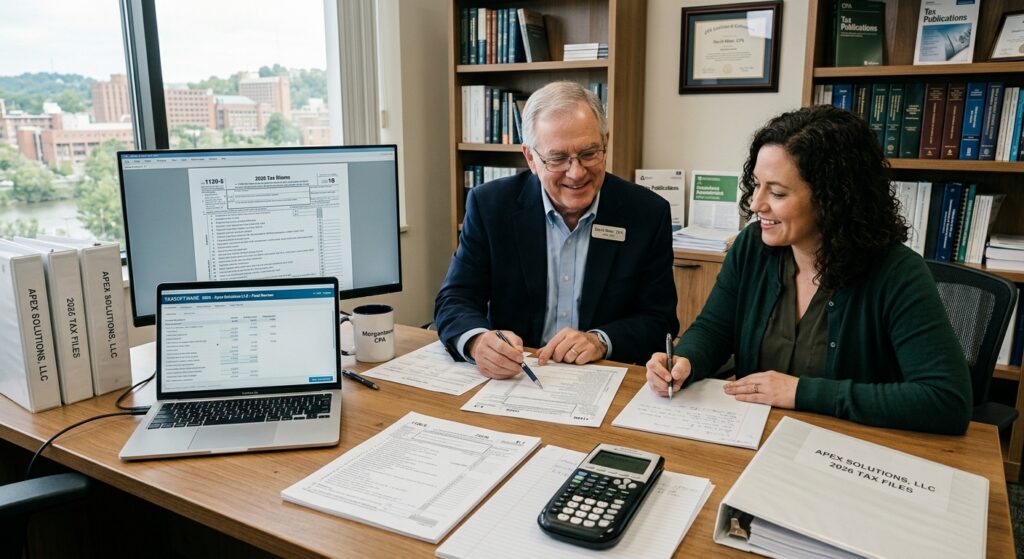
Why You Need a Morgantown CPA for Your 2026 Small Business Tax Strategy


Why You Need a Morgantown CPA for Your 2026 Small Business Tax Strategy
For small business owners in West Virginia, working with a skilled Morgantown CPA who specializes in small business taxation has never been more critical. The 2026 tax year brings significant changes to estimated tax rules, updated safe harbor provisions, and revised penalty structures that demand immediate attention. As business complexity increases and tax regulations evolve, partnering with experienced professionals at tax preparation services throughout West Virginia ensures your company stays compliant while maximizing savings. This comprehensive guide explains why your business needs a Morgantown CPA today.
Table of Contents
- Key Takeaways
- What Changed for 2026 Tax Season?
- Why Your Morgantown CPA Matters More Than Ever
- How Can You Maximize Your 2026 Business Tax Deductions?
- What Are the New 2026 Estimated Tax Rules?
- How Should You Plan 2026 Retirement Contributions?
- Uncle Kam in Action: Small Business Owner Success Story
- Next Steps
- Frequently Asked Questions
Key Takeaways
- New 2026 estimated tax rules require quarterly recalculation with updated safe harbor provisions.
- A Morgantown CPA helps identify overlooked deductions that reduce your taxable income by thousands.
- 401(k) limits increased to $24,500 and IRA limits to $7,500 for 2026 retirement savings.
- Penalty structures for missed quarterly payments are stricter in 2026 than previous years.
- Strategic planning now prevents costly mistakes during tax filing season.
What Changed for 2026 Tax Season?
Quick Answer: The 2026 tax year introduced new estimated tax calculation methods, enhanced safe harbor rules, and revised penalty thresholds that significantly impact how small business owners manage quarterly tax obligations.
As we move deeper into 2026, small-business owners and self-employed individuals face significant changes to estimated tax rules. These modifications reshape how quarterly tax obligations are calculated and managed throughout the year. Understanding these updates is essential to avoid penalties and maintain cash flow efficiency.
The first quarter of 2026 introduced new calculation methodologies for estimated quarterly tax payments. Previous years relied on straightforward percentage-of-income approaches. For 2026, the IRS updated its safe harbor provisions to reflect modern business volatility. This means a one-size-fits-all approach no longer works for many business structures.
Additionally, penalty structures have become stricter. If you miss a quarterly payment or underpay, the consequences are more severe than in 2025. A Morgantown CPA will ensure your estimated tax strategy aligns with 2026 rules.
New Safe Harbor Provisions Impact Your Quarterly Taxes
The updated safe harbor provisions for 2026 allow greater flexibility in quarterly payments. Under these new rules, you can adjust your quarterly estimated tax based on actual year-to-date income rather than relying solely on prior-year figures. This flexibility helps business owners whose income fluctuates seasonally.
However, the flexibility requires active management. Missing the safe harbor calculations triggers penalties. A Morgantown CPA tracks these calculations quarterly, ensuring you remain compliant while maximizing tax efficiency. This proactive approach prevents underpayment penalties from compounding across quarters.
Revised Penalty Structures Create Urgency
In 2026, failure-to-file penalties and accuracy-related penalties increased. The IRS tightened enforcement of underpayment rules. If quarterly payments fall below safe harbor thresholds, penalties accrue daily, compounding quarterly.
| Penalty Type | 2025 Rate | 2026 Rate |
|---|---|---|
| Underpayment Penalty (Quarterly) | 8% annually | 8.5% annually |
| Failure-to-File Penalty | 5% per month | 6% per month |
| Accuracy-Related Penalty | 20% of underpayment | 25% of underpayment |
The table above shows how penalties increased from 2025 to 2026. These changes make professional tax planning essential.
Why Your Morgantown CPA Matters More Than Ever
Quick Answer: A Morgantown CPA provides expertise in 2026 tax law, proactive planning to minimize liability, quarterly monitoring to avoid penalties, and strategic deduction identification that saves thousands.
Small business owners wear many hats. Managing taxes alongside operations, sales, and customer service creates stress and increases error risk. A Morgantown CPA eliminates this burden by handling complex tax compliance while you focus on growing your business.
In 2026, the stakes are higher. New estimated tax rules, stricter penalties, and evolving deduction rules mean one mistake costs significantly more than in previous years. A proactive Morgantown CPA catches issues before they become problems.
Expertise in Current 2026 Tax Law
Tax law changes constantly. What worked for your business in 2025 may not apply in 2026. A Morgantown CPA stays current with all IRS updates, new regulations, and state-specific requirements for West Virginia businesses. This expertise ensures your tax strategy reflects current law, not outdated guidance.
Additionally, your CPA understands how recent legislative changes impact your specific business structure—whether you’re an LLC, S Corporation, sole proprietorship, or partnership. Each structure has unique 2026 tax implications.
Proactive Planning Reduces Tax Liability
Reactive tax management (filing after year-end) leaves thousands in unclaimed deductions on the table. A Morgantown CPA plans strategically throughout the year. Quarterly reviews identify optimization opportunities before December arrives.
For example, timing major purchases, managing retirement contributions, and optimizing entity structure can be adjusted mid-year for maximum benefit. A CPA implements these strategies proactively rather than discovering missed opportunities during tax prep.
Pro Tip: Schedule quarterly reviews with your Morgantown CPA starting in April. This timing allows mid-year adjustments that maximize 2026 tax savings.
How Can You Maximize Your 2026 Business Tax Deductions?
Quick Answer: A Morgantown CPA identifies overlooked deductions like vehicle expenses, home office costs, equipment purchases, health insurance, and retirement contributions that reduce your taxable income by thousands annually.
Many West Virginia small business owners leave money on the table by missing legitimate deductions. The IRS allows numerous business expenses to reduce your taxable income. A Morgantown CPA ensures you claim every deduction you qualify for.
Common overlooked deductions include home office deductions, vehicle mileage, equipment depreciation, professional development, and meals with clients. These deductions are legitimate but often missed by business owners managing taxes themselves.
Vehicle and Mileage Deductions
If you use a vehicle for business, you can deduct either actual expenses or the standard mileage rate. For 2026, the IRS has set updated mileage rates. Tracking mileage diligently throughout the year can result in thousands in deductions.
A Morgantown CPA implements systems to track business mileage. Whether you use a mileage log or mobile app, proper documentation ensures the IRS accepts your deduction if audited. Many businesses miss this deduction entirely because they lack documentation.
Home Office and Equipment Depreciation
Working from home? You’re likely entitled to a home office deduction. Calculate the percentage of your home used for business, multiply it by your home’s operating expenses, and claim the deduction.
Equipment purchases also generate deductions. Under Section 179 of the tax code, qualifying business equipment purchased in 2026 can be deducted immediately rather than depreciated over multiple years. Using our small-business tax calculator, you can estimate how Section 179 deductions impact your 2026 tax liability.
| Deduction Category | 2025 Limit | 2026 Limit | Example Savings |
|---|---|---|---|
| Section 179 Immediate Deduction | $1.15M | $1.21M | $300k equipment = $75k savings |
| Home Office (per sq ft) | $5/sq ft | $5.50/sq ft | 500 sq ft = $2,750 deduction |
| Vehicle Mileage | $0.67/mile | $0.70/mile | 20,000 miles = $14,000 deduction |
What Are the New 2026 Estimated Tax Rules?
 Free Tax Write-Off Finder
Quick Answer: The 2026 estimated tax rules require quarterly recalculation based on year-to-date income, updated safe harbor formulas, and strict adherence to revised payment deadlines to avoid increased penalties.
Estimated quarterly tax payments are mandatory for self-employed individuals, business owners, and those with significant investment income. In 2026, calculating these payments has become more complex due to new safe harbor provisions.
Previously, you could pay based on 100% of last year’s tax liability (or 110% if your adjusted gross income exceeded $150,000). For 2026, this approach still works, but it’s often suboptimal for businesses with variable income.
Safe Harbor Calculation Methods for 2026
The IRS offers multiple safe harbor methods for calculating 2026 estimated taxes. Understanding which method applies to your situation prevents underpayment penalties.
- Method 1: Pay 100% of your 2025 tax liability (or 110% if AGI exceeded $150,000).
- Method 2: Pay 90% of your 2026 estimated tax liability based on current-year income projections.
- Method 3: For variable-income businesses, recalculate quarterly based on year-to-date income (new for 2026).
A Morgantown CPA analyzes your income pattern and recommends the method that minimizes penalties while avoiding overpayment. For businesses with seasonal income, Method 3 often saves thousands.
2026 Quarterly Payment Deadlines
Missing a quarterly deadline triggers immediate penalties in 2026. The deadlines are strict:
- Q1 (Jan-Mar): Due April 15, 2026
- Q2 (Apr-Jun): Due June 15, 2026
- Q3 (Jul-Sep): Due September 15, 2026
- Q4 (Oct-Dec): Due January 18, 2027
A Morgantown CPA manages these deadlines, ensuring payments reach the IRS on time. Late payments trigger daily-compounding penalties even if you ultimately owe less tax.
How Should You Plan 2026 Retirement Contributions?
Quick Answer: For 2026, maximize 401(k) contributions at $24,500 and IRA contributions at $7,500. These contributions reduce your 2026 taxable income while building retirement savings.
Retirement contributions serve a dual purpose: building financial security and reducing current-year taxes. For 2026, the IRS increased contribution limits, allowing you to save more while deducting larger amounts.
2026 Contribution Limits and Tax Benefits
For the 2026 tax year, employees can contribute up to $24,500 to a 401(k). If you own a business offering a 401(k), you can contribute this amount as an employee while also making employer contributions, significantly increasing retirement savings.
Traditional IRA contributions for 2026 are limited to $7,500 per person. Self-employed individuals can establish a Solo 401(k) or SEP-IRA, allowing contributions exceeding these limits. A Morgantown CPA helps determine which structure maximizes your tax savings.
Example: A self-employed business owner with $150,000 in net income can contribute significantly more through a Solo 401(k) than an IRA alone, creating substantial 2026 tax deductions.
Did You Know? Contributions made by December 31, 2026, are deductible on your 2026 tax return. However, many retirement plans allow contributions until April 15, 2027 (with a June 15 extension). A Morgantown CPA uses this timing strategically.
Catch-Up Contributions for Age 50+
Individuals age 50 and older qualify for catch-up contributions. For 2026, employees age 50+ can contribute an additional $8,000 to their 401(k), bringing the total to $32,500. IRA catch-up contributions add $1,000, allowing age 50+ participants to contribute $8,500 to traditional IRAs.
These catch-up provisions recognize that many business owners don’t maximize retirement savings until later in their careers. A Morgantown CPA ensures you take full advantage of these age-based increases.
Uncle Kam in Action: Small Business Owner Success Story
Meet Sarah Chen, owner of a West Virginia consulting firm generating $425,000 in annual revenue. Sarah managed her own taxes for three years, filing returns herself to save on CPA fees.
By 2025, Sarah realized her approach created inefficiencies. She was missing deductions, overpaying quarterly estimated taxes, and receiving penalty notices for underpayment calculations. In April 2026, Sarah engaged a Morgantown CPA for quarterly support.
During the first quarterly review, the CPA identified overlooked deductions: $8,400 in vehicle expenses, $2,200 in home office costs, and $5,600 in professional development. Additionally, the CPA restructured Sarah’s quarterly estimated tax payments using the new 2026 safe harbor formula, reducing overpayment by $12,000.
The CPA also recommended establishing a Solo 401(k), allowing Sarah to contribute $68,000 from business profits—reducing her 2026 taxable income significantly.
Results:
- Total 2026 tax savings: $38,200
- Quarterly payments optimized: $12,000 less overpaid
- Retirement savings increased: $68,000 contributed to Solo 401(k)
- CPA investment: $3,600 annually for quarterly support
- First-Year ROI: 1,062% ($38,200 savings ÷ $3,600 investment)
Sarah’s experience demonstrates why working with a Morgantown CPA pays for itself many times over. She now maintains consistent quarterly contact to optimize ongoing tax strategy. Learn more about similar success stories at client results here.
Next Steps
Don’t wait until December to optimize your 2026 taxes. Take action now:
- Schedule a consultation with a Morgantown-area CPA within the next two weeks to assess 2026 opportunities.
- Document your business expenses using a systematic approach—spreadsheets, accounting software, or mobile apps.
- Review retirement contributions and determine whether establishing a Solo 401(k) or SEP-IRA benefits your situation.
- Set up quarterly payment reminders for April 15, June 15, September 15, and January 18 to avoid penalties.
- Use our small-business tax calculator to estimate 2026 tax liability based on projected income.
Frequently Asked Questions
How much should a small business owner pay a Morgantown CPA annually?
CPA fees vary based on business complexity, revenue level, and service scope. Most small business owners invest $2,500-$5,000 annually for quarterly support and tax preparation. This investment typically returns 5-10x in tax savings and penalty avoidance.
Can I deduct health insurance premiums if I’m self-employed?
Yes. For 2026, self-employed individuals can deduct 100% of health insurance premiums paid for themselves, spouses, and dependents. This deduction appears on Schedule C and reduces self-employment tax liability. A Morgantown CPA ensures you claim this deduction correctly.
What happens if I miss a quarterly estimated tax payment deadline?
Late quarterly payments trigger IRS penalties that compound daily. The penalty rate for 2026 is 8.5% annually. However, if you can demonstrate reasonable cause (documented illness, financial hardship, or reliance on professional advice), you may request penalty abatement. Filing extensions do not extend quarterly payment deadlines.
Should I elect S Corporation status for my LLC?
S Corporation election can save significant self-employment taxes for high-income businesses. However, it requires quarterly payroll processing and additional tax filings. A Morgantown CPA analyzes your specific situation to determine if S Corp status benefits your business. Generally, businesses netting over $60,000 annually should evaluate this option.
Can I write off meals and entertainment for business purposes in 2026?
For 2026, meal expenses related to business purposes are 50% deductible (75% for certain qualified meals). Entertainment expenses are no longer deductible unless directly associated with business activities. Detailed documentation and clear business purpose are required. A Morgantown CPA guides you on compliant meal deduction strategies.
What records should I maintain for a Morgantown CPA audit defense?
Maintain receipts, invoices, bank statements, credit card statements, and contemporaneous notes for all deductions. Specifically document: mileage (vehicle log), home office (photos and square footage calculations), equipment purchases (receipts and depreciation schedules), and entertainment (attendees, dates, locations, and business purpose). A Morgantown CPA helps organize these records into audit-ready files.
Related Resources
- Comprehensive tax strategy planning for business owners
- Entity structuring and S Corporation election guidance
- Services specifically designed for business owners
- Tax preparation and compliance filing services
- Learn about the MERNA™ tax optimization method
Last updated: May, 2026

