
What Is the Difference Between Tax Planning Software and Tax Preparation Software in 2026?
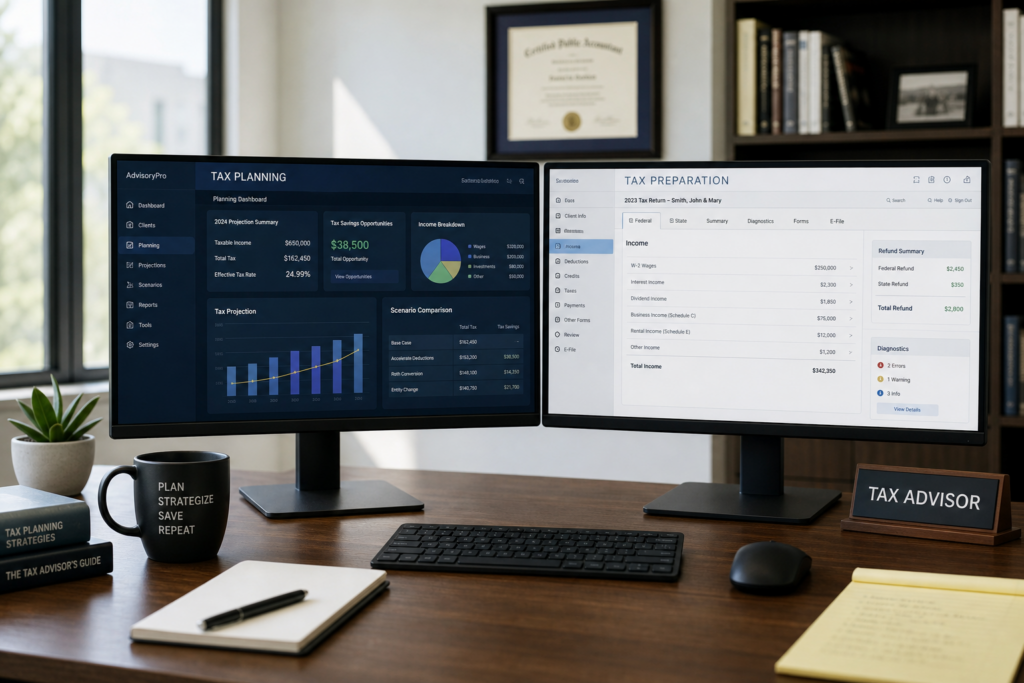
Understanding what is the difference between tax planning and tax preparation software is essential for tax professionals who want to scale advisory services in 2026. Tax planning software helps you design proactive strategies and deliver high-value client work. Tax preparation software handles compliance and filing. Knowing when to use each tool transforms your tech stack from a cost center into a revenue driver.
Table of Contents
Used by 2,400+ tax professionals
- Key Takeaways
- What Is Tax Planning Software and How Does It Work?
- What Is Tax Preparation Software and When Should You Use It?
- What Are the Key Differences Between Planning and Preparation Software?
- Which Software Should Tax Advisors Use for High-Value Services?
- How Do You Build a Complete Tax Advisory Tech Stack?
- What Is the ROI of Investing in Both Types of Software?
- Uncle Kam in Action: CPA Firm Scales Advisory With the Right Software Stack
- Next Steps
- Frequently Asked Questions
- Related Resources
Key Takeaways
- Tax planning software drives proactive strategy and advisory revenue for 2026.
- Tax preparation software handles compliance, filing, and return accuracy efficiently.
- Forward-thinking firms separate planning from preparation in their tech stack.
- Corporate tax provision software accelerates processes by 30% to 50% in 2026.
- The right software combination positions your firm for recurring advisory fees.
What Is Tax Planning Software and How Does It Work?
Quick Answer: Tax planning software models tax scenarios, compares strategies, and generates professional deliverables for clients. It focuses on proactive advisory work, not compliance filing.
Tax planning software is built for strategic tax advisory work. These platforms help you analyze client situations, model different strategies, and quantify potential tax savings. In 2026, advanced planning tools incorporate scenario modeling for the One Big Beautiful Bill Act (OBBBA), which took effect after being signed into law on July 4, 2025. This legislation reshaped international tax structures and extended business-friendly provisions that planning software must now account for.
Core Features of Tax Planning Software
Modern tax planning platforms deliver capabilities that compliance software cannot match. These tools are designed for tax professionals who sell advisory services, not just file returns. For the 2026 tax year, planning software includes specialized modules that address recent legislative changes and evolving disclosure requirements.
- Multi-Entity Scenario Modeling: Compare strategies across S Corps, LLCs, and C Corps simultaneously
- Strategy Database: Access libraries with hundreds of tax strategies applicable to 2026 rules
- Client-Ready Reports: Generate professional PDF deliverables with implementation roadmaps
- ROI Calculators: Show clients exactly how much they save compared to your advisory fee
- International Tax Modules: Handle GILTI to NCTI transitions and FDDEI calculations for 2026
- Jurisdictional Analysis: Model state-by-state tax impacts instead of blended approaches
How Tax Planning Software Supports Advisory Services
Tax planning software transforms how you deliver value. Instead of billing hourly for compliance work, you package strategic insights into fixed-fee engagements. According to Thomson Reuters research, corporate tax provision software accelerates planning processes by 30% to 50% while strengthening internal controls. This efficiency gain lets tax professionals spend more time on high-value advisory conversations and less time on manual calculations.
For 2026, planning tools must accommodate immediate expensing for domestic R&D costs and the restoration of 100% bonus depreciation under OBBBA. These changes create significant planning opportunities for business owners. Software like Neo.Tax and Orbitax helps ensure newly expensed domestic R&D costs are captured accurately as rules continue evolving throughout the year.
Pro Tip: Use planning software during discovery meetings, not after. Model scenarios in real-time to close advisory engagements on the spot.
Why Planning Software Matters More in 2026
The 2026 tax landscape demands sophisticated scenario modeling. ASU 2023-09 disclosure requirements are now in effect for public entities, requiring detailed eight-category rate reconciliations and jurisdiction-level taxes-paid disclosures. Non-public entities must comply starting in 2026. This creates unprecedented demand for tax professionals who can navigate complex reporting while delivering strategic value.
Additionally, the shift from Global Intangible Low-Taxed Income (GILTI) to Net CFC Tested Income (NCTI) and the renaming of Foreign-Derived Deduction Eligible Income (FDDEI) take effect in 2026. Multinationals need advisors who understand cross-border implications. Planning software with international tax calculators becomes essential, not optional.
What Is Tax Preparation Software and When Should You Use It?
Quick Answer: Tax preparation software completes tax returns accurately and files them electronically. It handles compliance obligations but does not design proactive strategies.
Tax preparation software excels at one thing: getting returns filed correctly and on time. These platforms manage the compliance side of your practice. They import data, apply current year tax rules, calculate liabilities, and e-file returns to the IRS and state agencies. For the 2026 tax year, preparation platforms must account for updated standard deductions, tax brackets, and contribution limits.
Core Functions of Tax Preparation Software
Preparation platforms are workflow engines designed for efficiency and accuracy. They automate repetitive tasks and reduce filing errors. For 2026, these systems must incorporate legislative updates from OBBBA and handle new disclosure requirements that affect how returns are prepared and filed.
- Data Import and Automation: Pull information from bookkeeping software and prior-year returns
- Form Population: Auto-complete IRS and state forms based on entered data
- Error Checking: Flag missing information and mathematical inconsistencies before filing
- E-Filing: Submit federal and state returns electronically with confirmation tracking
- Document Management: Store tax documents securely and organize client files
- Compliance Updates: Receive automatic updates when tax laws change during the year
When Tax Preparation Software Is Essential
Every tax practice needs reliable tax preparation and filing software. Even advisory-focused firms must file returns. The difference is how you position preparation work. Compliance-only firms compete on price and speed. Advisory firms use preparation as a foundation for deeper client relationships.
For 2026, preparation software must handle standard deduction amounts of $25,100 for married filing jointly and $12,550 for single filers. It must also apply the $40,000 state and local tax (SALT) cap for joint filers and properly calculate IRA contribution limits of $7,500 (with an additional $1,000 catch-up for those 50 and older). These figures require precise application during return preparation.
The Limitations of Preparation Software for Advisory Work
Tax preparation platforms are not designed for strategic planning. They calculate what happened last year. They do not model what could happen next year. You cannot compare entity structures side by side. You cannot generate client-facing strategy reports. You cannot quantify the tax impact of business decisions before they happen.
According to Accounting Today, tax professionals increasingly recognize that strategic tax planning must be separated from return preparation for workflow optimization. Advisory-driven firms use planning tools for high-value work while core software handles compliance and preparation at scale. This separation allows firms to charge premium fees for planning while maintaining efficient compliance operations.
What Are the Key Differences Between Planning and Preparation Software?
Quick Answer: Planning software models future scenarios and drives advisory revenue. Preparation software completes past-year returns and ensures compliance. Each serves a distinct purpose in a complete practice.
Understanding what is the difference between tax planning and tax preparation software comes down to timing, purpose, and revenue model. These platforms solve different problems for tax professionals. Confusing the two leads to misaligned expectations and missed revenue opportunities.
Side-by-Side Comparison Table
| Feature | Tax Planning Software | Tax Preparation Software |
|---|---|---|
| Primary Purpose | Proactive strategy design | Historical return filing |
| Time Focus | Future tax years | Prior tax year |
| Revenue Model | Advisory fees, project-based | Per-return fees, hourly billing |
| Client Deliverable | Tax strategy reports, action plans | Completed tax returns, e-file confirmations |
| Core Function | Scenario modeling, strategy comparison | Data entry, form completion, filing |
| Typical Fee Range | $2,500-$15,000+ per engagement | $300-$2,000 per return |
| 2026 Compliance Focus | OBBBA modeling, Pillar Two strategy | Accurate filing per 2026 IRS rules |
Timing and Workflow Differences
Tax planning happens throughout the year, ideally before clients make major financial decisions. You model strategies in January, mid-year, and during Q4 planning sessions. Tax preparation happens after the year ends, when all income and expenses are finalized. Planning is proactive. Preparation is reactive.
For 2026, this distinction matters more than ever. With ASU 2023-09 disclosure requirements in effect and new international tax rules from OBBBA, planning must happen earlier in the year. Waiting until tax season eliminates most strategic opportunities. Clients who receive year-end planning advice in December can still implement entity restructuring, retirement contributions, and other moves before the 2026 tax year closes.
Revenue Generation Comparison
Tax preparation generates one-time annual revenue per client. You complete the return, file it, and wait until next year. Tax planning generates recurring advisory fees. You deliver quarterly strategy sessions, annual planning engagements, and implementation support throughout the year. Advisory clients are worth 3-10 times more than compliance-only clients over their lifetime.
Pro Tip: Price planning separately from preparation. Bundling them together commoditizes your advisory value and leaves money on the table.
Which Software Should Tax Advisors Use for High-Value Services?
Quick Answer: Tax advisors need dedicated planning software with scenario modeling, strategy libraries, and professional deliverables. Preparation software alone cannot deliver high-value advisory services for 2026.
If you want to charge $5,000+ for tax strategy engagements, you need software built for that purpose. Tax preparation platforms cannot model entity comparisons, sequence strategies, or generate client-ready advisory reports. For 2026, advisory-focused firms must invest in planning tools that address current legislative complexity.
Essential Features for Advisory Software in 2026
Advisory software must do more than calculate numbers. It must help you sell, deliver, and scale planning services. The right platform becomes a competitive advantage that differentiates your firm from compliance shops.
- Unlimited Client Assessments: Run free scenarios on prospects to prove value before engagement
- Entity-Aware Modeling: Compare S Corps, LLCs, and C Corps across the same client portfolio
- Strategy Sequencing Framework: Prioritize strategies based on client situation and ROI
- AI-Powered Plan Generation: Convert complex modeling into client-ready deliverables automatically
- 2026 Legislative Compliance: Account for OBBBA, ASU 2023-09, and Pillar Two impacts
- International Calculators: Handle NCTI and FDDEI transitions for multinational clients
Why Generic Software Fails for Advisory Work
Many tax professionals try to use spreadsheets or repurpose preparation software for planning. This approach fails because it lacks structure, scalability, and professional presentation. Clients do not pay premium fees for Excel files. They pay for polished strategy reports with clear implementation steps and quantified savings.
According to Bloomberg Tax, the biggest challenge tax practitioners face in 2026 is the speed of change and pressure that comes with it. Success requires being structurally prepared with the right technology, not just reacting quickly. Teams that build readiness across talent, technology, and data provide forward-looking insight that businesses expect from tax advisors.
How Do You Build a Complete Tax Advisory Tech Stack?

Quick Answer: A complete tech stack includes planning software for advisory, preparation software for compliance, and integration tools for seamless workflows. Each component serves a specific function in your practice.
Building the right tech stack requires understanding what is the difference between tax planning and tax preparation software, then selecting best-in-class tools for each function. Advisory firms that scale profitably use specialized platforms instead of trying to make one tool do everything.
The Three-Layer Technology Model
Successful advisory practices separate their technology into three distinct layers. This separation allows you to excel at both planning and compliance without compromise.
| Layer | Purpose | Example Tools |
|---|---|---|
| Advisory Layer | Strategy modeling, client deliverables | Uncle Kam, Corvee, TaxPlanIQ |
| Compliance Layer | Return preparation, e-filing | Lacerte, ProSeries, Drake, UltraTax |
| Integration Layer | Data flow, workflow automation | Practice management, CRM, portals |
How to Integrate Planning and Preparation Software
Your planning and preparation platforms do not need direct integration. They serve different points in the client lifecycle. Planning happens during discovery and quarterly reviews. Preparation happens during tax season. The key is workflow clarity, not technical connectivity.
For example, you might use tax planning software with unlimited assessments to model strategies for a business owner in June. You generate a professional report showing $47,000 in projected savings. The client signs an advisory agreement. Throughout the year, you implement the strategies. In April, you use your preparation software to file the return that captures those savings.
Common Tech Stack Mistakes to Avoid
- Using Only Preparation Software: Limits you to compliance work and low per-client revenue
- Buying Too Many Tools: Creates complexity without improving client outcomes or revenue
- Choosing Based on Price Alone: Cheap software costs more in lost revenue and inefficiency
- Ignoring 2026 Compliance: Software must handle OBBBA, ASU 2023-09, and international changes
- No Training Investment: Software without training produces mediocre results and frustrated teams
For business owners and tax professionals alike, understanding technology limitations prevents costly mistakes. The right tools support specific business goals. Do you want to grow advisory revenue or process more returns? Your tech stack reflects that strategic choice.
What Is the ROI of Investing in Both Types of Software?
Quick Answer: Advisory firms that invest in both planning and preparation software see 3-5x ROI within the first year. Planning software drives high-margin revenue while preparation software maintains efficient compliance operations.
The financial case for separating planning from preparation is straightforward. Tax preparation software might cost $2,000-$5,000 annually per license. Tax planning software ranges from $3,000-$15,000 annually depending on features and firm size. However, a single advisory engagement priced at $5,000 pays for an entire year of planning software.
Revenue Impact Analysis
Consider a CPA firm with 100 business clients. If they only offer preparation services at $1,500 per return, they generate $150,000 annually from this client base. If they add advisory services using planning software and convert just 20 clients to $5,000 annual planning engagements, they add $100,000 in new revenue. Total revenue from the same client base increases to $250,000 — a 67% improvement.
According to research from Thomson Reuters, firms using corporate tax provision software report 30% to 50% process acceleration. This efficiency gain frees capacity for analysis and planning work that drives real business value. Instead of spending all your time on compliance, you invest hours in high-margin advisory conversations.
Software Cost Comparison for 2026
| Software Type | Annual Cost Range | Revenue Potential | Typical ROI |
|---|---|---|---|
| Tax Preparation | $2,000-$5,000 | $300-$2,000 per client | 10-30x (essential baseline) |
| Tax Planning | $3,000-$15,000 | $2,500-$15,000+ per client | 3-10x first year |
| Combined Stack | $5,000-$20,000 | $3,000-$17,000+ per client | 5-15x with full utilization |
Pro Tip: Track software ROI by measuring new advisory revenue generated, not just cost savings. Planning software should pay for itself with 1-2 new advisory clients.
Lifetime Value Comparison
Compliance-only clients generate predictable but limited revenue. Advisory clients deliver exponentially more value over time. A compliance client paying $1,500 annually generates $15,000 over 10 years. An advisory client paying $5,000 for planning plus $1,500 for preparation generates $65,000 over the same period. The difference compounds when you consider referrals and engagement expansion.
For 2026, firms that invest in planning capabilities position themselves for the future. As IRS forms and publications become more complex and disclosure requirements expand, clients need advisors who provide strategic guidance, not just compliance processing. The firms that deliver this value command premium pricing and build sustainable competitive advantages.
Uncle Kam in Action: CPA Firm Scales Advisory With the Right Software Stack
Client Snapshot: Regional CPA firm with 150 small business clients, primarily S Corps and LLCs in professional services and real estate. The firm generated $450,000 annually from tax preparation services but struggled to break into advisory work. Partners wanted to increase revenue per client and reduce seasonal workload volatility.
Financial Profile: Average client paid $3,000 for annual tax preparation. Firm had attempted advisory work using spreadsheets but lacked professional deliverables and consistent methodology. Clients viewed them as compliance providers, not strategic advisors.
The Challenge: The firm needed to differentiate from competitors and command higher fees. They recognized that understanding what is the difference between tax planning and tax preparation software was critical. Their existing tech stack only supported compliance work. They had no systematic way to model strategies, quantify savings, or present advisory recommendations professionally.
The Uncle Kam Solution: In January 2026, the firm implemented a complete advisory tech stack. They maintained their existing preparation software for compliance but added dedicated tax planning software with unlimited client assessments and AI-powered plan generation. The platform included the MERNA framework for strategy sequencing and entity-aware modeling capabilities.
They trained staff on the advisory selling process and began offering free tax assessments to existing clients. Within 90 days, they converted 25 clients to annual advisory engagements priced at $6,000 each. These clients still paid for tax preparation separately. The firm added $150,000 in new advisory revenue in the first quarter alone.
More importantly, the firm repositioned itself in the market. Clients began referring colleagues specifically for tax planning, not just tax preparation. Partners reduced their compliance workload by delegating preparation to staff while focusing on high-value advisory conversations. The separation of planning from preparation in their tech stack enabled this transformation.
For 2026 planning engagements, the software helped them model strategies accounting for OBBBA provisions, including immediate R&D expensing and restored bonus depreciation. They used international tax calculators to handle clients affected by the GILTI to NCTI transition. This technical depth strengthened client confidence and justified premium pricing.
Learn more about how tax professionals are scaling advisory practices at Uncle Kam Client Results.
Next Steps
Now that you understand what is the difference between tax planning and tax preparation software, you can make informed decisions about your tech stack. Here are your next actions:
- Audit your current software to identify gaps in planning capabilities
- Calculate potential advisory revenue from your existing client base
- Research planning platforms that support 2026 legislative requirements
- Book a strategy session to design your advisory tech stack
- Review our complete guide to entity structuring for advisory opportunities
The firms that separate planning from preparation in 2026 will capture the advisory market. Those that continue relying only on preparation software will compete on price in an increasingly commoditized compliance market. Your technology choices today determine your revenue opportunities tomorrow.
This information is current as of 6/7/2026. Tax laws and software capabilities change frequently. Verify updates with the IRS or software providers if reading this later.
Frequently Asked Questions
Can tax preparation software do tax planning?
No, tax preparation software cannot perform true tax planning. Preparation platforms complete tax returns based on historical data. They cannot model future scenarios, compare entity structures, or generate professional strategy reports. Planning requires dedicated software built for scenario analysis and advisory deliverables.
How much does tax planning software cost in 2026?
Tax planning software ranges from $3,000 to $15,000 annually for 2026. Pricing depends on features, user licenses, and firm size. However, a single advisory engagement priced at $5,000 typically covers the annual software cost. Most firms see 3-10x ROI in the first year.
Do I need both planning and preparation software?
Yes, if you want to offer both advisory and compliance services. Preparation software handles filing obligations efficiently. Planning software drives high-margin advisory revenue. Forward-thinking firms use both, separating their tech stack by function. This separation allows you to excel at strategic work while maintaining efficient compliance operations.
What features should I look for in 2026 tax planning software?
For 2026, essential features include scenario modeling for OBBBA provisions, entity-aware comparisons, international tax calculators for NCTI and FDDEI transitions, AI-powered plan generation, unlimited client assessments, and strategy libraries. The software must handle ASU 2023-09 disclosure requirements and Pillar Two minimum tax complexities.
How do I justify the cost of planning software to partners?
Show the revenue opportunity. Calculate how many advisory clients you need to cover the software cost. For a $10,000 annual platform, you need just two $5,000 advisory engagements to break even. Present the lifetime value difference between compliance-only clients and advisory clients. Demonstrate how competitors using planning software are capturing market share.
Can I use spreadsheets instead of planning software?
You can, but you should not. Spreadsheets lack structure, scalability, and professional presentation. Clients do not pay $5,000 for Excel files. They pay for polished strategy reports with clear implementation steps. Spreadsheets also create errors and inefficiencies. Planning software provides consistency, accuracy, and client-ready deliverables that justify premium pricing.
When should I implement tax planning software in my firm?
Implement planning software before tax season, ideally in summer or fall. This gives you time to learn the platform and start advisory conversations before year-end planning season. For 2026, firms should have planning tools in place by October to capitalize on Q4 year-end planning opportunities and model strategies accounting for new legislative requirements.
Related Resources
- Uncle Kam Tax Planning Software: Complete Advisory Operating System
- MERNA Method: Framework for Strategy Sequencing
- Tax Strategy Blog: Latest Advisory Insights
- High-Net-Worth Tax Strategies
Last updated: June, 2026

