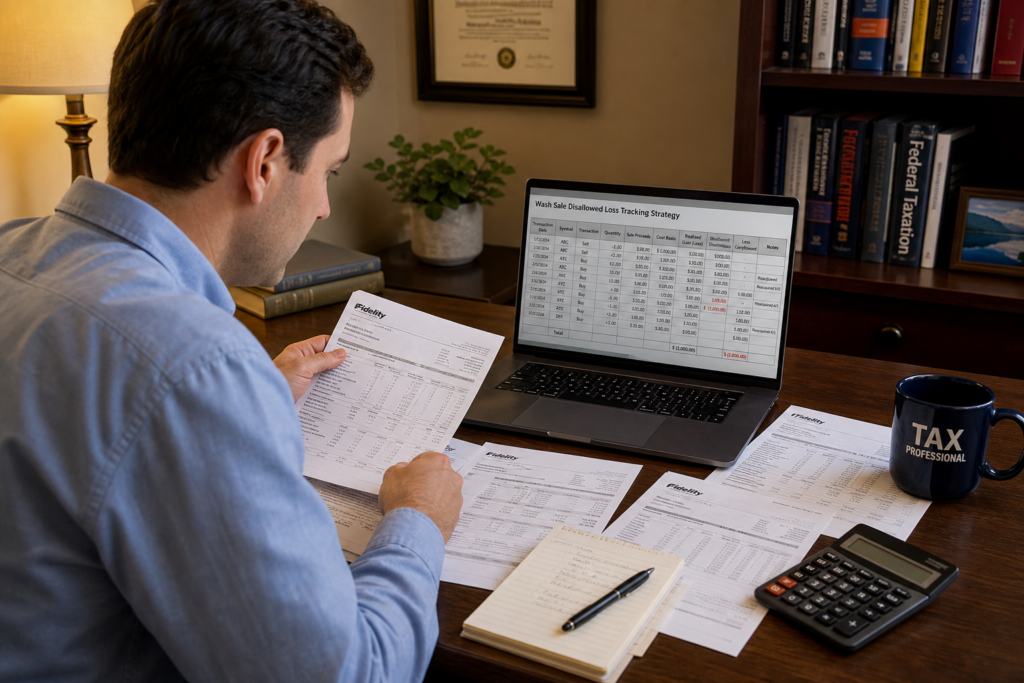
Wash Sale Disallowed Loss Tracking Strategy: 2026 Guide
A solid wash sale disallowed loss tracking strategy separates the tax pro who scales from the one who drowns in spreadsheets. For the 2026 tax year, active traders generate thousands of trades. Each loss could trigger a wash sale. Missing one means a wrong return, an angry client, or an IRS notice. This guide gives solo practitioners a repeatable system. Moreover, it shows how tracking becomes an advisory service you can charge for. Ready to turn compliance into profit? Let us dig in. Book a strategy session to start.
Table of Contents
- Key Takeaways
- What Is the Wash Sale Rule in 2026?
- How Do You Track Disallowed Losses Across Accounts?
- How Do You Report Wash Sales on Form 8949?
- Do Crypto Clients Face Wash Sale Rules?
- How Can You Turn Tracking Into Advisory Revenue?
- Uncle Kam in Action
- Related Resources
- Next Steps
- Frequently Asked Questions
 For Tax Professionals
Build your next chapter in tax advisory.
Explore how Uncle Kam Pro could support the next stage of your practice.
Key Takeaways
- The wash sale rule disallows losses on securities repurchased within 30 days.
- A disallowed loss adds to the replacement share’s cost basis.
- For 2026, crypto still escapes the wash sale rule under current law.
- A wash sale disallowed loss tracking strategy protects clients and grows your firm.
- Losses inside an IRA vanish forever, so watch cross-account trades.
What Is the Wash Sale Rule in 2026?
Quick Answer: The wash sale rule blocks a loss deduction when a client buys the same security within 30 days before or after selling at a loss.
The wash sale rule lives in Internal Revenue Code Section 1091. It stops investors from claiming a tax loss while keeping the same position. Therefore, the loss is not lost forever. Instead, it moves into the cost basis of the replacement shares. In addition, the holding period of the old shares tacks onto the new ones. This matters for both traders and your workflow. The IRS Publication 550 on investment income explains the full rule in plain terms.
Many solo practitioners work with active traders. As a result, wash sales appear constantly. A single client may trade one stock dozens of times. Consequently, tracking each disallowed loss by hand becomes impossible. You need a system. Building that system is the heart of a strong proactive tax strategy plan for trader clients.
The 61-Day Window Explained
The rule covers a 61-day window. It runs 30 days before the sale and 30 days after. The sale day sits in the middle. Furthermore, the rule applies to stocks, bonds, options, and mutual funds. It also covers “substantially identical” securities. For example, selling a share and buying a call option on it can trigger the rule.
What Counts as Substantially Identical?
This term causes the most confusion. Two shares of the same company are clearly identical. However, two different S&P 500 index funds may not be. Bonds from the same issuer with different terms often differ. Therefore, judgment matters. Document your reasoning for each call. This creates a defensible record if the IRS asks questions later.
Pro Tip: The wash sale rule was not changed by the One Big Beautiful Bill Act for 2026. Verify current rules at IRS.gov before each season.
How Do You Track Disallowed Losses Across Accounts?
Quick Answer: Use a central system that pulls every account. Brokers only track wash sales within one account, not across accounts or spouses.
Here lies the biggest trap for solo pros. A broker reports wash sales on Form 1099-B. However, the broker only sees its own account. It cannot see the client’s other brokerage. It also cannot see a spouse’s account or an IRA. Therefore, the 1099-B is often incomplete. A strong wash sale disallowed loss tracking strategy fills these gaps. Traders in Newark, Delaware face the same cross-account risks as anyone else.
Consider a client with three accounts. He sells Apple at a loss in one. Then he buys Apple in another within 30 days. The broker misses it. But the IRS rule still applies. As a result, you must catch it. This is where automation and financial systems save hours of manual work.
Build a Central Tracking Ledger
Pull every trade into one master file. Include the date, security, quantity, and price. Then sort by security and date. Next, scan each loss for a purchase within 61 days. Modern tax software does this automatically. Still, you must review the output. Software cannot judge “substantially identical” positions on its own.
Active traders create real complexity. You need leverage, not more hours. Uncle Kam offers entity-aware tax planning software with scenario modeling that evaluates positions across 1040s, 1120-Ss, and K-1s at once. This lets one person handle many trader clients at scale.
Sample Disallowed Loss Calculation
Say your client sells 100 shares of XYZ. He bought them at $50 and sold at $40. That is a $1,000 loss. However, he rebought 100 shares at $42 within 20 days. The rule disallows the full $1,000 loss. Instead, it adds $1,000 to the new basis. So the new basis becomes $5,200, not $4,200.
Tracking these adjustments is tedious but critical. Our team built a resource to help. Use the wash sale rule tracking tool for tax professionals to speed up 2026 calculations and reduce errors.
How Do You Report Wash Sales on Form 8949?
Quick Answer: Report each wash sale on Form 8949 with code “W” in column (f). Then enter the disallowed amount as a positive number in column (g).
Reporting is where tracking pays off. You list the sale on Form 8949, Sales and Dispositions of Capital Assets. In column (f), enter code “W” for the wash sale. In column (g), add back the disallowed loss as a positive figure. Then the loss reduces to zero or partial for that line. Totals flow to Schedule D.
Accuracy here protects your client and your license. A wrong entry inflates a loss. The IRS matches 1099-B data to returns. Therefore, mismatches invite notices. Good tax prep and filing systems reduce this risk sharply.
Common Reporting Mistakes
Several errors appear every season. Watch for these:
- Trusting the 1099-B without checking other accounts.
- Forgetting to adjust the replacement share basis.
- Missing the holding period carryover on new shares.
- Ignoring wash sales between a taxpayer and spouse.
Capital Loss Limits for 2026
Even allowed losses face limits. For 2026, a client may offset up to $3,000 of ordinary income with net capital losses. Any excess carries forward to future years. Therefore, disallowed wash sale losses hurt more when a client wants that $3,000 write-off now. Smart planning times sales to avoid the trap.
Did You Know? For 2026, long-term gains are taxed at 0%, 15%, or 20%. Short-term gains hit ordinary rates up to 37%.
| Item | 2026 Treatment |
|---|---|
| Wash sale window | 61 days total (30 before, 30 after) |
| Disallowed loss | Added to replacement share basis |
| Capital loss vs. ordinary income | Up to $3,000 per year |
| Form 8949 code | Code “W” in column (f) |
Do Crypto Clients Face Wash Sale Rules?

Quick Answer: For 2026, crypto is not a “security” under Section 1091. So the wash sale rule generally does not apply to digital assets yet.
This is a major planning gap you can use. The wash sale rule applies to securities. However, the IRS treats crypto as property, not a security. Therefore, a client can sell Bitcoin at a loss and rebuy it minutes later. The loss still counts. This is a powerful tax-loss harvesting move for 2026.
Congress has tried to close this gap for years. As of mid-2026, no law has passed. The CLARITY Act stalled in the Senate. Meanwhile, courts keep shaping crypto tax rules case by case. Stay alert for change. Your high-net-worth investor clients may hold large crypto positions.
Why This Loophole May Not Last
Lawmakers view this gap as lost revenue. As a result, closure is likely someday. Advise clients to use the strategy while it exists. However, warn them it could end fast. Document your advice with dates. This protects you if rules shift midyear.
Crypto Recordkeeping Still Matters
No wash sale rule does not mean easy records. Crypto clients still need cost basis by lot. They need dates, amounts, and fair market values. Poor records cause overpayment or audit risk. Therefore, apply the same tracking discipline you use for stocks. The IRS FAQ on digital asset transactions covers the basics.
Pro Tip: Offer crypto tax-loss harvesting as a premium service. Clients pay well for savings they cannot find alone.
How Can You Turn Tracking Into Advisory Revenue?
Quick Answer: Package wash sale tracking as a proactive advisory service. Charge a flat fee for planning, not just a hourly prep rate.
Tax prep is a commodity. Advisory is not. A wash sale disallowed loss tracking strategy is advisory work. It requires judgment, systems, and foresight. Therefore, price it as such. Solo pros who shift to advisory earn more per client. They also work fewer chaotic hours during tax season. Learn how the Uncle Kam marketplace helps tax pros transition to advisory.
Think about the value you create. You save a trader thousands in denied losses. You prevent an IRS notice. You give peace of mind. That is worth far more than a $400 return fee. Position yourself as a strategist, not a preparer. Learn how in our tax advisory services overview.
Build a Repeatable System First
Scale requires systems, not heroics. First, standardize your intake for trader clients. Next, automate the trade pull and match. Then review the output with expert eyes. Finally, deliver a clean, branded report. This turns a messy task into a product you can sell again and again.
Find and Close More Trader Clients
Systems mean nothing without clients. Active traders need pros who understand wash sales. However, finding them takes time you may not have. Uncle Kam includes a built-in marketplace that routes pre-qualified advisory leads to certified pros. So you spend less time chasing and more time serving. Ready to grow? Book a strategy session today.
Pro Tip: Bundle wash sale tracking with year-round planning. Recurring fees smooth your income across the year.
Uncle Kam in Action: Solo CPA Scales a Trader Practice
Client Snapshot: Maria runs a one-person CPA firm. She is 42 years old. She serves active stock and crypto traders in her city.
Financial Profile: Her firm earned about $180,000 in annual revenue. However, she worked 70-hour weeks each tax season. Manual wash sale tracking ate most of her time.
The Challenge: One trader client had 4,200 trades in 2026. His broker missed cross-account wash sales entirely. Maria caught $38,000 in disallowed losses claimed wrongly on his draft return. Fixing it by hand took two full days. She realized this did not scale. Moreover, she could not take on more traders without help.
The Uncle Kam Solution: Maria adopted a full wash sale disallowed loss tracking strategy. She used entity-aware software to pull all accounts at once. Then she standardized her intake and delivered branded reports. As a result, review time dropped from days to hours. She repriced the service as flat-fee advisory, not hourly prep.
The Results: Maria raised her trader package to $3,500 per client. She added 12 new trader clients in one year. Therefore, her advisory revenue grew by $42,000. Her tax savings work also protected clients from a costly IRS notice.
- New Advisory Revenue: $42,000 in year one
- Investment: roughly $6,000 in software and training
- First-Year ROI: about 7x her investment
Maria now works fewer hours and earns more. See more wins like hers on our documented client results page.
Related Resources
Next Steps
Take action now to protect clients and grow your firm. Here is where to start:
- Audit one trader client’s 1099-B for missed cross-account wash sales.
- Build a central tracking ledger for all trades.
- Reprice trader work as flat-fee advisory services.
- Book a strategy session to systemize your practice.
This information is current as of 7/19/2026. Tax laws change frequently. Verify updates with the IRS if reading this later.
Frequently Asked Questions
Does the wash sale rule apply to crypto in 2026?
No, not under current law. The IRS treats crypto as property, not a security. Therefore, the wash sale rule generally does not apply. However, Congress could change this. Always verify current rules before advising clients.
What happens to a disallowed wash sale loss?
The loss is not gone forever. Instead, it adds to the cost basis of the replacement shares. Furthermore, the old holding period carries over. So the client recovers the loss when they sell the new shares later.
Can a wash sale happen between two different accounts?
Yes. The rule applies across all a taxpayer’s accounts. It even includes a spouse’s accounts. However, brokers only track wash sales within one account. Therefore, you must catch cross-account trades yourself.
What if the wash sale replacement is bought in an IRA?
This is the worst trap. If a client sells at a loss in a taxable account, then buys in an IRA, the loss vanishes forever. It does not add to any basis. So this move should almost always be avoided.
How much should I charge for wash sale tracking?
Price it as advisory work, not hourly prep. Many pros charge a flat fee from $2,000 to $5,000 for complex trader clients. The fee reflects the tax saved and the risk avoided, not just the time spent.
Which form reports a wash sale to the IRS?
You report it on Form 8949. Use code “W” in column (f). Then enter the disallowed loss as a positive number in column (g). Totals flow to Schedule D of the return.
Last updated: July, 2026

