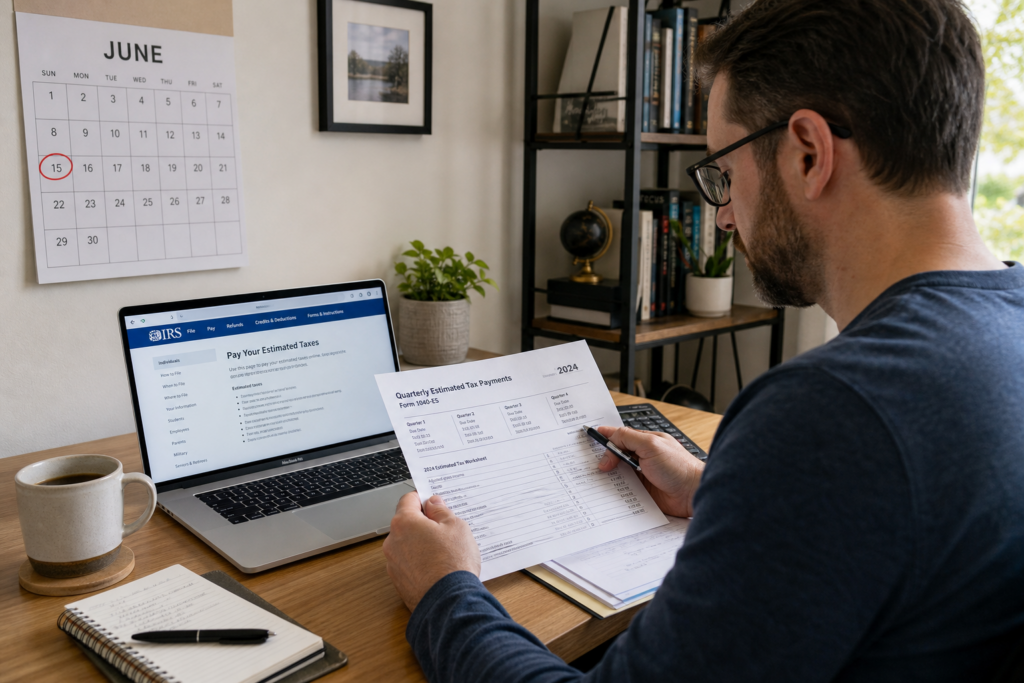
Underpayment Penalty Avoidance: 2026 Guide
Underpayment Penalty Avoidance: 2026 Complete Guide for the Self-Employed
Underpayment penalty avoidance is one of the most urgent priorities for self-employed workers in 2026. With the IRS’s new Working Families Tax Cuts now in effect — thanks to the One Big Beautiful Bill Act signed in July 2025 — many freelancers and contractors face bigger income shifts that make accurate estimated tax payments harder. Miss a payment or underpay, and the IRS charges interest-based penalties that compound quickly. This guide walks you through every step to stay penalty-free in 2026.
Table of Contents
- Key Takeaways
- What Is an IRS Underpayment Penalty?
- Who Must Pay Estimated Taxes in 2026?
- What Are the 2026 Quarterly Estimated Tax Deadlines?
- How Does the Safe Harbor Rule Work for 2026?
- How Do You Calculate Your 2026 Estimated Tax Payments?
- How Does the One Big Beautiful Bill Act Affect Your Estimated Taxes?
- What Strategies Best Avoid Underpayment Penalties?
- Uncle Kam in Action: From Penalty Payer to Smart Planner
- Next Steps
- Related Resources
- Frequently Asked Questions
Key Takeaways
- Your 2026 Q2 estimated tax payment is due June 15, 2026 — do not miss it.
- Use the safe harbor rule to avoid penalties: pay 100% of last year’s tax (or 110% if your 2025 AGI exceeded $150,000).
- The One Big Beautiful Bill Act introduced new deductions for tips, overtime, and car loan interest that can change your 2026 tax liability.
- Self-employed workers pay 15.3% self-employment tax on top of income taxes — accurate quarterly payments are critical.
- Proactive tax strategy planning throughout the year prevents surprises at filing time.
What Is an IRS Underpayment Penalty?
Quick Answer: An underpayment penalty is an interest-based charge the IRS adds when you haven’t paid enough tax during the year. For 2026, the penalty rate equals the federal short-term rate plus 3 percentage points. Verify the current exact rate at IRS.gov.
When you work for an employer, your taxes are withheld from every paycheck. As a self-employed worker, however, no one withholds taxes for you. You must send payments to the IRS yourself — on a quarterly schedule. If you don’t send enough, the IRS charges an underpayment penalty.
The IRS calculates the penalty using Form 2210. It is not a fixed percentage. Instead, it is based on the federal short-term interest rate plus 3 percentage points, applied to the amount underpaid. The rate changes quarterly. As of recent IRS announcements, the rate has been in the 7–8% range. Always verify the current rate at IRS.gov before filing.
How the Penalty Adds Up
Many self-employed workers are surprised by how large the penalty becomes. The IRS charges interest on each underpaid quarter separately. So if you miss Q1, you carry that penalty through three more quarters before filing. Furthermore, the penalty applies even if you ultimately pay your full tax bill at filing time.
Consider a real example. Suppose you underpaid your 2026 Q1 estimated taxes by $3,000. At an 8% annual rate, you would owe roughly $120 in underpayment penalties for Q1 alone. Multiply that across multiple quarters or a larger shortfall, and the penalties climb fast. Therefore, underpayment penalty avoidance is not just smart — it directly protects your bottom line.
Exceptions That Waive the Penalty
In some cases, the IRS may waive the underpayment penalty. These include situations where:
- Your total tax owed for 2026 is less than $1,000 after withholding and credits.
- You had no tax liability in 2025 (and were a U.S. citizen or resident for the full year).
- A casualty, disaster, or unusual circumstance caused the underpayment.
- You retired or became disabled during 2025 or 2026 and the underpayment was not willful neglect.
However, most self-employed workers do not qualify for these exceptions. Proactive underpayment penalty avoidance remains your strongest defense. Our self-employed tax guidance can help you stay ahead every quarter.
Who Must Pay Estimated Taxes in 2026?
Quick Answer: You must pay estimated taxes in 2026 if you expect to owe at least $1,000 in federal tax after subtracting withholding and credits. Most self-employed workers, freelancers, and 1099 contractors meet this threshold easily.
The estimated tax requirement affects millions of Americans. It applies to anyone who receives income without automatic withholding. That includes:
- Independent contractors and freelancers
- Sole proprietors and single-member LLC owners
- Gig economy workers (rideshare, delivery, online platforms)
- Partners in a partnership
- S corporation shareholders
- Investors with dividends, capital gains, or rental income
For self-employed workers, the threshold is particularly easy to reach. You face both regular income tax and the 15.3% self-employment tax. Even a modest net profit triggers the $1,000 threshold. For example, if you earn $10,000 in net self-employment income, your SE tax alone reaches $1,530 — well above the threshold.
Understanding Self-Employment Tax in 2026
The self-employment tax rate for 2026 remains 15.3%. This breaks down as 12.4% for Social Security and 2.9% for Medicare. The Social Security portion applies to the first $184,500 of net earnings in 2026, according to published 2026 figures. Income above that threshold is still subject to the 2.9% Medicare portion.
Additionally, if your net earnings exceed $200,000 (single) or $250,000 (married filing jointly), the Additional Medicare Tax of 0.9% also applies. You can deduct half of your self-employment tax when calculating your adjusted gross income. This deduction helps reduce your income tax — but you still owe the full SE tax amount as part of your estimated payments. Use our Self-Employment Tax Calculator for Idaho Falls to estimate your exact 2026 quarterly obligation.
Pro Tip: Many new freelancers forget that SE tax applies to net profit, not gross revenue. Deduct all legitimate business expenses first. Then calculate your SE tax on what remains.
What Are the 2026 Quarterly Estimated Tax Deadlines?
Quick Answer: For 2026, the four estimated tax deadlines are April 15, June 15, September 15, and January 15, 2027. Missing any deadline triggers penalty accrual from that date forward.
The IRS divides the year into four estimated tax payment periods. Each period covers a different span of months. Note that the periods are not perfectly quarterly — the second period (Q2) only covers two months. This is a common source of confusion. Paying attention to each deadline is a core part of underpayment penalty avoidance.
| Payment Period | Income Earned | Due Date (2026) | Notes |
|---|---|---|---|
| Q1 2026 | Jan 1 – Mar 31 | April 15, 2026 | Same as tax filing deadline |
| Q2 2026 | Apr 1 – May 31 | June 15, 2026 | Only 2 months in this period |
| Q3 2026 | Jun 1 – Aug 31 | September 15, 2026 | Standard 3-month period |
| Q4 2026 | Sep 1 – Dec 31 | January 15, 2027 | Or file your full return by Feb 1 |
Important: If a deadline falls on a weekend or holiday, the IRS pushes it to the next business day. Always verify the exact date at IRS.gov’s estimated taxes page before sending a payment.
How to Submit Your 2026 Estimated Payments
You have several options to submit your estimated tax payments to the IRS. The fastest and most reliable method is the IRS Direct Pay system at IRS.gov. This is free and processes your payment the same day. Other options include:
- Electronic Federal Tax Payment System (EFTPS): Requires advance enrollment but is preferred for recurring payments.
- IRS2Go mobile app: Convenient for quick payments from your phone.
- Credit or debit card: Available through IRS-approved third-party processors (fees apply).
- Check or money order: Mail with Form 1040-ES voucher (allow extra time for processing).
Pro Tip: Set calendar reminders 2 weeks before each deadline. This gives you time to review your income and calculate the exact amount owed before paying.
How Does the Safe Harbor Rule Work for 2026?
Quick Answer: The safe harbor rule protects you from underpayment penalties as long as you pay enough. You need to pay 100% of your 2025 tax bill (or 90% of your 2026 tax). If your 2025 AGI exceeded $150,000, you must pay 110% of your 2025 tax to qualify.
The safe harbor is the most powerful tool for underpayment penalty avoidance. It works as an automatic protection. If you meet the safe harbor threshold, the IRS cannot charge you an underpayment penalty — even if you end up owing more tax at filing time.
There are two main safe harbor tests for 2026. You only need to meet one of them. Most self-employed workers find the prior-year method easier, since it does not require projecting this year’s income. Our tax prep and filing team can help you confirm which method is best for your situation.
Safe Harbor Method 1: Prior-Year Tax
Under this method, you pay an amount equal to 100% of your total tax from your 2025 return. If your 2025 adjusted gross income was more than $150,000 (or $75,000 if married filing separately), you must pay 110% of your 2025 tax. This higher percentage protects higher earners who might have significant income swings.
Here is a practical example. Say you owed $20,000 in total federal tax on your 2025 return, and your 2025 AGI was $120,000. To meet the safe harbor for 2026, you must pay at least $20,000 in estimated taxes throughout the year. Divide $20,000 by four and pay $5,000 per quarter. Even if your 2026 income jumps to $200,000 and you owe $40,000 in total tax, the IRS cannot penalize you — as long as you paid your $20,000 on time.
Safe Harbor Method 2: 90% of Current Year Tax
Under this method, you estimate your total 2026 tax liability and pay at least 90% of it through the year. This method works best when you expect lower income in 2026 compared to 2025. However, it requires you to accurately forecast your income — which is harder for freelancers with variable earnings.
If your income is steady and predictable, the 90% method may allow you to pay less each quarter. Nevertheless, if your income ends up higher than expected, you could undershoot and owe a penalty at filing. Therefore, when in doubt, many tax advisors recommend the prior-year method for reliable underpayment penalty avoidance.
| Safe Harbor Method | Amount Required | Best For | Risk Level |
|---|---|---|---|
| Prior-Year (AGI ≤ $150K) | 100% of 2025 tax | Income growers | Low |
| Prior-Year (AGI > $150K) | 110% of 2025 tax | High earners | Low |
| Current-Year (90%) | 90% of 2026 tax | Income decliners | Medium |
| Under $1,000 Tax Owed | N/A — automatic waiver | Very low earners | None |
How Do You Calculate Your 2026 Estimated Tax Payments?
 Free Tax Write-Off Finder
Quick Answer: Use IRS Form 1040-ES worksheets to calculate your quarterly payments. Add your expected income tax and self-employment tax together. Then subtract any withholding or credits and divide the remainder into four equal payments.
Calculating accurate estimated payments is the foundation of underpayment penalty avoidance. The IRS provides a worksheet inside Form 1040-ES to guide you through this process. You will need your prior-year return and a reasonable projection of your 2026 income to complete the worksheet.
Step-by-Step Estimated Tax Calculation
Follow these steps to estimate your 2026 quarterly payments:
- Project your net self-employment income. Start with expected gross revenue. Subtract all deductible business expenses. The result is your net profit.
- Calculate your self-employment tax. Multiply your net profit by 92.35% (your net earnings from SE). Then multiply that figure by 15.3%. This is your SE tax. Deduct half of it from your income.
- Subtract deductions and apply 2026 tax rates. Apply the relevant 2026 federal income tax brackets to your adjusted income. Include the new OBBBA deductions if applicable (tips, overtime, car loan interest).
- Add income tax and SE tax together. This is your total estimated annual tax liability.
- Subtract any withholding. If you have a part-time W-2 job or a spouse with withholding, subtract that amount.
- Divide the remainder by 4. Send one-quarter to the IRS each quarter by the respective deadline.
A Real-World 2026 Calculation Example
Suppose Sarah is a freelance graphic designer based in Idaho Falls. Her projected 2026 net self-employment income is $85,000. Here is how she calculates her quarterly payments:
- Net SE income × 92.35% = $85,000 × 92.35% = $78,498
- SE tax = $78,498 × 15.3% = $12,010
- SE tax deduction (half) = $6,005
- Adjusted income for income tax = $85,000 – $6,005 = $78,995
- Estimated income tax (single filer, 2026 brackets) ≈ $13,500 (verify at IRS.gov for current rates)
- Total estimated tax = $12,010 + $13,500 = $25,510
- Quarterly payment = $25,510 ÷ 4 = $6,378 per quarter
By paying $6,378 each quarter, Sarah stays within safe harbor and avoids all underpayment penalties. This example illustrates exactly why consistent quarterly payments are the foundation of underpayment penalty avoidance. Idaho Falls freelancers can use our Idaho Falls Self-Employment Tax Calculator to run these numbers instantly for their own income level.
Did You Know? During the 2026 filing season, approximately 45% of individual tax returns claimed one or more of the new OBBBA deductions. The average refund for those returns was over $3,200. Planning for these deductions in your estimated payments could lower your quarterly amount significantly.
How Does the One Big Beautiful Bill Act Affect Your Estimated Taxes?
Quick Answer: The One Big Beautiful Bill Act, signed in July 2025, introduced new Working Families Tax Cuts. These include deductions for tips, overtime pay, car loan interest, and senior citizens. For self-employed workers, claiming these in 2026 can lower your taxable income — and therefore your estimated tax payments.
The One Big Beautiful Bill Act (OBBBA) brought major changes to the 2026 tax landscape. These new deductions were dubbed the Working Families Tax Cuts and went into effect for the 2026 filing season. During 2026 filings, the IRS reported that 45% of individual returns claimed at least one of these deductions, with average refunds exceeding $3,200.
For self-employed workers focused on underpayment penalty avoidance, these new deductions matter for two reasons. First, they reduce your taxable income, which means your total 2026 tax liability could be lower than you projected. Second, if you claimed tips or overtime income in the past but now deduct them, your base for calculating estimated taxes changes. Always factor in these deductions when computing your quarterly payments. Check the IRS guidance on these deductions for eligibility details.
New OBBBA Deductions Relevant to Self-Employed Workers
Here is a summary of the key 2026 Working Families Tax Cuts that may affect your estimated tax calculations:
- Tip Income Deduction: Qualifying tip income can be deducted from your taxable income. This applies to certain occupational categories as defined by the IRS. Review IRS guidance to confirm whether your tips qualify.
- Overtime Pay Deduction: Eligible overtime compensation may be deductible. This primarily applies to W-2 workers, but if you have a hybrid income situation, it can affect your total picture.
- Car Loan Interest Deduction: Interest paid on car loans used for personal vehicles may be deductible in 2026 under the OBBBA. This is separate from the existing business vehicle deduction on Schedule C.
- Senior Citizen Deduction: Workers over a certain age may qualify for an enhanced deduction. Check IRS newsroom updates for full eligibility criteria.
These deductions can meaningfully reduce your 2026 tax liability. However, they can also create a trap for underpayment penalty avoidance. If you lower your estimated payments expecting these deductions but then fail to qualify, you may underpay and face penalties. Always confirm your eligibility before reducing quarterly payments. Our tax advisory team can review your specific situation before you adjust your payment schedule.
SALT Deduction Cap Changes in 2026
Another important change for 2026: the state and local tax (SALT) deduction cap rose to $40,000 for most filers (or $20,000 if married filing separately), subject to income-based limits. For self-employed workers in high-tax states, this higher cap can increase your itemized deduction significantly. If you previously took the standard deduction, it may now make sense to itemize — further reducing your 2026 tax liability and your required estimated payments.
What Strategies Best Avoid Underpayment Penalties?
Quick Answer: The best strategies combine the safe harbor rule, quarterly income tracking, and proactive deduction planning. Locking in safe harbor payments early eliminates most penalty risk. Adjusting for mid-year income changes prevents overpayment.
Smart underpayment penalty avoidance goes beyond simply sending payments on time. It requires a proactive approach to tax planning throughout the year. The following strategies work best for self-employed workers navigating 2026’s complex tax environment.
Strategy 1: Lock In Safe Harbor Early
The safest path is to pull your 2025 tax return and calculate the prior-year safe harbor amount immediately. Divide it into four equal payments. Set up automatic payments through EFTPS or schedule reminders for each deadline. This approach requires almost no ongoing monitoring and completely eliminates penalty risk, regardless of what happens to your income in 2026.
For example, if you owed $18,000 total tax in 2025 and your AGI was below $150,000, schedule four payments of $4,500 each. You are now fully safe harbor compliant. You may owe a balance at filing, but the IRS cannot charge you an underpayment penalty. This strategy pairs well with a strong annual tax strategy to minimize what you owe when you file.
Strategy 2: Track Income Monthly and Adjust
Monthly income tracking lets you spot large income swings early. If your income surges in Q2, increase your Q2 and Q3 payments to reflect the higher tax liability. Conversely, if you land a big deduction (like a major equipment purchase under Section 179), you can reduce a future payment accordingly.
The annualized income installment method (via Form 2210, Schedule AI) allows you to pay higher amounts in quarters when income is high and lower amounts when income is low. This method is more complex but can reduce total payments for workers with very uneven income. It requires meticulous recordkeeping, however. Our business solutions services include bookkeeping support that makes this tracking straightforward.
Strategy 3: Maximize Deductions Before Each Deadline
Every deduction you legitimately claim reduces your taxable income — and therefore your required estimated payments. Before each quarterly deadline, review potential deductions. In 2026, these include:
- Home office deduction (actual expenses or simplified method at $5 per square foot)
- Health insurance premiums (self-employed health insurance deduction)
- Self-employed retirement plan contributions (SEP-IRA, Solo 401(k), SIMPLE IRA)
- Vehicle expenses (actual cost or standard mileage rate)
- Business equipment (Section 179 expensing or bonus depreciation)
- Software, subscriptions, and professional services
- New OBBBA deductions (tips, car loan interest, if eligible)
Pro Tip: Contribute to a SEP-IRA before your tax deadline to reduce your 2026 taxable income. You can contribute up to 25% of your net self-employment income. Verify current limits at IRS.gov for the most accurate 2026 figure.
Strategy 4: Use a Dedicated Tax Savings Account
One of the simplest behavioral strategies for underpayment penalty avoidance is maintaining a separate tax savings account. Each time you receive payment for your services, transfer 25–30% of the net income into a dedicated savings account. This approach ensures that funds are always available for each quarterly payment — eliminating the scramble that leads to missed or underpaid installments.
Many Idaho Falls freelancers find this to be transformative. Instead of dreading April, June, September, and January, they simply transfer the saved amount. The funds are already set aside and earning interest while they wait. This is a hallmark of proactive MERNA™ tax planning methodology — building systems that automate compliance.

Uncle Kam in Action: From Penalty Payer to Smart Planner
Client Profile: Marcus, a freelance web developer based in Idaho Falls, Idaho. Annual revenue: $110,000. Filing status: Single.
The Challenge: When Marcus first started freelancing in 2024, he had no idea about estimated taxes. He filed his 2024 return in April 2025 and was hit with a $1,400 underpayment penalty in addition to a $22,000 tax bill. He had set aside money for taxes — but he had no system in place. He missed all four 2024 quarterly deadlines. Furthermore, he had not tracked his deductions properly, so his taxable income was higher than it needed to be.
The Uncle Kam Solution: Marcus came to Uncle Kam ahead of the 2025 tax year. Our team did four key things. First, we calculated his safe harbor amount from his 2024 tax return — $20,500 — and set up four automatic EFTPS payments of $5,125 each. Second, we identified $14,000 in previously missed deductions: home office, software subscriptions, professional development, and health insurance premiums. Third, we helped Marcus open a dedicated tax savings account and showed him how to fund it with each client payment. Fourth, as the OBBBA new deductions launched in 2026, we reviewed his situation and confirmed he qualified for the car loan interest deduction, saving him an additional $800.
The Results for 2026:
- Underpayment Penalties Avoided: $1,400 saved (zero penalties vs. prior year)
- Additional Tax Savings (deductions): $4,200 in reduced income tax
- Uncle Kam Investment: $1,800 in advisory services
- First-Year ROI: $5,600 total savings ÷ $1,800 fee = 211% ROI
Marcus no longer dreads tax deadlines. He pays on time, every quarter, automatically. His deductions are documented and maximized. And he sleeps soundly knowing he has zero penalty exposure. Want results like Marcus? See more stories at Uncle Kam’s client results page.
Next Steps
Ready to master underpayment penalty avoidance in 2026? Here is what to do right now:
- Pay Q2 by June 15, 2026. If you have not sent your second-quarter payment yet, do it today at IRS Direct Pay.
- Pull your 2025 tax return. Find your total tax owed and calculate your safe harbor quarterly amount for the rest of 2026.
- Review your OBBBA eligibility. Check whether you qualify for the tips, overtime, or car loan interest deductions under the new law.
- Open a tax savings account. Start transferring 25–30% of each payment received into a separate account right now.
- Schedule a tax strategy session. Visit our self-employed tax services page to book a review and protect your 2026 position before Q3.
This information is current as of 6/11/2026. Tax laws change frequently. Verify updates with the IRS if reading this later.
Related Resources
- Tax Prep and Filing Services for Self-Employed Workers
- Tax Strategy Planning to Reduce Your 2026 Bill
- 2026 Tax Calendar: All Key Deadlines
- General Tax FAQs for Freelancers and Contractors
- Comprehensive Tax Guides for the Self-Employed
Frequently Asked Questions
What is the underpayment penalty rate for 2026?
The 2026 underpayment penalty rate equals the federal short-term interest rate plus 3 percentage points, adjusted quarterly by the IRS. This means the rate changes every three months. In recent years, the rate has been in the 7–8% range for individuals. You can find the exact current rate for each quarter at IRS.gov. The rate applies to each dollar underpaid and each day it remains unpaid.
Can I avoid the underpayment penalty if my income is unpredictable?
Yes. The safest approach for freelancers with irregular income is the prior-year safe harbor. Pay 100% of your total 2025 tax (or 110% if your 2025 AGI exceeded $150,000) across four equal installments. No matter how much your 2026 income varies, you are fully protected from underpayment penalties. Alternatively, use the annualized income installment method via Form 2210 to match payments more closely to your actual quarterly earnings.
What happens if I miss the June 15, 2026 Q2 deadline?
If you miss the June 15, 2026 Q2 deadline, the IRS begins charging an underpayment penalty on the amount you should have paid from June 15 onward. The penalty compounds daily. You do not need to file anything separately — the IRS calculates it automatically when you file your 2026 return. To minimize the damage, pay as soon as possible after missing the deadline. You can also try to overpay Q3 to compensate, but this does not eliminate the Q2 penalty for the months already elapsed.
Do the new OBBBA deductions (tips, overtime) apply to self-employed workers?
Some OBBBA deductions apply to self-employed workers, while others primarily target W-2 employees. The tip income deduction applies to workers in specific occupational categories — verify whether your work qualifies using IRS newsroom guidance. The car loan interest deduction is broader and may apply regardless of employment status. The overtime deduction primarily benefits W-2 workers. Always confirm eligibility before reducing your estimated quarterly payments based on these deductions.
How do I report and pay my estimated taxes for 2026?
Use IRS Form 1040-ES to calculate and mail your estimated payments. However, paying online is faster and safer. Use IRS Direct Pay at IRS.gov to pay from your bank account at no charge, or enroll in EFTPS for recurring payments. Keep records of every payment, including the confirmation number and date. You will report your estimated payments on your 2026 Form 1040 at filing time.
Is there a way to reduce underpayment penalties after the fact?
Yes, in limited circumstances. You can request a penalty waiver on Form 2210 if you qualify for one of the IRS exceptions — such as casualty, disaster, or unusual circumstances beyond your control. You can also use the annualized income installment method on Form 2210, Schedule AI, which may reduce the penalty if your income was weighted heavily toward the end of the year. However, prevention through consistent underpayment penalty avoidance planning is always more effective than asking for relief after the fact.
Last updated: June, 2026

