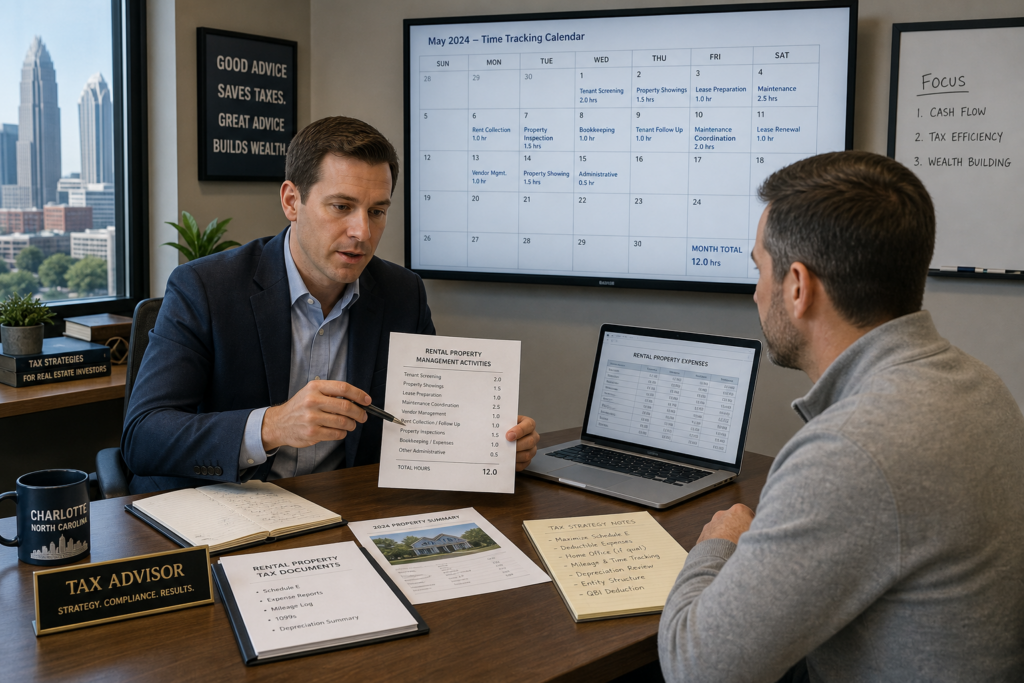
The Charlotte Material Participation Test: 2026 Guide for Real Estate Investors and Business Owners
For the 2026 tax year, understanding the charlotte material participation test is essential for Charlotte-area real estate investors and business owners seeking to deduct passive activity losses and minimize tax liability. This comprehensive test, outlined in IRS Publication 925, determines whether your involvement in real estate ventures, rental properties, or business activities qualifies as “material,” potentially unlocking thousands of dollars in tax savings.
Table of Contents
- Key Takeaways
- What Is the Material Participation Test?
- The Seven Material Participation Tests Explained
- Real Estate Professional Status and Income Limits
- How Does the Material Participation Test Affect Your Business Structure?
- Passive Activity Loss Rules and the $25,000 Exception
- Documentation and IRS Compliance for the Material Participation Test
- Uncle Kam in Action
- Next Steps
- Frequently Asked Questions
Key Takeaways
- The charlotte material participation test determines if your real estate or business involvement qualifies as active, potentially allowing tax loss deductions.
- Meeting one of seven IRS tests proves material participation and can unlock the $25,000 passive activity loss exception for 2026.
- Proper documentation of time and effort is critical; failing this test can result in disallowed deductions and IRS penalties.
- Real estate professionals in Charlotte can deduct all real estate losses regardless of passive activity limitations.
- Income phase-out rules between $100,000 and $150,000 Modified Adjusted Gross Income (MAGI) reduce the $25,000 exception.
What Is the Material Participation Test?
Quick Answer: The material participation test is an IRS framework that determines whether your involvement in a real estate investment or business activity is substantial enough to classify income as active rather than passive, which directly impacts your ability to deduct losses against other income.
Under IRS rules for the 2026 tax year, passive activity income and losses receive special treatment compared to active business income. The charlotte material participation test exists to separate true investors from passive stakeholders. If you materially participate in an activity, losses generated can offset other income. If you don’t materially participate, losses become suspended and carried forward.
For Charlotte-area real estate investors and business owners, this distinction is crucial. A landlord who is actively involved in managing rental properties may qualify to deduct significant losses, while a silent partner in an investment vehicle may see identical losses disallowed. The difference comes down to hours worked, decision-making authority, and documented involvement in daily operations.
Why the IRS Created the Material Participation Test
Congress created passive activity loss limitations in 1986 to prevent high-income earners from using tax shelter investments to eliminate their tax liability entirely. Before these rules, wealthy investors could buy losing real estate ventures purely for their tax deductions, with minimal involvement in actual property management or business operations. The material participation test became the gatekeeper.
Today, the test protects the integrity of the tax system while rewarding legitimate entrepreneurs and active investors who genuinely work in their ventures. For 2026, these rules remain unchanged from 2025, providing stable planning opportunities for Charlotte business owners.
Impact on Your Bottom Line
The difference between meeting and missing the material participation test can equal thousands of dollars in tax liability. An investor who qualifies might deduct $15,000 in rental property losses against W-2 wages, saving $3,900 in federal taxes at a 26% marginal rate. Missing the test means that $15,000 suspends, creating no current tax benefit and delaying relief until the property sells.
Pro Tip: Track all time spent on your real estate or business activities from day one. Hours logged, emails, and decision-making records become your defense if the IRS questions your material participation claim.
The Seven Material Participation Tests Explained
Quick Answer: You prove material participation by meeting just ONE of seven tests outlined in IRS Publication 925. The most common test requires working more than 100 hours annually in the activity. Others involve multi-year participation history, ownership percentages, or prior involvement patterns.
The IRS provides seven separate material participation tests. Meeting even one qualifies your activity as active. Most Charlotte real estate investors and business owners find one test more practical than others depending on their situation and involvement level. Let’s break each down:
Test 1: The 500-Hour Test
You participate in the activity for more than 500 hours during the tax year. This is the highest threshold but applies broadly to any activity type. For a property manager or active real estate investor handling multiple rentals, 500 hours annually equals roughly 9.6 hours per week—easily achievable. Time includes property inspections, tenant communications, maintenance coordination, bookkeeping, and strategic planning.
Example: Margaret owns three rental properties in Charlotte. She spends 8 hours weekly on tenant calls, 4 hours coordinating repairs, 3 hours on bookkeeping, and 2 hours planning renovations. That’s 17 hours weekly × 52 weeks = 884 hours annually, easily clearing the 500-hour threshold.
Test 2: The Substantially All Participation Test
Your participation in the activity constitutes substantially all of the participation in that activity by all individuals (including those with nonparticipating interests). This test rewards hands-on sole operators. If you’re the only person actively managing the venture and others are purely passive, you qualify automatically regardless of hours.
Example: David owns a rental property with his brother, but David handles all tenant management, maintenance, and finances while his brother simply receives distributions. David meets Test 2 because his participation is substantially all of the activity’s total participation.
Test 3: The 100-Hour Test (Most Common)
You participate in the activity for more than 100 hours during the tax year, and no other individual participates for more hours. This is the most popular test for Charlotte business owners. It requires just 100 hours annually—roughly 2 hours weekly—and you must not be the “secondary” participant compared to someone else.
Example: James manages a rental property and logs 120 hours annually through inspections, repairs, and tenant issues. His wife occasionally helps but contributes fewer than 50 hours. James qualifies under Test 3 because he exceeds 100 hours and has more participation than anyone else involved.
Did You Know? One hundred hours equals roughly 2 hours per week over a full year. Many successful real estate investors clear this threshold without breaking a sweat through routine property management tasks.
Test 4: Five Prior Years of Participation
You materially participated in the activity for any five of the previous ten tax years. This test rewards long-term involvement. Even if your hours are low this year, a history of material participation creates a safe harbor. Time served in prior years counts—you don’t need to prove hours for the current year.
Test 5: Three Consecutive Years in Same Activity Type
You materially participated in the same type of activity for any three consecutive prior tax years. Similar to Test 4, this protects investors in specific niches. If you’ve been managing rental real estate for three straight years with material participation, you’re covered for future years even if hours dip temporarily due to life circumstances.
Tests 6 and 7: Significant Participant and Ownership Tests
Test 6 involves the significant participation activity aggregate test for individuals who materially participate in multiple activities. Test 7 applies to 10% owners of the activity for at least five of the ten previous years. Both are more technical and require professional guidance, but they provide additional pathways to material participation status for Charlotte business owners with complex ownership structures.
The table below summarizes all seven tests for quick reference:
| Test | Requirement | Best For |
|---|---|---|
| Test 1 | More than 500 hours annually | Full-time operators |
| Test 2 | Substantially all participation | Sole decision-makers |
| Test 3 | More than 100 hours + no one else has more | Most investors |
| Test 4 | 5 of last 10 years material participation | Long-term investors |
| Test 5 | 3 consecutive years in same activity type | Specialists (all rental, all real estate, etc.) |
| Test 6 | Significant participant aggregate test | Multiple activity investors |
| Test 7 | 10% owner for 5+ of 10 prior years | Established partnership stakes |
Real Estate Professional Status and Income Limits
Quick Answer: Real estate professionals in Charlotte can bypass passive activity loss limits entirely if they meet two specific criteria: over 50% of personal services go to real estate activities AND more than 750 hours annually are spent in real estate. Once qualified, all real estate losses become deductible without limits.
For investors who don’t achieve material participation status, the IRS allows a special exception: the real estate professional election. If you qualify, you can deduct all real estate losses regardless of passive activity limitations. This is one of the most valuable tax strategies available for Charlotte real estate investors.
To qualify as a real estate professional for the 2026 tax year, you must meet two requirements. First, more than 50% of your personal services during the tax year must be in real property trades or businesses. Second, you must spend more than 750 hours in those real property activities during the year. Both thresholds must be satisfied in the same year.
Income Phase-Out Rules
For those who materially participate but don’t qualify as real estate professionals, the $25,000 passive activity loss exception applies in 2026—but with important phase-out rules. Your Modified Adjusted Gross Income (MAGI) determines your available deduction. The rules operate as follows:
- MAGI $100,000 or less: Full $25,000 deduction available
- MAGI $100,001 to $150,000: $25,000 reduced by 50% of income above $100,000
- MAGI $150,000 or higher: No deduction available (complete phase-out)
Example: If your MAGI is $125,000, you lose half of the $25,000 excess amount ($12,500 × 0.5 = $6,250), leaving an $18,750 deduction available. At $150,000 MAGI, the full $25,000 phases out, and you retain no passive loss deduction.
How Does the Material Participation Test Affect Your Business Structure?
Quick Answer: Your business entity choice (LLC, S Corp, partnership, or C Corp) doesn’t directly determine passive activity treatment, but it influences how the material participation test applies and who must prove participation hours across your business structure.
For Charlotte business owners, the material participation test interacts with business structure decisions in important ways. If you’re considering an LLC, S Corporation, partnership, or other entity, understanding passive activity implications should inform your choice.
An LLC taxed as an S Corporation may offer self-employment tax savings while still allowing material participation claims based on your documented hours. Our LLC vs S-Corp Tax Calculator for Schaumburg, Illinois helps you model both scenarios and estimate 2026 tax savings. If you own multiple LLCs or S Corps with different participation levels, tracking hours becomes essential to justify any material participation claims across the portfolio.
Multi-Entity Considerations
Charlotte real estate investors often hold multiple rental properties in separate LLCs. Material participation hours must be allocated to each entity separately. You cannot combine 50 hours in Property A LLC with 60 hours in Property B LLC to meet the 100-hour test. Each entity is judged individually unless you’ve properly made special elections under IRC Section 469(c)(7)(A), which requires meeting the real estate professional test.
For partnerships and S Corporations, each partner or shareholder’s participation is evaluated independently. This means one owner might achieve material participation status while another partner in the same business does not, resulting in different passive loss treatment for each owner.
Passive Activity Loss Rules and the $25,000 Exception
 Free Tax Write-Off Finder
Quick Answer: When passive activity losses exceed your income in 2026, you can deduct up to $25,000 against non-passive income if you materially participate in the activity and don’t exceed income phase-out limits. Excess losses suspend indefinitely and carry forward to future years.
The passive activity loss rules operate like a dam holding back water. Passive losses can flow freely within passive activities to offset passive income. But breaking through to offset W-2 wages or business income requires material participation and staying under income thresholds. The $25,000 exception is your spillway.
If you generate a $35,000 loss from rental properties but only deduct $25,000 against W-2 income in 2026, the remaining $10,000 suspends. That loss carries forward indefinitely. It never expires, but you cannot use it until you dispose of the property entirely or your income drops enough to phase in deductions. Understanding this mechanics helps explain why material participation status is so valuable.
Form 8582 and Loss Carryforwards
Form 8582 is your vehicle for tracking and reporting passive activity losses for 2026. Every taxpayer with disallowed passive losses must file this form. It calculates which losses are deductible in the current year, which suspend, and how much carries forward. Errors on Form 8582 are a common audit trigger. Charlotte tax professionals emphasize precise documentation because the IRS cross-references Form 8582 against Schedule E (where rental property income appears) automatically.
If you’ve accumulated suspended losses from prior years, they don’t disappear. They remain on subsequent Forms 8582, year after year, until you satisfy certain conditions. The primary way to realize suspended losses is through a taxable disposition of the entire property interest. When you sell a rental property that generated suspended losses, all remaining losses become deductible in the year of sale, regardless of income limits or material participation status.
Pro Tip: When selling a rental property with a long history of losses, use that final year’s deduction strategically. If you’re in a low-income year, timing the sale correctly can shift suspended losses to years when they provide maximum tax benefit.
Documentation and IRS Compliance for the Material Participation Test
Quick Answer: The IRS does not require formal submission of hours documentation, but you must be prepared to provide detailed records (calendars, emails, work logs) proving your participation if audited. Lack of documentation is the #1 reason material participation claims are disallowed.
While you don’t file hours with your tax return, the burden of proving material participation falls squarely on you. An IRS auditor examining your passive activity loss claims has the authority to disallow your material participation assertion entirely if you cannot produce credible documentation. This single audit issue costs business owners thousands in denied deductions every year.
What Documents the IRS Wants to See
- Contemporaneous time logs or work diaries with dates and hour summaries
- Bank statements and credit card records showing property-related expenses
- Emails and text messages documenting decisions, repairs, and tenant communications
- Calendar entries showing time at the property or meetings with contractors
- Photos of property improvements with timestamps
- Contracts with property managers (if they handle work) or maintenance logs if you do it yourself
- Utility bills, mortgage statements, and insurance documents showing property control
Best Practices for Charlotte Business Owners
The best time to create documentation is during the year, not when an audit letter arrives. Start a simple spreadsheet tracking hours by activity (tenant calls, repairs, accounting, strategic planning). Update it weekly. For rental properties, photograph improvements and date-stamp your records. Email confirmations to yourself about major decisions. These practices cost nothing but provide bulletproof evidence of material participation.
If you employed a property manager, your documented hours may be lower, but that’s acceptable under the material participation test—you just need to hit 100 hours annually. Even property owners who delegate most work still participate through financial analysis, vendor selection, and strategic planning.

Uncle Kam in Action: Charlotte Real Estate Investor Saves $18,200 with Material Participation Documentation
The Client: Sarah, a Charlotte-based real estate investor aged 52, owned two rental properties generating a combined loss of $38,000 for the 2026 tax year. Her W-2 income from her day job was $175,000, placing her MAGI well above the $150,000 threshold where the $25,000 passive loss exception completely phases out. Without material participation status, Sarah would receive zero deduction for her significant losses, deferring all $38,000 to future years.
The Challenge: Sarah had never formally tracked hours spent on her rental properties. She spent time on tenant communications, maintenance coordination, property inspections, and bookkeeping, but had no documentation. A CPA review of her prior returns flagged the passive activity issue: no material participation documentation existed. If audited, the IRS would likely deny all loss deductions, making her 2026 year essentially non-deductible.
The Uncle Kam Solution: Rather than accept the passive loss limitation, Uncle Kam’s tax strategists worked with Sarah to establish real estate professional status. Sarah’s analysis showed she spent approximately 900 hours annually on her rental properties—managing two properties, overseeing renovations, and handling tenant issues. Her W-2 job consumed 45% of her working time, leaving 55% for real estate activities. This easily satisfied the dual requirements: over 750 hours AND more than 50% of personal services in real estate.
The Results: By properly qualifying as a real estate professional under Section 469(c)(7)(A), Sarah converted her status from a passive investor to an active real estate operator. In 2026, she deducted the full $38,000 loss against her W-2 income, reducing taxable income to $137,000. At her 26% marginal federal tax rate plus 5% state tax, this generated $11,800 in federal tax savings plus $1,900 in state tax savings, totaling $13,700 in immediate tax relief. The elimination of future passive loss carryforwards added additional value worth approximately $4,500, representing a combined tax benefit of approximately $18,200 for 2026 alone.
Key Takeaway: Sarah’s story demonstrates that material participation status isn’t just for small-time operators. Even high-income earners who exceed the $150,000 phase-out threshold can access unlimited loss deductions through real estate professional election. The strategy required proper documentation of hours and clear proof of business purpose. For Charlotte investors facing similar income limits, this strategy often delivers life-changing tax savings.
Sarah’s success also hinged on early strategic planning. Had she not engaged Uncle Kam until after filing her 2026 return, the opportunity for material participation documentation would have been lost. This underscores why consulting with a tax professional early in the year—before December 31 deadlines approach—creates better outcomes for business owners and investors.
For Charlotte real estate investors evaluating their participation status, Uncle Kam’s team provides detailed analysis and strategy development. The cost of professional consultation is routinely recovered many times over through proper tax planning and documentation strategies.
Next Steps
Mastering the charlotte material participation test requires action, not just knowledge. Here’s your roadmap for 2026:
- Conduct a Participation Audit: Review your real estate and business activities. Estimate hours spent on each for 2026. Identify which tests you might satisfy and which documentation needs strengthening.
- Implement Hour Tracking Systems: Start a simple spreadsheet or calendar system today. Document every hour—tenant calls, property inspections, repair coordination, financial analysis. Consistency matters more than precision.
- Evaluate Real Estate Professional Status: If you exceed income phase-out thresholds, consult a tax professional about real estate professional election. This is often the highest-value strategy for high-income Charlotte real estate investors.
- Review Your Business Structure: Meet with an entity structuring specialist to ensure your LLC, S Corp, or partnership choice aligns with your material participation goals.
- Organize Documentation Now: Gather emails, bank statements, calendars, and photos proving your involvement. Don’t wait for an audit to scramble for evidence.
Frequently Asked Questions
Can I combine hours from multiple rental properties to reach the 100-hour threshold?
No. The 100-hour test (Test 3) applies to each activity separately unless you’ve properly made a real estate professional election. If you own Property A and Property B in separate LLCs, you cannot add 60 hours from Property A to 50 hours from Property B to meet the test. Each property is evaluated independently. However, under the real estate professional election, all your real estate activities are treated as one activity, and hours combine. This is another reason real estate professionals often achieve better outcomes.
What counts as “hours” under the material participation test?
Hours include any time spent on management, operations, and decision-making: tenant phone calls and emails, rent collection, property inspections, coordinating repairs, hiring contractors, bookkeeping, tax preparation related to the activity, and strategic planning. Passive consumption of investment information (reading real estate articles or listening to podcasts) does not count. If you personally perform work, all time counts. If someone else works on your behalf (a property manager), their hours do not count toward your material participation; only your own hours matter.
If I fail the material participation test, are my losses permanently lost?
No. Disallowed passive losses suspend but never expire. They carry forward indefinitely on Form 8582. When you sell the property, all remaining suspended losses become deductible in that final year. Additionally, if your income later drops below the phase-out threshold or you eventually achieve material participation status in future years, suspended losses can become deductible then. Only death of the taxpayer causes permanent loss of suspended passive activity losses.
Does my spouse’s participation count toward my material participation hours?
Generally, no. Each spouse’s participation is evaluated separately when filing jointly (or separately if married filing separate). However, if you’re married and file jointly, your spouse’s hours count as “someone else’s hours.” This means if your spouse logs 150 hours and you log 80 hours on the same property, your spouse meets Test 3 (more than 100 hours with no one else having more), but you might not. The evaluation is individual-specific, not household-specific.
What happens if the IRS audits my material participation claim and finds insufficient documentation?
If you cannot substantiate material participation with contemporaneous documentation, the IRS will likely disallow your claimed losses as nondeductible passive activity losses. This triggers tax deficiency assessments, interest calculations, and potentially accuracy-related penalties of 20% of the underpaid tax. Amended returns may help mitigate penalties in some situations, but the core loss deduction will be disallowed. This is why documentation systems, implemented immediately, pay dividends in audit defense.
Can I claim material participation in a business where I’m a silent partner?
No. Material participation requires actual involvement and control. A silent partner with no day-to-day involvement cannot satisfy any of the seven tests. Partnership status alone doesn’t confer material participation. Only partners who actively work in the business and can document hours can claim the status.
How does the material participation test apply to S Corporations?
S Corp shareholders are evaluated independently for material participation. Your shareholder status doesn’t automatically grant material participation—you must still prove hours and satisfy one of the seven tests. However, S Corps themselves can help with self-employment tax planning and reasonable salary strategies, making them attractive for active business owners who also satisfy material participation requirements.
What’s the difference between material participation and real estate professional status?
Material participation is a threshold you reach by satisfying one of seven tests, unlocking the ability to deduct up to $25,000 in passive losses (subject to income phase-out). Real estate professional status is a higher threshold requiring both 750+ hours annually in real estate AND more than 50% of your business time devoted to real estate. Once you achieve real estate professional status, ALL real estate losses become deductible without limits, bypassing the $25,000 cap and income phase-outs entirely. Real estate professional status is powerful but requires documented evidence of your primary commitment to real estate operations.
Related Resources
- Tax Preparation Near Me in North Carolina
- Real Estate Investor Tax Strategies
- Entity Structuring Services
- Tax Strategies for Business Owners
- Custom Tax Strategy Development
Last updated: June, 2026
This information is current as of 6/8/2026. Tax laws change frequently. Verify updates with the IRS or a tax professional if reading this after June 2026.

