Tennessee Installment Sale Real Estate: Complete 2026 Tax Planning Guide for Investors and Homeowners
Tennessee Installment Sale Real Estate: Complete 2026 Tax Planning Guide for Investors and Homeowners
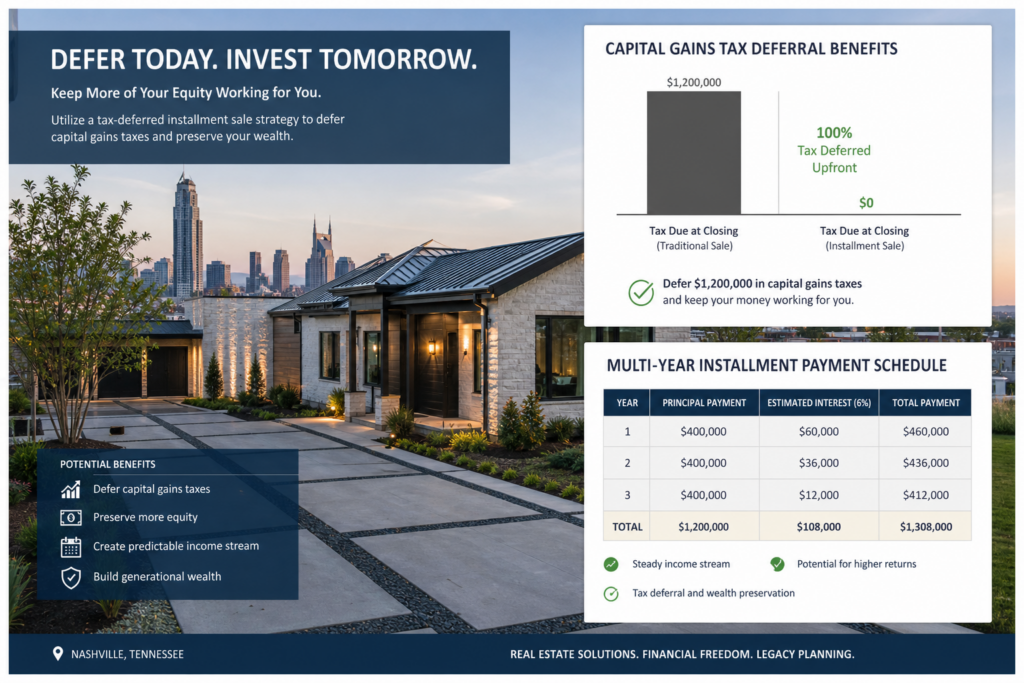
For the 2026 tax year, Tennessee real estate sellers can leverage installment sale strategies to significantly reduce federal capital gains taxes while taking advantage of the state’s lack of income tax. As home prices continue rising and more homeowners exceed the outdated $250,000 (single) or $500,000 (married) federal capital gains exclusion limits, a Tennessee installment sale real estate transaction offers a proven method to spread gains over multiple years, potentially keeping you in lower tax brackets and preserving more of your profit.
Table of Contents
- Key Takeaways
- What Is a Tennessee Installment Sale Real Estate Transaction?
- How Capital Gains Tax Works for Property Sales in Tennessee
- What Are the Key Tax Benefits of an Installment Sale in Tennessee?
- How to Structure an Installment Sale of Real Estate in Tennessee
- How Does an Installment Sale Affect Your Annual Tax Liability in Tennessee?
- What Common Mistakes Derail Tennessee Installment Sales?
- Uncle Kam in Action
- Next Steps
- Frequently Asked Questions
Key Takeaways
- Tennessee installment sale real estate transactions spread capital gains over multiple years, potentially reducing your annual tax burden in 2026.
- Tennessee has no state income tax, so your federal capital gains rate of 15% or 20% (depending on income) is your only concern.
- Installment sales require strict compliance with IRS Section 453, Form 1099-S filing, and proper documentation or face severe penalties.
- Depreciation recapture on rental properties remains taxable at 25% regardless of installment treatment.
- For 2026, with capital gains exclusions unchanged since 1997 and home prices up 3.5x, installment sales are increasingly essential for Tennessee sellers.
What Is a Tennessee Installment Sale Real Estate Transaction?
Quick Answer: An installment sale is when you sell Tennessee real estate and receive payment from the buyer over multiple years instead of one lump sum. The IRS allows you to report capital gains using the installment method, spreading tax recognition across the payment period.
A Tennessee installment sale real estate deal occurs when a property seller receives payment in at least two tax years. Under IRS Section 453, taxpayers can elect installment sale treatment, which defers the recognition of capital gain to the years when payments are actually received. This is fundamentally different from a lump-sum sale, where all capital gains are recognized in the year of closing.
For example, if you sell a Nashville rental property worth $800,000 with an adjusted basis of $300,000, your total gain is $500,000. In a traditional sale, you’d owe federal capital gains tax on the entire $500,000 in year one. With an installment sale receiving $200,000 down payment and four annual payments of $150,000, you’d recognize gain proportionately over five years instead of paying it all at once.
Why Tennessee Real Estate Makes Installment Sales Strategic
Tennessee offers a unique advantage: there is no state income tax. This means your only capital gains tax exposure is federal, making installment sale strategies especially powerful. Combined with the spreading of gains across multiple years, Tennessee sellers can optimize their federal tax bracket positioning and potentially drop into lower capital gains brackets (15% instead of 20%) by controlling income recognition annually.
When an Installment Sale Qualifies Under Section 453
Not all real estate sales qualify for installment treatment. Your sale must meet these requirements: the property must be sold for a price greater than your basis, at least one payment must be received in a tax year after the year of sale, and you cannot be a dealer in real estate (unless the property qualifies as real property in your trade or business).
How Capital Gains Tax Works for Property Sales in Tennessee
Quick Answer: Federal capital gains tax rates for 2026 are 15% or 20% depending on income level. Tennessee has no state income tax. Capital gains exclusions (Section 121 for primary residences) have not changed since 1997: $250,000 single, $500,000 married filing jointly.
The fundamental issue facing Tennessee real estate sellers in 2026 is straightforward: the federal capital gains exclusion for primary residences is outdated. In 1997, the median home price was $129,000. Today, it’s $419,300 according to Realtor.com data. Yet the exclusion remains frozen at $250,000 for single filers and $500,000 for married couples. This creates what researchers call the “hidden home equity tax,” forcing more sellers than ever to confront unexpected capital gains taxes.
Federal Long-Term Capital Gains Rates in 2026
For the 2026 tax year, long-term capital gains are taxed at three federal rates based on your income bracket. If your taxable income falls in the 10% or 12% ordinary income brackets, capital gains are taxed at 0%. For those in the 22%, 24%, 32%, or 35% brackets, capital gains are taxed at 15%. And for those in the highest 37% bracket, capital gains are taxed at 20%. This is why spreading gains across multiple years through an installment sale can be transformative—you might keep gains in the 15% bracket instead of jumping to 20%.
Tennessee’s Tax Advantage: No State Income Tax
Tennessee does not impose state income tax on real estate capital gains. This is a significant advantage compared to neighboring states like Kentucky (6% tax) or Virginia (5.75% tax). When you structure a Tennessee installment sale real estate transaction, you eliminate the state tax component entirely, leaving only the federal rate as your concern. This singular focus simplifies planning and maximizes the benefit of spreading income recognition across multiple years.
What Are the Key Tax Benefits of an Installment Sale in Tennessee?
Quick Answer: Installment sales reduce annual tax liability, enable tax bracket management, defer payment timing, and allow Tennessee sellers to preserve retirement assets while maintaining seller financing income.
An installment sale of Tennessee real estate real estate offers multiple financial advantages beyond simple tax deferral. Let’s examine the concrete benefits that make this strategy increasingly popular for high-net-worth sellers.
Benefit 1: Tax Bracket Management and Lower Effective Tax Rates
Consider a Tennessee homeowner selling a property with $600,000 in capital gains. In a lump-sum sale, recognizing the entire $600,000 in one year could push their income into the 20% capital gains bracket plus potentially subject them to net investment income tax (3.8%), creating a combined 23.8% federal rate. However, structuring as an installment sale receiving $120,000 gain per year for five years allows that seller to stay in the 15% bracket or potentially even the 0% bracket if other income is managed strategically. Over five years, that difference between 23.8% and 15% could represent $52,800 in tax savings on a $600,000 gain.
Benefit 2: Seller Financing Creates Ongoing Income Stream
Beyond tax management, offering seller financing in a Tennessee installment sale real estate transaction increases the pool of qualified buyers. Owner financing can result in a higher sale price than an all-cash transaction. Additionally, you receive interest income on the outstanding balance, which is ordinary income but provides predictable cash flow during retirement years.
Benefit 3: Deferred Recognition of Gains Provides Planning Flexibility
Timing of gain recognition allows sophisticated planning. If you’re planning major charitable donations, you can coordinate with years of lower installment income. If you anticipate retirement income changes, you can structure payments to align with lower-income years. This flexibility is impossible with a lump-sum sale.
Pro Tip: Track your modified adjusted gross income (MAGI) carefully in each year of an installment sale. This affects your capital gains bracket, Medicare premium calculation, and potential exposure to net investment income tax (3.8%). Advanced coordination with your CPA can minimize total tax across all buckets.
How to Structure an Installment Sale of Real Estate in Tennessee
 Free Tax Write-Off Finder
Quick Answer: Document the sale contract with clear terms, set appropriate interest rates using IRS Applicable Federal Rates (AFR), file Form 1099-S with the IRS, report on Form 6252 (Installment Sale Income) on your tax return, and maintain detailed payment records.
Structuring a proper Tennessee installment sale real estate transaction requires careful attention to IRS compliance. Here’s the step-by-step process:
Step 1: Execute Proper Sale Documentation
Create a comprehensive purchase agreement that clearly identifies all parties (buyer, seller, any intermediaries), describes the property in detail, specifies total sale price, and outlines the installment payment schedule. The contract must be binding and unambiguous. If you’re seller-financing, include loan terms, interest rate, repayment schedule, and default provisions. Work with a Tennessee real estate attorney to ensure the documentation complies with state law and creates an enforceable security interest in the property.
Step 2: Set Appropriate Interest Rates
The IRS requires “adequate interest” on installment sales. You must charge at least the Applicable Federal Rate (AFR). For 2026, AFR rates change monthly based on Treasury yields. You can charge a higher rate, but any rate below AFR triggers imputed interest rules, creating additional phantom income and penalty exposure. Your real estate attorney or tax professional should verify current AFR rates before documenting the sale.
Step 3: Determine Gain Recognition and File Form 1099-S
Calculate your total gain (sale price minus adjusted basis minus selling expenses). Determine the percentage of gain to total sale price. For example, if you sell for $800,000 with $200,000 in basis and $30,000 in expenses, your gain is $570,000 on proceeds of $770,000, or approximately 74% of each payment is gain. The closing agent or settling attorney must file Form 1099-S with the IRS and provide Copy B to you by February 17, 2026 (for 2025 sales; adjust dates accordingly for later years). The form reports gross proceeds; the IRS then applies installment method calculations on your tax return.
Step 4: Report Installment Income on Form 6252
File Form 6252 (Installment Sale Income) with your 2026 tax return (or the return for the year of sale). This form officially elects installment method reporting, calculates the gross profit and gross profit percentage, and determines how much gain to recognize in the current year based on payments received. Your tax professional must complete this form accurately. Failure to file Form 6252 in the year of sale can result in loss of installment treatment and recognition of all gain in year one.
Step 5: Maintain Detailed Payment Records
Document every payment received, including the date, amount, and whether it represents principal gain or interest. Create an amortization schedule showing the allocation of each payment. Keep these records for at least seven years (the extended statute of limitations for real estate transactions involving depreciation recapture).
How Does an Installment Sale Affect Your Annual Tax Liability in Tennessee?
Quick Answer: Each year you receive payments, you recognize capital gain proportional to the percentage of gain in the sale. Interest income is ordinary income. Use our Self-Employment Tax Calculator for Baltimore to estimate how additional income affects Medicare premiums and net investment income tax.
The annual tax impact of a Tennessee installment sale real estate transaction is determined by a formula: payments received times the gain percentage equals recognized capital gain for that year. Let’s illustrate with a concrete example.
Calculating Annual Capital Gain Recognition
Assume you sell a Memphis commercial property for $1,000,000 with a basis of $400,000 and selling costs of $50,000. Your total gain is $550,000. The gross profit percentage is $550,000 ÷ $1,000,000 = 55%. If the buyer pays $200,000 down and four annual payments of $200,000, each year you recognize $200,000 × 55% = $110,000 in capital gain. Additionally, if you’re charging interest at 6%, the first year’s interest on $800,000 outstanding is $48,000, which is ordinary income. So your first-year total income from the sale is $110,000 capital gain plus $48,000 ordinary interest = $158,000 reportable income from that transaction alone.
Impact on Total Federal Tax Liability
The capital gain component of $110,000 is subject to the 15% or 20% federal capital gains rate, costing approximately $16,500 to $22,000 in federal tax on that portion. The interest component of $48,000 is ordinary income subject to your marginal bracket, likely 22%, 24%, 32%, or 35% depending on your total income. The combined tax burden in year one could be approximately $26,000 to $28,000 on the installment income. By comparison, a lump-sum sale would recognize all $550,000 in year one, potentially pushing total income into the $1,000,000+ range, triggering the highest brackets and net investment income tax, potentially costing $180,000+ in federal tax. The installment method shows significant advantage.
Don’t Forget Depreciation Recapture
For rental or business properties, depreciation recapture is still taxed at 25% regardless of whether you use installment method. In the above example, if $200,000 of the $550,000 gain is depreciation recapture, that $200,000 is taxed at 25% in the year of sale, not spread across installments. Only the remaining $350,000 long-term capital gain is eligible for installment treatment. This is a critical distinction that many sellers overlook.
What Common Mistakes Derail Tennessee Installment Sales?
Quick Answer: The most costly errors include failing to file Form 6252, charging inadequate interest, treating payments incorrectly, miscalculating depreciation recapture, and not documenting gains properly.
Even well-intentioned Tennessee installment sale real estate transactions fail due to common compliance mistakes. Here are the pitfalls that trigger IRS audits and penalties:
- Failing to file Form 6252: If you don’t file Form 6252 in the year of sale, the IRS treats it as a regular sale with all gain recognized immediately. This cannot be corrected later without amended returns and substantial penalties.
- Charging below-AFR interest: Setting interest below Applicable Federal Rates triggers IRS imputation rules. The difference becomes phantom ordinary income, and underpayment penalties apply.
- Receiving payments without written documentation: Relying on informal agreements or oral promises creates disputes with buyers and IRS scrutiny. All payments must be documented with loan documents, promissory notes, and regular statements.
- Failing to report installment income annually: Each year you must file Form 6252 continuation, showing payment received and gain recognized. Missing years triggers accuracy-related penalties.
- Mishandling depreciation recapture: Failing to segregate and immediately recognize 25% depreciation recapture creates significant additional tax liability and penalties.
- Not recording the promissory note: If your state requires or allows recordation of promissory notes to perfect a security interest, failure to record weakens your collateral position and may trigger tax consequences if the note becomes unsecured.
- Forgetting to file Form 1099-S: The closing agent must file this with the IRS by March 31. If they don’t, and you claim installment treatment, the IRS questions whether the transaction actually occurred. Verify this yourself.
Pro Tip: Work with a CPA familiar with installment sales from day one. The cost of professional guidance ($2,000 to $5,000) is trivial compared to the cost of IRS corrections ($50,000+) plus penalties and interest. Have your CPA review all documentation before closing.

Uncle Kam in Action: Nashville Commercial Property Installment Sale
Client Profile: Mike, a 58-year-old real estate investor and business owner in Nashville, owned a commercial office building purchased in 1998 for $200,000. The property had appreciated to a $950,000 fair market value by 2026. Mike had claimed $150,000 in depreciation deductions over 28 years of ownership.
The Challenge: A buyer offered $950,000 cash for the property. Mike’s gain calculation: $950,000 sale price minus $200,000 basis minus $150,000 depreciation recapture basis adjustment equals $600,000 in total gain. Of this, $150,000 is subject to 25% depreciation recapture tax, and $450,000 is long-term capital gain. A lump-sum sale would trigger immediate taxation of all $150,000 at 25% ($37,500) plus the $450,000 at his marginal rate of 20% ($90,000), totaling $127,500 in federal taxes on the sale alone.
The Uncle Kam Solution: We structured a Tennessee installment sale real estate deal: $150,000 down (satisfying the depreciation recapture immediately), then five annual payments of $160,000 each over five years, with interest at 6% (current AFR for mid-term obligations). This immediately recognized the $150,000 depreciation recapture at closing ($37,500 tax). Over the next five years, Mike receives $160,000 annually, of which 75% ($120,000) is capital gain and 25% ($40,000) represents declining interest on the outstanding balance. Each year’s capital gain recognition is $120,000 × 75% = $90,000 (plus interest income). This spreads the $450,000 long-term capital gain evenly over five years rather than all at once.
The Financial Results: In year one of the installment sale, Mike’s federal capital gains tax is approximately $13,500 (on the $90,000 annual gain at 15% bracket). Years two through five are similar. Total federal tax on the capital gain component: approximately $67,500 spread over five years rather than $90,000 in year one. Additionally, the seller financing gave Mike a competitive advantage in the sale—the buyer preferred installment terms to obtaining bank financing, allowing Mike to negotiate the final price up 2% to $970,000. That additional $20,000 more than offset the cost of professional structuring. By coordinating with professional tax preparation services in Tennessee, Mike positioned himself to manage annual tax brackets strategically, potentially keeping future capital gains in the 15% bracket instead of jumping to 20%.
Outcome: Total federal tax savings across the five-year installment sale period: approximately $35,000 compared to lump-sum treatment. Additionally, Mike maintained a retirement income stream of $160,000 annually for five years, plus interest income, creating predictable cash flow.
Next Steps for Tennessee Installment Sale Real Estate Planning
- Calculate your gain immediately if you’re considering selling in 2026. Know your cost basis, depreciation recapture, and selling expenses before engaging a buyer.
- Consult a Tennessee-licensed real estate attorney to draft sale documentation that creates proper installment terms and security interests.
- Work with a CPA or tax professional experienced in tax strategy to model multiple sale scenarios and determine optimal payment structures.
- Review your 2026 income projections. If an installment sale will push you into higher brackets, consider timing the down payment and first installment in different tax years.
- Obtain a copy of the applicable federal rate from the IRS website for the month of sale to ensure proper interest rate documentation.
Frequently Asked Questions
Can I use the Section 121 capital gains exclusion ($250,000 or $500,000) if I structure an installment sale?
Yes, you can combine the Section 121 primary residence exclusion with installment method reporting. If you sell a primary residence for $750,000 with a $400,000 basis, your gain is $350,000. The first $250,000 (single) or $500,000 (married) is excluded from tax. With installment method, the remaining gain after exclusion is spread over the payment years. For married couples selling for $750,000, for example, the entire $250,000 gain might fall within the $500,000 exclusion, eliminating all capital gains tax regardless of installment treatment.
What happens if the buyer defaults on installment payments?
If the buyer defaults, you can attempt foreclosure to reclaim the property (if you recorded a mortgage or deed of trust). For tax purposes, a default is complex. You may claim a bad debt deduction for the uncollected gain, or if you’re a business, this might be ordinary loss treatment. Consult your tax professional immediately if default occurs, as the tax rules differ significantly based on the type of property and your situation.
If my buyer assumes a mortgage, how does that affect the installment sale?
If the buyer assumes an existing mortgage, the loan amount reduces the gross proceeds for installment calculation purposes. Your contract must clearly reflect whether the mortgage is assumed or paid off from sale proceeds. An assumed mortgage creates additional tax complexity because the IRS treats the mortgage relief as proceeds, which can trigger gain recognition in the year of sale. Always involve a CPA in transactions where mortgages are assumed.
Is there a time limit on how long an installment sale can extend (5 years, 10 years, 30 years)?
Technically, there is no statutory limit on the term of an installment sale. You could theoretically structure a 30-year payout. However, practical considerations apply. If you pass away before the final payment, your estate must account for the remaining note as an asset. Additionally, the longer the term, the greater the default risk. Most installment sales use five to ten-year terms to balance tax spreading benefits with practical risk management.
Can I convert a rental property to a primary residence to claim the Section 121 exclusion before selling via installment sale?
This is a common strategy called “conversion to primary residence,” but it’s heavily scrutinized. To claim the Section 121 exclusion, you must own and live in the property as your primary residence for at least two of the five years before sale. If you owned a rental for ten years, then converted to personal use for two years, then sold, the IRS will recapture depreciation claimed during the rental years (that $150,000 in our earlier example). While some of the gain may benefit from the Section 121 exclusion, depreciation recapture is still taxed at 25%, and the IRS applies pro-rata calculation of the exclusion based on rental vs. personal use periods. Consult a tax professional before attempting this strategy.
What IRS forms do I need to file each year of an installment sale?
In the year of sale, file Form 6252 (Installment Sale Income) with your tax return. In each subsequent year, file the continuation Form 6252 showing payments received and gain recognized. If you’re tracking ordinary interest income, ensure it’s reported on Schedule B (if over $1,500 in total interest). Additionally, if you provided seller financing and the note includes accrued interest exceeding $600, you must send Form 1099-INT to the buyer and file with the IRS. Keep all supporting documentation (amortization schedules, payment records, promissory note copies) for at least seven years.
Does an installment sale affect my Medicare premiums or Social Security taxation?
Yes. Capital gains increase your Modified Adjusted Gross Income (MAGI), which affects Medicare premium brackets (Income-Related Monthly Adjustment Amounts or IRMAA). If you’re receiving Social Security benefits, increased income can trigger taxation of benefits. Additionally, capital gains over certain thresholds trigger Net Investment Income Tax (3.8% surtax). An installment sale spreading gains over multiple years can help manage these secondary tax consequences. Coordinate with your tax professional to avoid triggering higher Medicare brackets or Social Security taxation in high-income years.
Last updated: May, 2026

