
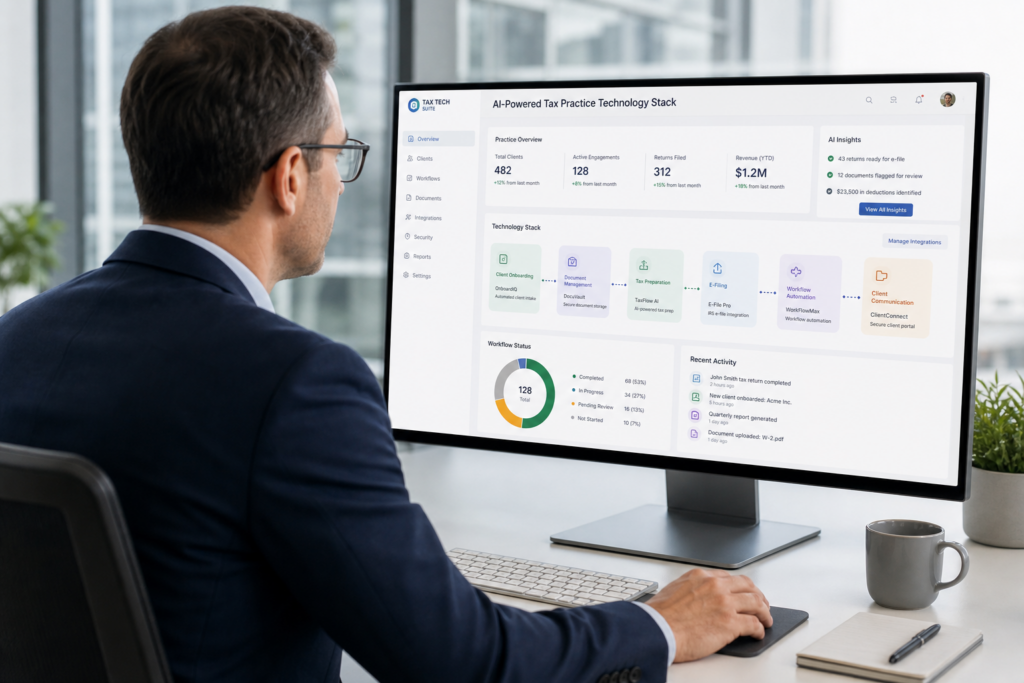
Tax Practice Technology Stack: 2026 Firm Guide
Your tax practice technology stack decides whether you thrive or stall in 2026. AI now automates the grunt work. As a result, your firm’s real value shifts to advice, not data entry. This guide shows you how to build a modern tax practice technology stack step by step. You will learn which tools matter, how to automate compliance, and how to turn saved hours into high-value tax strategy services that clients gladly pay for.
Table of Contents
- Key Takeaways
- What Is a Tax Practice Technology Stack?
- What Tools Belong in Your 2026 Stack?
- How Does AI Fit Into a Tax Technology Stack?
- How Do You Move From Compliance to Advisory?
- How Do You Audit and Build Your Stack?
- What Are the Risks and Compliance Rules?
- Uncle Kam in Action
- Related Resources
- Next Steps
- Frequently Asked Questions

Key Takeaways
- A strong tax practice technology stack automates compliance and frees time for advisory work.
- In 2026, clients want speed, better advice, and stronger data privacy.
- AI adds value only with a clear strategy, not just new software.
- Fixed-fee advisory pricing now beats hourly billing for firm profit.
- A written security plan (WISP) is a must-have layer of your stack.
What Is a Tax Practice Technology Stack?
Quick Answer: A tax practice technology stack is the connected set of software tools your firm uses to prepare returns, plan taxes, manage clients, and protect data.
Your stack is more than tax prep software. It is every tool that runs your firm end to end. Think intake, document gathering, preparation, planning, billing, and security. When these tools talk to each other, work flows smoothly. When they do not, staff waste hours on manual re-entry.
Many solo practitioners and small firm owners feel anxious about all this change. That worry is normal. However, the right stack does not replace you. Instead, it removes busywork so you can do the thinking that clients truly pay for.
The Four Core Layers of a Modern Stack
Every effective stack has four layers. Each layer solves a different problem. Together, they form one smooth system.
- Compliance layer: tax prep software, e-file tools, and document scanners.
- Advisory layer: tax planning software and scenario modeling tools.
- Operations layer: workflow, billing, and client portals.
- Security layer: encryption, backups, and your written security plan.
Why Integration Matters More Than Any Single Tool
A tool that stands alone creates friction. For example, if your planning software cannot pull client data from your prep tool, you type it twice. As a result, errors rise and hours vanish. Therefore, choose tools that connect through clean data links. This is the heart of a smart tax practice technology stack.
Pro Tip: Map your data flow before you buy anything. Draw how a client file moves from intake to filing. Gaps in that map show you exactly which tools to add.
What Tools Belong in Your 2026 Stack?
Quick Answer: A 2026 stack needs prep software, a client portal, workflow tools, tax planning software, and strong security. AI now sits across all of these.
Start with the basics, then layer up. You do not need dozens of tools. In fact, fewer tools that connect well beat many that do not. Below is a simple map of what most firms need in 2026.
Stack Layers and Their Job
| Layer | Main Job | Client Benefit |
|---|---|---|
| Compliance | Prepare and e-file returns | Accurate, on-time filing |
| Advisory | Model tax-saving strategies | Lower lifetime tax bill |
| Operations | Manage workflow and billing | Faster service and clarity |
| Security | Protect client data | Trust and legal safety |
Clients now expect speed above all. In a 2026 survey covered by Accounting Today, 79% of clients said faster service tops their list. Better advice came next at 67%. Data privacy followed at 66%. Your stack must deliver on all three.
The Client Portal Is No Longer Optional
A secure client portal replaces risky email attachments. Clients upload documents safely. You reply through one channel. Moreover, the IRS urges pros to exchange records through secure portals, not random email. So a portal serves both speed and security at once.
Pro Tip: Pick a portal that supports two-factor login. It blocks most phishing attempts and meets rising client privacy demands in 2026.
How Does AI Fit Into a Tax Technology Stack?
Quick Answer: AI now automates data entry, document review, and research. It works best when paired with a clear strategy and human review.
AI is the biggest shift in your tax practice technology stack today. It reads documents, sorts data, and drafts research. As a result, tasks that took hours now take minutes. However, AI does not replace judgment. It removes the boring parts so you can focus on advice.
Big firms show the path. Ernst & Young rolled out an internal AI assistant and Microsoft Copilot to its tax teams. Yet even EY notes AI has limits and needs human oversight. The lesson is clear. Buy AI with intent, not hype.
Where AI Delivers the Fastest Wins
- Reading and sorting client documents automatically.
- Drafting first-pass tax research and memos.
- Flagging planning opportunities across returns.
- Turning complex data into client-ready summaries.
This is where a purpose-built platform helps. Uncle Kam is an AI tax planning software that turns messy client data into clear strategy plans. It uses the MERNA framework to review deductions, entity structure, retirement, niche moves, and advanced plays across every entity at once. So you spend less time modeling and more time advising.
Strategy Beats Software Every Time
A 2026 report found that 91% of professionals say their firms fall short of what AI could deliver. This gap comes from buying tools without a plan. Therefore, define the outcome first. Then pick the tool that fits it. To learn more about safe AI use, review the NIST AI Risk Management Framework.
Did You Know? In a 2026 poll, half of firm leaders said AI helped them expand into tax planning. Advisory is now the fastest-growing service line.
How Do You Move From Compliance to Advisory?
Quick Answer: Use your stack to automate compliance, then reinvest the saved hours into paid advisory services with fixed-fee pricing.
Compliance work is getting commoditized. AI makes it faster and cheaper each year. So your growth now comes from advice, not prep. This is the core reason to build a modern tax practice technology stack in the first place.
The numbers back this up. In 2026, fixed-fee pricing became the top model for tax prep at 37%. Meanwhile, pure hourly billing fell below 3%. Clients want price certainty. Advisory retainers give them that. They also give you steady, recurring revenue.
A Simple Three-Step Transition Plan
- Automate prep with AI to free up staff hours.
- Run a tax plan for every prep client as a value-add.
- Convert those plans into paid advisory engagements.
Serving self-employed and 1099 clients is a great starting niche. They often overpay on self-employment tax. Orlando freelancers can estimate their liability with our Self-Employment Tax Calculator for Orlando to spot savings for 2026. That single number opens a real advisory conversation.
The Deliverable Is What Clients Pay For
Clients pay for clarity, not spreadsheets. A polished plan with a summary, a roadmap, and a risk note feels worth the fee. Uncle Kam’s engine builds these branded deliverables for you. Ready to sell more advisory? Book a strategy session to see how firms scale this fast.
Pro Tip: Price your advisory as a monthly retainer. It smooths revenue and keeps you working with clients all year, not just at filing time.
How Do You Audit and Build Your Stack?

Quick Answer: List every tool, cut redundant ones, map your data flow, and add tools that fill real gaps in your workflow.
Many firms pay for tools they barely use. A yearly audit fixes this. It cuts cost and reduces confusion. Furthermore, a clean stack runs faster and trains new staff more easily.
The Five-Step Stack Audit
- List every tool, its cost, and its owner.
- Mark tools that overlap or go unused.
- Map how data moves between each tool.
- Cut redundant tools to lower cost.
- Add one tool to fill your biggest gap.
Do not rebuild everything at once. Pick one gap and solve it. Then measure the result. This slow, steady method beats a rushed overhaul. It also keeps your team calm during change.
Measure ROI on Every Tool
Each tool must earn its keep. Ask a simple question. Does this tool save hours or grow revenue? If not, cut it. For a firm that models entities, entity-aware planning tools pay for themselves fast. They spot S corp savings across a whole client base in minutes.
| Old Manual Workflow | AI-Powered Workflow |
|---|---|
| Manual document entry (hours) | Auto document scan (minutes) |
| Research by hand (4-5 hours) | AI first draft (minutes) |
| Email document exchange | Secure client portal |
| Hourly billing under 3% growth | Fixed-fee advisory revenue |
What Are the Risks and Compliance Rules?
Quick Answer: Tax pros must protect client data with a written security plan. AI needs human review to avoid errors and privacy risks.
A tech stack brings power and risk together. Client data is a prime target for scammers. In 2026, the IRS Security Summit warned that criminals now target tax pros directly. They chase PTINs, EFINs, and CAF numbers to file fake returns.
Because of this, a written information security plan (WISP) is a core layer of your stack. It is also a federal expectation for paid preparers. The IRS shares a free template you can adapt. Review the official guidance in IRS Publication 5708 before your next filing season.
Core Security Steps Every Firm Needs
- Use multi-factor login on every account.
- Exchange files only through a secure portal.
- Verify new clients before opening documents.
- Write and update your WISP each year.
Keep the Human in the Loop
AI can make mistakes. It may miss context or misread a rule. Therefore, a pro must review every AI output. You sign the return, so you own the result. Stay current on preparer duties through IRS Circular 230 guidance. Learn about broader safe deployment ideas from the Brookings Institution research on AI.
Did You Know? The IRS launches its Automatic Exemption from Penalty program in summer 2026. It waives some penalties for clients with a clean three-year record.
Working with high-net-worth clients raises the stakes even more. Their data is richer and their plans more complex. So your security and review layers must be airtight. This information is current as of 7/11/2026. Tax laws change often. Verify updates with the IRS if reading this later.
Uncle Kam in Action: How a Solo CPA Doubled Revenue With a Modern Stack
Client Snapshot: Maria is a solo CPA in Orlando, Florida. She served about 180 clients, mostly self-employed contractors and small business owners.
Financial Profile: Her firm earned around $240,000 in yearly revenue. Nearly all of it came from tax prep at fixed low fees.
The Challenge: Maria felt stuck. Compliance work ate her whole calendar. She wanted to add advisory but had no time. Moreover, she feared AI would soon undercut her prep prices.
The Uncle Kam Solution: We rebuilt her tax practice technology stack in three moves. First, she added AI document tools to cut prep time. Second, she added a secure client portal to speed up intake. Third, she adopted Uncle Kam’s AI tax planning software to run plans on every client. You can learn how the Uncle Kam marketplace helps tax pros transition to advisory the same way.
Because prep now took less time, Maria ran a free plan for each client. Many showed real savings from an S corp election or a retirement move. She turned those findings into fixed-fee advisory offers. As a result, clients said yes because they saw the dollar value first.
The Results: In one year, Maria signed 42 clients into advisory retainers. Her firm revenue grew from $240,000 to roughly $500,000. She reduced prep hours by nearly a third.
- New Advisory Revenue: about $260,000 in year one.
- Investment in Uncle Kam: a modest yearly platform fee.
- First-Year ROI: well over 20x on the platform cost.
Maria no longer fears AI. Instead, she uses it to win. See more stories like hers on our client results page.
Related Resources
- Grow a profitable tax advisory practice
- Learn the MERNA tax planning method
- Read more tax strategy insights
- Explore firm automation and systems
Next Steps
You now have a clear plan to build your stack. Take these steps to move forward with confidence.
- Audit your current tools and cut what you do not use.
- Add one AI tool to automate your biggest bottleneck.
- Write or update your WISP before filing season.
- Explore proactive tax strategy services to add advisory revenue.
- Apply to join the Uncle Kam network and get the complete system.
- Book a free strategy session to build your 2026 roadmap.
Frequently Asked Questions
Will AI replace tax preparers in 2026?
No. AI automates routine tasks, but it needs human review. In fact, AI frees your time for advisory work. That advice is what clients value most and pay the most for.
How much should a small firm spend on its tech stack?
Focus on ROI, not price. A tool that saves 10 hours a week pays for itself fast. Start lean, then add tools as advisory revenue grows.
What is the first tool I should add to my stack?
Start with a secure client portal. It boosts speed and security at once. Next, add AI document tools. Then layer in tax planning software to launch advisory.
Do I really need a written security plan?
Yes. A WISP is expected for paid preparers who handle client data. The IRS offers a free template in Publication 5708. Update it every year.
How long does it take to build a full stack?
Plan for a phased rollout over three to six months. Add one layer at a time. This keeps your team calm and lets you measure each win before the next step.
Last updated: July, 2026

