
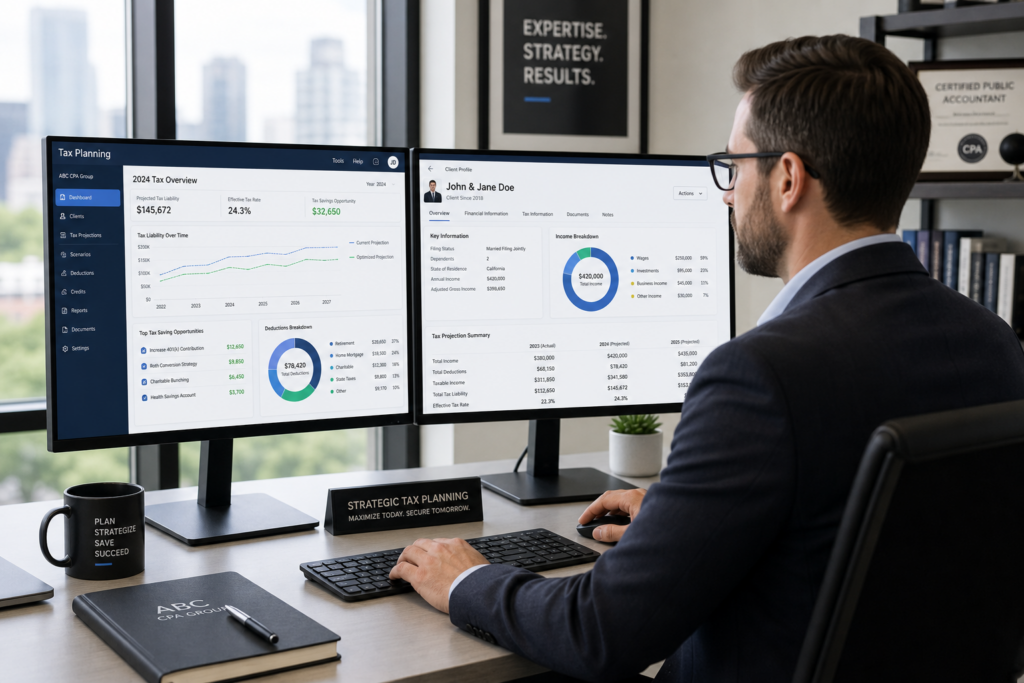
Tax Planning Software for CPAs and EAs: 2026 Guide
For the 2026 tax year, CPAs and Enrolled Agents face an unprecedented transformation in how they deliver tax services. Advanced tax planning software for CPAs and EAs now integrates AI-powered scenario modeling, automated compliance tools, and client advisory features that convert traditional compliance practices into high-margin consulting businesses. With the IRS modernizing electronic administration and clients demanding proactive planning, selecting the right software platform determines whether your firm thrives or struggles in this new landscape.
Table of Contents
- Key Takeaways
- What Separates Tax Planning from Tax Preparation Software?
- What Features Should CPAs Prioritize in 2026?
- How Does AI Enhance Tax Planning Capabilities?
- What Pricing Models Exist for Tax Planning Software?
- How Do Integration Capabilities Affect Workflow Efficiency?
- What Compliance Standards Must Software Meet?
- How Can Firms Transition to Advisory-Based Pricing?
- Uncle Kam in Action: Multi-State CPA Firm Transformation
- Next Steps
- Frequently Asked Questions
- Related Resources

Key Takeaways
- Modern tax planning software for CPAs and EAs transforms compliance work into profitable advisory services
- AI-powered scenario modeling saves 10+ hours weekly while improving client outcomes
- Integration with existing tax systems determines implementation success and ROI
- Advisory pricing models generate 3-5x higher revenue per client engagement
- IRS modernization requirements emphasize digital workflows and API connectivity
What Separates Tax Planning from Tax Preparation Software?
Quick Answer: Tax preparation software handles compliance and filing. Tax planning software enables proactive strategy development, multi-year scenario analysis, and client advisory deliverables that command premium fees.
The distinction between these categories fundamentally shapes your firm’s revenue potential. Preparation tools like Lacerte, ProSeries, and Drake focus on accurate return completion and e-filing. Therefore, they optimize for speed and compliance rather than strategic value creation.
In contrast, dedicated tax planning software empowers CPAs to model entity structures, evaluate retirement strategies, and quantify tax-saving opportunities before clients make irreversible decisions. The American Institute of CPAs launched its Tax Transformation initiative in 2026 specifically to help practitioners shift from reactive compliance to proactive advisory work that leverages these advanced platforms.
Core Capability Differences
Planning platforms deliver capabilities absent from traditional preparation systems. These include comparative scenario analysis across multiple entity types, multi-year tax projections incorporating legislative changes, and branded client deliverables suitable for board presentations. Consequently, firms can demonstrate tangible value beyond annual return filing.
Jan Lewis, chair of the AICPA, emphasized this distinction at the Engage 2026 conference. She explained that while AI will assist with return preparation, tax professionals add value through guidance and planning insights discovered during the preparation process. Moreover, clients pay for ideas and problem-solving rather than mere compliance work.
The Advisory Revenue Opportunity
CPAs using planning software typically charge $3,000-$15,000 for comprehensive tax strategy engagements. This compares to $500-$2,000 for standard preparation services. The software enables professionals to justify premium pricing through quantifiable savings projections and professional deliverables that clients value.
Furthermore, tax advisory services create recurring revenue streams. Clients require quarterly strategy updates, annual plan revisions, and ongoing consultation as circumstances change. Therefore, a single planning client often generates more lifetime value than ten preparation-only relationships.
Pro Tip: Firms transitioning to advisory work should maintain both preparation and planning software. Use preparation tools for compliance efficiency and planning platforms for high-margin consulting engagements.
What Features Should CPAs Prioritize in 2026?
Quick Answer: Essential features include entity-aware scenario modeling, unlimited client assessments, automated strategy sequencing, professional deliverable generation, and seamless integration with existing tax systems.
The IRS Electronic Tax Administration Advisory Committee released 18 modernization recommendations in June 2026. Their annual report emphasizes API connectivity, real-time data sharing, and AI transparency. Consequently, forward-thinking CPAs should prioritize software that aligns with these emerging standards.
Entity-Aware Architecture
The most sophisticated platforms analyze entire client portfolios simultaneously. This means evaluating the 1040, multiple 1120-S returns, partnership K-1s, and trust returns as an interconnected system. Therefore, software identifies optimization opportunities that single-entity tools miss entirely.
For example, entity-aware systems automatically calculate optimal S Corp salary levels across multiple entities. They model income shifting between spouses and evaluate whether rental properties should remain in personal names or transfer to holding companies. Additionally, these platforms track how changes in one entity cascade through the entire tax structure.
Unlimited Assessment Capabilities
Traditional platforms often limit analyses per subscription period. However, this constraint creates a critical business problem. CPAs hesitate to run assessments on prospects who might not convert. In addition, they ration analyses for existing clients despite identifying planning opportunities.
Leading solutions provide unlimited client assessments at every tier. This eliminates usage anxiety and enables CPAs to prove value before engagement agreements. Furthermore, unlimited access supports offering complimentary initial assessments as a client acquisition strategy.
Strategic Framework Integration
The best platforms incorporate structured strategy frameworks rather than presenting random suggestions. For instance, the MERNA methodology sequences strategies across five categories: Maximize Deductions, Entity Structure, Retirement Planning, Niche Strategies, and Advanced Techniques. Consequently, CPAs deliver organized recommendations rather than overwhelming clients with scattered ideas.
| Feature Category | Why It Matters for 2026 | Impact on Practice |
|---|---|---|
| AI-Powered Automation | Reduces manual calculation time by 80%+ | Serve 3x more clients with same team |
| Multi-Year Projections | Shows long-term impact of current decisions | Justifies premium advisory fees |
| Client-Ready Deliverables | Professional PDFs replace spreadsheets | Elevates perceived expertise and value |
| Integration APIs | Eliminates duplicate data entry | Reduces errors and saves 5+ hours weekly |
| Compliance Tracking | Monitors IRS requirement changes automatically | Prevents costly planning mistakes |
How Does AI Enhance Tax Planning Capabilities?
Quick Answer: AI automates complex calculations, identifies overlooked strategies, generates professional deliverables, and enables CPAs to focus on high-value client relationships rather than manual analysis.
Artificial intelligence fundamentally changes capacity constraints in tax practices. According to research presented at the AI Tax Summit in May 2026, firms using autonomous tax preparation systems process individual returns and K-1s significantly faster than traditional workflows. However, the real transformation occurs in planning rather than preparation.
Strategy Identification and Ranking
Advanced AI engines analyze client data against databases of 300+ tax strategies. The system then ranks opportunities by potential savings, implementation complexity, and client-specific circumstances. Consequently, CPAs present the most impactful recommendations first rather than overwhelming clients with every possible tactic.
Moreover, AI continuously learns from implementation outcomes. When certain strategies consistently succeed for specific client profiles, the system prioritizes similar recommendations for comparable situations. This creates compound expertise that improves with each engagement.
Scenario Modeling at Scale
Manual scenario analysis often limits CPAs to comparing two or three alternatives. AI platforms model dozens of variations simultaneously. For instance, the software can compare LLC versus S Corp elections across five different income levels, three states, and two retirement contribution strategies—generating 30 scenarios in seconds.
This capability proves invaluable when clients face complex decisions. A business owner considering entity conversion, real estate acquisition, and equipment purchases can see how different timing and structure combinations affect their five-year tax liability. Therefore, CPAs provide data-driven guidance rather than relying on rules of thumb.
Professional Deliverable Generation
AI tax plan generators transform analysis into polished client presentations. The system produces executive summaries, detailed strategy explanations, implementation timelines, and compliance calendars. Additionally, it includes risk assessments and documentation requirements for each recommendation.
These deliverables position CPAs as strategic advisors rather than compliance technicians. Clients receive professional documents suitable for sharing with business partners, lenders, and financial advisors. Furthermore, the comprehensive presentation format justifies premium advisory fees that spreadsheets never could.
Pro Tip: The AICPA emphasizes that AI assists but does not replace professional judgment. Review all AI-generated recommendations for client-specific circumstances before finalizing deliverables.
Capacity Liberation
Perhaps most importantly, AI frees CPAs from mechanical work. Industry analysis shows firms save 10+ hours weekly per staff member after implementing AI-powered planning tools. This recovered time redirects toward client communication, business development, and strategic consulting—activities that actually differentiate successful practices.
As one CPA noted, “If I can manage a $500,000 client portfolio on AI-assisted software after my kids go to bed, full-time accountants can accomplish significantly more.” The technology addresses the profession’s capacity constraints without requiring firms to hire proportionally or offshore work.
What Pricing Models Exist for Tax Planning Software?
Quick Answer: Software vendors use per-user subscriptions, tiered packages based on firm size, per-analysis pricing, or hybrid models combining base fees with usage limits.
Understanding pricing structures helps firms calculate true ROI and select platforms aligned with their growth plans. Software costs represent recurring expenses that must generate proportional revenue increases through improved efficiency or expanded service offerings.
Per-User Subscription Models
Many platforms charge monthly or annual fees per licensed user. Solo practitioners typically pay $200-$500 monthly. Mid-size firms with 5-10 users encounter $1,500-$3,000 monthly costs. Enterprise packages for large practices start at $5,000+ monthly.
This model provides predictable expenses and unlimited usage within the licensed user count. However, it can create friction when firms want support staff or administrative personnel to access client data without purchasing full licenses. Therefore, evaluate whether the vendor offers read-only or limited-access user tiers.
Tiered Package Structures
Tiered pricing creates Good-Better-Best options with escalating features. Entry tiers might include basic scenario modeling and standard deliverables. Mid-tier packages add entity-aware analysis and customizable reporting. Premium tiers unlock AI-powered strategy ranking, unlimited assessments, and priority support.
The advantage of this approach is scalability. Firms can start with basic functionality and upgrade as their advisory practice matures. Additionally, some vendors allow mixing tier levels across team members based on role requirements.
Per-Analysis Pricing Concerns
Some platforms charge per tax plan generated or per client analysis. While this appears attractive for firms with limited planning volume, it creates problematic incentives. CPAs ration analyses to control costs, avoiding complimentary assessments for prospects or exploratory scenarios for existing clients.
Moreover, per-analysis pricing penalizes success. As your advisory practice grows, software costs increase proportionally. This differs from per-user models where marginal cost per engagement decreases as volume rises. Consequently, most successful advisory firms prefer unlimited-use subscriptions.
| Pricing Model | Best For | Watch Out For |
|---|---|---|
| Per-User Subscription | Growing firms with multiple planners | Hidden costs for support staff access |
| Tiered Packages | Firms testing advisory services | Feature limitations in entry tiers |
| Per-Analysis | Very occasional planning needs | Discourages prospect analysis and exploration |
| Unlimited Access | Established advisory practices | Higher upfront cost requires volume to justify |
ROI Calculation Framework
Evaluate software investments by analyzing three factors: time savings, revenue expansion, and competitive positioning. If the platform saves 10 hours monthly and your billable rate is $250 per hour, that represents $2,500 in recovered capacity. Additionally, if you convert five compliance clients to $5,000 planning engagements annually, that generates $25,000 in incremental revenue.
Therefore, even $3,000 monthly software costs become negligible when generating $30,000+ in additional annual revenue. The key is actually implementing advisory services rather than purchasing software that sits unused while you continue offering only compliance work.
How Do Integration Capabilities Affect Workflow Efficiency?

Quick Answer: Seamless integration with tax preparation software, practice management systems, and document platforms eliminates duplicate data entry and enables real-time collaboration across your technology stack.
The IRS ETAAC committee specifically emphasized API connectivity in their 2026 recommendations. Application Programming Interfaces allow authorized systems to exchange data automatically. Consequently, information flows between platforms without manual file transfers or rekeying.
Tax Software Integration Priority
Your planning platform should connect with your primary preparation software. This enables importing prior-year returns for baseline analysis and exporting planning scenarios for detailed what-if modeling. For example, a CPA can import a client’s complete 2025 return, adjust income assumptions for 2026, and instantly recalculate federal and state liability.
Leading platforms integrate with Lacerte, ProSeries, UltraTax, Drake, and CCH Axcess. However, integration depth varies. Some offer full bidirectional synchronization while others only support one-way data imports. Therefore, verify specific integration capabilities with your existing software before committing.
Practice Management Connectivity
Integration with practice management platforms like Karbon, Financial Cents, or Canopy streamlines client communication and project tracking. When planning software connects to your PM system, completed analyses automatically attach to client records. Engagement letters, deliverables, and follow-up tasks sync across platforms.
This connectivity eliminates the common problem of CPAs completing excellent planning work that then gets buried in email threads or saved to individual desktop folders. Instead, the entire team accesses current planning recommendations through the centralized client record.
Document Management Synchronization
Platforms offering ShareFile, SmartVault, or similar document portal integration ensure client deliverables automatically appear in secure client portals. The CPA generates a comprehensive tax plan, and the system immediately uploads the PDF to the client’s document center with appropriate access permissions configured.
Additionally, document management integration supports compliance documentation. When implementing recommended strategies, supporting calculations and decision memos automatically attach to permanent client files. Therefore, future audits or continuity situations have complete documentation trails.
Pro Tip: Request demonstration environments that connect to your actual software stack. Many integration issues only surface during real-world implementation rather than sales presentations.
What Compliance Standards Must Software Meet?
Quick Answer: Tax planning software must comply with IRS e-filing requirements, maintain SOC 2 certification for data security, follow Circular 230 standards, and implement proper audit trails for professional liability protection.
CPAs and Enrolled Agents operate under strict regulatory frameworks. The software you use for client services must meet corresponding security and compliance standards. Consequently, vendor selection requires evaluating technical certifications alongside features and pricing.
IRS Modernization Requirements
The IRS ETAAC 2026 report emphasizes real-time validation of Preparer Tax Identification Numbers and Electronic Filing Identification Numbers. Software platforms should verify credentials automatically and flag potential issues before submission deadlines.
Moreover, the committee recommends stronger oversight of paid preparers. While specific regulations remain pending, platforms that build in credential verification and continuing education tracking position users ahead of likely future requirements. Therefore, forward-thinking CPAs should prioritize vendors investing in compliance infrastructure.
Data Security and Privacy
Tax planning software handles sensitive financial information including Social Security numbers, income details, and strategic business plans. SOC 2 Type II certification demonstrates that vendors maintain appropriate security controls. This certification requires independent auditing of security practices, data encryption, and access management.
Additionally, evaluate encryption standards for data at rest and in transit. The software should use AES-256 encryption for stored data and TLS 1.2 or higher for data transmission. Role-based access controls ensure team members only view information relevant to their responsibilities. Furthermore, audit logs track who accessed which client records and when.
Professional Liability Protection
Comprehensive audit trails protect CPAs in disputes or professional liability claims. The software should document exactly which data inputs generated specific recommendations, which strategies the CPA selected for client presentation, and what disclaimers accompanied deliverables.
Version control becomes critical when clients implement multi-year strategies. If circumstances change or legislation shifts, you need records showing recommendations were appropriate based on information available at the time. Therefore, platforms should maintain historical versions of all analyses and deliverables with timestamp documentation.
How Can Firms Transition to Advisory-Based Pricing?
Quick Answer: Start with existing clients showing clear planning opportunities, package planning and preparation services together, and use software-generated savings projections to justify premium fees.
The AICPA Tax Transformation Framework released in June 2026 provides structured guidance for this evolution. The framework identifies five drivers: technology adoption, service model redesign, pricing innovation, talent development, and operational excellence. However, the transition begins with mindset shifts rather than software purchases.
Identifying High-Potential Clients
Review your current client base for common advisory indicators. Business owners with fluctuating income, real estate investors acquiring properties, and high-income professionals changing employers all present clear planning opportunities. Additionally, clients approaching retirement or considering entity conversions need proactive guidance.
Run complimentary initial assessments using your planning software to quantify potential savings. When software identifies $15,000 in tax reduction opportunities, proposing a $5,000 planning engagement becomes straightforward. The client sees immediate ROI while you establish the advisory relationship.
Packaging Strategies
Many firms successfully bundle planning and preparation services. For example, create a “Complete Tax Solution” package including quarterly planning reviews, year-end strategy sessions, and annual return preparation for one comprehensive fee. This positions planning as the core service with preparation as implementation support.
Alternatively, offer standalone planning engagements with preparation as an optional add-on. This works particularly well for high-net-worth individuals who may already have preparers but lack strategic guidance. Therefore, you compete on expertise and advisory value rather than compliance pricing.
Value Communication
Software-generated deliverables dramatically improve value perception. A polished 20-page tax plan with executive summary, strategy explanations, and implementation timeline looks substantially different than email recommendations or verbal suggestions during return signing.
Furthermore, quantified savings projections anchor pricing discussions. When presenting recommendations projected to save $30,000 over three years, a $7,500 engagement fee represents 25% of benefits—a compelling value proposition. The professional deliverable format reinforces that clients are purchasing strategic expertise rather than hourly labor.
| Client Type | Planning Opportunity | Typical Advisory Fee |
|---|---|---|
| Small Business Owner | Entity optimization, retirement planning | $3,000-$7,500 annually |
| Real Estate Investor | Cost segregation, entity structuring, STR classification | $5,000-$12,000 annually |
| High-Income Professional | Backdoor Roth, mega backdoor, deferred comp | $4,000-$8,000 annually |
| Multi-Entity Business | Holding company strategy, income shifting, succession | $10,000-$25,000 annually |
Uncle Kam in Action: Multi-State CPA Firm Transformation
A mid-sized CPA firm in the Midwest operated for 15 years providing traditional compliance services to 320 small business clients. Annual revenue plateaued at $1.8 million. The managing partner recognized that adding staff wouldn’t solve capacity constraints or improve profitability. Therefore, she explored advisory transformation using tax planning software for CPAs and EAs.
The firm selected a comprehensive platform offering unlimited client assessments, entity-aware analysis, and AI-powered strategy ranking. Implementation began with identifying 50 high-potential clients based on income levels and business complexity. The team ran complimentary tax planning assessments for this group during the 2025 tax season.
Results exceeded expectations. The software identified an average of $18,500 in potential tax savings per analyzed client. Consequently, the firm offered comprehensive planning engagements at $6,500 per client. Thirty-seven of the fifty clients immediately accepted. This generated $240,500 in advisory revenue—representing entirely new income without adding staff or extending work hours.
The transformation continued as word spread among clients. The firm now offers tiered advisory packages: Basic ($3,500), Comprehensive ($7,500), and Elite ($15,000). They completed 85 planning engagements in their first full year. Additionally, the professional deliverables improved client retention. Clients receiving detailed tax plans showed 95% retention compared to 78% for compliance-only relationships.
Financial outcomes proved compelling. The firm invested $42,000 annually in software and training. They generated $510,000 in new advisory revenue during year one. This represented a first-year ROI of more than 12x. Moreover, the managing partner noted that staff satisfaction increased significantly because team members spent time on strategic work rather than repetitive data entry.
Explore similar transformation opportunities through real-world case studies demonstrating how technology-enabled advisory services create sustainable competitive advantages for forward-thinking practices.
Next Steps
Implementing the right tax planning software for CPAs and EAs requires strategic evaluation and methodical execution. Consider these actionable steps:
- Request demonstrations from three platforms that integrate with your existing tax software
- Identify 10-15 current clients with clear planning opportunities for pilot testing
- Calculate your target ROI by estimating time savings and potential advisory revenue
- Review the AICPA Tax Transformation Framework to design your service model evolution
- Explore how comprehensive tax strategy services position your firm for sustainable growth
Book a strategy session at Uncle Kam to discuss how our advisory operating system combines software, training, and client opportunities into one integrated platform designed specifically for tax professionals building high-value practices.
Frequently Asked Questions
Can tax planning software replace experienced CPAs?
No. The AICPA explicitly addressed this concern at the 2026 Engage conference. AI and automation assist with calculations and analysis. However, professional judgment remains essential for evaluating client-specific circumstances, explaining complex concepts, and providing strategic guidance. Software identifies opportunities; CPAs determine which strategies align with client goals and risk tolerance.
How long does implementation typically take?
Most firms complete basic implementation within 2-4 weeks. This includes user training, software configuration, and integration with existing systems. However, developing advisory service offerings and pricing models requires 2-3 months. Therefore, plan to run pilot engagements during slower periods before scaling firmwide.
What if clients cannot afford premium advisory fees?
Advisory services naturally segment your client base. Not every client needs or values comprehensive planning. Continue offering compliance services for price-sensitive clients while developing premium advisory relationships with those willing to invest in proactive strategies. Many firms maintain both service tiers successfully. Additionally, mid-tier packages at $2,500-$3,500 make planning accessible to broader client segments.
Does planning software work for individual tax clients?
Absolutely. High-income W-2 employees benefit from retirement optimization, backdoor Roth conversions, and charitable giving strategies. Self-employed individuals and 1099 contractors gain from entity structure analysis and estimated payment planning. The software identifies relevant strategies regardless of income source or business ownership status.
How do I justify costs to partners skeptical of technology investments?
Calculate specific ROI metrics. If software costs $3,000 monthly but enables your team to complete five additional $5,000 planning engagements quarterly, that generates $60,000 in annual revenue from a $36,000 investment. Furthermore, demonstrate opportunity cost. Firms maintaining compliance-only models while competitors build advisory practices lose market share and talent. Technology investment represents necessary evolution rather than optional experimentation.
What happens when tax laws change after delivering plans?
Quality platforms include legislative update services. When significant tax law changes occur, the software flags affected client plans and recommends revisions. This creates natural touchpoints for ongoing advisory relationships. Additionally, annual retainer models include plan updates as legislation evolves. Therefore, law changes become service opportunities rather than liability concerns.
Can solo practitioners compete with large firms using the same software?
Yes. Software levels the analytical playing field. A solo practitioner with comprehensive planning capabilities delivers comparable value to national firms for most small business and individual clients. Moreover, solo and boutique practices often provide superior client service and responsiveness. The technology enables you to compete on expertise and relationship quality rather than pure resources.
Should we build custom software or use commercial platforms?
Commercial platforms prove more practical for virtually all CPA firms. Custom development requires substantial upfront investment, ongoing maintenance, and continuous updates for tax law changes. Leading commercial solutions cost a fraction of custom development while offering immediate deployment and proven functionality. Furthermore, vendor-supported platforms include customer service, training resources, and automatic legislative updates.
How do I get started with minimal disruption to current operations?
Begin with pilot programs during non-peak periods. Select 5-10 receptive clients and offer complimentary initial planning assessments. Use their feedback to refine your process, pricing, and deliverables before launching firmwide. Additionally, designate one team member as the planning specialist who builds expertise while others maintain current workflows. Gradually expand as confidence and demand grow.
Related Resources
- Comprehensive Tax Strategy Services
- Tax Advisory Practice Development
- Tax Planning for Business Owners
- The MERNA Framework for Strategic Tax Planning
- Tax Professional Success Stories
Last updated: June, 2026
This information is current as of 6/21/2026. Tax laws change frequently. Verify updates with the IRS or FTB if reading this later.

