
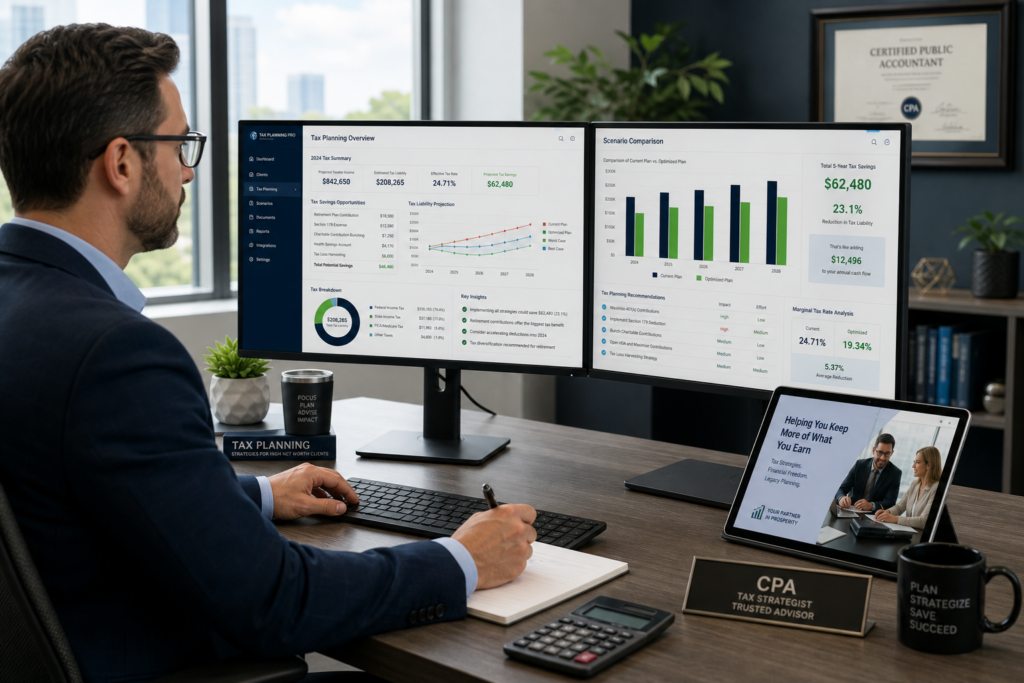
Tax Planning Software for CPAs: 2026 Buyer’s Guide
For CPAs in 2026, choosing the right tax planning software for CPAs is no longer optional. With two-thirds of tax firms expecting revenue growth and profit margins averaging above 30%, technology has become the difference between firms that scale profitably and those that plateau. Modern tax planning software for CPAs enables practitioners to transition from low-margin compliance work to high-value advisory services while maintaining IRS Circular 230 compliance in an AI-driven landscape.
Table of Contents
- Key Takeaways
- Why CPAs Need Tax Planning Software in 2026
- What Features Should CPAs Prioritize in Tax Planning Software?
- How Do IRS AI Guidelines Affect Software Selection?
- What Is the ROI of Tax Planning Software for CPAs?
- How to Transition From Compliance to Advisory With Software
- What Pricing Models Work Best for Tax Advisory Services?
- Uncle Kam in Action: How One CPA Scaled From $300K to $850K
- Next Steps
- Frequently Asked Questions
- Related Resources

Key Takeaways
- Tax planning software for CPAs must now comply with 2026 IRS AI guidelines requiring human review and due diligence
- Firms using advisory-focused platforms report 30%+ margins compared to compliance-only practices
- Multi-entity scenario modeling and AI-driven plan generation are essential for scaling client engagements
- Value-based pricing for advisory work consistently outperforms hourly billing models
- Professional deliverables and client education tools reduce plan implementation time by 60%
Why CPAs Need Tax Planning Software in 2026
Quick Answer: CPAs need tax planning software to meet client demand for proactive strategies, comply with new AI regulations, and achieve higher profit margins than compliance-only work delivers.
The accounting profession reached an inflection point in 2026. According to the Thomson Reuters State of Tax Professionals Report, two-thirds of tax firms expect revenue to increase over the next 12 months. However, this growth isn’t translating to proportional margin improvements for most practices.
The disconnect stems from how firms are growing. Fee increases and organic client acquisition have natural ceilings. Advisory services represent the profession’s most in-demand category, yet paradoxically produce the lowest margins when billed hourly alongside compliance work.
Tax planning software for CPAs addresses this challenge by enabling practitioners to deliver sophisticated tax strategy services at scale. Modern platforms automate scenario modeling, generate professional deliverables, and structure advisory engagements for profitability rather than perpetuating the billable hour trap.
The 2026 Regulatory Landscape
In June 2026, the IRS Office of Professional Responsibility introduced preliminary guidelines for tax practitioners using AI. These guidelines don’t create new rules but clarify how Circular 230 applies to AI-assisted work. For CPAs evaluating software, this matters significantly.
According to IRS guidance, practitioners must exercise due diligence on AI outputs and transparently pass cost savings to clients. Software that generates tax strategies without human-verifiable logic creates compliance risk. The IRS explicitly states that AI cannot replace professional judgment under Circular 230 Section 10.22.
Client Expectations Are Accelerating
Business owners no longer accept reactive tax preparation. They expect CPAs to quantify tax-saving opportunities throughout the year. A Thomson Reuters report found that $143 billion in client revenue is at risk in the U.S. alone when firms fail to deliver AI-driven value.
Tax planning software bridges this gap by enabling CPAs to provide quarterly tax projections, year-end strategies, and multi-year planning without hiring additional staff. The best platforms integrate with existing practice management systems, creating a seamless workflow from client intake to tax advisory delivery.
Pro Tip: Firms that position tax planning as a year-round service rather than a March deliverable achieve 4x higher client retention rates and command premium pricing.
What Features Should CPAs Prioritize in Tax Planning Software?
Quick Answer: Prioritize entity-aware modeling, unlimited assessments, professional deliverables, 2026 tax law updates, and platforms that support value-based pricing instead of consumption limits.
Not all tax planning software serves CPAs equally. Platforms designed for individual taxpayers lack the sophistication CPAs need for business owner clients. When evaluating options for 2026, focus on these differentiators.
Entity-Aware Architecture
The best tax planning software for CPAs recognizes that business owners operate across multiple entities. A client might have a 1040, an S Corporation, rental properties reported on Schedule E, and investment income. Effective software must model these interdependencies simultaneously.
For example, evaluating whether an LLC should elect S Corp status requires comparing self-employment tax savings against reasonable compensation requirements, payroll tax costs, and state-level implications. Software that analyzes these entities in isolation produces incomplete recommendations.
Unlimited Assessment Capability
Many platforms charge per analysis or cap monthly assessments. This creates perverse incentives. CPAs either ration software usage (reducing service quality) or inflate pricing to cover unpredictable software costs.
Unlimited assessment platforms eliminate this friction. You can run tax scenarios for every prospect during initial consultations, proving value before engagement agreements. You can also provide complimentary tax reviews during preparation season, creating natural upsell opportunities for year-round advisory.
Professional Deliverable Generation
Clients pay for clarity, not spreadsheets. The software should produce branded, client-ready reports that explain complex tax strategies in accessible language. Look for platforms offering implementation roadmaps, risk assessments, and strategic summaries alongside numerical projections.
AI-powered plan generation is particularly valuable in 2026. Systems that convert scenario modeling into structured written plans save 5-8 hours per client engagement. This efficiency enables CPAs to serve more clients without proportional increases in labor costs.
2026 Tax Law Integration
Software must reflect current-year tax provisions. For 2026, verify the platform incorporates the standard deduction of $32,200 for married filing jointly, the 401(k) contribution limit of $23,000 (plus $7,500 catch-up for those 50+), and IRA contribution limits of $6,500 ($7,500 with catch-up).
Tax brackets also shifted for 2026. The 22% bracket begins at $100,800 for joint filers, while the 24% bracket starts at $211,400. Software using outdated 2025 figures produces inaccurate projections and erodes client trust.
Strategy Sequencing Framework
Tax strategies shouldn’t be evaluated in isolation. Platforms using frameworks like MERNA (Maximize Deductions, Entity Structure, Retirement, Niche, Advanced) help CPAs prioritize recommendations logically.
For instance, optimizing entity structure before implementing retirement strategies prevents situations where a client funds a SEP IRA for an LLC that should have been an S Corporation. Sequenced planning protects CPAs from liability while maximizing client outcomes.
| Feature Category | Essential for CPAs | Nice to Have | Avoid |
|---|---|---|---|
| Assessment Limits | Unlimited | 100+ per month | Per-use fees |
| Entity Support | Multi-entity modeling | Partnership support | Individual-only |
| Deliverables | Branded PDF reports | White-label options | Screenshots only |
| Tax Law Updates | Automatic 2026 updates | Quarterly updates | Manual updates required |
| AI Compliance | Verifiable outputs | Audit trails | Black-box algorithms |
How Do IRS AI Guidelines Affect Software Selection?
Quick Answer: CPAs must select tax planning software with transparent AI that allows human verification of recommendations, maintains audit trails, and enables practitioners to explain how conclusions were reached.
The June 2026 IRS guidelines on AI use in tax practice fundamentally altered software evaluation criteria. Section 10.22 of Circular 230 requires practitioners to verify the correctness of representations made to the Treasury and to clients. This means CPAs cannot rely on AI-generated outputs they cannot independently confirm.
Competence Includes Understanding the Tool
Circular 230 has always required competence—appropriate knowledge, skill, and preparation. For AI-assisted work, competence now includes understanding how the software reaches conclusions. Tax planning software for CPAs must therefore provide transparency into calculation methodologies.
Black-box systems that generate recommendations without showing supporting logic create compliance risk. If a CPA cannot explain why the software recommended a particular strategy, they lack the competence Circular 230 demands.
Due Diligence and Cost Savings Transparency
According to Section 10.27(a), practitioners cannot charge unconscionable fees. The IRS clarified that cost savings from AI should be passed to clients transparently. Billing clients for manual labor time not actually spent may constitute a violation.
This guidance favors value-based pricing over hourly billing for AI-assisted work. If software reduces a 6-hour tax planning engagement to 2 hours, billing the client for 6 hours becomes problematic. Fixed-fee advisory pricing aligned with client outcomes avoids this issue entirely.
Confidentiality and Data Security
IRC Sections 6713 and 7216(a), along with Circular 230 Section 10.51(a)(15), require strict handling of taxpayer information. Tax planning software must use robust confidentiality safeguards. Consumer-grade AI tools that don’t guarantee data isolation create willful mishandling risk.
Enterprise-grade platforms with dedicated cloud infrastructure, SOC 2 compliance, and contractual data protection guarantees meet these requirements. Free or low-cost tools that train AI models on user inputs violate client confidentiality obligations.
Firm-Level AI Policies
The IRS guidance emphasizes that Circular 230 requires firms to maintain adequate compliance procedures. This extends to AI governance. CPAs should select software vendors that support firm policy implementation through documentation features, user access controls, and compliance reporting.
A proper AI policy documents which tools are approved, what client information may be entered, required review procedures, staff training requirements, and vendor vetting processes. Tax planning software that integrates with existing compliance workflows simplifies policy enforcement.
Pro Tip: Request AI audit reports from vendors. Platforms that cannot document how their AI makes recommendations expose CPAs to regulatory risk under the 2026 guidelines.
What Is the ROI of Tax Planning Software for CPAs?
Quick Answer: CPAs report 3x-5x first-year ROI through increased advisory fees, higher client retention, and reduced labor costs. The average firm recoups software investment within the first three client engagements.
ROI calculations for tax planning software extend beyond software subscription costs. The true return encompasses revenue expansion, margin improvement, and practice scalability.
Revenue Expansion
A CPA charging $2,500 for tax preparation can typically command $5,000-$15,000 for annual tax advisory services. The difference lies in shifting from reactive compliance to proactive planning. Tax planning software provides the infrastructure to deliver this higher-value service.
Consider a 40-client practice. Adding $7,500 average advisory fees to existing preparation fees generates $300,000 additional annual revenue. Even with a $5,000 annual software investment, the return exceeds 60x.
Margin Improvement
Manual tax planning consumes 6-10 hours per client when CPAs model scenarios in spreadsheets, research strategies, and format deliverables. Quality software reduces this to 2-3 hours through automation and templates.
This efficiency enables CPAs to maintain healthy margins on fixed-fee advisory work. A $10,000 engagement taking 3 hours yields a $3,333 effective hourly rate. The same engagement requiring 8 hours manually drops to $1,250 per hour—still profitable, but less scalable.
Client Acquisition and Retention
Unlimited assessment platforms enable CPAs to run complimentary tax analyses for prospects. Demonstrating $25,000 in potential tax savings during an initial consultation converts prospects at 3x higher rates than traditional sales conversations.
Retention also improves. Clients receiving quarterly tax planning reviews have 4x higher retention compared to annual-only preparation clients. The recurring revenue model creates predictable cash flow and increases practice valuation multiples.
Practice Valuation Impact
According to recent industry analysis, CPA firms with recurring advisory revenue command 1.5x-2x higher valuation multiples than compliance-only practices. This reflects the predictability and scalability of advisory models.
A $500,000 revenue practice with 80% compliance and 20% advisory might sell for 0.8x revenue ($400,000). The same practice with inverted revenue mix—80% advisory—could command 1.4x revenue ($700,000). Tax planning software enables this transformation.
| ROI Component | Annual Impact (40-client practice) | Calculation |
|---|---|---|
| Advisory Fee Revenue | $300,000 | 40 clients × $7,500 average fee |
| Time Savings (at $200/hr) | $40,000 | 40 clients × 5 hours saved × $200 |
| Software Investment | -$5,000 | Annual subscription |
| Net ROI | $335,000 | 67x return |
This calculation understates total value by excluding client lifetime value increases, referral generation, and practice valuation improvements. However, it demonstrates that even conservative adoption scenarios produce exceptional returns.
How to Transition From Compliance to Advisory With Software

Quick Answer: Start by offering complimentary tax reviews to existing clients during tax season. Use software to identify savings opportunities, then convert high-opportunity clients to year-round advisory engagements.
The compliance-to-advisory transition intimidates many CPAs. Tax planning software for CPAs reduces this friction by providing structure and automation that makes advisory delivery manageable alongside existing preparation work.
Phase 1: Tax Season Value Demonstrations
During tax preparation season, run complimentary assessments for every business owner client. The software identifies opportunities the return alone doesn’t reveal. Present these findings during tax review meetings.
For example, a Schedule C filer earning $180,000 might save $12,000 annually through S Corp election, retirement contributions, and home office optimization. Showing this analysis costs nothing with unlimited assessment software but demonstrates substantial value.
Phase 2: Selective Advisory Conversions
Don’t attempt to convert your entire client base simultaneously. Focus on the 20% showing the highest tax-saving potential. These clients recognize advisory value most readily because software has already quantified their opportunity.
Offer a mid-year planning engagement priced at $3,500-$7,500 depending on complexity. Structure this as a one-time deliverable initially. Once you’ve successfully served 8-10 clients through this model, convert it to annual recurring advisory.
Phase 3: Recurring Advisory Standardization
After proving the concept, systematize delivery. Create quarterly touchpoint templates using your software’s deliverable features. Establish cadences: Q1 review prior year and implement strategies, Q2 mid-year projection, Q3 year-end planning, Q4 implementation and next-year preview.
This rhythm transforms tax planning from episodic to continuous. Clients appreciate predictable service rather than scrambled December conversations. CPAs benefit from even workflow distribution instead of seasonal peaks.
Phase 4: Marketing to New Advisory-First Clients
Once you’ve established advisory capability with existing clients, begin attracting advisory-first prospects. These clients seek year-round strategic guidance and view compliance as secondary.
Tax planning software enables compelling marketing content. Case studies showing $45,000 first-year tax savings attract high-net-worth clients willing to pay premium advisory fees. Educational content demonstrating software capabilities positions you as sophisticated rather than transactional.
Pro Tip: Document your first five advisory engagements meticulously. These become templates that reduce future delivery time by 40% while maintaining quality and consistency.
What Pricing Models Work Best for Tax Advisory Services?
Quick Answer: Value-based fixed fees tied to tax savings potential consistently outperform hourly billing. Tiered annual advisory packages with quarterly deliverables produce the highest margins and client satisfaction.
Pricing represents the most critical decision in advisory practice development. The Thomson Reuters 2026 State of Tax Professionals Report confirmed that advisory services produce the profession’s lowest margins when billed hourly alongside compliance.
Value-Based Fixed Fees
Tax planning software for CPAs enables value pricing by quantifying client savings before engagement. If analysis shows $32,000 in annual tax reduction potential, a $8,000 advisory fee represents 25% of value delivered—a compelling proposition.
This approach decouples pricing from hours worked. Whether implementation takes 3 hours or 8 hours becomes irrelevant. Clients pay for outcomes, not inputs. This eliminates the AI billing concerns raised in the 2026 IRS guidance.
Tiered Advisory Packages
Offering good-better-best tiers accommodates client diversity while creating natural upsell paths. A typical structure might include Essential ($5,000), Professional ($10,000), and Premium ($20,000) annual packages.
Essential provides semi-annual planning meetings with software-generated reports. Professional adds quarterly touchpoints and entity structuring analysis. Premium includes monthly financial review integration and family tax coordination for high-net-worth individuals.
Engagement Fee + Annual Retainer
Some CPAs charge an upfront engagement fee ($3,500-$7,500) for initial comprehensive planning, then convert clients to annual retainers ($6,000-$15,000) for ongoing advisory.
This model works particularly well for complex situations requiring substantial upfront analysis. The software handles entity comparisons, multi-year projections, and strategy documentation. The engagement fee covers this intensive work. Annual retainers maintain the relationship and adjust strategies as circumstances change.
Why Hourly Billing Fails
Hourly billing for advisory work creates perverse incentives incompatible with modern software efficiency. As platforms become more capable, advisory delivery time decreases. Under hourly models, improved efficiency reduces revenue—exactly the opposite of desired outcomes.
Additionally, the 2026 IRS guidance on AI cost savings creates compliance risk. Billing hourly for AI-accelerated work while not transparently crediting efficiency gains may constitute unconscionable fees under Circular 230 Section 10.27.
| Pricing Model | Typical Range | Best For | AI Compatibility |
|---|---|---|---|
| Value-Based Fixed Fee | $5,000-$15,000 | Business owners, investors | Excellent |
| Tiered Packages | $5,000-$20,000 | Diverse client base | Excellent |
| Engagement + Retainer | $7,500-$25,000 | Complex, multi-entity clients | Good |
| Hourly Billing | $200-$400/hour | Not recommended | Poor (compliance risk) |
Uncle Kam in Action: How One CPA Scaled From $300K to $850K
Sarah Chen, a CPA in Phoenix, operated a traditional tax preparation practice generating $300,000 annually from 150 individual and small business clients. She worked 60-hour weeks during tax season and struggled to grow beyond referrals. Her 2024 practice looked identical to 2019.
In early 2025, Sarah attended a continuing education course on advisory services. The instructor mentioned tax planning software as infrastructure for scaling advisory. Sarah researched platforms and selected one offering unlimited assessments, multi-entity modeling, and professional deliverables.
During the 2025 tax season, Sarah ran complimentary assessments for her 40 highest-earning business owner clients. The software identified an average of $18,500 in annual tax savings opportunities per client. She presented these findings during tax review meetings.
Twenty-two clients immediately engaged for mid-year planning at $6,500 per engagement. This generated $143,000 in new revenue within 90 days. Sarah delivered comprehensive tax plans using the software’s AI-powered report generation, completing each engagement in 3-4 hours instead of the 8-10 hours manual planning required.
By January 2026, Sarah had converted 35 clients to annual advisory retainers averaging $10,200. She also attracted 8 new advisory-first clients through referrals from satisfied existing clients. Her 2026 revenue projection exceeds $850,000—a 183% increase from 2024.
The transformation required a $4,800 annual software investment. Sarah’s first-year ROI exceeded 30x. More importantly, she now works 45-hour weeks during tax season because advisory revenue reduced her dependence on volume-based preparation work.
Sarah credits the software’s unlimited assessment feature as the breakthrough. “I could prove value to every prospect and client without rationing software usage. That changed everything about how I sell services,” she explained. She also noted that professional deliverables elevated her market positioning: “Clients see me as a strategic advisor now, not just someone who files returns.”
Read more success stories at Uncle Kam Client Results.
Next Steps
If you’re ready to transition from compliance-only to advisory-focused practice, follow these steps:
- Evaluate tax planning software for CPAs using the feature criteria outlined above, prioritizing unlimited assessments and 2026 compliance
- Run complimentary assessments for your top 20 business owner clients to identify advisory opportunities
- Develop value-based pricing for advisory services aligned with software-quantified savings potential
- Create firm-level AI policies compliant with June 2026 IRS guidance on practitioner technology use
- Book a consultation with tax advisory experts to accelerate your transition and avoid common implementation pitfalls
The firms that thrive in 2026 and beyond will be those that embrace technology not as a cost center, but as the foundation for scalable, high-margin advisory services. Tax planning software for CPAs provides this foundation.
Frequently Asked Questions
What is the difference between tax preparation software and tax planning software for CPAs?
Tax preparation software processes historical transactions and generates returns. Tax planning software models future scenarios, compares entity structures, and quantifies savings from proactive strategies. CPAs need both—preparation software for compliance, planning software for advisory services.
How do 2026 IRS AI guidelines impact software selection?
The June 2026 guidelines require CPAs to verify AI outputs and maintain competence in tools used. Select software with transparent calculation methodologies, audit trails, and verifiable recommendations. Avoid black-box systems that generate conclusions without showing supporting logic.
Can small CPA firms afford tax planning software?
Yes. Most platforms cost $3,000-$8,000 annually. A firm converting just three clients to $8,000 advisory engagements recoups this investment with $16,000 profit remaining. The barrier isn’t cost—it’s the decision to transition business models from hourly compliance to value-based advisory.
What if my clients only want tax preparation?
Clients resist advisory when value isn’t demonstrated. Run complimentary assessments showing specific dollar savings opportunities. When business owners see $22,000 in potential tax reduction, they become interested. Position planning as optional initially, then use results to build advisory practice gradually.
How long does implementation take?
Quality software requires 2-4 weeks for team onboarding. Plan to run 5-10 practice assessments before engaging paying clients. Most CPAs feel confident delivering advisory services after completing three supervised engagements. Full practice transformation typically occurs over 12-18 months.
Does tax planning software replace CPA judgment?
No. Software automates calculations and generates draft recommendations. CPAs must review outputs, apply professional judgment, and customize strategies for client circumstances. The 2026 IRS guidelines explicitly state that AI cannot replace human professional judgment under Circular 230.
What types of clients benefit most from tax planning software analysis?
Business owners earning over $150,000, real estate investors with multiple properties, self-employed professionals, and high-income W-2 earners with side businesses show the highest savings potential. However, software identifies opportunities across all income levels when properly utilized.
How often should tax planning software be updated with new tax laws?
Reputable vendors update platforms immediately when tax laws change. For 2026, verify software reflects the current standard deduction of $32,200 for married filing jointly, the $23,000 401(k) limit, and updated tax brackets. Annual subscriptions should include automatic updates throughout the year.
Related Resources
- Tax Strategy Services for Business Owners
- Entity Structuring and S Corp Election Guidance
- The MERNA Method for Strategic Tax Planning
- Client Success Stories and Case Studies
Scale Tax Advisory With Uncle Kam
For CPAs who want to operationalize advisory without building everything from scratch, the Uncle Kam tax planning software platform combines AI-driven strategy modeling, MERNA certification, and a built-in marketplace of warm, high-value clients.
Learn how the Uncle Kam marketplace helps tax pros transition to advisory by providing the technology, MERNA training, and done-for-you lead flow needed to scale profitably. Learn how the Uncle Kam marketplace helps tax pros transition to advisory.
To get a personalized roadmap for launching or scaling an advisory-focused firm, including pricing, packaging, and workflow design, Book a Free Strategy Session with an Uncle Kam growth strategist.
Last updated: June, 2026
This information is current as of 6/27/2026. Tax laws change frequently. Verify updates with the IRS or professional advisors if reading this later.

