
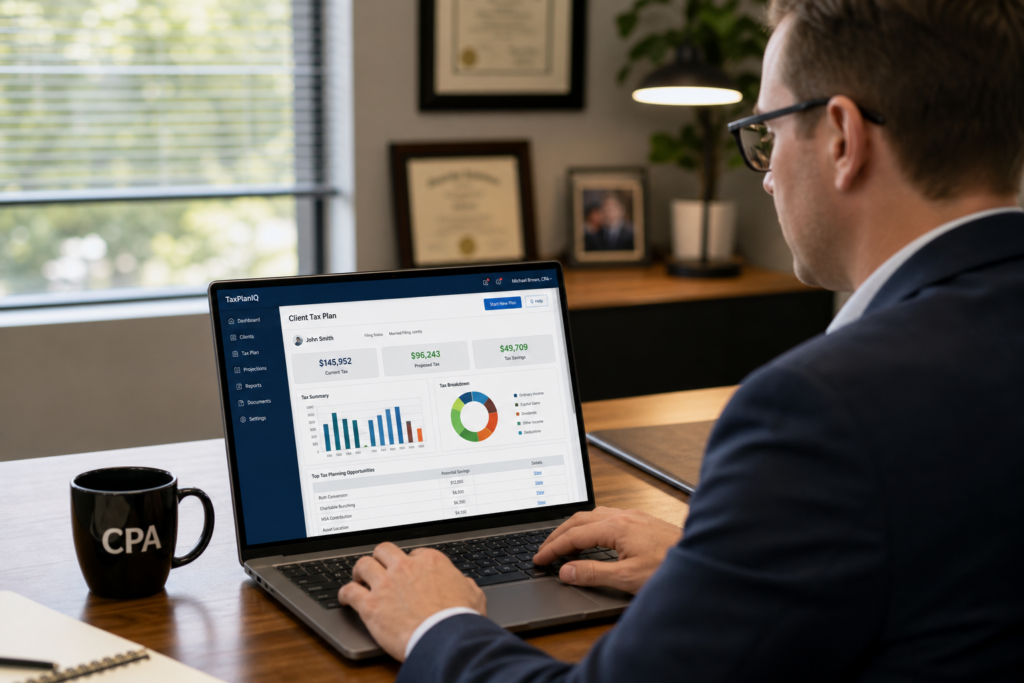
Tax Planning Software for CPAs: 2026 Buyer’s Guide
Choosing the right tax planning software for CPAs is now a business decision, not just a tech purchase. In 2026, firms are shifting from compliance-only work to high-value advisory. The right platform helps you deliver bigger client savings, charge premium fees, and grow. This guide breaks down features, AI tools, pricing, and how to pick a solution that scales your firm. Let’s dive in.
Table of Contents
- Key Takeaways
- What Is Tax Planning Software for CPAs?
- Why Should You Move Beyond Compliance-Only Tools?
- What Features Should You Look For in 2026?
- How Is AI Transforming Tax Advisory?
- How Do You Choose the Right Platform?
- How Much Does Tax Planning Software Cost?
- Uncle Kam in Action
- Next Steps
- Related Resources
- Frequently Asked Questions

Key Takeaways
- Tax planning software for CPAs helps firms shift from compliance to profitable advisory work.
- In 2026, half of surveyed firms are expanding into tax planning services.
- Look for AI, entity-aware modeling, and client-ready deliverables when comparing platforms.
- Unlimited free assessments let you prove value before signing an engagement.
- The best software also includes training and a built-in client marketplace.
What Is Tax Planning Software for CPAs?
Quick Answer: Tax planning software for CPAs models future tax outcomes. It identifies savings strategies before returns are filed. Then it turns them into client deliverables.
Tax planning software for CPAs is a tool built for forward-looking advice. It differs from tax prep software. Prep tools look backward and file last year’s numbers. Planning tools look ahead and reduce next year’s bill. As a result, they power a completely different revenue model for your firm.
Most modern platforms run “what-if” scenarios. For example, they compare an S corp election against a sole proprietorship. Furthermore, they estimate savings from retirement plans, entity changes, and timing moves. Therefore, you can show clients real dollars before they act. This drives higher-value ongoing tax advisory relationships that clients happily pay for.
Planning Versus Compliance: The Core Difference
Compliance is required work. Planning is chosen work. Clients must file returns, but they choose to plan. Consequently, planning commands premium fees because it delivers measurable savings. In addition, it builds a recurring relationship rather than a once-a-year transaction.
Who Uses These Tools?
CPAs, enrolled agents, and firm owners all use planning software. Solo practitioners use it to punch above their weight. Meanwhile, larger firms use it to standardize advisory across many staff. Either way, the goal stays the same. Specifically, firms want to serve business owners and entrepreneurs with proactive advice.
Pro Tip: Pick software that models entities and 1040s together. Isolated strategies often miss the biggest savings.
Why Should You Move Beyond Compliance-Only Tools?
Quick Answer: Compliance-only tools cap your income. Advisory-focused tax planning software for CPAs unlocks premium fees and recurring revenue in 2026.
Compliance work is getting commoditized. AI now handles routine returns faster and cheaper. According to Accounting Today, 50% of surveyed firms are moving into tax planning and preparation as a growth area. Therefore, standing still is risky. Clients now expect strategic advice, not just filed forms.
The 2025 One Big Beautiful Bill Act (OBBBA) changed many rules for 2026. It enhanced bonus depreciation and eased the business interest deduction cap. It also made Opportunity Zones a permanent, recurring program. As a result, clients need help navigating these shifts. You can review official guidance on the IRS newsroom as changes roll out.
The Revenue Ceiling Problem
Compliance pricing is stuck. A return costs what a return costs. However, planning pricing scales with the value you deliver. For example, a strategy saving $40,000 easily justifies a $6,000 fee. Consequently, one advisory client can equal ten prep clients in profit.
Client Expectations Have Shifted
AI has raised the bar for good service. Clients now expect fast, insightful guidance. Moreover, they compare you to instant AI answers. Therefore, you must deliver proactive strategy, not reactive filing. Advisory software helps you meet that standard at scale. Ready to make the leap? You can book a strategy session to map your path.
Did You Know? Client advisory services (CAS) is a top growth area, with 38% of firms already offering it in 2026.
What Features Should You Look For in 2026?
Quick Answer: Prioritize AI strategy engines, entity-aware modeling, client-ready deliverables, and unlimited assessments. These features drive both results and revenue.
Features vary widely across platforms. Some tools only screen returns for missed strategies. Others model full multi-entity scenarios. When comparing tax planning software for CPAs, focus on outcomes. Specifically, ask what the tool helps you sell and deliver. The table below rates key criteria for 2026.
| Feature | Why It Matters | Priority |
|---|---|---|
| AI strategy engine | Surfaces strategies faster and reduces manual research | High |
| Entity-aware modeling | Evaluates 1040s, 1120-S, and K-1s together | High |
| Client-ready deliverables | Turns analysis into branded, easy-to-read plans | High |
| Unlimited assessments | Lets you prove value before signing clients | High |
| Built-in training | Teaches you to sell and price advisory | Medium |
| Lead marketplace | Routes qualified advisory prospects to you | Medium |
Entity-Aware Scenario Modeling
Strategies rarely work in isolation. For example, an S corp election affects payroll, retirement, and QBI. Therefore, your tool must model the whole picture. Uncle Kam uses the MERNA framework to sequence strategies. This entity structuring approach evaluates the full portfolio at once.
Professional Client Deliverables
Clients pay for clarity, not spreadsheets. So your software should produce polished plans. These include strategy summaries, roadmaps, and risk notes. As a result, clients understand the value and say yes. This is where a professional tax planning software that generates branded deliverables wins engagements.
Unlimited Free Assessments
Many tools charge per analysis. That creates friction with prospects. You hesitate to “spend a credit” on someone who may not buy. In contrast, unlimited assessments remove that risk. Therefore, you can run a plan for every prospect and win more deals.
How Is AI Transforming Tax Advisory?
Quick Answer: AI now scans data, surfaces strategies, and drafts plans in minutes. This makes scalable, tailored advice possible for firms of any size.
AI is reshaping the profession fast. In 2026, firms use agentic AI across audit and tax. According to Accounting Today, agents are starting to handle routine work. As a result, staff focus on higher-value strategy. This shift favors advisory-first firms.
AI helps in three big ways. First, it captures and connects messy client data. Second, it surfaces relevant strategies quickly. Third, it drafts plans you can refine. Consequently, one advisor can serve far more clients. Learn how proactive tax strategy and planning pairs with AI to boost savings.
From Data to Insight in Minutes
Manual planning takes hours per client. AI cuts that to minutes. For example, it reads a prior return and flags missed strategies. Then it estimates savings automatically. Therefore, you spend time advising, not calculating.
Keeping Up With 2026 Law Changes
Tax law changes constantly. In 2026, OBBBA rules keep evolving through IRS guidance. For instance, Notice 2026-40 governs the Opportunity Zone transition. Good software updates strategies as rules change. As a result, your advice stays current and defensible.
Pro Tip: Use AI to draft the plan, then add your judgment. Clients pay for your expertise, not the software.
How Do You Choose the Right Platform?

Quick Answer: Match the platform to your growth goals. Score each option on strategies, deliverables, cost, and business support.
Choosing software feels overwhelming. However, a simple process makes it clear. First, define your goal. Do you want to save clients more, charge more, or both? Then score each tool against that goal. Below is a step-by-step guide to building an advisory practice.
A Simple 5-Step Selection Process
- Define your revenue goal and target client type first.
- List must-have features like AI and entity modeling.
- Test each tool with a real client scenario.
- Check pricing, including per-analysis fees or caps.
- Confirm training and lead support are included.
Understanding the Market Options
The market includes several types of tools. Some focus on return screening, like Holistiplan. Others focus on planning, like Corvee and TaxPlanIQ. Intuit Tax Advisor integrates with prep software. Meanwhile, Uncle Kam combines software, training, and leads. Each serves a different firm need.
| Platform Type | Best For | Focus |
|---|---|---|
| Return screeners | Fast strategy scans | Compliance-adjacent |
| Point planners | Firms with a sales process | Planning only |
| Integrated advisory systems | Firms scaling advisory | Software, training, leads |
Selling advisory and delivering advisory are two different skills. Most tools only identify savings. However, you also need help closing and pricing. Uncle Kam works as a full tax advisory operating system that supports the whole lifecycle. It is especially useful when serving high-net-worth individuals with complex needs.
How Much Does Tax Planning Software Cost?
Quick Answer: Prices range from monthly subscriptions to per-analysis fees. Focus on ROI, not sticker price, since one client can cover the cost.
Cost structures vary widely across the market. Some tools charge a flat annual subscription. Others charge per client analysis. A few cap the number of plans you can run. Therefore, read the pricing terms carefully. Hidden per-analysis fees add up fast during a busy season.
A Simple ROI Calculation
Let’s run the numbers on a real example. Suppose software costs $5,000 per year. Then you close five advisory clients at $5,000 each. That equals $25,000 in new revenue. As a result, your first-year ROI is 400%. Furthermore, most of that revenue repeats every year.
Did You Know? Late filing penalties can reach 25% of unpaid tax. Good planning helps clients avoid costly surprises.
Why Unlimited Beats Per-Analysis Pricing
Per-analysis pricing punishes growth. Every prospect analysis costs you money. Consequently, you run fewer plans and win fewer clients. Unlimited access flips that math. You can run assessments freely and prove value first. This is a key advantage of choosing tax planning software with unlimited assessments. It also supports firms serving self-employed and 1099 clients at scale.
Pricing should never block your growth. Instead, it should fuel it. If your tool caps usage, you may leave money on the table. So weigh cost against revenue potential. Want a personalized ROI estimate for your firm? You can book a free strategy session to review the math together.
Uncle Kam in Action: How a Solo CPA Added $180K in Advisory Revenue
Client Snapshot: Maria runs a solo CPA firm in the Midwest. She served about 120 tax prep clients. Most paid $500 per return. As a result, she felt stuck on a revenue ceiling.
Financial Profile: Her firm generated roughly $90,000 in annual revenue. However, she worked long hours during tax season. Meanwhile, she had no recurring income outside of filing season.
The Challenge: Maria knew her clients needed strategy. Yet she lacked a system to sell and deliver it. She had tried a point-solution planner. However, per-analysis fees made her hesitant to run plans. Therefore, she rarely used it.
The Uncle Kam Solution: Maria adopted the Uncle Kam advisory operating system. First, she ran unlimited free assessments on her top 30 clients. Then the AI engine surfaced strategies using the MERNA framework. These included an S corp election and a retirement plan. Next, the platform produced branded, client-ready plans. Finally, weekly coaching taught her how to price and pitch.
The Results: Maria closed 36 advisory clients in her first year. Each paid an average of $5,000. As a result, she added $180,000 in new revenue. Her investment in the platform was about $6,000. Therefore, her first-year ROI exceeded 29x. Moreover, most of that revenue now repeats annually. See more outcomes on the Uncle Kam client results page.
Next Steps
You now understand what to look for in tax planning software for CPAs. So take action while the momentum is fresh.
- List your top 20 clients who need proactive planning.
- Compare platforms using the feature table above.
- Explore Uncle Kam’s tax strategy and planning tools today.
- Run a free assessment to prove value fast.
- Book a strategy session to build your advisory roadmap.
Related Resources
- The MERNA Method Explained
- Tax Prep and Filing Services
- Business Solutions for Firms
- Uncle Kam Tax Strategy Blog
Frequently Asked Questions
Is tax planning software different from tax prep software?
Yes, the two serve different purposes. Prep software files last year’s return. In contrast, planning software reduces next year’s tax bill. Therefore, planning drives premium advisory fees, while prep is compliance work.
Can tax planning software help me find new clients?
Some platforms include a built-in marketplace. This routes pre-qualified advisory leads to certified pros. As a result, you get clients, not just software. Additionally, free assessments help you convert existing prospects.
How long does it take to see a return on investment?
Most firms see ROI within a few months. For example, one advisory client often covers the annual cost. Therefore, the software pays for itself quickly. After that, added revenue is largely profit.
Do I need to be a CPA to use these tools?
No, enrolled agents and tax advisors also use them. Anyone offering tax advice can benefit. However, you must hold a valid PTIN to prepare returns for pay. Always follow IRS tax professional guidelines.
How does software keep up with 2026 tax law changes?
Quality platforms update strategies as laws change. In 2026, OBBBA rules keep evolving through IRS guidance. Therefore, choose a tool with active updates. This keeps your advice accurate and defensible.
What is the most cost-effective option for a small firm?
Look for unlimited assessments and included training. These features remove usage anxiety for small firms. As a result, you can grow without per-analysis fees. Book a free consultation to compare your options.
This information is current as of 7/10/2026. Tax laws change frequently. Verify updates with the IRS if reading this later.
Last updated: July, 2026

