
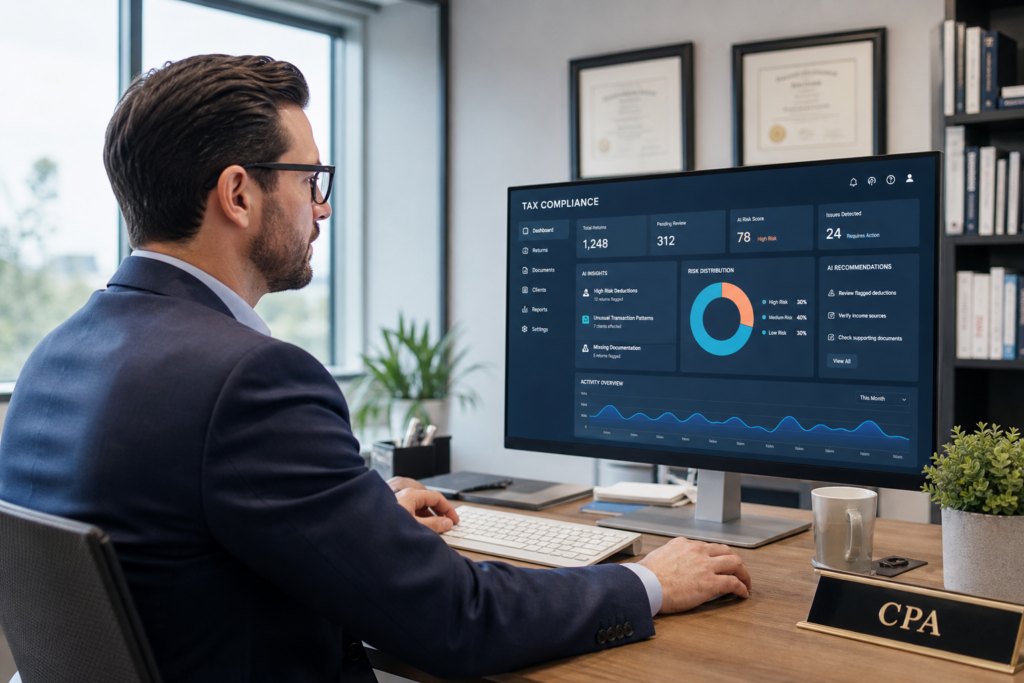
Tax Compliance Software 2026: Future-Proof Your Firm
If you fear that automation will replace you, tax compliance software in 2026 is either your biggest threat or your best growth engine. The truth depends on how you use it. For CPAs, Enrolled Agents, and solo practitioners, 2026 marks a turning point. The IRS is going fully digital. AI is rewriting how returns get processed. Smart tax pros are not hiding from this shift. Instead, they are using it to move from low-margin prep into high-value advisory work.
This guide shows you how to future-proof your practice. Furthermore, it explains how the right technology helps you serve clients better, save them more, and grow a scalable firm. Ready to build a practice that thrives in the AI era? You can book a strategy session to map your next steps. Let us dig into what really matters for 2026.
Table of Contents
- Key Takeaways
- What Is Tax Compliance Software in 2026?
- Will AI and Tax Compliance Software Replace Tax Preparers?
- How Does Tax Compliance Software Change Your Workflow?
- How Do You Choose the Right Tax Compliance Software in 2026?
- How Does Software Help You Shift From Prep to Advisory?
- What Are the Security Risks of Tax Compliance Software?
- Uncle Kam in Action
- Next Steps
- Related Resources
- Frequently Asked Questions
Key Takeaways
- Tax compliance software automates data entry, so you can sell strategy instead.
- AI will not replace advisors, but it will replace pure data-entry preparers.
- The 2026 IRS digital push makes modern software non-negotiable for firms.
- Advisory clients pay far more than prep clients for the same hours.
- Security and data governance now matter as much as automation features.
What Is Tax Compliance Software in 2026?
Quick Answer: Tax compliance software handles data collection, calculations, filing, and reporting. In 2026, it also uses AI to reduce manual work and flag risks automatically.
Tax compliance software is the toolkit that keeps returns accurate and on time. It pulls in client data, runs the math, and files with agencies. Traditionally, this meant heavy manual entry. However, 2026 tools now automate most of that grind. As a result, your time gets freed up for higher-value work.
The shift is bigger than a feature update. The OECD calls it “Tax Administration 3.0.” In this model, compliance gets built into everyday business systems. In other words, “tax just happens” in the background. Meanwhile, the IRS is racing to catch up with its own digital push. For a deeper look at proactive planning, review our tax strategy services.
The Core Functions You Rely On
Modern tax compliance software covers several key jobs. Therefore, understanding each helps you buy smart.
- Data import from bank feeds, payroll, and prior returns.
- Automated calculations for federal and state filings.
- E-filing that meets IRS electronic submission rules.
- Error checks that flag missing forms or numbers.
Why 2026 Feels Different
This year, government policy is accelerating change. In July 2026, the Senate Finance Committee released the Taxpayer Assistance and Service Act. Notably, it would require the IRS to accept and process all returns electronically. Furthermore, it mandates optical character recognition to transcribe paper filings. Consequently, firms tied to old paper workflows will fall behind fast.
Pro Tip: Pick software that supports full e-filing now. The 2026 IRS digital mandate will make paper workflows obsolete.
Will AI and Tax Compliance Software Replace Tax Preparers?
Quick Answer: AI will replace repetitive data entry, not advisors. Tax pros who add strategy and judgment stay in high demand through 2026 and beyond.
This is the question that keeps you up at night. Let us answer it honestly. AI is very good at pattern work. It reads documents, fills forms, and catches math errors. As a result, pure data-entry roles are shrinking. However, AI cannot replace trusted judgment or client relationships.
The market proves this point. One July 2026 report estimated AI could raise US tax collections by $216 billion by 2030. Meanwhile, new legislation in Congress would require continuing education for unlicensed preparers. In short, the bar for human expertise is rising, not falling. Business owners who need guidance can explore our resources for business owners seeking tax help.
What AI Does Well
AI shines at speed and consistency. For example, it can scan hundreds of receipts in minutes. Likewise, it flags mismatches a tired human might miss. Therefore, using AI makes your prep work faster and cleaner.
What Only You Can Do
Clients do not pay top dollar for math. They pay for clarity, trust, and savings. You interpret the law for a specific life situation. Moreover, you spot planning moves no algorithm suggests. That is why ongoing tax advisory relationships command premium fees. The AI-anxious tax pro who adds this layer wins.
Did You Know? Only 37% of advisors proactively discuss tax planning with clients, per 2026 Nationwide research. That gap is your opportunity.
How Does Tax Compliance Software Change Your Workflow?
tax compliance software cuts the manual busywork. As a result, your team spends less time typing and more time advising clients on real strategy.
Your old workflow probably looks like a bottleneck during tax season. Documents pile up. Data entry drags. Reviews get rushed. However, modern tax compliance software rebuilds this flow from the ground up. Consequently, you gain hours back every week.
The 2026 IRS upgrades also help. Proposed rules would let practitioners view a rolling six-year client history online. Furthermore, you could access multiple client accounts without separate logins. This means less time chasing transcripts. Instead, you focus on accurate filing and reporting.
Before and After Automation
Consider a solo CPA handling 200 returns. The table below shows the shift.
| Task | Manual (Hours) | With Software (Hours) |
|---|---|---|
| Data entry per return | 1.5 | 0.3 |
| Error review per return | 0.8 | 0.3 |
| Time freed for advisory | 0 | 1.7 |
Turning Saved Time Into Revenue
Saved hours mean nothing if you waste them. Instead, reinvest that time into advisory calls. For example, one planning meeting can add thousands in fees. Therefore, automation is really a revenue tool in disguise.
How Do You Choose the Right Tax Compliance Software in 2026?
Quick Answer: Choose tax compliance software based on automation depth, security, integrations, and advisory features. Avoid tools that only handle basic prep.
Not all tools are equal. Some only file returns. Others help you sell strategy. Because your goal is growth, you need software that supports both. So use a clear checklist before you buy.
Several vendors serve this market. Corvee and TaxPlanIQ focus on planning workflows. Holistiplan scans returns for opportunities. Meanwhile, Thomson Reuters and CCH serve larger firms with deep compliance suites. Each has a different target audience and price point. For firms testing new tools, our business systems and automation guidance can help.
Your 2026 Buyer’s Checklist
- Full e-filing that meets the 2026 IRS digital mandate.
- Strong data security and clear breach protocols.
- Integrations with your bookkeeping and payroll tools.
- Advisory features that turn data into client-ready plans.
- Fair pricing without steep per-analysis fees.
Pricing models matter more than most pros realize. Many tools charge per analysis or cap your usage. Consequently, you hesitate to run assessments on prospects. That friction blocks growth. By contrast, Uncle Kam offers tax planning software with unlimited assessments. This lets you prove value to every prospect before they sign. It is an advisory operating system, not just a filing tool.
Sacramento business owners want real numbers before they commit. Use our Sacramento Small Business Tax Calculator to estimate 2026 savings.
How Does Software Help You Shift From Prep to Advisory?

Quick Answer: Software automates prep so you have time to advise. Then advisory tools turn data into paid strategic plans clients value.
Here is the real path to future-proofing your firm. Prep alone is a race to the bottom. AI keeps pushing prices down. However, advisory is where margins live. Therefore, the smartest move is to shift your business model.
The demand is clearly there. In 2026, Nationwide found 80% of investors expect taxes to rise. Yet fewer than one-third are adjusting their plans. That gap is a goldmine for proactive tax pros. Advisory is not just filing; it is guidance across entities and years. Learn more about the MERNA planning method we use.
Selling and Delivering Advisory
Selling advisory and delivering it are two different skills. First, you must show clear value before the engagement. Then you need a system to deliver structured plans. Uncle Kam works as a complete tax advisory operating system. It pairs software with training and inbound leads. You can also learn how the Uncle Kam marketplace helps tax pros transition to advisory.
Pricing Advisory the Right Way
Advisory clients pay for outcomes, not hours. For instance, a plan saving $20,000 easily supports a $5,000 fee. As a result, one advisory client can equal ten prep clients in revenue. Ready to make that shift? You can book a strategy session today.
Pro Tip: Run a free tax assessment during prep season. Then use it to upsell advisory before next year.
What Are the Security Risks of Tax Compliance Software?
Quick Answer: The main risks are data breaches, weak access controls, and unpatched software. Strong security must be a top buying priority in 2026.
Automation brings power, but it also brings risk. You hold sensitive client data. Therefore, a breach can destroy trust overnight. In 2026, security is no longer optional. It is a core part of choosing tax compliance software.
Even the IRS struggles here. In July 2026, the Treasury Inspector General flagged security gaps in the IRS Zero Paper Initiative. Auditors found unpatched software and weak physical access controls at contractor sites. Consequently, the IRS said it would update Publication 4557 safeguards guidance. This shows security failures can hit anyone. High-income clients especially value discretion, as our high-net-worth tax planning page explains.
Your Security Must-Haves
- Encryption for data at rest and in transit.
- Multi-factor login for every user account.
- Regular software updates and security patches.
- A written data security plan, per IRS rules.
The IRS Requires a Written Plan
Many pros do not know this rule. The IRS requires paid preparers to keep a written information security plan. You can find the framework in IRS Security Summit guidance. Furthermore, good software makes this compliance far easier. As a result, you protect clients and your license at the same time.
Uncle Kam in Action: The Solo CPA Who Beat AI Anxiety
Client Snapshot: Maria is a solo CPA in Sacramento. She ran a small firm focused on individual and small business returns.
Financial Profile: Her firm earned about $180,000 in yearly revenue. Most came from low-fee prep work during a brutal tax season.
The Challenge: Maria feared AI would gut her prep business. Prices were dropping. Clients kept asking why software could not just do it. Meanwhile, she worked 70-hour weeks and still felt behind. She knew she needed to change, but she did not know how.
The Uncle Kam Solution: Maria adopted our advisory operating system in early 2026. First, she used the unlimited free assessments to review her top 30 clients. The software flagged big savings across entity structure and retirement plans. Then she used the branded plan generator to build client-ready deliverables. Because she could run assessments freely, she showed value before charging a dime.
Next, she attended the weekly coaching on pricing and selling advisory. As a result, she learned to package plans as flat-fee engagements. She stopped trading hours for dollars. Instead, she sold outcomes.
The Results: Within her first year, Maria closed 12 advisory clients. Each paid an average $4,800 fee. Therefore, she added roughly $57,600 in new advisory revenue. Her total client tax savings topped $210,000 across the group. Her investment in the platform was about $7,200 for the year. That produced a first-year ROI of roughly 8x on her fees alone. More importantly, her AI anxiety faded. She now sees software as her partner, not her replacement. See more outcomes on our client results page.
Next Steps
You do not have to fear the AI era. Instead, take control with a clear plan. Here are your first moves for 2026.
- Audit your current tax compliance software for e-filing and security.
- Run free assessments on your top 20 clients this quarter.
- Package one advisory offer and price it by outcome.
- Review our entity structuring services for client planning ideas.
- Book a call to build your future-proof roadmap.
Ready to move from prep to profit? You can book a strategy session now and apply to join the Uncle Kam network today.
Related Resources
- Tax Strategy Blog for Pros
- In-Depth Tax Planning Guides
- Free Tax Calculators
- About the Uncle Kam Team
Frequently Asked Questions
Will tax compliance software make my CPA license useless?
No. Software handles the mechanics, not the judgment. In fact, 2026 legislation raises education standards for preparers. Therefore, your license and expertise grow more valuable, not less.
What is Tax Administration 3.0?
It is the OECD model for digital tax administration. In this vision, compliance is built into everyday business systems. As a result, “tax just happens” in the background with less manual effort.
How much does tax compliance software cost in 2026?
Prices vary widely by vendor and features. Some charge per analysis, which limits your use. Others, like Uncle Kam, offer unlimited assessments for one predictable fee. Always compare total cost, not just the sticker price.
How do I start shifting to advisory work?
Start small and stay focused. First, run free assessments on current clients. Then present one clear savings plan. Next, price it by the outcome you deliver. Finally, repeat the process to build recurring revenue.
Is my client data safe with cloud tax software?
It can be safe with the right tool. Look for encryption and multi-factor login. Also confirm regular security patches. Furthermore, the IRS requires you to keep a written security plan for client data.
Do freelancers and 1099 clients need this too?
Yes, they benefit greatly from proactive planning. Self-employed clients often overpay in taxes. Our self-employed tax planning resources show why advisory helps them most.
This information is current as of 7/29/2026. Tax laws change frequently. Verify updates with the IRS or FTB if reading this later.
Last updated: July, 2026

