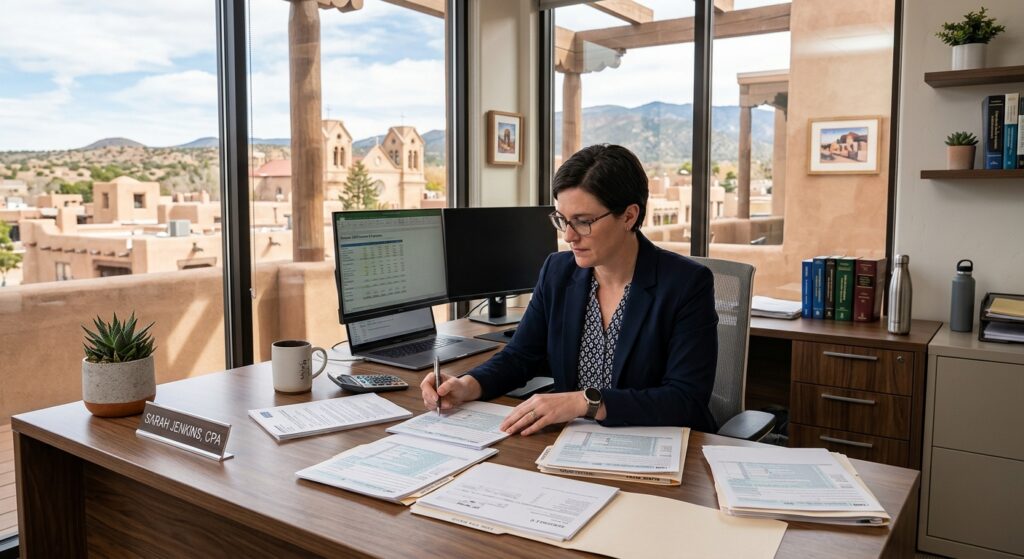
Santa Fe Flat Rate Tax Preparation for 2026: Self-Employed & Small Business Tax Strategy Guide
Santa Fe Flat Rate Tax Preparation for 2026: Self-Employed & Small Business Tax Strategy Guide
For Santa Fe residents managing business income, 1099 earnings, or self-employment responsibilities, navigating 2026 tax obligations can feel overwhelming. Santa Fe flat rate tax preparation services have emerged as a cost-effective solution, combining affordable fixed fees with professional tax planning strategies. By working with a Santa Fe tax preparation specialist, you can maximize deductions, optimize your business structure, and retain more of your hard-earned income. This comprehensive guide explores how flat-rate tax preparation works, what deductions you might be missing, and how to strategically structure your 2026 taxes for maximum savings.
Table of Contents
- Key Takeaways
- What Is Flat-Rate Tax Preparation for 2026?
- How Self-Employment Tax Works in 2026
- Vehicle Deductions and Business Mileage Strategy
- S Corporation Tax Benefits vs. Sole Proprietor
- 2026 Tax Credits and Deductions for Self-Employed
- Uncle Kam in Action
- Next Steps
- Frequently Asked Questions
Key Takeaways
- Flat-rate tax preparation in 2026 provides fixed-fee service for predictable costs and professional compliance.
- Self-employed individuals pay 15.3% self-employment tax on net income exceeding $400 for 2026.
- Business mileage deductions for 2026 are 67.5 cents per mile, potentially saving thousands annually.
- S-Corp election can reduce self-employment tax by over $7,000 annually on $100,000 net income.
- Proper entity structuring and deduction planning through professional tax prep yields significant ROI.
What Is Flat-Rate Tax Preparation for 2026?
Quick Answer: Flat-rate tax preparation means paying a fixed fee regardless of how complex your return is, eliminating surprise costs and providing budget certainty for 2026 filing.
Flat-rate tax preparation represents a shift from hourly billing to transparent, fixed-price service. Rather than paying accountants by the hour (which can range from $150-300+ per hour), you pay one set fee for complete tax filing and planning services. This model gained significant popularity in 2026 as self-employment and 1099 work continues expanding across America.
For Santa Fe residents, flat-rate tax preparation offers several advantages. First, you know exactly what you’ll pay upfront. Second, tax professionals have incentive to work efficiently. Third, the model aligns well with self-employed tax planning needs, where strategic structuring saves far more than any fee you pay.
How Flat-Rate Tax Prep Works in 2026
Flat-rate providers typically offer tiered pricing based on complexity level. A simple 1099 return might cost $299-499. More complex returns with multiple income sources, business entities, and rental properties could run $799-1,499. The critical advantage: the price is locked in before you start.
Professional flat-rate firms in Santa Fe include preliminary tax strategy sessions to identify deductions before filing. This proactive approach means you’re not just filing—you’re optimizing. Many 2026 clients report saving $3,000-$15,000 in taxes through proper planning, making the flat fee an excellent investment.
Flat-Rate vs. Hourly Tax Preparation Comparison
| Billing Method | Cost Structure | 2026 Typical Cost | Best For |
|---|---|---|---|
| Flat-Rate | Fixed fee, no surprises | $299-$1,499 | Predictable budgets |
| Hourly | $150-$350/hour | $1,500-$5,000+ | Complex multi-year cases |
Pro Tip: For most Santa Fe self-employed individuals and small business owners, flat-rate tax preparation provides superior value. The fixed cost combined with tax strategy typically delivers 5-10x ROI in the first year alone through deduction optimization and entity planning.
How Self-Employment Tax Works in 2026
Quick Answer: In 2026, self-employed workers pay 15.3% self-employment tax on net profits exceeding $400, covering Social Security and Medicare contributions that W-2 employees split with employers.
Self-employment tax is the hidden tax burden that catches many Santa Fe entrepreneurs off-guard. Unlike W-2 employees where employers cover half of Social Security and Medicare taxes, self-employed individuals pay both halves: 12.4% for Social Security and 2.9% for Medicare, totaling 15.3% for 2026.
This tax applies to net business income exceeding $400 annually. If you earned $50,000 in 1099 income in 2026, you’d owe approximately $7,065 in self-employment tax alone, on top of regular income tax. This is why strategic business structuring through professional entity structuring can save thousands.
2026 Self-Employment Tax Calculation Example
Let’s say you’re a Santa Fe consultant earning $75,000 in net 1099 income for 2026. Here’s your self-employment tax calculation:
- Net business income: $75,000
- Self-employment tax (15.3%): $11,475
- You can deduct 50% on your income tax return: -$5,738 deduction
- Net self-employment tax cost: approximately $11,475
Reducing Self-Employment Tax Through Strategic Planning
The most powerful self-employment tax reduction strategy for 2026 is electing S-Corporation treatment. With professional tax preparation and filing services, you can structure your business to pay yourself a reasonable salary (subject to payroll taxes) and take remaining profits as distributions (not subject to self-employment tax).
Did You Know? On $75,000 net business income, an S-Corp election could reduce self-employment taxes by $5,250+, even after adding payroll processing fees. That’s why professional tax planning typically pays for itself many times over.
Vehicle Deductions and Business Mileage Strategy
Quick Answer: For 2026, the IRS standard business mileage deduction is 67.5 cents per mile, allowing significant tax savings for Santa Fe self-employed workers using vehicles for business purposes.
Santa Fe’s geographic terrain and business community make vehicle deductions particularly valuable for local professionals. Whether you’re a contractor traveling to client sites, a real estate agent showing properties, or a consultant meeting with various clients, vehicle mileage deductions are one of the most accessible and valuable tax breaks available.
The 2026 standard mileage rate of 67.5 cents per mile applies to business use of your vehicle. This rate covers gas, maintenance, depreciation, and other ownership costs. For someone driving 15,000 business miles annually, that’s $10,125 in deductions, potentially saving $2,500-$3,500 in taxes depending on your tax bracket.
2026 Hyundai Santa Fe and Business Vehicle Considerations
If you’re purchasing a 2026 Hyundai Santa Fe or similar SUV for business use in Santa Fe, New Mexico, understanding tax treatment is essential. The IRS allows deductions for vehicles used in business, whether purchased new or used. For 2026, Section 179 depreciation allows significant first-year write-offs on qualifying business vehicles.
You have two mileage deduction approaches: the standard mileage method (67.5¢ per mile in 2026) or actual expense method (track all repairs, insurance, fuel costs). Most Santa Fe professionals benefit from the standard method due to simplicity and competitive deduction amounts.
Proper Vehicle Expense Documentation
- Maintain detailed mileage logs with dates, destinations, and business purpose
- Separate personal and business mileage meticulously
- Keep fuel receipts and maintenance records for actual expense method
- Calculate business percentage of total vehicle use annually
- Consider mileage tracking apps to reduce manual documentation burden
S Corporation Tax Benefits vs. Sole Proprietor
 Free Tax Write-Off Finder
Quick Answer: S-Corp election for 2026 can save self-employed individuals over $7,000 annually on $100,000 net income by splitting earnings into reasonable salary and distribution income.
The distinction between sole proprietor taxation and S-Corporation taxation represents the single largest tax optimization decision for Santa Fe entrepreneurs. A sole proprietor pays self-employment tax on 92.35% of net business income. An S-Corp owner pays payroll taxes only on salary and takes remaining profits as distributions, avoiding self-employment tax entirely on distributions.
According to 2026 tax analysis, the self-employment tax difference at $100,000 net income exceeds $7,000 annually when comparing standard structures to optimized S-Corp setups. This doesn’t include potential state tax savings or health insurance deduction advantages that further improve the S-Corp position.
S-Corp Reasonable Salary Requirement
A critical IRS requirement for S-Corps is paying yourself a “reasonable salary” for services rendered. You can’t pay yourself $1,000 salary and take $99,000 in distributions—the IRS will challenge this. The reasonable salary must reflect fair market compensation for your actual work.
Professional flat-rate tax preparation services in Santa Fe help determine appropriate reasonable salaries based on your industry, experience level, and comparable compensation. This ensures IRS compliance while maximizing distributions and self-employment tax savings.
Pro Tip: S-Corp conversion timing matters. Electing S-Corp status mid-year creates complexity. Most Santa Fe professionals benefit from establishing S-Corp status in January or immediately upon business launch to maximize 2026 tax savings and simplify year-end compliance.
2026 Tax Credits and Deductions for Self-Employed
Quick Answer: 2026 tax credits include expanded child tax credits, working family credits, and enhanced deductions under the One Big Beautiful Bill Act, significantly benefiting Santa Fe small business owners.
Recent tax law changes through the One Big Beautiful Bill Act expanded deductions and credits available for self-employed professionals in 2026. These changes require proactive planning to maximize benefits. Many Santa Fe entrepreneurs miss thousands in available credits simply due to lack of awareness.
Common Overlooked Deductions for 2026
- Home office deduction (simplified method: $5/square foot, actual expenses method)
- Health insurance premiums (self-employed health insurance deduction)
- Professional development and continuing education
- Equipment purchases and office supplies under $2,500
- Software subscriptions, cell phone plans, internet service
- Business meals and entertainment (50% deductible)
- Professional liability insurance and licenses
- Accounting and tax preparation fees
2026 Tax Deduction Maximization Strategies
Working with professional flat-rate tax preparation ensures you capture every deduction legally available. A comprehensive 2026 tax strategy includes:
- Quarterly deduction category reviews during the year
- Equipment purchase timing optimization
- Section 179 depreciation elections on business purchases
- Health savings account contributions if self-insured
- Qualified business income deductions under current tax law

Uncle Kam in Action: Real Results from Santa Fe Business Owner
Client Profile: Maria, a Santa Fe-based real estate consultant with approximately $95,000 in annual 1099 income, initially filed her 2025 taxes as a sole proprietor with a CPA using hourly billing at $250/hour. She estimated roughly $12,000 in self-employment taxes plus income tax.
The Challenge: Maria paid $3,200 in tax preparation fees while missing significant deductions and failing to optimize her business structure. She was paying full self-employment taxes on all 1099 income despite significant business expenses. Additionally, her vehicle expenses were under-documented, and she wasn’t maximizing home office deductions.
Uncle Kam’s Solution: Through professional tax strategy services, Maria’s business was restructured as an S-Corporation effective January 2026. We implemented the following optimizations:
- S-Corp election reducing self-employment tax from $13,395 to $8,100 annually
- Documented 12,000 business miles at 67.5¢/mile = $8,100 vehicle deduction
- Established home office deduction using actual expense method = $4,800 annually
- Implemented health insurance deduction and equipment write-offs
The Results: Maria’s 2026 federal tax liability decreased by $6,200, while state taxes saved an additional $1,100. Her total tax savings for 2026 reached $7,300. She invested $899 in flat-rate tax preparation service, yielding an 812% first-year return on investment. Maria now uses our quarterly planning sessions to ensure she captures all 2026 deductions and maintains compliance with S-Corp requirements.
Key Insight: Maria’s situation is common among Santa Fe professionals. Many self-employed individuals pay 15-20% more in taxes than necessary simply due to suboptimal business structure and incomplete deduction tracking. Professional flat-rate tax preparation, combined with strategic planning, transforms tax liability from a burden into an optimization opportunity.
Next Steps
- Schedule a 2026 tax consultation: Meet with a professional offering tax preparation services in New Mexico to review your current structure and identify immediate optimization opportunities.
- Gather 2026 documentation: Compile all 1099 forms, business expense receipts, vehicle mileage logs, and deduction records to maximize preparation efficiency and accuracy.
- Evaluate S-Corp feasibility: Determine whether S-Corporation election offers tax benefits exceeding the increased compliance costs for your specific income level.
- Implement quarterly planning: Transition from annual tax filing to quarterly tax strategy reviews to capture deductions throughout 2026 and adjust withholdings proactively.
- Compare flat-rate options: Request quotes from multiple providers offering flat-rate tax preparation to ensure competitive pricing with quality service delivery.
Frequently Asked Questions
What Is the Deadline for 2026 Tax Filing in Santa Fe?
The 2026 federal tax deadline is April 15, 2027. However, many Santa Fe professionals file earlier to receive refunds faster or manage quarterly estimated tax payments. Extensions to October 15, 2027 are available by filing Form 4868 by April 15, 2027. State of New Mexico returns generally follow federal deadline but confirm with New Mexico Taxation & Revenue Department.
How Much Should I Charge for Mileage Deductions if Using a 2026 Santa Fe Vehicle?
Use the IRS standard mileage rate of 67.5 cents per mile for 2026 business mileage. Simply multiply business miles driven by 0.675. If you drove 15,000 business miles in 2026, your deduction is $10,125. Alternatively, track actual expenses (gas, insurance, maintenance, depreciation) and deduct the business percentage. Most professionals find the standard rate more advantageous and easier to document.
Can I Deduct the Purchase Price of My 2026 Santa Fe Vehicle?
You cannot deduct the full purchase price, but Section 179 depreciation allows significant first-year write-offs for qualifying business vehicles. For 2026, Section 179 limit is $1,080,000. Additionally, bonus depreciation allows 100% deduction of qualifying property placed in service during 2026. A professional tax preparer can determine the optimal depreciation strategy based on your specific purchase price, business use percentage, and income level.
What Makes Flat-Rate Tax Preparation Different From DIY Tax Software?
DIY tax software (TurboTax, H&R Block, TaxAct) costs $60-200 but requires you to identify deductions and ensure compliance. Flat-rate professional preparation ($299-1,499) includes expert guidance identifying deductions you might miss, strategic planning to minimize taxes, and professional review before filing. The difference typically pays for itself many times over through deduction optimization and strategic planning.
How Does 2026 Estimated Tax Work for Self-Employed in Santa Fe?
If you owe $1,000 or more in taxes after accounting for withholdings, you must make quarterly estimated tax payments. These are due April 15, June 15, September 15, 2026, and January 15, 2027. Form 1040-ES guides calculation. Many Santa Fe professionals underpay, creating tax bills and penalties. Flat-rate tax preparation providers typically calculate correct quarterly amounts to avoid this outcome.
Should I Form an LLC or S-Corp for My Santa Fe Business in 2026?
An LLC (Limited Liability Company) provides liability protection. An S-Corp provides tax efficiency. You can form an LLC and elect S-Corp taxation for optimal benefits—liability protection plus tax optimization. For 2026 income exceeding $50,000+, S-Corp election typically saves more than compliance costs. Professional tax advisors can model your specific situation to confirm benefits before implementing.
What 2026 Tax Changes Affect Santa Fe Self-Employed Professionals?
The One Big Beautiful Bill Act (OBBA) expanded several deductions and credits for 2026. Changes include increased child tax credits, expanded business deductions, enhanced senior deductions, overtime income deductions, and tip income deductions. Additionally, state and local tax deductions expanded significantly. Santa Fe tax professionals stay current with these changes to ensure you capture all available benefits.
Is Flat-Rate Tax Preparation Available for Complex Situations?
Yes, most flat-rate providers offer tiered pricing for complexity levels. Simple returns cost less than returns with multiple income sources, business entities, rental properties, or investment income. Professional flat-rate firms in Santa Fe can handle most self-employed and small business situations within standard pricing tiers. Extremely complex situations (multi-state businesses, significant international income) may require custom pricing, but most Santa Fe professionals fit standard service levels.
Related Resources
- Complete Self-Employed Tax Planning Guide
- LLC vs S-Corp: Entity Structuring Comparison
- Strategic Tax Planning Services for Business Owners
- Business Tax Optimization Solutions
- Real Client Tax Savings Success Stories
Last updated: May, 2026

