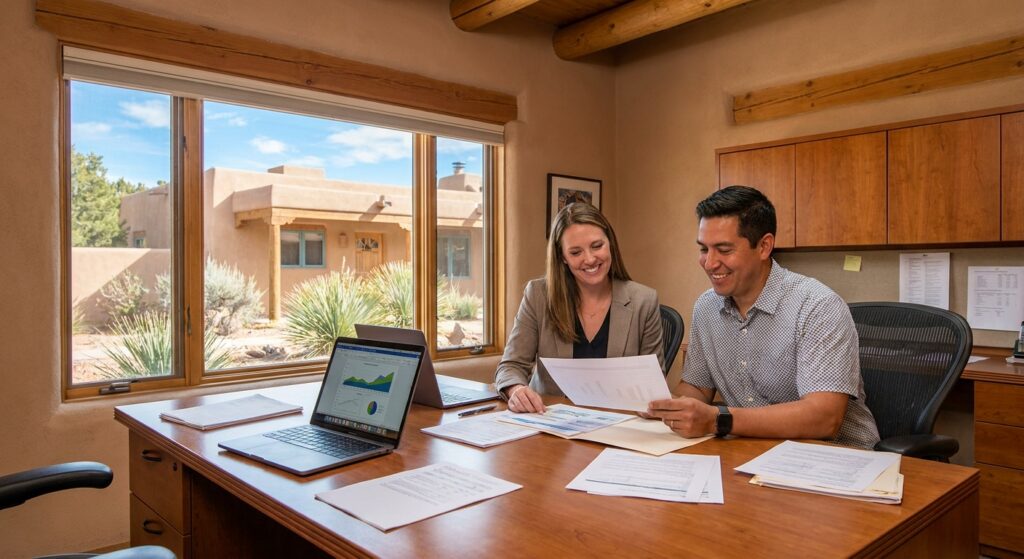
Santa Fe Affordable Tax Preparation 2026: Complete Guide for Local Taxpayers
Finding affordable tax preparation in Santa Fe shouldn’t mean compromising on quality or missing valuable tax-saving opportunities. For the 2026 tax year, Santa Fe residents have significant advantages: the state charges zero income tax on retirement distributions, property taxes sit at just 0.45%, and the median home price in the luxury market has hit $2.69 million. Whether you’re a W2 employee, retiree, freelancer, or small business owner, understanding 2026 tax rules helps you keep more money in your pocket. This guide covers key deductions, credits, and tax filing strategies to help Santa Fe taxpayers navigate the current year successfully.
Table of Contents
- Key Takeaways
- What Is the Standard Deduction for 2026?
- What Are Santa Fe’s Retirement Income Tax Advantages?
- What Tax Deductions Can Santa Fe Small Business Owners Claim for 2026?
- How Do Freelancers and 1099 Contractors Calculate Estimated Quarterly Taxes?
- How Can W2 Employees Optimize Their Tax Withholding for Maximum Refunds?
- How Do You Find Affordable Tax Preparation Services in Santa Fe?
- Uncle Kam in Action
- Next Steps
- Frequently Asked Questions
Key Takeaways
- For 2026, the standard deduction is $35,500 for married couples over 65 and $18,150 for single filers.
- New Mexico does not tax retirement income, making Santa Fe ideal for retirees seeking tax efficiency.
- Santa Fe’s property tax rate of 0.45% is among the lowest in the nation, rewarding luxury homebuyers.
- Self-employed individuals must pay 15.3% self-employment tax and track estimated quarterly payments carefully.
- Professional tax preparation can uncover thousands in deductions and credits specific to your situation.
What Is the Standard Deduction for 2026?
Quick Answer: The 2026 standard deduction for married couples is $35,500 (if either spouse is age 65+). Single filers get $18,150. These amounts represent your baseline tax-free income floor.
The standard deduction is one of the most important tax benefits available to Americans. It’s the amount of income the IRS allows you to exclude from taxation without needing to itemize deductions. For the 2026 tax year, understanding your filing status and age is crucial because the IRS provides higher standard deductions for older taxpayers.
If you’re married filing jointly and at least one spouse has reached age 65 by December 31, 2026, you qualify for the higher $35,500 standard deduction. This is $6,000 higher than the base married deduction. For single filers, the standard amount is $18,150, also increased if you’re age 65 or older.
Who Should Itemize Instead of Taking the Standard Deduction?
Itemizing deductions makes sense only if your total itemized deductions exceed your standard deduction. Santa Fe residents with significant property taxes (even at the favorable 0.45% rate), substantial mortgage interest, large charitable contributions, or significant medical expenses may benefit from itemizing. However, for most middle-income households, the standard deduction provides greater overall tax savings.
A professional tax preparer can calculate both scenarios to determine which filing method saves you the most money. This is especially important for high-income Santa Fe residents who may have complex tax situations requiring detailed analysis.
How Standard Deductions Affect Tax Bracket Placement
Your standard deduction reduces your taxable income, which determines your federal tax bracket. For 2026, federal tax brackets include 10% on income up to $27,100 (single), 12% from $27,101 to $64,000, and progressively higher rates above that. By maximizing your standard deduction, you potentially lower your bracket and reduce your overall tax bill. Santa Fe taxpayers should work with tax strategists to optimize their deduction usage.
What Are Santa Fe’s Retirement Income Tax Advantages?
Quick Answer: New Mexico does not tax retirement distributions from IRAs, pensions, or 401(k)s, making it one of the most retirement-friendly states. Combined with Santa Fe’s low 0.45% property tax rate, retirees enjoy exceptional overall tax efficiency.
Santa Fe has become a premier destination for retirees specifically because New Mexico imposes zero state income tax on retirement income. This means distributions from traditional IRAs, 401(k)s, Roth IRAs, and pension plans are not subject to New Mexico state income tax. Retirees only pay federal taxes on these distributions, not state taxes—a massive advantage compared to high-tax states like California or New York.
When combined with Santa Fe’s property tax rate of just 0.45%, one of the lowest in the nation, the total cost structure for retirees becomes exceptionally attractive. A retiree with $75,000 in annual retirement income pays only federal tax, avoiding state income tax entirely while benefiting from minimal property taxes.
Federal Tax Considerations for Retirement Income
Although Santa Fe offers state-level tax advantages, federal taxes still apply to most retirement income. Traditional IRA and 401(k) withdrawals are taxed as ordinary income at federal rates. For 2026, federal tax brackets include a 10% rate on income up to $27,100 (single) and 12% on income up to $64,000. Using your standard deduction effectively reduces your taxable retirement income and can keep you in a lower federal bracket.
Roth Conversions and Tax Planning for Retirees
Santa Fe retirees should consider Roth conversions during lower-income years. Converting traditional IRA funds to a Roth IRA involves paying federal tax in the conversion year but creating tax-free growth and withdrawals forever after. Since New Mexico doesn’t tax conversions or subsequent Roth withdrawals, the state-level benefit is substantial. This strategy works best when you’re in a lower federal bracket during early retirement.
The new Federal Saver’s Match program, effective in 2027, also offers up to $1,000 per individual or $2,000 for married couples for those earning under $35,500-$71,000. Santa Fe residents in this range should track this opportunity for additional retirement savings assistance.
What Tax Deductions Can Santa Fe Small Business Owners Claim for 2026?
Quick Answer: Small business owners can deduct ordinary and necessary business expenses including office rent, equipment, supplies, utilities, insurance, and vehicle costs. Using our small business tax calculator helps estimate potential tax savings for your 2026 business deductions.
Santa Fe small business owners operate with unique advantages under the New Mexico tax code. While there is no state income tax to shield from, federal tax deductions directly reduce your federal taxable income and overall tax liability. Every business expense properly documented and deducted lowers your Schedule C (self-employment income) or business return.
The IRS allows deductions for any business expense that is ordinary and necessary. For Santa Fe businesses, this includes office rent, utilities, equipment purchases (including 100% bonus depreciation available through 2026), supplies, professional services, marketing, insurance, vehicle expenses, and home office deductions. The key is maintaining detailed records and ensuring each expense directly relates to your business.
Home Office Deductions for Santa Fe Business Owners
If you operate a business from your Santa Fe home, you can claim a home office deduction using either the simplified method ($5 per square foot, up to 300 square feet maximum) or the regular method (percentage of actual home expenses). The simplified method is easier for small operations, while the regular method may yield larger deductions for those with substantial dedicated workspace. Proper documentation is critical for IRS compliance.
Vehicle and Travel Deductions for 2026
Santa Fe business owners can deduct mileage driven for business purposes at the current IRS standard mileage rate or actual vehicle expenses. Commuting from home to a regular office location is not deductible, but travel to meet clients, visit job sites, or conduct business is fully deductible. Maintain a mileage log documenting dates, destinations, and business purpose to support your deduction claims during an audit.
Meals and entertainment expenses are partially deductible (50% for most meals, 100% for specific entertainment). Travel expenses for business trips are fully deductible when the primary purpose is business, not personal vacation. A professional accountant helps maximize these deductions while staying within IRS guidelines.
How Do Freelancers and 1099 Contractors Calculate Estimated Quarterly Taxes?
Quick Answer: Freelancers and 1099 contractors must pay quarterly estimated taxes on IRS Form 1040-ES if they expect to owe more than $1,000 in 2026 taxes. The total self-employment tax rate is 15.3%, plus applicable federal income tax on profits.
Unlike W2 employees who have taxes withheld by employers, freelancers and 1099 contractors must actively manage their own tax payments. The IRS requires estimated quarterly tax payments if you’ll owe more than $1,000 in taxes for 2026. Failing to make these payments can result in underpayment penalties, even if you ultimately owe money overall when you file.
The self-employment tax for 2026 consists of two components: Social Security tax (12.4% on net earnings up to a certain cap) and Medicare tax (2.9% on all net earnings). Combined, this is 15.3%. On top of self-employment tax, you owe federal income tax on your net profit at rates ranging from 10% to 37% depending on your income bracket. Santa Fe freelancers benefit from avoiding New Mexico income tax, but federal obligations remain.
Calculating Your Quarterly Estimated Tax Payments
To calculate estimated quarterly payments, start by projecting your 2026 net self-employment income (gross income minus business deductions). Multiply this by 92.35% to get your self-employment income subject to self-employment tax. Apply the 15.3% rate to this amount. Then add your expected federal income tax for the year based on your tax bracket. Divide the total by four to get your quarterly payment amount due on April 15, June 15, September 15, and January 15.
New rules for 2026 include updated safe harbor provisions for estimated tax calculations. If your income is expected to be significantly higher or lower than previous years, recalculate quarterly to avoid overpaying or facing penalties for underpayment.
Safe Harbor Options to Avoid Estimated Tax Penalties
The IRS provides two main safe harbors to avoid underpayment penalties: (1) pay 100% of your 2025 tax liability (or 110% if 2025 AGI exceeded $150,000), or (2) pay 90% of your 2026 tax liability as it develops throughout the year. Most freelancers use the 100% safe harbor based on prior year taxes. Santa Fe tax professionals can advise which method works best for your situation.
How Can W2 Employees Optimize Their Tax Withholding for Maximum Refunds?
 Free Tax Write-Off Finder
Quick Answer: Review your W4 withholding elections annually to match your life changes. Optimize deductions, maximize retirement contributions, and leverage credits to ensure correct federal tax withholding for optimal refunds.
Many Santa Fe W2 employees receive refunds because too much tax is withheld throughout the year. While a refund feels good, it’s actually an interest-free loan to the government. Optimizing your W4 withholding allows you to receive more take-home pay each paycheck instead of waiting for a large refund check at tax time.
The key to optimization is understanding that your withholding should equal your expected actual tax liability. Life changes like marriage, children, second jobs, side income, mortgage interest, or significant charitable giving all affect your tax liability. Update your W4 (Employee’s Withholding Certification Form) whenever major changes occur.
Maximizing Retirement Contributions to Reduce Taxable Income
Contributing to traditional 401(k)s or IRAs directly reduces your taxable income dollar-for-dollar. For 2026, if your employer offers a 401(k), consider increasing your contribution to maximize tax-deductible savings. IRA contributions also provide tax deductions (subject to income phaseouts for those with access to workplace plans). These contributions both reduce your current tax bill and build retirement savings—a powerful combination.
Itemizing Deductions if You Exceed the Standard Amount
Santa Fe W2 employees with significant property taxes, mortgage interest, charitable contributions, or medical expenses may benefit from itemizing deductions. When itemized deductions exceed the $35,500 standard deduction (married), you should itemize instead. Professional tax preparation helps identify and properly document these deductions.
How Do You Find Affordable Tax Preparation Services in Santa Fe?
Quick Answer: Look for local tax professionals offering flat-fee or itemized pricing, ask for estimates upfront, verify credentials, and choose Santa Fe tax preparation services that understand your specific situation (W2, freelance, retirement, business).
Affordable doesn’t mean cheap—it means getting professional tax preparation at fair market rates without unnecessary upsells. Santa Fe residents have several options for finding quality, affordable tax services. Start by asking friends, family, and business contacts for referrals. Local business associations and chambers of commerce maintain lists of tax professionals who serve the Santa Fe community.
When evaluating tax preparers, ask about their pricing structure upfront. Some charge flat fees based on return complexity, while others charge hourly rates. Request an estimate before committing. Verify that the preparer is a CPA, Enrolled Agent, or attorney (the IRS-licensed categories). Ask specifically about their experience with your type of return—business owners benefit from preparers with small business experience, while retirees benefit from those specializing in retirement income planning.
Red Flags in Tax Preparation Services
Avoid tax preparers who guarantee specific refund amounts (no one can promise this), push you toward aggressive positions without proper documentation, rush through your interview without detailed questions, or resist providing copies of your return. Quality tax preparation involves thorough document review, detailed questioning about your income and deductions, and explanation of positions taken on your return.
DIY vs. Professional Tax Preparation for Santa Fe Residents
Santa Fe residents with simple returns (W2 income only, no deductions beyond the standard deduction) might successfully use tax software. However, anyone with business income, rental property, significant deductions, or multiple income sources benefits from professional guidance. The typical cost of professional preparation ($300-$1,000) often pays for itself through deductions a professional identifies that you might miss using software alone. Additionally, professional tax strategists can provide ongoing advice to minimize future tax liability, not just file the current year’s return.

Uncle Kam in Action: A Santa Fe Freelancer Maximizes 2026 Tax Savings
Meet Maria, a 42-year-old freelance graphic designer who relocated to Santa Fe in 2025 specifically for its favorable tax environment. Maria earned $120,000 in freelance income in 2025 and expected similar earnings for 2026. She was initially filing her own taxes, paying quarterly estimated taxes without professional guidance, and taking only a basic home office deduction.
Maria engaged Uncle Kam’s tax strategy services to optimize her 2026 approach. The analysis revealed she was missing significant deductions: $8,000 annually in home office expenses using the regular method (vs. simplified), $4,200 in equipment depreciation, $3,600 in professional development and software subscriptions, and $2,400 in vehicle and mileage expenses she hadn’t documented previously.
Additionally, Uncle Kam recommended Maria increase her SEP-IRA contribution from $0 to $18,600 (25% of self-employment income, up to the annual limit) to provide both immediate tax deduction and retirement savings. The team also helped Maria implement quarterly tax payment adjustments using the new 2026 safe harbor provisions, reducing her quarterly payments by $400 per quarter ($1,600 annually) while still maintaining compliance.
The Results: Maria’s total tax-saving strategies reduced her 2026 taxable income by $36,800. On a self-employed income of $120,000, this represented a reduction in self-employment taxes of approximately $5,200 and federal income tax savings of approximately $7,600 (at her 22% marginal rate), totaling $12,800 in first-year tax savings. Maria paid Uncle Kam $2,400 for strategic planning and tax preparation, achieving a 5.3x return on her investment in professional services. She also established better systems for documenting business expenses and tracking mileage, setting herself up for continued tax efficiency in future years.
Next Steps
Don’t leave money on the table in 2026. Take action now to optimize your tax situation:
- Schedule a Tax Review: Contact local Santa Fe tax professionals for a free initial consultation to assess your 2026 tax planning needs.
- Gather Your Documents: Compile W2s, 1099s, investment statements, business records, and receipts for professional organization and analysis.
- Review Withholding: Update your tax filing documents and W4 forms to align with your 2026 life circumstances.
- Maximize Contributions: Increase 401(k), IRA, or SEP-IRA contributions before year-end to reduce current tax liability.
- Track Business Expenses: Implement systems for documenting mileage, meals, equipment, and home office expenses if you’re self-employed.
Frequently Asked Questions
Do I need professional tax preparation in Santa Fe, or can I file myself?
Simple returns with only W2 income and standard deductions can often be filed successfully with tax software. However, anyone with self-employment income, business ownership, rental property, significant deductions, or complex income should use professional preparation. The cost of professional services typically pays for itself through overlooked deductions and tax optimization strategies.
What’s the difference between a CPA, Enrolled Agent, and tax preparer?
CPAs (Certified Public Accountants) have passed rigorous exams and are licensed by state boards. Enrolled Agents (EAs) are IRS-credentialed tax specialists who’ve passed federal exams. Both can represent you before the IRS. Tax preparers without EA or CPA credentials have fewer credentials and cannot represent you in audits. For complex situations, CPAs are often preferred because of their broader accounting knowledge.
How much should affordable tax preparation cost in Santa Fe?
Simple 1040 returns typically cost $200-$400. Business returns with Schedule C might range from $500-$1,200. Complex returns with multiple income sources, rentals, or investments can cost $1,500-$3,000+. Expect to pay more for strategic planning beyond just filing returns. Get estimates upfront and compare service offerings, not just prices.
Can I deduct home office expenses if I work from home in Santa Fe?
Yes. Use either the simplified method ($5 per square foot, up to 300 sq ft) or the regular method (actual percentage of home expenses including mortgage interest, utilities, insurance, depreciation). The regular method usually yields larger deductions but requires more documentation. A dedicated, regularly-used space for business qualifies for deduction.
What happens if I don’t pay quarterly estimated taxes as a freelancer?
The IRS charges underpayment penalties and interest on taxes owed but not paid quarterly. Avoiding penalties requires paying either 100% of prior year tax liability or 90% of current year liability in quarterly installments. If your income fluctuates significantly, recalculate quarterly to avoid overpaying. Professional tax preparation helps calculate correct payment amounts.
Does moving to Santa Fe immediately save me state income tax?
For most income types, yes—New Mexico has no state income tax. However, tax residency involves more than moving. You must establish domicile through activities like registering to vote, updating your driver’s license, and maintaining no other state residence. If you relocated from a high-tax state and maintained property there, you may still owe taxes to that state on income earned while a resident. Consult a tax professional about your specific situation.
What IRS forms do I need for Santa Fe business taxes?
Sole proprietors file Schedule C (Profit or Loss from Business) with their Form 1040. Self-employed individuals file Schedule SE (Self-Employment Tax). If you incorporate, you’ll file Form 1120 (corporate return) or 1120-S (S-corporation return). LLCs can choose their tax classification. A professional helps determine the right structure and forms for your situation.
Related Resources
- Tax Preparation Near Me in New Mexico
- Tax Strategies for Business Owners
- Self-Employment Tax Planning
- Advanced Tax Planning for High-Income Professionals
- Entity Structure Optimization Services
Last updated: May, 2026
This information is current as of 5/4/2026. Tax laws change frequently. Verify updates with the IRS or a local tax professional if reading this later.

