
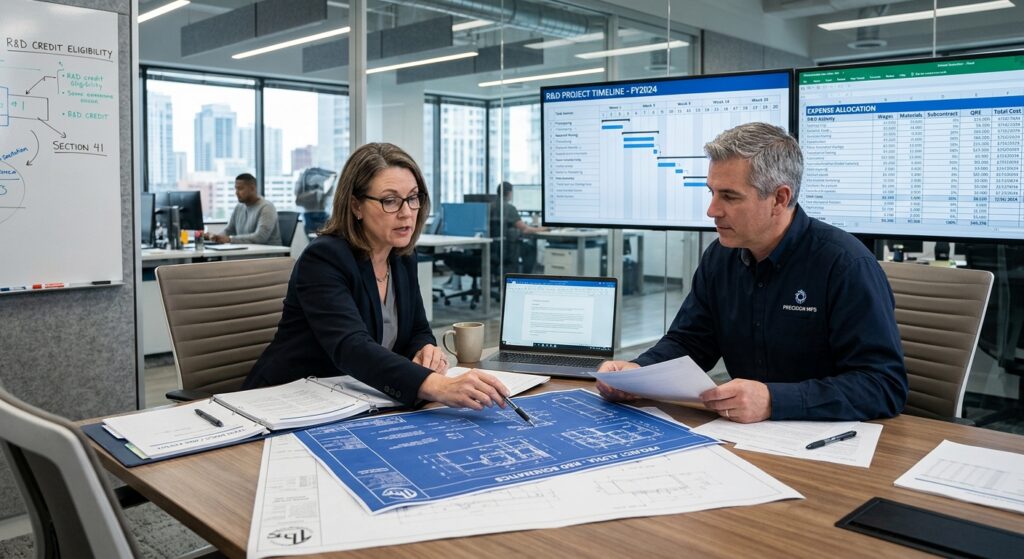
R&D Credit Four-Part Test for Qualified Research: 2026 Guide
The R&D credit four-part test for qualified research remains one of the most valuable yet complex tax incentives available to businesses in 2026. Tax professionals who master IRC Section 41’s technical requirements can deliver substantial savings for clients while building defensible audit positions. This guide provides CPAs and tax advisors with the framework to identify qualifying activities, document research efforts, and navigate IRS scrutiny with confidence.
Table of Contents
Used by 2,400+ tax professionals
- Key Takeaways
- What Is the R&D Credit Four-Part Test for Qualified Research?
- What Is the Permitted Purpose Test?
- What Is the Technological in Nature Test?
- How Does the Process of Experimentation Test Work?
- What Qualifies as Qualified Research Under the Business Component Test?
- What Documentation Is Required to Survive an IRS Audit?
- How Can Tax Advisors Build Defensible R&D Credit Claims?
- Uncle Kam in Action: Manufacturing Firm Secures $847K in R&D Credits
- Next Steps
- Frequently Asked Questions
- Related Resources

Key Takeaways
- The R&D credit four-part test for qualified research requires activities to meet permitted purpose, technological nature, experimentation, and business component criteria under IRC Section 41.
- Contemporaneous documentation is mandatory for audit defense—retroactive reconstruction rarely satisfies IRS scrutiny in 2026.
- Process of experimentation evidence must demonstrate systematic evaluation of alternatives, not just trial-and-error problem-solving.
- Tax professionals should implement real-time documentation systems to capture qualifying activities as they occur, not during tax season.
- Audit rates for R&D claims increased in 2026 as AI-powered systems flag inconsistencies and undocumented expenses.
What Is the R&D Credit Four-Part Test for Qualified Research?
Quick Answer: The R&D credit four-part test for qualified research evaluates whether activities meet IRS criteria under IRC Section 41. All four tests must be satisfied simultaneously for expenses to qualify for the federal research credit.
The federal research and experimentation tax credit offers one of the most powerful incentives for innovation-driven businesses. However, the R&D credit four-part test for qualified research creates strict guardrails that tax professionals must navigate carefully. Under IRC Section 41, the IRS requires that qualifying activities satisfy four distinct criteria.
For tax advisors working with manufacturing, software development, pharmaceutical, engineering, and technology clients, understanding these requirements is essential. The stakes are substantial: qualified research expenses can generate credits worth 6% to 14% of eligible costs, depending on whether clients use the regular credit or alternative simplified credit method.
The Four Mandatory Tests
Every R&D credit claim must demonstrate that research activities satisfy these requirements:
- Permitted Purpose Test: Research must aim to create new or improve existing business components in functionality, performance, reliability, or quality
- Technological in Nature Test: Activities must rely on hard sciences like engineering, physics, chemistry, biology, or computer science
- Process of Experimentation Test: Research must involve systematic evaluation of alternatives to eliminate technical uncertainty
- Qualified Research Test: Activities must relate to developing or improving a defined business component owned or licensed by the taxpayer
Failure to meet any single test disqualifies the entire activity. Therefore, tax professionals must evaluate each element rigorously before claiming credits. This is where strategic tax advisory services separate amateur preparers from sophisticated practitioners who protect clients from costly audit adjustments.
Why the Four-Part Test Matters in 2026
The IRS has intensified scrutiny of R&D credit claims in recent years. With AI-powered audit systems now flagging inconsistencies and unsupported expense allocations, tax advisors must build bulletproof documentation from day one. The four-part test provides the framework for defensible claims, but only when applied with technical precision and supported by contemporaneous evidence.
Pro Tip: Begin documentation at project initiation, not during tax preparation. Real-time records demonstrating technological uncertainty and experimentation process carry far more audit weight than retroactive summaries prepared months later.
What Is the Permitted Purpose Test?
Quick Answer: The permitted purpose test requires that research activities aim to create new or improve existing business components in their functionality, performance, reliability, or quality. Aesthetic improvements alone do not qualify.
The permitted purpose test establishes the fundamental objective of qualifying research. Under IRC Section 41(d)(3), research must be undertaken to discover information that eliminates uncertainty concerning the development or improvement of a business component.
Qualifying Improvement Categories
The IRS recognizes four categories of improvement that satisfy the permitted purpose test:
- Functionality: Adding new capabilities or features that the component did not previously possess
- Performance: Increasing speed, efficiency, capacity, or output of existing capabilities
- Reliability: Improving consistency, durability, or reducing failure rates and defects
- Quality: Enhancing precision, accuracy, or technical specifications beyond aesthetic considerations
Common Permitted Purpose Failures
Tax professionals must help clients distinguish qualifying improvements from excluded activities. Research focused solely on cost reduction, market research, or aesthetic styling typically fails the permitted purpose test. Similarly, routine data collection, efficiency studies, and management activities do not constitute qualified research regardless of their business value.
However, cost reduction achieved through functional or performance improvements may qualify. For instance, redesigning a manufacturing process to reduce material waste through improved precision would satisfy the permitted purpose test, whereas simply sourcing cheaper materials would not.
Pro Tip: Document the specific technical improvement objective at project launch. Clear statements like “increase processing speed by 40%” or “reduce defect rate to below 0.5%” establish permitted purpose more effectively than vague references to “optimization” or “enhancement.”
What Is the Technological in Nature Test?
Quick Answer: The technological in nature test requires that research fundamentally rely on principles of engineering, physics, chemistry, biology, computer science, or similar hard sciences. Business or social science methodologies alone do not qualify.
The technological in nature test ensures that R&D credits support scientific and engineering innovation rather than general business development. This test examines both the nature of the uncertainty being addressed and the methodology used to resolve it.
Qualifying Hard Sciences
Research satisfies the technological in nature test when it depends on one or more of these disciplines:
- Engineering (mechanical, electrical, chemical, civil, software)
- Physics and physical sciences
- Chemistry and biochemistry
- Biology and biotechnology
- Computer science and information technology
Technological Uncertainty Requirement
Beyond relying on hard sciences, qualifying research must address genuine technological uncertainty. Uncertainty exists when the appropriate design, methodology, or capability cannot be determined without investigation. The solution must not be readily available in public sources or within the organization’s existing knowledge base.
Tax professionals should help clients distinguish technological uncertainty from business or commercial uncertainty. Uncertainty about market acceptance, competitive positioning, or financial viability does not satisfy this test. The uncertainty must be rooted in technical challenges requiring scientific or engineering problem-solving.
| Qualifying Technological Uncertainty | Non-Qualifying Business Uncertainty |
|---|---|
| Can we achieve 99.9% uptime with this architecture? | Will customers prefer this feature? |
| How do we reduce thermal expansion in this alloy? | Should we price at $99 or $129? |
| Which algorithm provides optimal performance? | How should we market this product? |
| Can we integrate these systems without data loss? | What distribution channel is most profitable? |
How Does the Process of Experimentation Test Work?
Quick Answer: The process of experimentation test requires systematic evaluation of alternatives through modeling, simulation, systematic trial and error, or other investigative methods. Simple troubleshooting or routine testing does not qualify without documented alternative evaluations.
The process of experimentation test represents the most complex and frequently misunderstood element of the R&D credit four-part test for qualified research. This requirement ensures that claimed activities involve genuine research methodology rather than routine problem-solving or production activities.
Acceptable Experimentation Methods
The IRS recognizes several approaches that satisfy the experimentation requirement:
- Modeling and Simulation: Creating virtual prototypes or mathematical models to evaluate design alternatives and performance characteristics
- Systematic Trial and Error: Iterative testing of multiple approaches with documented evaluation criteria and selection rationale
- Prototyping: Building physical or software prototypes to test hypotheses about functionality or performance
- Laboratory Testing: Controlled experiments measuring specific variables to evaluate alternative solutions
The key distinction is systematic evaluation of alternatives. Research teams must consider multiple potential solutions and document why certain approaches were selected or rejected based on experimental results. Single-path development without alternative evaluation typically fails this test.
Documentation Requirements for Experimentation
Tax professionals must ensure clients capture evidence of the experimentation process contemporaneously. Effective documentation includes project notes describing alternatives considered, test results comparing different approaches, design iteration records showing evolution of solutions, and technical meeting minutes discussing experimental findings. For clients in software development or advanced manufacturing sectors, specialized R&D tax credit calculators can help quantify qualified research expenses while ensuring proper allocation methodologies.
Pro Tip: Implement version control systems and project management tools that automatically create audit trails. Git commits, Jira tickets, and engineering change orders provide contemporaneous evidence of systematic experimentation that the IRS finds highly credible.
Common Experimentation Pitfalls
Many R&D credit claims fail because activities represent adaptation or troubleshooting rather than experimentation. Customizing off-the-shelf products to meet customer specifications generally does not qualify unless significant uncertainty exists about the technical approach. Similarly, debugging code or fixing production defects constitutes routine activity unless the underlying problem involves genuine technological uncertainty requiring systematic investigation.
What Qualifies as Qualified Research Under the Business Component Test?

Quick Answer: Qualified research must relate to developing or improving a business component—defined as a product, process, software, technique, formula, or invention—that the taxpayer intends to hold for sale, lease, license, or use in their trade or business.
The business component test grounds R&D credit claims in tangible business outcomes. Research must aim to create or improve components that have commercial application within the taxpayer’s operations or that will be offered to customers.
Defining Business Components
The IRS defines business components across several categories that tax professionals should understand thoroughly when evaluating client activities. Products represent any tangible property intended for sale to customers or used in operations. Processes encompass manufacturing methods, production techniques, or operational procedures. Software includes both customer-facing applications and internal systems. Techniques and formulas cover proprietary methodologies, algorithms, and specialized knowledge.
The Shrinking-Back Rule
One of the most nuanced aspects of the business component test is the shrinking-back rule. This principle states that if research relates to improving only part of a larger business component, the credit applies only to that specific part. Tax advisors must identify the most discrete component that satisfies all four tests.
For example, if a manufacturer develops a new coating process for metal parts, the business component is the coating process itself, not the entire finished product. This distinction affects expense allocation and requires precise technical understanding of where innovation actually occurred. Working with business owners to properly scope business components prevents overclaiming and audit exposure.
| Industry | Broader Component (Less Defensible) | Shrunken Component (More Defensible) |
|---|---|---|
| Manufacturing | Entire production line | New welding process for aluminum joints |
| Software | Complete SaaS platform | Machine learning recommendation engine |
| Pharmaceutical | Drug development program | Novel synthesis pathway for active compound |
| Engineering | Bridge construction project | Seismic damping system design |
What Documentation Is Required to Survive an IRS Audit?
Quick Answer: IRS audits require contemporaneous documentation proving all four tests were met. Project descriptions, technical uncertainty statements, experimentation records, and time tracking must be created during research activities, not retroactively during examination.
Documentation separates successful R&D credit claims from costly audit adjustments. The IRS R&D Credit Audit Technique Guide emphasizes that contemporaneous records carry substantially more weight than after-the-fact summaries prepared when examination begins.
Core Documentation Elements
Tax professionals should ensure clients maintain comprehensive documentation across several critical areas:
- Project Initiation Documents: Project charters, scope statements, and technical objectives that establish permitted purpose
- Uncertainty Documentation: Technical challenge descriptions, unknown elements, and questions requiring investigation
- Experimentation Evidence: Design alternatives, test plans, results analysis, and selection rationale for chosen approaches
- Time and Expense Records: Detailed timesheets, payroll allocations, and supply expense tracking tied to specific qualifying activities
- Technical Outputs: Prototypes, test results, design specifications, source code versions, and engineering drawings
Real-Time Documentation Systems
Forward-thinking tax advisors help clients implement documentation systems that capture qualifying activities automatically. Project management platforms like Jira, Asana, or Monday.com create time-stamped records of work allocation. Version control systems like GitHub or GitLab document software experimentation processes. Time tracking integrated with payroll systems ensures accurate wage expense allocation.
These systems provide defensible audit trails without creating additional administrative burden on technical teams. The key is designing workflows where documentation occurs as a byproduct of normal engineering and development processes rather than as a separate compliance activity.
Pro Tip: Conduct quarterly R&D documentation reviews rather than annual year-end scrambles. This approach identifies gaps while memories are fresh and allows teams to supplement records with reasonable detail before audit trails grow cold.
Documentation Red Flags That Trigger Audits
IRS examiners and AI-powered audit systems flag certain documentation patterns that suggest overclaiming or insufficient substantiation. Generic project descriptions that could apply to any business component raise scrutiny. Uniform time allocations suggesting all employees spent identical percentages on R&D activities appear fabricated. Missing experimentation evidence particularly weakens claims, as does documentation created entirely after audit selection.
How Can Tax Advisors Build Defensible R&D Credit Claims?
Quick Answer: Build defensible claims by implementing prospective documentation systems, conducting technical interviews with engineering teams, applying conservative expense allocation methodologies, and maintaining detailed nexus documentation between claimed amounts and specific qualifying activities.
Tax professionals who consistently prevail in R&D credit examinations follow disciplined methodologies that anticipate IRS scrutiny. These approaches balance maximum credit capture with audit defensibility, protecting clients from costly adjustments while delivering substantial tax savings.
The Five-Step Defensibility Framework
Sophisticated advisors implement this systematic approach to R&D credit claims:
- Step 1 – Technical Discovery: Conduct detailed interviews with engineers, developers, and technical staff to identify activities meeting all four tests
- Step 2 – Four-Part Test Analysis: Document how each identified activity satisfies permitted purpose, technological nature, experimentation, and business component requirements
- Step 3 – Expense Quantification: Apply conservative allocation methodologies to wages, supplies, and contract research using defensible apportionment ratios
- Step 4 – Documentation Assembly: Gather contemporaneous evidence supporting each element of the claim before filing returns
- Step 5 – Ongoing Compliance: Implement systems ensuring future years maintain the same documentation standards established in baseline year
Conservative vs. Aggressive Positioning
Tax advisors must counsel clients on the risk-reward trade-off between conservative and aggressive R&D credit positions. Conservative approaches exclude borderline activities and use narrow expense allocations, resulting in smaller credits with minimal audit exposure. Aggressive positions claim maximum allowable activities and use broad allocations, generating larger credits but inviting scrutiny and potential adjustment.
The optimal strategy typically falls between these extremes. Claim activities with clear four-part test satisfaction while excluding questionable items. Use reasonable allocation methodologies supported by time studies or project tracking rather than arbitrary percentages. This balanced approach maximizes benefits while maintaining defensibility during examination.
For comprehensive strategic guidance on positioning R&D credits within broader tax strategy frameworks, consider how these credits interact with other incentives like Section 179 expensing, bonus depreciation, and state-level innovation credits.
| Documentation Best Practice | Audit Benefit | Implementation Difficulty |
|---|---|---|
| Quarterly technical interviews | High – creates fresh contemporaneous records | Medium |
| Integrated time tracking systems | Very High – provides precise expense substantiation | High |
| Project-based expense allocation | High – demonstrates nexus between costs and activities | Medium |
| Version control documentation | Very High – proves experimentation process | Low (for software clients) |
| Annual four-part test certification | Medium – documents advisor due diligence | Low |
Uncle Kam in Action: Manufacturing Firm Secures $847K in R&D Credits
Client Profile: A precision manufacturing company specializing in aerospace components faced intense pressure to reduce production costs while maintaining strict quality tolerances. The firm employed 85 people and generated $22 million in annual revenue, with engineering teams constantly developing new machining processes and material treatments.
The Challenge: The company’s previous CPA prepared basic tax returns without evaluating R&D credit opportunities. Management believed only pharmaceutical and software companies qualified for research credits. Meanwhile, engineering teams documented technical challenges and experimentation processes in project files that were never reviewed for tax purposes.
The Uncle Kam Solution: Our tax advisory team conducted comprehensive technical interviews with engineering leadership and project managers. We identified 17 distinct projects over three years that clearly satisfied the R&D credit four-part test for qualified research. These included development of a novel thermal treatment process for titanium alloys, experimentation with advanced CNC toolpath optimization to reduce cycle times, and systematic testing of coating applications to improve corrosion resistance.
We implemented contemporaneous documentation protocols leveraging the company’s existing project management systems. Engineering teams already tracked time by project and documented design iterations through version-controlled CAD files. By mapping these existing records to four-part test requirements, we built audit-defensible claims without creating additional administrative burden.
The Results: The client claimed $847,000 in federal R&D credits across three open tax years, reducing their effective tax rate by 4.2 percentage points. When the IRS selected the most recent year for examination, our documentation package demonstrated clear four-part test satisfaction for each claimed project. The examination closed with no adjustments, validating our conservative allocation methodology and technical analysis.
Investment and ROI: The client paid $47,000 in professional fees for the three-year R&D credit study and examination support. This represents an 18:1 first-year return on investment, with ongoing annual credits estimated at $220,000-$280,000 as the company continues innovation activities.
This outcome demonstrates how sophisticated tax advisors who understand the R&D credit four-part test for qualified research deliver transformational value beyond basic compliance. For more success stories, visit our client results page.
Next Steps
Tax professionals ready to deliver R&D credit value to clients should take these immediate actions:
- Review current client portfolios to identify businesses with engineering, development, or technical innovation activities that may qualify under the four-part test
- Implement prospective documentation systems for clients claiming R&D credits to ensure audit readiness before examinations begin
- Develop technical interview protocols that systematically evaluate permitted purpose, technological nature, experimentation, and business component requirements
- Partner with specialized tax advisory firms to provide sophisticated R&D credit analysis and audit defense for complex manufacturing, software, and engineering clients
- Schedule consultations with clients to discuss R&D credit opportunities and implement documentation best practices for the current tax year
Frequently Asked Questions
Can software development activities qualify for the R&D credit four-part test?
Yes, software development frequently qualifies when it involves technological uncertainty and systematic experimentation. Development of new algorithms, performance optimization requiring technical investigation, and integration challenges lacking readily available solutions typically satisfy all four tests. However, routine coding, user interface design without technical challenges, and implementation of known techniques generally do not qualify. The key is documenting genuine uncertainty about technical approach and demonstrating evaluation of alternative solutions.
What happens if a client’s R&D credit claim is audited?
IRS R&D credit examinations focus on documentation substantiating the four-part test for each claimed activity. Examiners request project descriptions, technical challenge statements, evidence of experimentation process, and expense allocation methodologies. Claims with contemporaneous documentation typically survive examination with minimal adjustment. Poorly documented claims may face substantial disallowance, with agents challenging expense allocation percentages and excluding activities lacking clear four-part test satisfaction. Tax professionals should prepare clients for examination by assembling comprehensive documentation packages before filing returns.
How do state R&D credits interact with the federal four-part test?
Many states offer R&D credits that reference federal qualified research definitions, meaning activities satisfying the federal four-part test also qualify for state benefits. However, some states impose additional requirements or use different definitions. California, for instance, requires activities to occur within the state and uses a narrower definition of qualified research. Tax advisors must evaluate both federal and state criteria when building comprehensive R&D credit strategies. State credits can provide substantial additional benefits, with some offering refundability or carryforward provisions more favorable than federal rules.
Can startups and unprofitable companies benefit from R&D credits?
Absolutely. The PATH Act of 2015 allows qualified small businesses to apply up to $500,000 of R&D credits against payroll tax liability, providing immediate cash benefit even without income tax liability. Eligible businesses must have gross receipts under $5 million and no gross receipts for any tax year preceding the five-year period ending with the current year. This provision makes R&D credits particularly valuable for technology startups and early-stage companies with significant research expenditures but limited revenue.
What expenses qualify as qualified research expenses beyond wages?
Qualified research expenses include wages paid to employees performing or directly supervising qualifying research, supplies consumed or expended during research activities, and contract research expenses paid to third parties conducting research on the taxpayer’s behalf. However, contract research expenses are limited to 65% of amounts paid. Expenses for land, buildings, and most depreciable property do not qualify. Tax advisors should carefully allocate supply costs to specific qualifying activities and ensure proper documentation of contract research arrangements to maximize allowable expenses.
How far back can taxpayers amend returns to claim missed R&D credits?
Generally, taxpayers can amend returns within three years of the original filing deadline to claim R&D credits for years where activities qualified but credits were not initially claimed. However, the challenge with retroactive claims is documentation. Contemporaneous records from several years ago may be incomplete or unavailable, weakening the claim’s defensibility. Tax advisors should counsel clients that while amendment is possible, documentation standards remain identical to original claims. The best approach is identifying R&D credit opportunities prospectively and implementing documentation systems going forward.
Do routine product improvements and customer customizations qualify?
Routine improvements typically do not qualify unless they involve genuine technological uncertainty requiring experimentation. If the improvement method is readily determinable using existing knowledge or available information, the activity fails the technological in nature test. However, customizations requiring significant adaptation involving uncertain technical approaches may qualify. The distinction depends on whether technical staff must investigate alternative solutions or simply apply known techniques. Tax professionals should evaluate the degree of uncertainty and experimentation involved rather than making categorical determinations based on activity labels.
What role do third-party R&D credit studies play in audit defense?
Third-party studies conducted by specialized firms can provide valuable technical analysis and documentation assembly that strengthens audit positions. However, the quality of these studies varies dramatically. Strong studies include detailed four-part test analysis for each claimed activity, conservative expense allocation methodologies, and comprehensive documentation gathering. Weak studies use aggressive allocations, generic project descriptions, and insufficient technical detail. Tax advisors should carefully evaluate study quality before relying on third-party work and ensure studies meet the documentation standards expected during IRS examination.
How do recent IRS audit trends affect R&D credit strategy in 2026?
The IRS has increased R&D credit audit activity in recent years, with AI-powered systems flagging returns showing unusual credit-to-revenue ratios or inconsistent year-over-year patterns. Examiners now receive enhanced training on technical evaluation and documentation requirements. Tax professionals should anticipate heightened scrutiny and build correspondingly robust documentation packages. The focus should shift from maximizing credit amounts to optimizing the balance between credit capture and audit defensibility. Conservative positions with excellent documentation consistently outperform aggressive positions with weak support.
Related Resources
- Comprehensive Tax Strategy Services for Business Clients
- MERNA Tax Planning Framework for Strategic Advisory
- Tax Planning Guides and Resources
- Client Success Stories and Case Studies
This information is current as of 5/6/2026. Tax laws change frequently. Verify updates with the IRS or qualified tax professionals if reading this later.
Last updated: May, 2026

