
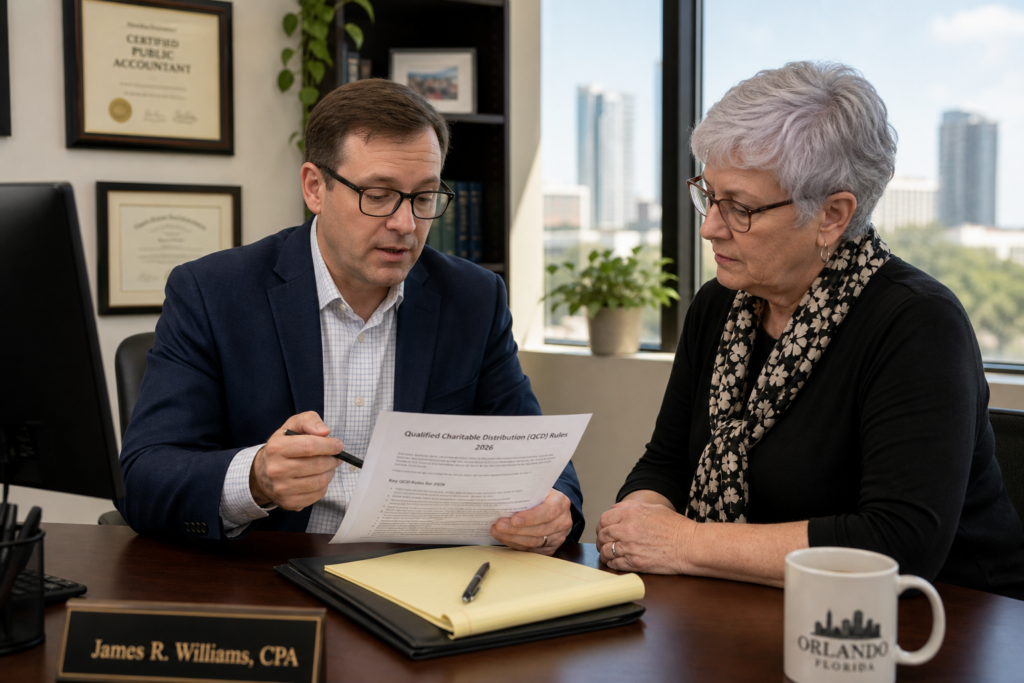
Qualified Charitable Distribution Rules 2026: The Solo Practitioner’s Playbook
The qualified charitable distribution rules 2026 just got more powerful. New OBBBA provisions add a 0.5% charitable floor and cap deductions for top earners. As a result, a QCD (a qualified charitable distribution paid straight from an IRA to charity) now bypasses both traps. For solo practitioners, this shift is a revenue opportunity. Learn more through our proactive tax strategy services. Let’s break it down.
Table of Contents
- Key Takeaways
- What Are the Qualified Charitable Distribution Rules 2026?
- Who Qualifies for a QCD in 2026?
- How Does OBBBA Change QCD Value?
- How Do QCDs Satisfy RMDs in 2026?
- How Can Solo Practitioners Turn QCD Planning Into Advisory Revenue?
- What Mistakes Should You Avoid With QCDs?
- Uncle Kam in Action
- Related Resources
- Next Steps
- Frequently Asked Questions

Key Takeaways
- The 2026 QCD limit rose to $108,000 per person, up from $105,000 in 2025.
- Clients must be at least 70½ to make a qualified charitable distribution.
- OBBBA added a 0.5% charitable floor; QCDs skip it entirely.
- QCDs count toward required minimum distributions and lower taxable income.
- Solo tax pros can package QCD planning as premium advisory service.
What Are the Qualified Charitable Distribution Rules 2026?
Quick Answer: A QCD lets IRA owners aged 70½ send up to $108,000 directly to charity in 2026. The amount is excluded from taxable income.
The qualified charitable distribution rules 2026 govern how retirees give directly from their IRAs. In short, a QCD moves money from a traditional IRA straight to a qualified charity. As a result, that amount never appears in the client’s taxable income. This is different from a normal donation. Furthermore, it beats an itemized deduction for most retirees.
For 2026, the annual QCD limit climbed to $108,000 per individual. Therefore, a married couple with separate IRAs can give up to $216,000 combined. The IRS adjusts this cap for inflation each year. You can confirm the mechanics on the IRS RMD guidance page.
Why QCDs Matter More Now
Most retirees no longer itemize. In fact, the 2026 standard deduction is $16,100 for singles and $32,200 for married couples. Consequently, a written check to charity often produces zero tax benefit. However, a QCD works differently. It reduces adjusted gross income directly, even when the client takes the standard deduction.
Lower AGI carries downstream benefits too. For example, it can reduce Medicare IRMAA surcharges. Moreover, it can shrink the taxable portion of Social Security. Business owner clients often overlook these ripple effects, so our ongoing tax advisory guidance makes them visible.
Pro Tip: Track each spouse’s QCD separately. Each person gets their own $108,000 cap for 2026.
Which Charities Qualify
Not every recipient counts. The gift must go to a 501(c)(3) public charity. In contrast, donor-advised funds and private foundations do not qualify. Likewise, split-interest trusts generally fail the test. Therefore, advisors must vet the charity before the transfer clears.
Who Qualifies for a QCD in 2026?
Quick Answer: Any IRA owner who is at least 70½ can make a QCD in 2026. The distribution must go directly to charity.
The age rule is strict. Your client must actually reach 70½, not simply turn 70 that year. Because of this, timing matters. Advisors serving high-net-worth individuals should calendar each client’s exact half-birthday.
Account type matters too. Traditional IRAs and inherited IRAs qualify. However, active SEP and SIMPLE IRAs receiving contributions do not. Additionally, 401(k) plans cannot make QCDs directly. Therefore, a rollover to an IRA may be a smart first step.
The Direct Transfer Requirement
The funds must never touch the client’s hands. Instead, the custodian sends the money straight to the charity. If the client withdraws first and donates later, the QCD fails. As a result, the whole amount becomes taxable income. This single mistake ruins many well-intended gifts.
- Instruct the custodian to write the check to the charity.
- Keep the acknowledgment letter from the charity.
- Confirm the transfer clears before December 31, 2026.
Did You Know? A check payable to charity but mailed to the client still counts as a QCD.
How Does OBBBA Change QCD Value?
Quick Answer: OBBBA added a 0.5% AGI charitable floor and capped deductions for top earners. QCDs bypass both, so their value jumped.
The One Big Beautiful Bill Act (OBBBA) reshaped charitable planning. For 2026, itemizers must clear a new 0.5% of AGI floor before charitable gifts count. In other words, the first slice of giving now produces no deduction. Furthermore, top-bracket clients see their charitable deduction value capped at 35%. You can review the enacted legislation on Congress.gov.
Here is the key insight. A QCD never runs through the deduction system. Consequently, the 0.5% floor does not apply. Likewise, the 35% cap does not touch it. Therefore, the same dollar delivers full tax value through a QCD but reduced value through an itemized gift.
Comparing Giving Methods Under 2026 Rules
| Feature | QCD (2026) | Itemized Cash Gift (2026) |
|---|---|---|
| Reduces AGI | Yes | No |
| Subject to 0.5% floor | No | Yes |
| Hit by 35% cap | No | Yes (top bracket) |
| Annual limit | $108,000 | Up to 60% of AGI |
| Requires itemizing | No | Yes |
This table drives client conversations. Specifically, it shows why the qualified charitable distribution rules 2026 favor the IRA route. Advisors serving business owners nearing retirement should walk clients through both columns.
Pro Tip: Run a side-by-side deduction model before year-end. The 0.5% floor changes the math for many clients.
How Do QCDs Satisfy RMDs in 2026?
Quick Answer: A QCD counts toward the required minimum distribution. It satisfies the RMD without adding taxable income.
The RMD (required minimum distribution) starts at age 73 for most clients. Because a QCD counts toward the RMD, it removes a tax burden. In effect, the client meets the mandate and gives to charity in one move. Meanwhile, taxable income stays lower.
Missing an RMD is expensive. The penalty equals 25% of the shortfall. However, it drops to 10% if corrected within two years using IRS Form 5329. Therefore, pairing QCDs with the RMD calendar protects clients on both fronts.
The Timing Trap Advisors Miss
Order matters here. The first dollars out of the IRA count toward the RMD. As a result, the QCD must happen before any other withdrawal. Otherwise, the client already took a taxable distribution. Then the QCD benefit shrinks. So plan the QCD early in the year.
A Real Calculation
Consider a client with a $40,000 RMD. She donates $25,000 through a QCD. Consequently, only $15,000 becomes taxable. In the 24% bracket, the QCD saves roughly $6,000 in federal tax. That is real money the client keeps or redirects.
- Total RMD required: $40,000
- QCD portion: $25,000 (excluded from income)
- Taxable remainder: $15,000
- Estimated federal savings: about $6,000
How Can Solo Practitioners Turn QCD Planning Into Advisory Revenue?

Quick Answer: Package QCD planning as a paid advisory deliverable, not a free filing add-on. Charge for the strategy, not the form.
Most solo practitioners give away QCD advice during tax prep. That is a costly habit. Instead, position it as advisory work. Because the qualified charitable distribution rules 2026 changed, clients need a plan. Therefore, a written QCD strategy justifies a premium fee. Learn how the Uncle Kam marketplace helps tax pros transition to advisory.
The biggest friction for solo firms is leverage. You wear every hat. However, you still need to prove value before a client signs. This is where an tax planning software with unlimited assessments changes the game. You can run client-ready assessments on every prospect for free, then upsell advisory with confidence.
Ready to stop leaving money on the table? Book a strategy session with Uncle Kam and see how to price QCD advisory work.
Pricing the Deliverable
Clients pay for clarity, not spreadsheets. So build a branded plan. Include the RMD calendar, the QCD amount, and the projected savings. Then present the return on investment. As a result, a $1,500 planning fee feels small next to $6,000 in savings.
Florida solo practitioners can also model entity questions for business-owner clients. Use our LLC vs S-Corp Tax Calculator for Orlando to compare structures for 2026.
Building a Repeatable System
Systems create leverage for a one-person firm. First, screen every client over 70. Next, flag those with IRAs and charitable intent. Then, generate a QCD plan. Finally, review it in a paid annual meeting. This turns a one-time gift into recurring advisory revenue.
Pro Tip: Bundle QCD planning with Roth conversion analysis. Together they form a strong retirement income service.
What Mistakes Should You Avoid With QCDs?
Quick Answer: Avoid indirect transfers, wrong charities, and bad reporting. Each error can turn a tax-free gift into taxable income.
Reporting trips up many preparers. The custodian issues a Form 1099-R with no QCD code. Therefore, you must report it correctly on the return. Specifically, subtract the QCD from the taxable amount and write “QCD” on the line. The IRS Publication 590-B explains the steps.
Common Errors to Catch
- Sending funds to a donor-advised fund, which disqualifies the QCD.
- Exceeding the $108,000 limit for 2026.
- Missing the charity acknowledgment letter.
- Reporting the full 1099-R amount as taxable.
The Split-Interest Election
SECURE 2.0 created a one-time QCD to a split-interest entity. For 2026, that lifetime cap is $54,000, inflation-adjusted. However, the rules are strict. So confirm eligibility before you recommend it. Our tax prep and filing team can help document these elections properly.
Did You Know? A QCD used for a charitable gift annuity counts toward the special one-time lifetime limit.
Uncle Kam in Action: The Solo CPA Who Built a $60K Advisory Line
Client Snapshot: Maria runs a solo tax practice in Orlando. She is 44 and handles roughly 180 returns each season. Like many solo pros, she wore every hat and had no advisory line.
Financial Profile: Her firm grossed about $190,000 in prep fees. However, margins were thin. Furthermore, tax season burnout was real. She wanted higher-value work without more clients.
The Challenge: Maria had 22 clients over age 70 with IRAs. Every year she mentioned QCDs during prep for free. As a result, she captured none of that value. Meanwhile, the new qualified charitable distribution rules 2026 confused her clients.
The Uncle Kam Solution: Maria joined Uncle Kam and used the MERNA framework to sequence strategies. First, she ran free assessments on all 22 clients. Then, she built branded QCD plans showing RMD timing and OBBBA savings. Next, she priced each plan at $1,800. Finally, she presented them in paid annual meetings.
The Results: Fourteen clients bought the QCD advisory package in the first quarter. Consequently, she added $25,200 in new advisory fees. Moreover, six clients expanded into full retirement income planning. Those engagements added another $36,000. Her total new revenue reached $61,200.
Tax Savings for Clients: Her 14 QCD clients saved a combined $78,000 in 2026 federal tax. Investment: Maria paid roughly $6,000 for Uncle Kam tools and coaching. ROI: Her first-year return topped 10x on the platform cost. See more outcomes on our client results page. Maria now leads with advisory, not prep.
Related Resources
- Explore the Uncle Kam tax strategy blog
- Learn the MERNA method framework
- See our tax advisory services
Next Steps
The qualified charitable distribution rules 2026 create a clear advisory opening. Take action now, before year-end deadlines hit. Start with our proven tax strategy resources. Uncle Kam provides the AI software, MERNA™ certification, and warm leads solo pros need to scale advisory fast.
- Screen every client over age 70 for IRA and charitable intent.
- Build a branded QCD plan with RMD timing and savings.
- Price the plan as advisory, not free prep advice.
- Book a Free Strategy Session to build your system and get a personalized roadmap.
Frequently Asked Questions
What is the QCD limit for 2026?
The 2026 QCD limit is $108,000 per individual. This is up from $105,000 in the prior year. The IRS adjusts the cap for inflation annually.
Can a client under 73 still make a QCD?
Yes. The QCD age is 70½, not 73. Therefore, a client can make a QCD before RMDs even begin. This is a smart early-planning move.
Does OBBBA make QCDs more valuable in 2026?
Yes. OBBBA added a 0.5% AGI floor and a 35% deduction cap for top earners. However, QCDs skip both. As a result, their relative value rose.
What happens if a client misses the QCD deadline?
The QCD must clear by December 31, 2026. If it misses that date, it counts for the next year. Meanwhile, the current RMD may still be taxable.
How should preparers report a QCD on the return?
Report the full 1099-R gross amount first. Then subtract the QCD as nontaxable. Finally, write “QCD” next to the taxable line per IRS instructions.
Can I charge clients for QCD planning?
Absolutely. QCD planning is advisory work, not simple filing. Therefore, a branded deliverable justifies a premium fee. Many solo pros charge $1,500 or more.
This information is current as of 7/11/2026. Tax laws change frequently. Verify updates with the IRS if reading this later.
Last updated: July, 2026

