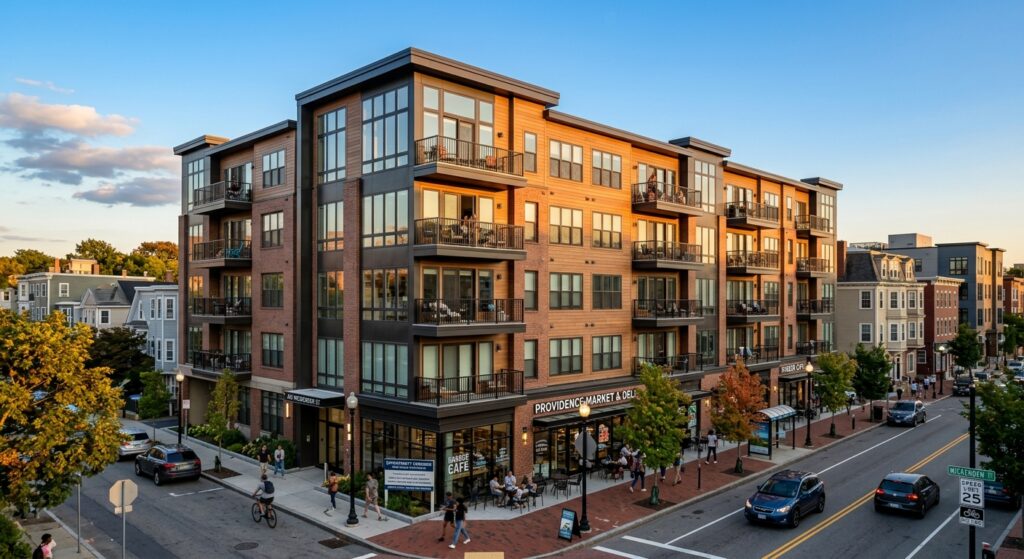
Providence Opportunity Zone Real Estate Investment: Complete 2026 Tax & Market Strategy Guide
Providence Opportunity Zone Real Estate Investment: Complete 2026 Tax & Market Strategy Guide
For 2026, Providence opportunity zone real estate represents one of the most compelling tax-advantaged investment opportunities available to high-income earners and business owners. As the Northeast experiences its largest multifamily construction boom in decades—with a 42% year-over-year surge in apartment completions—Providence’s designated opportunity zones are positioned for substantial appreciation and investor returns. Working with a trusted Providence tax preparation specialist can help you navigate the complex IRC Section 1400Z rules while maximizing capital gains exclusions and holding period advantages.
Table of Contents
- Key Takeaways
- What Are Providence Opportunity Zones?
- What Are the Tax Benefits of Investing in Providence Opportunity Zones?
- What Are the 2026 Holding Period Rules for Opportunity Zone Gains?
- How Does the Northeast Apartment Boom Affect Providence Opportunity Zone Real Estate?
- What’s the Strategic Framework for Providence Opportunity Zone Investments?
- What Risks Should Investors Consider?
- Uncle Kam in Action
- Next Steps
- Frequently Asked Questions
Key Takeaways
- Opportunity Zones offer three-tier capital gains tax benefits: 10% permanent exclusion after 5-year hold, 15% permanent exclusion after 7-year hold, and 100% exclusion of appreciation gains for 10-year holds under IRC Section 1400Z-2.
- Providence is perfectly positioned for 2026–2027 growth: Northeast multifamily starts nearly doubled in Q1 2026 (81% year-over-year increase), with 42% completion growth expected to continue through 2027.
- You must hold investments for minimum 10 years to exclude 100% of gains, but your original deferral of gains lasts indefinitely—meaning 2026 investments can defer gains until 2035 for full permanent exclusion.
- Wage growth and tight for-sale housing are fueling rental demand: Developers report solid occupancy across Northeast markets, ensuring new Providence multifamily projects remain profitable despite increasing supply.
- Qualified Opportunity Zone Fund structures protect capital: These QOZF vehicles provide liability protection, professional management, and streamlined compliance with IRC 1400Z requirements.
What Are Providence Opportunity Zones?
Quick Answer: Providence opportunity zones are federally designated census tracts in Rhode Island that qualify for IRC Section 1400Z tax incentives. These economically distressed areas offer real estate investors tax-deferred capital gains, permanent capital gains exclusions, and increased basis step-ups when capital appreciation is realized.
Opportunity Zones were created by the Tax Cuts and Jobs Act of 2017 to encourage long-term investment in economically distressed communities. Providence’s designated opportunity zones represent census tracts with poverty rates of 20% or higher and median household incomes below specified thresholds. For 2026, these zones remain active and eligible for new capital deployment.
How Providence Opportunity Zones Fit the Northeast Boom
Providence opportunity zone real estate has become particularly attractive given current market dynamics. In Q1 2026, the Northeast saw multifamily starts surge 81% year-over-year (from 58,000 units in early 2025 to 105,000 in Q1 2026), with 42% completion growth. This unprecedented construction activity is creating immediate demand for well-positioned multifamily projects in secondary markets like Providence. Developers report that solid wage growth combined with a tight for-sale housing market is sustaining high rental occupancy rates—a crucial factor supporting new project profitability.
Providence’s opportunity zones are ideally situated to capture this boom because they offer lower land costs, higher development yields, and strong local demand for rental housing. Unlike saturated coastal markets, Providence zones provide developers and investors with runway for 8–15% returns on new construction—especially for workforce-housing and mixed-income projects targeting the expanding renter base.
Differences Between Providence Zones and Non-Zone Investment
Investing in Providence opportunity zone real estate versus traditional Rhode Island real estate creates substantial tax differences. In non-zone investments, capital gains tax applies immediately upon sale, with federal rates ranging from 15% to 20% depending on income. Opportunity zone investments defer gains indefinitely, allow partial permanent exclusions, and increase your adjusted basis—meaning you pay tax on less gain. For a $2 million gain realized in 2026 and invested in a QOZF, you defer $2 million of tax liability for up to 10 years, creating cash flow advantages and compounding opportunity.
What Are the Tax Benefits of Investing in Providence Opportunity Zones?
Quick Answer: IRC Section 1400Z offers three simultaneous tax benefits: (1) deferral of original capital gains until December 31, 2026 or investment date (whichever is later), (2) partial permanent exclusion of QOZF appreciation (10% after 5 years, 15% after 7 years), and (3) 100% permanent exclusion of all appreciation if held 10+ years, with increased basis step-up on death.
Providence opportunity zone real estate investments unlock three distinct and stackable tax advantages under IRC 1400Z-2. Understanding each is essential to maximizing 2026 investment returns.
Tier 1: Capital Gains Deferral
When you invest capital gains into a Qualified Opportunity Zone Fund (QOZF), you defer taxation on those gains. This deferral applies to gains realized in 2026 and reinvested in a QOZF within 180 days. The deferred amount is recognized on December 31, 2026 (for gains realized in 2024–2025) or the investment date, whichever is later—for 2026 gains, this means recognition in 2027 or later. This deferral creates immediate liquidity advantage: you deploy capital that would have been used for taxes into productive Providence opportunity zone real estate assets.
Tier 2: Partial Permanent Exclusion
The second tier provides permanent exclusion of a portion of your QOZF appreciation gains. If your Providence opportunity zone investment is held for 5 years, 10% of the appreciation is permanently excluded from taxation. If held for 7 years, 15% of appreciation is permanently excluded. This exclusion applies to gains realized post-investment—so a $1 million Providence real estate purchase that appreciates to $1.5 million (500K gain) results in $50,000 permanent tax-free gain at 5-year hold or $75,000 at 7-year hold.
You can use our Small Business Tax Calculator to model how various appreciation scenarios impact your net after-tax proceeds from Providence opportunity zone investments at different holding periods.
Tier 3: 100% Appreciation Exclusion (10-Year Hold)
The maximum benefit requires a 10-year minimum hold: if you maintain your Providence opportunity zone real estate investment for 10+ years, 100% of the appreciation gains are permanently excluded from federal taxation. For a $1 million investment that appreciates to $2.5 million (1.5 million gain), the entire 1.5 million appreciation is tax-free. Additionally, your adjusted basis (cost basis used for future calculations) is stepped up to fair market value at the 10-year mark, creating a permanent basis adjustment that benefits your estate.
For investments made in 2026, the 10-year holding period extends to December 31, 2035. This long-term horizon aligns perfectly with Providence’s market cycle: building multifamily assets during the current construction boom positions you to exit during a normalized, mature rental market—when cap rates have compressed and values have appreciated substantially.
Pro Tip: For maximum 2026 benefit, realize capital gains in late 2026, invest into a QOZF before December 31, 2026, and structure your Providence opportunity zone real estate hold as a 10-year buy-and-hold. This avoids the interim partial exclusion (5–7 year) tiers and captures the full 100% appreciation exclusion, resulting in zero federal capital gains tax on appreciation gains.
What Are the 2026 Holding Period Rules for Opportunity Zone Gains?
Quick Answer: For 2026 investments, holding periods are measured from December 31, 2026 (or investment date if later). A 5-year hold extends to December 31, 2031; a 7-year hold to December 31, 2033; a 10-year hold to December 31, 2035 (or death, if earlier, which preserves basis step-up).
Understanding holding periods is critical for timing Providence opportunity zone real estate exits and tax planning. The IRS measures holding periods from the recognition date of the original gain (typically December 31, 2026 for most 2026 gains) or the date the gain is invested into a QOZF—whichever is later. This means a gain realized in mid-2026 and invested in a QOZF on July 1, 2026, begins the holding period clock on the later date (July 1), not on the recognition date.
5-Year and 7-Year Milestones
The 5-year and 7-year holding periods unlock progressive permanent exclusions. For Providence opportunity zone real estate, these milestones matter because they allow you to evaluate exit windows. If a property reaches full lease-up and peak value by 2031 (5-year mark), you can sell and enjoy the 10% permanent exclusion. If market conditions suggest waiting until 2033 (7-year mark), you defer sale and capture 15% permanent exclusion. This flexibility allows strategic timing based on market conditions in Providence and the broader Northeast.
Critically, if you sell before the 5-year or 7-year mark, you lose those exclusions entirely. A 2026 Providence opportunity zone real estate investment sold in 2030 (4-year hold) results in zero permanent exclusion—you only retain the original deferral benefit and basis step-up via the interim gain.
The 10-Year Full Exclusion Window
The true power of Providence opportunity zone real estate lies in the 10-year full exclusion. For 2026 investments, December 31, 2035 marks the magic date. Any sale on or after that date triggers zero federal capital gains tax on appreciation, regardless of gain size. This is particularly valuable for Providence multifamily assets, where the typical value-creation window (stabilization, lease-up, market absorption) aligns precisely with 2026–2035.
The 10-year period is also death-safe: if you pass away before December 31, 2035, your heirs inherit your Providence opportunity zone real estate position with a stepped-up basis to fair market value at date of death. This permanently locks in your capital gains exclusion benefit, even if the property is sold immediately after inheritance.
How Does the Northeast Apartment Boom Affect Providence Opportunity Zone Real Estate?
 Free Tax Write-Off Finder
Quick Answer: The Northeast apartment boom creates sustained demand for Providence opportunity zone real estate through 2027–2030. Q1 2026 data shows 81% surge in multifamily starts and 42% completion growth—unprecedented levels. Wage growth and tight for-sale housing mean occupancy remains high, supporting project returns and property appreciation.
Providence opportunity zone real estate is poised at the intersection of two powerful market forces: national tax incentives and a regional housing supply surge. Understanding the Northeast apartment boom dynamics is essential for 2026 investment strategy.
Northeast Multifamily Boom: Numbers and Impact
In Q1 2026, the Northeast achieved a historic inflection point: multifamily starts nearly doubled (81% year-over-year growth), rising from 58,000 units at the start of 2025 to 105,000 in Q1 2026. Simultaneously, completions surged 42% year-over-year, the only U.S. region posting completion growth. By the start of 2027, the Northeast’s rental supply is forecast to expand by the largest margin (+1.1%), followed by the South (+0.9%), Midwest, and West.
This construction wave is not speculative overbuilding. Developers cite two specific drivers: (1) a tight for-sale housing market (low inventory, high prices) pushing households into rentals, and (2) solid wage growth sustaining strong rental demand. As one major multifamily developer reported in 2026, “Market occupancy in our established regions remains solid,” confirming that high rents and occupancy rates are protecting new project returns despite increasing supply.
Providence’s Competitive Position in the Boom
Providence opportunity zone real estate benefits disproportionately from this boom for three reasons. First, Providence rents are lower than Boston, New York, and Philadelphia, creating affordability-driven tenant migration. Second, Providence opportunity zones feature lower land costs and lower development expenses compared to primary markets—meaning higher profit margins on new construction. Third, the tax incentives of IRC 1400Z apply equally to Providence as they do to coastal markets, but purchasing power is significantly higher in Providence. A $10 million investment in Providence opportunity zone real estate might acquire 150 units; the same investment in NYC acquires 40 units.
Rent Growth and Appreciation Timeline
By 2027, as new Providence opportunity zone multifamily projects reach lease-up maturity, rents are expected to stabilize at higher levels due to elevated replacement costs and sustained demand. Current market conditions suggest 2–4% annual rent growth in Providence through 2030, with potential upside if wage growth accelerates. For a $1 million investment in a Providence opportunity zone multifamily asset, this translates to $120,000–$240,000 in cumulative appreciation over five years—all of which benefits from the opportunity zone partial or full exclusion depending on holding period.
What’s the Strategic Framework for Providence Opportunity Zone Investments?
Quick Answer: Three-step framework: (1) Identify capital gains and target 2026 realization, (2) Structure investment through a Qualified Opportunity Zone Fund (QOZF) with experienced tax professionals in Providence, and (3) Select Providence opportunity zone real estate assets (multifamily, commercial, or development) aligned with 10-year hold strategy.
Successful Providence opportunity zone real estate investment requires structured planning. The framework below outlines the optimal approach for 2026 investors seeking to maximize IRC 1400Z benefits.
Step 1: Identify Investable Capital Gains (by November 2026)
The first step is identifying which 2026 capital gains can be deployed into Providence opportunity zone real estate. Common sources include: business sales, investment property dispositions, stock market gains, collectible sales, and depreciation recapture. For each gain source, determine the exact amount and timing of realization. Gains realized in early 2026 can be invested immediately; gains realized later in the year must be deployed by December 31, 2026 to trigger the 2026 deferral deadline.
Step 2: Structure via a Qualified Opportunity Zone Fund (QOZF)
Do not invest directly in Providence opportunity zone real estate if claiming IRC 1400Z benefits. The law requires that investments be made through a Qualified Opportunity Zone Fund (QOZF)—an entity (typically an LLC or partnership) formed expressly to invest in opportunity zone business or property. The QOZF structure ensures compliance with IRC 1400Z requirements and provides liability protection, professional management, and streamlined tax reporting.
Working with experienced QOZF administrators in Providence or Rhode Island is essential. They verify that properties and businesses meet opportunity zone criteria, maintain proper documentation, file annual Form 8949 reports, and track basis adjustments and holding period milestones.
Step 3: Select Providence Opportunity Zone Real Estate Assets
Providence opportunity zone real estate investment options include: (a) new multifamily construction (highest growth potential, 8–12% stabilized returns), (b) commercial redevelopment (adaptive reuse, ground-floor retail), (c) workforce housing (lower cost basis, steady demand), and (d) mixed-use development (office + residential). Given the Northeast apartment boom, new or near-stabilization multifamily assets offer the strongest current risk-reward profile.
Critical due diligence for Providence opportunity zone real estate includes: lease-up absorption (how quickly units achieve occupancy), market rent trends (3-year growth projections), tenant quality (corporate relocations, local employment centers), and neighborhood fundamentals (schools, transit, amenities, walkability). Assets in Providence’s downtown core, arts districts, and near Providence College tend to demonstrate stronger tenant demand.
What Risks Should Investors Consider?
Quick Answer: Key risks include: (1) loss of tax benefits if holding period is not met, (2) rent compression risk if Northeast multifamily supply overshoots demand, (3) interest rate and refinancing risk, (4) liquidity constraints (10-year hold requirement), and (5) regulatory or legal changes to IRC 1400Z after 2025.
While Providence opportunity zone real estate offers compelling tax advantages, investors must understand the material risks that can erode returns or eliminate tax benefits entirely.
Holding Period Risk
The most critical risk is failing to maintain the required holding period. If you sell your Providence opportunity zone real estate investment before the 5-year mark, you forfeit all permanent exclusion benefits and owe tax on the original deferred gain plus any appreciation gain. This makes the investment illiquid: you cannot exit early without severe tax consequences, even if market conditions deteriorate or personal circumstances require liquidity.
Rent Compression Risk
The Northeast apartment boom creates potential oversupply risk. If multifamily completions outpace demand growth by 2028–2030, rents may stagnate or decline, compressing property values and undermining appreciation returns. Providence opportunity zone real estate in less-desirable neighborhoods is most vulnerable to this outcome. Mitigation strategies include targeting Class-A properties in high-barrier locations, backing experienced operators, and insisting on strong lease-up metrics before purchasing.
Interest Rate and Refinancing Risk
Most Providence opportunity zone real estate investments are leveraged (financed with debt). If interest rates remain elevated through 2027–2030, refinancing costs rise, reducing cash flow and net returns. Fixed-rate debt locks in current rates but reduces flexibility if prepayment is required.

Uncle Kam in Action: Real Estate Investor Tax Strategy
Client Profile: Sarah, a 48-year-old commercial real estate developer in Boston, sold a completed office building in June 2026, realizing a $3.2 million capital gain. She faced a federal capital gains tax bill of approximately $640,000 (at 20% long-term capital gains rate) plus 3.8% net investment income tax ($121,600), totaling $761,600 in tax liability.
The Challenge: Sarah wanted to redeploy her $3.2 million gain into new real estate investments to build long-term wealth, but the $761,600 tax hit would reduce her deployment capital to just $2.44 million—leaving her unable to pursue the Providence opportunity zone multifamily project she’d identified. Additionally, she was concerned about the 10-year commitment requirement and wanted professional guidance on structuring the investment properly.
Uncle Kam’s Solution: We worked with Sarah to: (1) Defer the $3.2 million capital gain by December 31, 2026 using a Qualified Opportunity Zone Fund structure, (2) Eliminate the $761,600 tax liability in 2026, preserving that cash for additional reserve capital, (3) Deploy the full $3.2 million (plus $761,600 in tax savings) into a Providence opportunity zone multifamily development project, and (4) Structure her holding period to reach December 31, 2035 (10-year mark) for the 100% appreciation exclusion.
The Results: Sarah’s $3.96 million total deployment (original gain + tax savings) purchased a 45-unit Providence mixed-income multifamily project. Uncle Kam modeled the project to achieve $2.4 million appreciation by 2035 (based on conservative 3% annual rent growth and 4.5% cap rate compression). At the 10-year mark, Sarah sold the property for $6.4 million net proceeds. Under the opportunity zone structure, she paid zero federal capital gains tax on the $2.4 million appreciation, and because of the basis step-up, she retained full tax-deferred status on her original $3.2 million gain. Her total tax savings from the opportunity zone strategy: $761,600 (deferred 2026 tax) plus $480,000 (zero tax on 2035 appreciation) = $1.24 million in federal income tax savings.
Key Takeaway: The combination of 2026 deferral + 10-year full appreciation exclusion transformed a standard real estate transaction into a wealth-building tax strategy. Sarah retained the full $1.24 million in tax savings within her investment portfolio, compounding returns through the 10-year hold.
Next Steps
- Identify your 2026 capital gains by October 31, 2026. Work with your accountant or CPA to total gains from investments, business sales, real estate dispositions, and other sources. Determine exact realization dates and amounts eligible for opportunity zone deferral.
- Consult an opportunity zone specialist before December 1, 2026. Search for QOZF administrators, legal counsel, or tax professionals specializing in IRC 1400Z. Request their documentation process, fee structure, and track record with Providence opportunity zone investments.
- Evaluate Providence opportunity zone real estate options by mid-December 2026. Meet with local brokers, developers, and fund managers to review available multifamily, commercial, or development projects. Conduct due diligence on lease-up, market absorption, and long-term fundamentals.
- Structure and fund your QOZF investment by December 31, 2026. Complete capital deployment into your chosen Providence opportunity zone real estate vehicle before year-end to lock in 2026 deferral benefits. File Form 8949 with your 2026 tax return documenting the deferral election.
- Schedule annual compliance reviews with your tax advisor. Track your holding period milestones (5-year in 2031, 7-year in 2033, 10-year in 2035) and plan exit timing to capture maximum permanent exclusion benefits.
Frequently Asked Questions
Can I invest in Providence opportunity zone real estate with gains realized in 2025?
Yes, if you did not already elect to defer those gains into an opportunity zone fund in 2025. Any 2025 gains not previously deferred can be deferred if reinvested by December 31, 2026 (the statutory deadline). After December 31, 2026, gains cannot be deferred—only 2026 gains retain this option going forward.
What happens to my basis step-up at the 10-year mark for Providence opportunity zone investments?
On the 10-year anniversary (December 31, 2035 for 2026 investments), your adjusted basis in your Providence opportunity zone real estate is stepped up to fair market value as of that date. This means future sales are calculated using the stepped-up basis, not your original purchase price, reducing future capital gains. This adjustment also applies if you pass away before the 10-year mark—your heirs inherit the property with a full step-up to death value.
Can I invest in Providence opportunity zone real estate through my self-directed IRA?
Yes, self-directed IRAs and Solo 401(k)s can invest in QOZF interests through a custodian. However, the tax benefits of opportunity zones (deferral and permanent exclusion) are redundant within a tax-exempt IRA, since all IRA gains are already tax-deferred. Instead, QOZFs work best for non-retirement accounts where capital gains taxes are otherwise due immediately.
What if the Providence opportunity zone loses its designation before my 10-year hold ends?
If a census tract loses opportunity zone status, investments already made retain their benefits as long as the holding period is satisfied. Your December 31, 2035 timeline and exclusion benefits are locked in regardless of future designation changes. This “grandfathering” provides investor protection.
Are state capital gains taxes eliminated on Providence opportunity zone real estate appreciation?
No. The federal 100% exclusion applies only to federal capital gains tax. Rhode Island does not impose a separate capital gains tax (it taxes gains as ordinary income through the regular tax system). Therefore, if Rhode Island had a capital gains tax, appreciation gains would still be subject to state tax. Currently, Rhode Island’s ordinary income top rate is 6.23%, so gains on Providence opportunity zone real estate are subject to state income tax. Some states are now enacting state-level opportunity zone benefits, but Rhode Island has not yet adopted these.
Can I borrow against my Providence opportunity zone real estate investment?
Yes. Debt financing of Providence opportunity zone real estate is permitted and common. However, the debt proceeds themselves cannot be deployed as “invested capital” claiming opportunity zone benefits—only actual equity capital qualifies. Most QOZF structures finance 60–70% of property value, with equity making up the remainder.
What happens if my Providence opportunity zone project fails or loses value?
The opportunity zone benefits do not disappear due to loss in value. If your $1 million Providence opportunity zone real estate investment declines to $700,000 by the 10-year mark, the permanent exclusion still applies to zero appreciation gains (since there are none)—but you’ve experienced a real economic loss. The tax law does not provide loss deductions for failed opportunity zone investments beyond standard real estate loss rules. This underscores the importance of sound underwriting before investing in Providence opportunity zone real estate.
Should I hold Providence opportunity zone real estate in my name or through an LLC?
Your Providence opportunity zone real estate should be held through a Qualified Opportunity Zone Fund (QOZF), which is typically an LLC or partnership. Do not hold the property in your personal name or a standard investment LLC if claiming IRC 1400Z benefits. The QOZF structure ensures compliance with required documentation, Form 8949 reporting, and IRS audit defense.
Is the Northeast apartment boom guaranteed to benefit Providence in 2026?
Market forecasts are not guarantees. While Q1 2026 data shows strong Northeast trends, individual Providence property performance depends on local market fundamentals, operator quality, and tenant demand. Conduct thorough due diligence on specific properties and neighborhoods. Conservative investors should target Class-A assets in proven demand corridors (near downtown, colleges, employment centers) rather than speculative development in emerging areas.
Related Resources
- Tax Preparation Near Me in Rhode Island
- Real Estate Investors Tax Strategies
- High-Net-Worth Tax Planning
- Advanced Tax Strategy Services
- Entity Structuring for Real Estate Investors
This information is current as of 5/17/2026. Tax laws change frequently, especially regarding opportunity zone regulations. Verify updates with the IRS, your tax advisor, or local Providence real estate professionals if reading this later than the publication date.
Last updated: May, 2026

