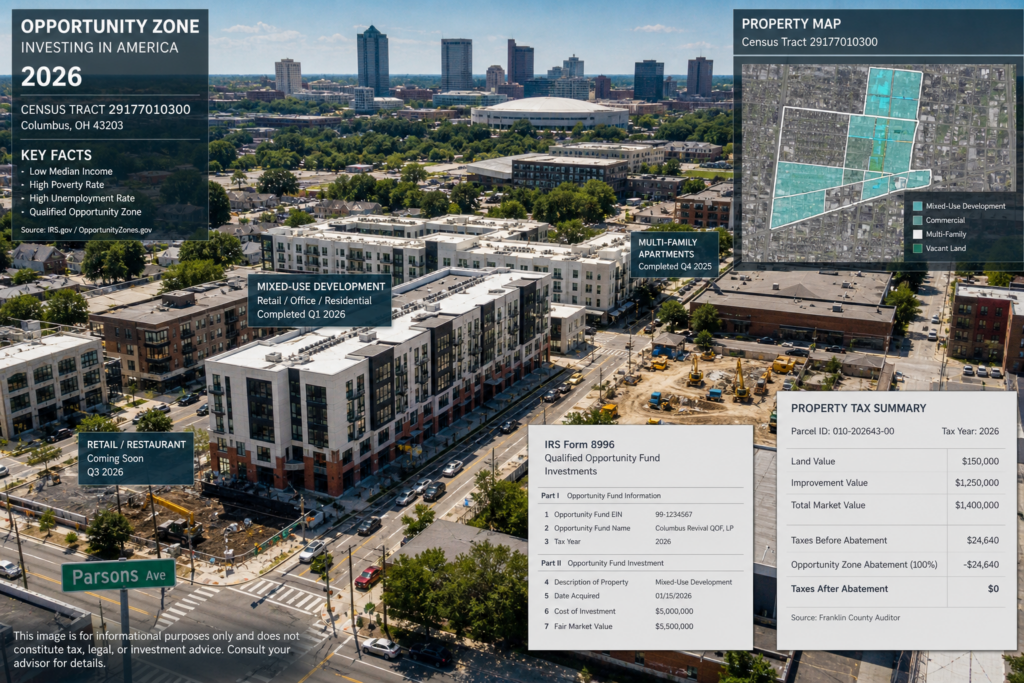
Opportunity Zone Map 2025: Investor Guide for 2026
Opportunity Zone Map 2025: Complete Investor Guide for 2026
The opportunity zone map 2025 is the essential starting point for every real estate investor seeking to defer or eliminate capital gains tax. In 2026, Opportunity Zones carry more weight than ever. The One Big Beautiful Bill Act made the program permanent and opened a new nomination round for qualified census tracts. If you invest in tax-advantaged real estate strategies, understanding this map is non-negotiable.
This information is current as of 6/17/2026. Tax laws change frequently. Verify updates with the IRS or CDFI Fund if reading this later.
Table of Contents
- Key Takeaways
- What Is the Opportunity Zone Map 2025?
- How Do You Use the Opportunity Zone Map to Find Qualified Tracts?
- What Changed for Opportunity Zones in 2026?
- What Are the Capital Gains Tax Benefits of Opportunity Zones?
- How Do You Invest in a Qualified Opportunity Fund?
- Which Opportunity Zone Markets Are Attracting the Most Investment in 2026?
- Uncle Kam in Action: Real Estate Investor Saves $180,000 in Capital Gains Tax
- Next Steps
- Related Resources
- Frequently Asked Questions
Key Takeaways
- The Opportunity Zone program was made permanent by the One Big Beautiful Bill Act signed July 4, 2025.
- On April 6, 2026, the IRS issued guidance to states for nominating new census tracts as qualified opportunity zones.
- You can use the free CDFI CIMS mapping tool to check any address against the opportunity zone map.
- Investors who hold a Qualified Opportunity Fund (QOF) for 10+ years can exclude 100% of appreciation from federal tax.
- You have 180 days from a capital gain event to roll proceeds into a QOF and qualify for deferral.
What Is the Opportunity Zone Map 2025?
Quick Answer: The opportunity zone map 2025 is a publicly available, federally maintained geographic database showing every qualified opportunity zone census tract across the United States. Investors use it to confirm whether a property or project is eligible for Opportunity Zone tax incentives.
Opportunity Zones are low-income census tracts designated by state governors and certified by the U.S. Department of the Treasury. The program was first created under the Tax Cuts and Jobs Act of 2017 (IRC §§ 1400Z-1 and 1400Z-2). Congress designed it to direct private capital into economically distressed communities by offering powerful tax incentives on capital gains reinvestment.
The original designations covered roughly 8,764 census tracts across all 50 states, the District of Columbia, and U.S. territories. However, under new 2026 rules, that number is expected to grow as states nominate fresh tracts under permanent legislation.
How Were Opportunity Zones Originally Designated?
Governors nominated census tracts from a pool of eligible low-income community tracts. Treasury then certified those nominations. Each state could nominate up to 25% of its eligible low-income census tracts. Tracts had to meet specific poverty rate or median family income thresholds to qualify.
Furthermore, contiguous tracts — those adjacent to a qualifying low-income tract — could also receive designation if certain conditions were met. This allowed some neighborhoods that didn’t independently qualify to still benefit from the program.
Why the Map Still Matters in 2026
Many investors assume all Opportunity Zones look the same on paper. In reality, the opportunity zone map 2025 reveals enormous variation in market conditions, property values, and growth potential. Some zones sit in rapidly appreciating urban corridors. Others sit in rural communities with limited infrastructure. Picking the right zone matters just as much as using the tax incentive correctly. Therefore, checking the map is step one — but deep market analysis is step two.
You can access the official IRS Opportunity Zones resource page for federally verified information on how the program works and which tracts are currently designated.
Pro Tip: Never rely on a third-party map as your only source. Cross-check every property address using the official CDFI Fund mapping tool before committing capital to any OZ investment.
How Do You Use the Opportunity Zone Map to Find Qualified Tracts?
Quick Answer: Use the CDFI Information Mapping System (CIMS) at cdfifund.gov to geocode any property address. The tool instantly shows whether that address sits within a qualified opportunity zone census tract.
The CDFI Fund maintains the official government mapping tool for Opportunity Zones. It is called the CDFI Information Mapping System (CIMS). You can use it to geocode individual addresses, visualize census tract boundaries on an interactive map, and confirm OZ designation status in seconds. Best of all, it is completely free to use.
Step-by-Step: How to Check an Address on the OZ Map
- Step 1: Visit cdfifund.gov/mapping-system and open the CIMS tool.
- Step 2: Enter the full property address in the geocoding search bar.
- Step 3: The tool will identify the census tract associated with that address.
- Step 4: Check whether the tract is listed as a Qualified Opportunity Zone (QOZ).
- Step 5: Cross-reference the result with the IRS’s official list of designated QOZs to confirm eligibility.
What to Look for Beyond the Map
Confirming OZ status is necessary, but it is not sufficient. Smart investors also examine the following factors before investing in any qualified census tract:
- Population trends: Is the neighborhood gaining or losing residents?
- Job growth: Are employers moving in or out of the area?
- Infrastructure investment: Are roads, transit, and utilities improving?
- Local government support: Does the city or county actively recruit OZ investment?
- Existing QOF activity: Are other funds already deploying capital in this zone?
In 2026, several Opportunity Zone markets — particularly in Sun Belt cities like Savannah, Georgia, and Miami, Florida — are drawing significant capital. These markets combine favorable OZ designations with strong population growth and AI-driven economic development. In fact, a $3 billion redevelopment project in Miami’s Little Haiti, a federally designated Opportunity Zone, recently attracted a major tech investor targeting AI company tenants.
Real estate investors interested in tax strategy around Savannah and the Georgia coast can also explore our Savannah Small Business Tax Calculator to model investment scenarios in the region.
What Changed for Opportunity Zones in 2026?
Quick Answer: The One Big Beautiful Bill Act, signed July 4, 2025, made Opportunity Zones permanent. In April 2026, the IRS and Treasury issued guidance allowing states to nominate entirely new census tracts for QOZ designation. This is a major expansion of the program.
The biggest news for OZ investors in 2026 is permanency. Before the One Big Beautiful Bill Act passed, the Opportunity Zone program had a built-in expiration. Investors worried about the long-term viability of the tax incentive. That uncertainty is now gone. Congress made the program a permanent part of the tax code, giving investors the confidence to make longer-term commitments.
IRS Guidance from April 6, 2026: New Tract Nominations
On April 6, 2026, the Treasury Department and IRS jointly issued IRS Release IR-2026-45. This release gave state governors formal guidance on how to nominate new census tracts as Qualified Opportunity Zones under the permanent program. It is a significant development. It means the opportunity zone map 2025 will eventually expand as states submit new nominations.
As of June 2026, the Treasury and IRS are still finalizing implementation procedures. Therefore, investors should monitor the CDFI Fund Opportunity Zones page for updates on newly designated tracts. This page is the most current source for map changes.
What the Permanent Program Means for Investors
Permanency changes the investment math in several ways. First, funds can raise capital without fear that the program will sunset. Second, investors starting a 10-year hold period today do not face the risk of legal uncertainty at the exit. Third, new census tract designations could open up previously ineligible neighborhoods, creating fresh opportunities in growing markets.
However, permanency also means greater IRS scrutiny over time. Compliance requirements remain strict. Moreover, investors who fail to meet the “substantial improvement” test or the 90% asset test for their Qualified Opportunity Fund may face disqualification and unexpected tax bills. Working with a qualified real estate tax strategy advisor has never been more important.
Pro Tip: Under the permanent program, new OZ designations will follow a nomination cycle. Watch for your state governor’s office to announce new nominations. Early-stage investors in newly designated tracts often see the greatest appreciation.
What Are the Capital Gains Tax Benefits of Opportunity Zones?
 Free Tax Write-Off Finder
Quick Answer: Opportunity Zone investors can defer capital gains, potentially reduce the deferred gain amount, and eliminate all future appreciation from federal tax if they hold their QOF investment for at least 10 years.
The Opportunity Zone tax incentive has three tiers. Each tier rewards investors who hold their investment longer. For real estate investors seeking to shelter large gains from property sales, stock sales, or business exits, this program is one of the most powerful tools available under current federal law. Let’s break down each tier.
Tier 1: Capital Gains Deferral
When you sell an appreciated asset and reinvest the gain into a Qualified Opportunity Fund within 180 days, you defer paying tax on that gain. Under the permanent program, deferral continues until the earlier of the date you sell your QOF interest or the applicable statutory deadline set by IRS guidance. This gives investors the ability to hold onto cash that would otherwise go to the IRS and put that capital to work inside the OZ investment instead.
For example, if you sold investment property in March 2026 and recognized a $500,000 long-term capital gain, you have 180 days from the sale to reinvest that $500,000 into a QOF. By doing so, you defer the federal tax on that entire $500,000 gain. At a 20% long-term capital gains rate plus the 3.8% Net Investment Income Tax, that is up to $118,000 in deferred tax you keep working for you inside the fund.
Tier 2: Basis Step-Up on Deferred Gain
Under prior law, investors who held a QOF for at least 5 years received a 10% basis step-up, and those who held for 7 years received a 15% step-up, on the deferred original gain. However, as of the current tax year, those specific basis step-up provisions have largely phased out for new investments due to timing rules established in prior IRS guidance. Consequently, the primary focus for 2026 investors is the Tier 1 deferral and the Tier 3 exclusion. Verify current basis step-up rules with a tax professional and at IRS.gov Opportunity Zones before making any investment decision.
Tier 3: Tax-Free Appreciation After 10 Years
This is the most powerful benefit. If you hold your Qualified Opportunity Fund investment for at least 10 years and then sell, you can elect to receive a stepped-up basis equal to the fair market value of your QOF interest on the sale date. In practical terms, this means you pay zero federal capital gains tax on all appreciation that occurred inside the fund from the date of your investment to the date of sale. None of the profit on the OZ investment itself is taxable.
This is transformative for real estate investors. Consider a $500,000 QOF investment that grows to $1.2 million over 10 years. That $700,000 in appreciation is completely free of federal capital gains tax when you exit. This benefit alone makes the opportunity zone map 2025 one of the most searched real estate tax tools in the country.
| OZ Benefit Tier | Holding Period Required | Tax Benefit |
|---|---|---|
| Tier 1: Deferral | Invest within 180 days of gain | Defer tax on original capital gain |
| Tier 2: Basis Step-Up | 5–7 years (timing rules apply) | Partial reduction of deferred gain (verify current rules at IRS.gov) |
| Tier 3: Full Exclusion | 10+ years | 100% exclusion of QOF appreciation from federal capital gains tax |
Did You Know? The 10-year exclusion applies to appreciation inside the Qualified Opportunity Fund, not to the original deferred gain from the triggering sale. You still owe tax on that original gain at some point. The magic of OZs lies in eliminating tax on all future growth.
How Do You Invest in a Qualified Opportunity Fund?
Quick Answer: You invest in a QOF by contributing capital gains proceeds to a fund organized as a partnership or corporation that self-certifies with the IRS using Form 8996. You must act within 180 days of the triggering gain event.
Investing in a Qualified Opportunity Fund is a structured process. However, it is more straightforward than many investors assume. The key requirements center on timing, proper fund structure, and ongoing compliance. Missing a deadline or skipping a required IRS filing can disqualify your investment and cost you the tax benefits entirely. Here is how the process works step by step.
What Qualifies as a Triggering Gain Event?
Almost any capital gain qualifies for OZ deferral. Common triggering events include:
- Sale of real estate (investment property, commercial buildings, land)
- Sale of publicly traded stocks or securities
- Business sale or asset sale gains
- Cryptocurrency or digital asset dispositions (subject to applicable guidance)
- Section 1231 gains from trade or business property
Short-term and long-term capital gains both qualify. This is important because many investors assume only long-term gains are eligible. In fact, reinvesting a short-term gain into a QOF is often especially attractive since short-term gains are otherwise taxed as ordinary income at rates up to 37%.
The 90% Asset Test and Substantial Improvement Rule
A Qualified Opportunity Fund must hold at least 90% of its assets in qualified opportunity zone property. This is measured twice per year. If a fund fails this test, it faces a monthly penalty. Furthermore, if the OZ property is an existing structure (not vacant land or a new build), it must be “substantially improved” within 30 months. Substantial improvement means the fund must invest at least as much in improvements as the original acquisition cost of the building itself — not the land.
This rule creates real complexity for real estate investors. For example, buying a building for $2 million and the land for $1 million means you must invest at least $2 million more in improvements to the building within 30 months. Careful deal structuring upfront avoids costly surprises.
Required IRS Forms for OZ Investors
Investors who roll gains into a QOF must file specific IRS forms every year. Missing these can trigger penalties and audit risk. The key forms include:
- Form 8997: Report your initial and annual QOF investments on your federal tax return.
- Form 8949: Report the original capital gain deferral election when you file your taxes.
- Form 8996: The QOF itself files this annually to self-certify and report compliance with the 90% asset test.
Working with a tax preparation and filing specialist who understands OZ compliance requirements is essential to keeping your investment on track every year.
Which Opportunity Zone Markets Are Attracting the Most Investment in 2026?
Quick Answer: In 2026, Sun Belt cities lead OZ investment activity. Miami, Atlanta, Nashville, and Savannah are among the top markets. These cities combine favorable OZ designations with strong population growth, infrastructure investment, and business-friendly policies.
Not all Opportunity Zones are created equal from an investment standpoint. The best markets in 2026 share a common set of characteristics: business-friendly state tax policy, rapid population and job growth, improving infrastructure, and active local government support for OZ development. Here is a look at some of the standout markets this year.
Miami, Florida: The AI-Driven OZ Leader
Miami has emerged as one of the most active Opportunity Zone markets in the country. The Little Haiti neighborhood — a federally designated OZ — is the center of a $3 billion redevelopment project targeting AI and tech companies. The project benefits from both a Special Area Plan designation and its OZ status, which stacks local zoning flexibility with federal tax incentives. Speed to market is a key factor. Miami has streamlined permitting, which is now a measurable criterion in CNBC’s 2026 America’s Top States for Business rankings.
Florida’s lack of a state income tax also amplifies the federal OZ benefit. Real estate investors in Florida-based OZ projects keep more of their tax savings at the state level compared to investors in high-tax states like California or New York.
Georgia: Savannah and Atlanta Lead Southeast OZ Activity
Georgia is another top-performing OZ state in 2026. Savannah’s coastal economy is expanding rapidly, driven by port expansion, logistics infrastructure, and a growing industrial base. Several census tracts within Savannah hold OZ status, making the region attractive for investors in industrial, mixed-use, and residential development. Atlanta’s designated OZ tracts in areas like the West End and Pittsburgh neighborhoods continue to attract capital from real estate developers and private equity funds.
Georgia’s strong incentive ecosystem and relatively low cost of doing business make it a compelling OZ state. Investors targeting Georgia-based projects can use the Savannah Small Business Tax Calculator to model their 2026 tax scenarios before committing capital.
Comparing Top OZ Markets for 2026 Investors
| Market | Key OZ Sectors | State Income Tax | 2026 Growth Driver |
|---|---|---|---|
| Miami, FL | Tech/AI, mixed-use, residential | None | AI hub development, port access |
| Savannah, GA | Industrial, logistics, residential | 5.75% flat rate | Port expansion, EV manufacturing |
| Nashville, TN | Multifamily, commercial | None | Population surge, healthcare sector |
| Atlanta, GA | Mixed-use, film industry, tech | 5.75% flat rate | Film production, corporate relocations |
Regardless of market, every investor should start with a thorough review of the official CDFI Fund OZ resources to confirm current designation status before investing. New designations under the 2026 permanent program may shift the competitive landscape in coming months.

Uncle Kam in Action: Real Estate Investor Saves $180,000 in Capital Gains Tax
Client Snapshot: Marcus is a 52-year-old real estate investor based in Savannah, Georgia. He owns a portfolio of residential rental properties and has been investing in commercial real estate for over 15 years.
Financial Profile: Marcus generates approximately $380,000 per year in gross rental income. He sold a commercial warehouse in early 2026 and realized a $900,000 long-term capital gain. His effective federal capital gains rate was 23.8% (20% long-term rate plus 3.8% Net Investment Income Tax).
The Challenge: Marcus faced a potential federal tax bill of approximately $214,200 on his $900,000 gain. He wanted to keep that capital working rather than send a large check to the IRS. He had heard about Opportunity Zones but was not sure where to start. He was also concerned about picking the wrong census tract and losing the tax benefit due to a compliance error.
The Uncle Kam Solution: Uncle Kam’s team walked Marcus through the opportunity zone map 2025 using the CDFI CIMS tool. They identified a qualified census tract in Savannah’s growing industrial corridor. The team confirmed OZ status, evaluated local market conditions, and helped Marcus structure a QOF investment within the required 180-day window. They also handled all the required filings, including Form 8997 and Form 8949, to ensure full compliance from day one. Additionally, they modeled the full 10-year scenario showing projected tax-free appreciation if Marcus held through the exit window.
The Results:
- Tax Deferred in 2026: $214,200 (full gain deferred by timely QOF investment)
- Projected Tax-Free Appreciation (10-year exit): $600,000+ in additional OZ gain excluded from federal tax
- Investment in Uncle Kam Services: $12,500
- First-Year ROI: Over 17x return on advisory fees based on tax deferral alone
Marcus now has a clear 10-year roadmap for his OZ investment. He understands his annual compliance obligations. Furthermore, he is positioned to exit tax-free on hundreds of thousands in appreciation. Stories like his are why Uncle Kam’s client results speak for themselves.
Next Steps
If you are ready to take advantage of Opportunity Zones in 2026, here is what to do next. Start by checking your target property on the official OZ map. Then engage a qualified tax advisor before you invest.
- Step 1: Verify your target address at CDFI CIMS to confirm OZ status.
- Step 2: Review the latest IRS guidance on new tract nominations at IRS.gov/opportunity-zones.
- Step 3: Calculate your capital gain exposure and model your 10-year OZ scenario with our Savannah Small Business Tax Calculator.
- Step 4: Connect with an Uncle Kam tax advisor to structure your QOF investment properly and meet all 180-day and annual filing requirements.
- Step 5: Monitor CDFI Fund and IRS for new 2026 census tract designations, especially if your target market is in a state that has submitted new nominations.
Related Resources
- Real Estate Investor Tax Strategies
- Tax Strategy Planning for High-Net-Worth Investors
- Tax Preparation and Filing Services
- Uncle Kam Tax Guides Library
- Uncle Kam Tax Strategy Blog
Frequently Asked Questions
Is the opportunity zone map 2025 still accurate in 2026?
Yes, the existing designated census tracts from the original 2018 nominations remain valid in 2026. However, the map is now expected to expand. The One Big Beautiful Bill Act made Opportunity Zones permanent and opened a new round of census tract nominations. On April 6, 2026, the IRS issued guidance to states for nominating new QOZ tracts. Always verify OZ status against the current CDFI Fund database before investing, since updated designations may add new tracts to the map in coming months.
How do I find out if a specific property is in an Opportunity Zone?
The fastest way is to use the CDFI Information Mapping System (CIMS) at cdfifund.gov/mapping-system. Enter the full property address and the tool will geocode the location and confirm whether it falls within a qualified opportunity zone census tract. You can also cross-check using the IRS’s official list of designated QOZs at irs.gov. Never rely solely on a third-party map or a fund sponsor’s representation without independent verification.
What is the 180-day rule for Opportunity Zone investing?
The 180-day rule requires you to invest your eligible capital gain into a Qualified Opportunity Fund within 180 days of the gain recognition date. For most investors, this is 180 days from the date of the asset sale. For gains recognized through a partnership or pass-through entity, slightly different timing rules may apply. Missing the 180-day window disqualifies the investment for capital gains deferral. Therefore, it is critical to act quickly after a triggering sale event. Work with a tax advisor to confirm your specific deadline based on how your gain was recognized.
Can I create my own Qualified Opportunity Fund?
Yes. Any domestic partnership or corporation can self-certify as a Qualified Opportunity Fund by filing Form 8996 with its annual federal tax return. There is no separate IRS approval process or registration requirement to become a QOF. However, operating your own fund carries significant compliance obligations, including meeting the 90% asset test twice per year and ensuring the underlying OZ property meets the substantial improvement requirements. Many individual investors choose to invest in an established third-party QOF to reduce the compliance burden, while experienced real estate investors often prefer to manage their own fund for maximum control.
Do Opportunity Zones apply to short-term capital gains?
Yes. Both short-term and long-term capital gains qualify for OZ deferral. This makes Opportunity Zones particularly attractive for investors who realize short-term gains — which are otherwise taxed at ordinary income rates up to 37% — because rolling those gains into a QOF defers the tax and converts the eventual income to long-term capital gains treatment if held for the required period. Real estate investors who flip properties and generate short-term gains have a strong incentive to explore OZ reinvestment as part of their overall high-income tax planning strategy.
What happens if I sell my QOF investment before 10 years?
If you sell your QOF investment before the 10-year mark, you lose the tax-free appreciation benefit. You will owe capital gains tax on any appreciation in the QOF at the time of sale. Additionally, the deferred gain from the original triggering event becomes taxable at the point of sale or, in some cases, by the applicable statutory deadline established by IRS guidance. Selling early eliminates the most powerful OZ benefit. However, if market conditions change dramatically, it may still make economic sense to exit — especially if the property value has declined or the investment is underperforming. Always model the full after-tax impact before exiting early.
Are Opportunity Zone gains subject to state income tax?
The OZ tax benefits described here apply only to federal taxes. State income tax treatment varies. Some states, like Florida and Tennessee, have no personal income tax, so OZ investors there enjoy the full benefit. Other states conform to the federal OZ rules and provide parallel state-level deferral or exclusion. However, some states — including California — do not conform to the federal OZ incentive, which means OZ gains may still be taxable at the state level even when fully deferred federally. Always confirm your state’s OZ conformity status with a qualified tax advisor before structuring your investment.
Last updated: June, 2026

