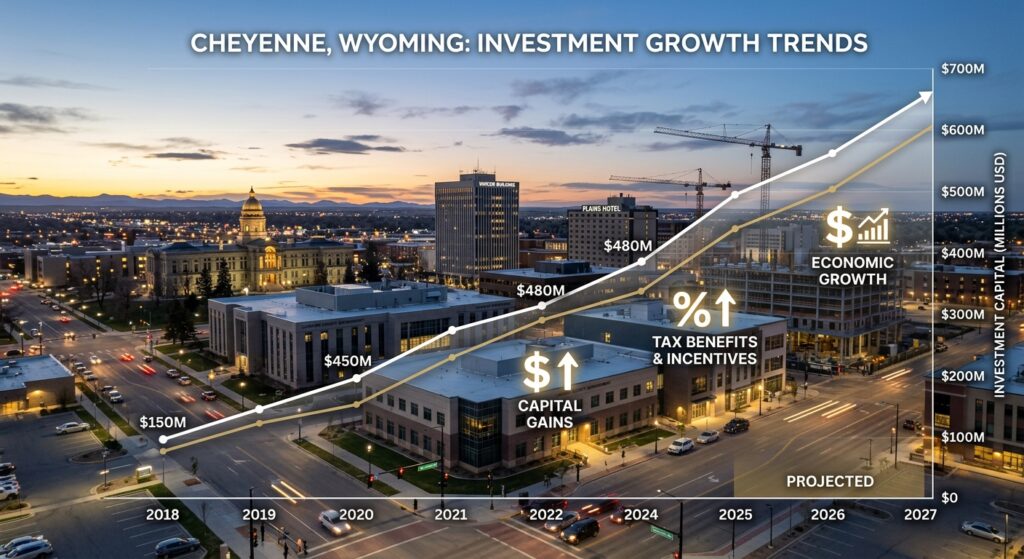
Opportunity Zone Capital Gains Tax Benefits in Cheyenne, Wyoming: 2026 Strategic Guide
For the 2026 tax year, investors seeking to defer capital gains while supporting economic development in Cheyenne and Laramie County can leverage opportunity zone capital gains investments to dramatically reduce their tax burden. Opportunity zones offer powerful federal tax incentives that defer, reduce, and potentially eliminate capital gains taxes on reinvested profits. Understanding how these benefits work in Wyoming’s growing economy—especially with major infrastructure projects like data centers and workforce housing developments—is essential for high-income investors and business owners planning for 2026.
Table of Contents
- Key Takeaways
- What Are Opportunity Zones and How Do They Work?
- What Are the Three Main Tax Benefits of Opportunity Zone Investments?
- What Are the Holding Period Requirements for Opportunity Zone Gains?
- How Does the 180-Day Reinvestment Window Work for Capital Gains Deferral?
- What Investment Opportunities Exist in Cheyenne’s Opportunity Zones for 2026?
- How Can Entity Structure Affect Opportunity Zone Investment Strategy?
- Uncle Kam in Action: Real Opportunity Zone Success Story
- Next Steps
- Frequently Asked Questions
- Related Resources
Key Takeaways
- Opportunity zones let investors defer capital gains taxes indefinitely under IRC Section 1400Z.
- A 5-year holding period locks in a 15% basis step-up; 10 years can eliminate all taxes on QOZ gains.
- You have 180 days from asset sale to reinvest gains in a qualified opportunity fund (QOF).
- Cheyenne’s 2026 infrastructure boom (data centers, workforce housing) creates real investment opportunities.
- Professional tax planning is essential to maximize deferral benefits and ensure IRS compliance.
What Are Opportunity Zones and How Do They Work?
Quick Answer: Opportunity zones are economically distressed areas designated by the federal government where investors can defer, reduce, and potentially eliminate capital gains taxes by reinvesting profits into qualified projects within 180 days.
Opportunity zones were created by the Tax Cuts and Jobs Act of 2017 under Internal Revenue Code Section 1400Z. They function as federal tax incentives designed to encourage investment in economically distressed communities across America. When you sell a stock, business asset, or other investment and realize a capital gain, you normally owe federal income tax on that profit immediately. With opportunity zones, you can defer paying that tax.
The mechanism is straightforward. You take your capital gains and reinvest them in a qualified opportunity fund (QOF) that invests in designated opportunity zones. This reinvestment must occur within 180 days of your sale. Once you invest through a QOF, your original capital gain tax liability is deferred until 2026 or the earlier date when you sell your QOZ investment, whichever comes first.
Understanding IRC Section 1400Z Requirements
For your opportunity zone investment to qualify for tax benefits, the QOF must meet specific IRS criteria. The fund must invest at least 90% of its assets in qualified opportunity zone property—which includes businesses, real estate, and other investments located in designated distressed areas. The regulations are clear: the fund cannot invest in golf courses, country clubs, or facilities primarily used for gambling. Instead, qualified investments typically focus on manufacturing, technology, real estate development, and infrastructure projects.
For 2026, opportunity zones across Wyoming offer promising investment targets. The state’s growing energy sector, combined with infrastructure development and workforce housing initiatives, creates legitimate opportunities for capital deployment. The key is ensuring your chosen fund meets all technical requirements and that you document your timeline carefully for the 180-day reinvestment window.
Designated Wyoming Opportunity Zones
Wyoming has multiple designated opportunity zones, including several in Laramie County that encompass Cheyenne and surrounding areas. These zones were selected because they meet federal criteria for economic distress, including below-average median income and high unemployment. Laramie County’s zones have attracted significant interest due to recent economic development activity, including major data center investments and infrastructure projects planned for 2026.
What Are the Three Main Tax Benefits of Opportunity Zone Investments?
Quick Answer: The three primary tax benefits are capital gains deferral (delays tax payment), basis step-up (reduces original taxable gain at 5 years), and exclusion of QOZ gain (eliminates all taxes on investment profits after 10 years).
Understanding the three-tier tax benefit structure is crucial for maximizing your opportunity zone strategy. Each benefit kicks in at different holding periods, and they compound significantly over time. Let’s examine how these benefits work individually and together.
Benefit 1: Capital Gains Deferral
The first benefit is immediate and powerful. When you invest your capital gains into a qualified opportunity fund, you defer paying federal income tax on that gain. This deferral continues as long as you hold the QOZ investment. For 2026, this means you can sell an appreciated asset, reinvest the proceeds, and avoid paying tax on the gain for months or years, depending on when you decide to exit the opportunity zone investment.
This deferral is particularly valuable for business owners selling enterprises or investors reallocating portfolios. Instead of paying a large capital gains tax in the year of sale, you preserve that cash and allow it to work in the opportunity zone investment. The time value of money is significant—even a 1-2 year deferral allows that capital to compound and grow tax-free during the deferral period.
Benefit 2: Basis Step-Up After 5 Years
The second benefit emerges if you hold your QOZ investment for at least 5 years. Your original capital gain basis is stepped up by 15% of the deferred gain. This sounds technical, but the math is powerful. If you invested $1 million in gains, that $1 million basis increases by $150,000. When you eventually sell the QOZ investment, you’ll owe tax on only $850,000 of your original gain instead of the full $1 million—saving you significant federal tax dollars.
For example, suppose you realize a $500,000 capital gain from selling a business in 2026. You reinvest into a Wyoming opportunity zone fund. If you hold for 5 years and then sell, that $500,000 basis increases by $75,000 ($500,000 × 15%). Your original gain is reduced to $425,000, saving you approximately $20,625 in federal tax (at the 29% combined federal rate for high earners).
Benefit 3: Complete Exclusion of QOZ Gain After 10 Years
The third benefit is the crown jewel of opportunity zone investing. If you hold your qualified opportunity zone investment for at least 10 years, you can permanently exclude all gains generated within the QOZ investment itself from federal income tax. This means any profit your money makes while invested in the opportunity zone is never taxed—federal tax-free growth.
This creates a profound incentive for long-term holding. If your $500,000 QOZ investment grows to $750,000 after 10 years, that $250,000 growth is completely excluded from federal income tax. You only owe tax on your original deferred capital gain when you exit. For sophisticated investors planning 10-year holding periods, this three-tier benefit structure can save hundreds of thousands in taxes.
What Are the Holding Period Requirements for Opportunity Zone Gains?
Quick Answer: You must hold your QOZ investment for at least 5 years to receive basis step-up benefits and 10 years to exclude all growth from QOZ gains. If you sell before 5 years, you owe tax on your original deferred gain plus 25% penalty on the appreciation.
The holding period is central to opportunity zone strategy. Unlike many tax incentives with flexible timelines, opportunity zones impose strict holding requirements to access each tier of benefits. Understanding these requirements helps you plan your investment timeline and ensure compliance.
Early Exit Penalties and Consequences
If you need to exit your opportunity zone investment before the 5-year mark, the IRS imposes consequences. You’ll owe tax on your original deferred capital gain immediately, plus a 25% tax on any appreciation your investment generated during the holding period. This penalty structure discourages short-term speculation and aligns with the original intent of opportunity zones—to encourage sustained capital investment in distressed communities.
For 2026, this means investors considering Cheyenne opportunity zone investments should plan for at least a 5-7 year minimum holding period. The good news is that Wyoming’s economic fundamentals support long-term investment. With data center development, energy projects, and workforce housing initiatives underway, there’s genuine long-term value creation occurring in opportunity zones.
Pro Tip: Document your investment timing carefully. The 180-day reinvestment window and holding period dates are critical. Keep detailed records of when you sold your original asset, when you invested in the QOF, and the holding period milestones. The IRS scrutinizes opportunity zone timing closely.
How Does the 180-Day Reinvestment Window Work for Capital Gains Deferral?
Quick Answer: You have exactly 180 days from the date you sell an asset and realize a capital gain to reinvest those proceeds into a qualified opportunity fund. Missing this deadline disqualifies the investment from opportunity zone benefits.
The 180-day window is your critical action item. From the moment you close on the sale of a business, real estate, investment portfolio, or other capital asset, you have six months to deploy that capital into a qualified opportunity fund. This isn’t a casual deadline—it’s a strict requirement for deferral eligibility.
Calculating Your 180-Day Deadline
For example, if you sell business property on May 1, 2026, your 180-day window closes on October 29, 2026. The IRS counts calendar days, not business days. Even if October 29 falls on a Saturday, your window still closes on that date. Many investors don’t realize this and assume business day calculations apply—a costly mistake.
The deadline is strict enough that the IRS provides no extensions or exceptions for late reinvestment. If you miss the window by a single day, you lose the opportunity zone benefits entirely. Your capital gains become immediately taxable, and you’ve forfeited years of potential tax savings.
Strategic Timing for 2026 Sales and Reinvestment
Smart investors plan their asset sales with the 180-day window in mind. If you’re considering selling a business or appreciated property in 2026, identify qualified opportunity funds in advance. Wyoming opportunity zones, particularly in Laramie County, offer realistic investment pathways. Meet with fund managers, review investment terms, and ensure they meet IRS requirements before your sale closes.
For sellers closing transactions in early 2026, your reinvestment window extends into late 2026. This gives you flexibility to evaluate opportunities thoroughly. Don’t rush into subpar investments just to hit the deadline. The opportunity zone strategy only works if the underlying investment has genuine value—combining tax benefits with economic merit creates optimal results.
What Investment Opportunities Exist in Cheyenne’s Opportunity Zones for 2026?
 Free Tax Write-Off Finder
Quick Answer: Cheyenne’s 2026 opportunity zones offer real investments in data center development, workforce housing (800-unit proposed facility), energy infrastructure, and commercial real estate supporting Wyoming’s economic expansion.
Cheyenne and Laramie County are experiencing significant economic development that creates legitimate opportunity zone investment pathways. This isn’t theoretical tax planning—there are real projects, real developers, and real economic growth occurring in designated opportunity zones.
Data Center and Technology Infrastructure
Major technology companies are investing in Cheyenne’s High Plains Business Park. Data center development represents significant capital deployment and job creation. These projects typically require substantial infrastructure investments, construction management, and ongoing operational support. Opportunity zone funds investing in data center facilities, manufacturing support infrastructure, or related technology businesses create legitimate qualified investments.
Workforce Housing Development Initiative
The proposed 800-unit workforce housing development in Laramie County represents one of the largest recent development proposals. While the Laramie County Planning Commission is reviewing the permit, this type of housing project fits perfectly within opportunity zone parameters. Housing development in economically distressed areas qualifies as a use of capital that supports community development while providing investors with property appreciation potential.
For real estate investors, workforce housing offers attractive characteristics: a clear demographic need (5,600 workers expected in the area), government economic development support, and long-term tenant demand from major employers. An opportunity zone investment in this housing development could provide both tax deferral benefits and meaningful economic returns.
Energy Sector and Infrastructure
Wyoming’s energy sector remains a cornerstone of the economy. Utility infrastructure projects, renewable energy development, and energy-related manufacturing all represent qualified opportunity zone investments. The advantage for Cheyenne investors is that these aren’t speculative bets—they’re tied to Wyoming’s established economic base and ongoing energy production.
How Can Entity Structure Affect Opportunity Zone Investment Strategy?
Quick Answer: Your business entity type (LLC, S Corp, partnership) affects how capital gains flow to you and how opportunity zone investments are structured. Consider using a separate LLC for QOZ holdings to separate tax liability and ensure clean compliance.
Entity structure matters significantly when deploying capital gains into opportunity zones. The way your business is organized determines how gains are realized, how investments are reported, and how the opportunity zone tax benefits ultimately flow through to your tax return.
Entity Flow-Through Considerations
If you operate as an S Corporation or LLC, capital gains pass through to your personal return. When you sell business assets or receive distributions, those gains flow through your entity structure. Opportunity zone investments are made in your personal name or through a separate holding entity you control. This separation is important for IRS tracking and compliance purposes.
Many high-income investors use LLC vs S-Corp Tax Calculator to model their entity structure around capital gains optimization. For opportunity zone investments specifically, a dedicated LLC can hold your QOZ fund shares, making tax tracking cleaner and providing liability protection between your operating business and investment holdings.
Qualified Opportunity Fund Structure Requirements
The qualified opportunity fund itself must be structured as a corporation or partnership meeting specific IRS requirements. You don’t establish your own QOF; rather, you invest in funds managed by professional fund managers who handle all regulatory compliance. The fund structure must hold at least 90% of assets in qualified opportunity zone property at all times.
When selecting a QOF, verify that it maintains proper structure, provides regular compliance documentation, and has a track record of IRS compliance. Many funds operating in Cheyenne and Laramie County opportunity zones maintain transparent structures that provide annual statements showing your basis, holding periods, and tax reporting information.

Uncle Kam in Action: Real Opportunity Zone Success Story
Client Profile: Real estate investor and LLC owner in Cheyenne, age 52, with multiple rental properties generating consistent cash flow. The client had owned commercial real estate for 18 years and decided to consolidate the portfolio.
Financial Profile: Sale of three commercial properties realized $850,000 in capital gains. The client’s ordinary income already placed him in the 37% federal tax bracket, meaning capital gains faced a 20% federal rate plus Wyoming has no state income tax, creating a combined federal tax liability of $170,000 on the gains.
The Challenge: The investor wanted to redeploy the $850,000 into new investments but faced an immediate $170,000 capital gains tax bill. Paying this tax would reduce the available capital for reinvestment, significantly impacting long-term returns. Additionally, the investor was concerned about Cheyenne’s economic diversification and wanted exposure to emerging industries beyond traditional real estate.
The Uncle Kam Solution: We identified that the client’s property sales closed on March 15, 2026, giving him until September 10, 2026, to reinvest under the 180-day window. We reviewed several qualified opportunity funds operating in Laramie County opportunity zones, focusing on projects supporting workforce housing development and data center infrastructure.
The client invested $850,000 into a qualified opportunity fund focused on the proposed 800-unit workforce housing development. This fund met all IRS requirements and had a credible development team with track records in similar projects. We structured the investment through a separate LLC to maintain clean tax accounting and to separate the QOZ holdings from the client’s ongoing rental property operations.
The Results: Immediate Year 1 Tax Savings: $170,000 in capital gains taxes deferred. The client retained the full $850,000 for investment and reinvested it into a project with reasonable economic potential. This tax deferral allowed the capital to compound without tax drag for years.
5-Year Projection (2031): Assuming 8% annual return on the $850,000 investment (reasonable given workforce housing demand in the region), the investment would grow to approximately $1,249,000. At the 5-year mark, the client receives a 15% basis step-up on the original $850,000 deferred gain, reducing taxable gain to approximately $722,500. When the fund is eventually exited, the capital gains tax on the original gain is reduced from $170,000 to approximately $144,500—saving $25,500 in federal taxes.
10-Year Projection (2036): If the investment grows to $1,830,000 by year 10 and the client holds that long, the entire $980,000 gain generated within the opportunity zone is completely excluded from federal income tax. The client pays tax only on the original deferred gain (approximately $144,500 at year 10), but never pays tax on the $980,000 growth within the QOZ. Total tax savings approach $196,000 over the 10-year period—effectively, the client receives a 23% tax reduction on total returns.
Investment Return Alignment: This wasn’t purely a tax-driven strategy. The workforce housing development offered genuine economic return potential due to Cheyenne’s documented demographic needs. Data center development expected to drive 5,000-6,000 new workers to the region, creating sustained housing demand. The investment combined tax deferral benefits with legitimate economic return potential—the combination that creates optimal wealth-building outcomes.
Key Learning: By combining professional tax preparation in Cheyenne with opportunity zone strategy, the client achieved: (1) immediate capital gains tax deferral, (2) reduced tax basis at year 5, (3) potential tax-free growth after year 10, and (4) real diversification into workforce housing at a critical moment in Cheyenne’s economic development.
Next Steps
If you’re considering opportunity zone investments in Cheyenne for 2026, start immediately with these steps:
- Review Your Capital Gains Timeline: If you’ve sold assets or are planning sales in 2026, calculate your 180-day reinvestment window. Mark your calendar to ensure you don’t miss this critical deadline.
- Research Qualified Opportunity Funds: Identify QOFs operating in Laramie County opportunity zones. Verify they meet IRS requirements and provide transparent reporting. Request information on their investment focus and track records.
- Analyze Economic Fundamentals: Don’t chase tax benefits alone. Evaluate whether the underlying investment makes economic sense. Cheyenne’s data center growth and workforce housing needs are real—but do your due diligence on specific projects.
- Model Your Opportunity Zone Strategy: Work with a tax strategist to project your specific tax savings over 5 and 10-year periods. Understand the holding period requirements and plan your exit strategy accordingly.
- Document Everything: Keep meticulous records of sale dates, reinvestment dates, fund documentation, and holding periods. The IRS scrutinizes opportunity zone timing, so clear documentation is essential.
Frequently Asked Questions
Can I invest in opportunity zones without a qualified opportunity fund?
No. IRS regulations require that capital gains be invested through a qualified opportunity fund (QOF). You cannot directly buy property or businesses in opportunity zones and claim deferral benefits. The fund must be properly structured and certified to hold at least 90% of assets in qualified zone property.
What happens if I want to sell my opportunity zone investment before 10 years?
You can sell anytime, but tax consequences depend on holding period. Before 5 years: immediate tax on original deferred gain plus 25% tax on appreciation. Between 5-10 years: tax on original deferred gain (with 15% reduction if held 5+ years) plus regular capital gains tax on appreciation. After 10 years: only tax on original deferred gain (reduced basis); all appreciation is excluded.
Do Wyoming opportunity zone investments offer state tax benefits?
Wyoming has no state income tax, so all opportunity zone benefits are federal. This makes Wyoming opportunity zones particularly attractive—you avoid both federal capital gains tax deferral plus Wyoming state tax on the deferred gains. Your full capital gains benefit is preserved without state tax leakage.
Are opportunity zone investments considered passive for self-employment tax purposes?
Opportunity zone investments are not subject to self-employment tax regardless of holding period. They’re treated as capital investments, not business income. This means even if you actively manage your QOZ investment, it doesn’t trigger self-employment tax liability—another tax advantage for 1099 contractors and self-employed investors.
Can I use inherited capital gains for opportunity zone investments?
Only capital gains you personally realize qualify for opportunity zone deferral. Inherited assets receive a stepped-up basis at the date of death, so heirs typically don’t have taxable gains. However, if you inherit assets and then sell them post-inheritance at a gain, that gain can be reinvested in opportunity zones using the 180-day window from your sale date.
What happens to my opportunity zone investment if I die before the 10-year holding period?
Your heirs inherit the investment with a stepped-up basis at your date of death. This is a significant benefit—if you’ve held the investment 5+ years and your estate value warrants it, your heirs receive the investment at fair market value on the date of your death, effectively eliminating the deferred capital gains tax burden.
What’s the difference between opportunity zones and 1031 exchanges for tax deferral?
1031 exchanges defer capital gains tax on like-kind property exchanges indefinitely if you keep rolling proceeds into new properties. Opportunity zones defer capital gains tax but also offer basis step-up and gain exclusion benefits that 1031 exchanges don’t provide. Many investors use both strategies together—executing a 1031 exchange to defer gains while simultaneously building an opportunity zone strategy for additional tax optimization.
Are there limits on how much capital gains I can invest in opportunity zones?
No statutory limit exists on total opportunity zone investment amounts. However, you must have actual capital gains from a sale to defer—you can’t artificially create gains. And fund investment minimums may apply (typically $25,000-$100,000 per investment). Work with fund managers to understand their minimums and investment structure.
Related Resources
- Tax Strategy Planning Services
- Real Estate Investor Tax Solutions
- High-Net-Worth Investment Strategy
- Tax Planning Guides and Resources
- IRS Opportunity Zones Official Page
Last updated: April, 2026
This information is current as of 4/27/2026. Tax laws change frequently. Verify updates with the IRS if reading this after April 2026.

