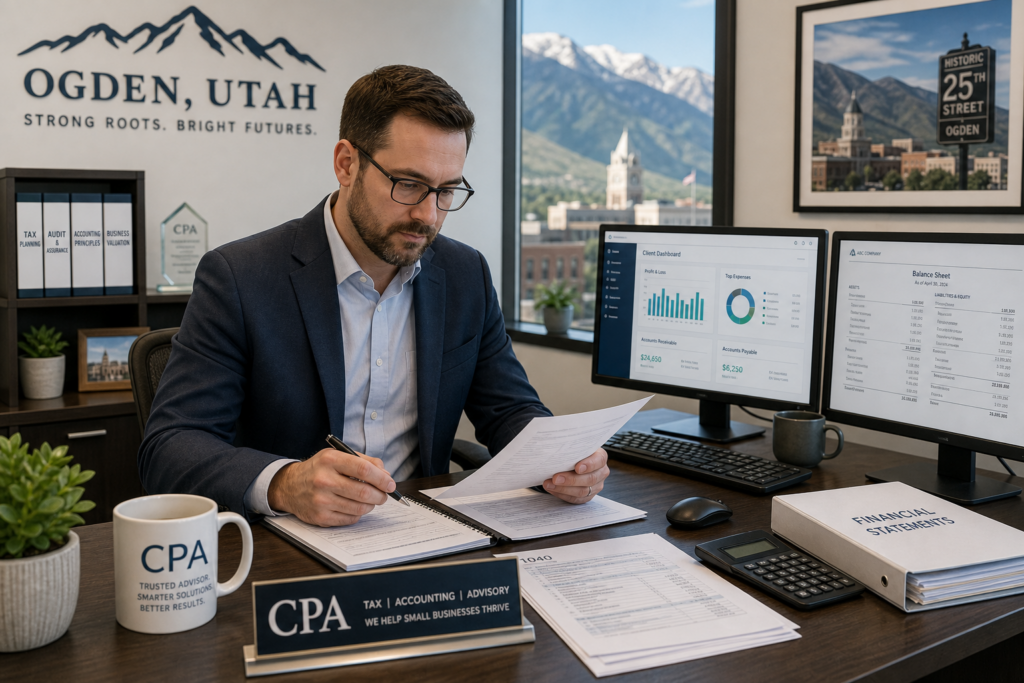
Ogden Small Business CPA Cost in 2026: Complete Pricing Guide & Tax Savings Strategies

Ogden Small Business CPA Cost in 2026: Complete Pricing Guide & Tax Savings Strategies
For Ogden business owners, understanding small business CPA costs in 2026 is crucial for budgeting and tax planning. Whether you’re a contractor, retailer, or professional service provider, working with a qualified Ogden CPA can transform your tax obligations into strategic opportunities. The average small business CPA cost ranges significantly based on business complexity, revenue size, and the services required, making it essential to understand both the investment and the return. This guide breaks down real 2026 pricing, explains what drives those costs, and shows you how to make the most of your CPA relationship.
Table of Contents
- Key Takeaways
- How Much Does a Small Business CPA Cost?
- What Factors Affect Ogden CPA Pricing?
- CPA Fee Models Explained
- 2026 Tax Compliance Requirements for Ogden Businesses
- Cost Breakdown by Ogden Business Type
- ROI: What You Get Back From CPA Services
- Uncle Kam in Action
- Next Steps
- Frequently Asked Questions
Key Takeaways
- Ogden small business CPA costs in 2026 typically range from $1,500 to $5,000+ annually depending on complexity and revenue size.
- Federal 1099 reporting threshold increased to $2,000 for 2026, affecting which contractor payments you must report.
- Sales and use tax compliance has become the fastest-growing cost driver for small business CPA services in Utah.
- Choosing the right fee model (hourly, fixed, retainer, or value-based) can reduce your total CPA investment by 20-30%.
- Strategic CPA services typically generate 3-5x return on investment through tax savings and operational improvements.
How Much Does a Small Business CPA Cost in Ogden, Utah in 2026?
Quick Answer: Small business CPA costs in Ogden for 2026 range from $1,500-$3,500 for basic tax compliance and filing, $3,500-$7,000 for full bookkeeping plus tax services, and $7,000-$15,000+ for comprehensive advisory relationships including tax planning and strategic consulting.
The cost of hiring a CPA for your Ogden small business depends on multiple interconnected factors. Most small business owners in Ogden pay between $2,000 and $5,000 annually for core tax preparation and filing services. However, the actual investment varies dramatically based on what services you need, your annual revenue, the complexity of your business structure, and the scope of advisory work you require.
For basic tax return preparation only, expect to invest $1,500-$2,500 annually. This covers Form 1040 with Schedule C (if you’re self-employed), basic deduction documentation, and filing with the IRS and Utah State Tax Commission. For businesses with employees or more complex structures, you’ll invest $3,000-$5,000 for complete compliance including payroll tax preparation, quarterly estimated tax planning, and state-specific filings.
Pricing by Service Scope
The most significant pricing variable is service scope. A CPA providing only tax return preparation charges less than one providing year-round bookkeeping, monthly financial reporting, and tax strategy consulting. Most Ogden firms that we work with follow this general pricing structure: tax return preparation alone ($1,500-$2,500), tax return plus basic bookkeeping ($3,000-$4,500), full bookkeeping plus quarterly tax planning ($4,500-$7,500), and comprehensive advisory including annual tax strategy sessions ($8,000-$15,000+).
The Cost Range Reality for Ogden Businesses
Small businesses under $250,000 in annual revenue typically spend $2,000-$4,000 for comprehensive tax compliance. Businesses between $250,000-$1,000,000 invest $4,000-$8,000. Larger businesses with multiple employees or complex operations often invest $8,000-$20,000 or more. These ranges assume you’re working with established Ogden CPA firms rather than large national firms, which typically charge 15-30% more for the same services.
What Factors Affect Ogden CPA Pricing in 2026?
Quick Answer: Your CPA costs are driven by business revenue, entity type (sole proprietor vs LLC vs S-Corp), number of employees, sales tax complexity, inventory management, multi-state operations, and the specific tax planning services you require.
Understanding the factors that drive CPA pricing helps you anticipate costs and make strategic decisions about service levels. The pricing doesn’t reflect arbitrary fees—each factor directly increases the time, expertise, and oversight your CPA must provide. In 2026, several factors have become more important than in previous years, particularly sales and use tax compliance and digital business operations.
Business Revenue and Complexity
Your annual business revenue is the primary cost driver. A sole proprietor with $50,000 in annual revenue requires minimal CPA involvement—primarily tax return filing. A business with $500,000 in revenue requires more substantial bookkeeping, quarterly tax planning, and strategic decision-making. A business with $2,000,000+ in revenue often requires corporate advisory services, profit planning, and advanced tax strategies.
Sales Tax and Multi-State Operations
For 2026, sales and use tax compliance has become the fastest-growing cost driver for small business CPA services. If your Ogden business sells across state lines, operates an ecommerce store, or sells digital products, your CPA costs increase significantly. This is because states like Washington and Chicago now tax information technology services and software-as-a-service (SaaS) offerings at 15%. Managing sales tax across multiple states, calculating nexus requirements, and maintaining proper documentation adds $1,500-$4,000 to annual CPA costs depending on complexity.
Utah requires state filing of 1099-NEC and 1099-MISC forms only when state income tax is withheld. However, the new federal threshold of $2,000 (up from $600) means fewer contractor payments trigger reporting requirements in 2026, potentially reducing your compliance costs by 10-15%.
CPA Fee Models Explained: Which Works Best for Ogden Businesses?
Quick Answer: Hourly billing costs $150-$300/hour, fixed fees typically range $2,000-$5,000 annually for defined services, and monthly retainers cost $400-$1,500/month, with value-based pricing emerging as the preferred 2026 model for businesses seeking strategic advisory.
CPAs structure fees in multiple ways. Understanding each model helps you choose the arrangement that minimizes your total investment while maximizing the value you receive. The right fee model depends on your business stability, growth rate, and whether you want predictable monthly costs or one-time annual investments.
Hourly Billing Model
Hourly billing typically ranges from $150-$300 per hour for Ogden CPAs, depending on their experience level and firm size. This model works best when you have minimal recurring needs or unpredictable service requirements. Disadvantages include unpredictable total costs, potential disincentive for efficiency, and billing surprises at year-end. For small business owners, hourly billing often costs 20-30% more than fixed fees for the same services because there’s no incentive for efficiency.
Fixed Annual Fee Model
Fixed annual fees range from $2,000-$6,000 depending on service scope and business complexity. You and your CPA agree on specific deliverables (tax return, quarterly reviews, bookkeeping, etc.), and that’s your total investment for the year. This model provides budgeting certainty and incentivizes your CPA to work efficiently. Most Ogden small business owners prefer this model because costs are predictable and transparent.
Monthly Retainer Model
Monthly retainers range from $400-$1,500 per month ($4,800-$18,000 annually) and work well for businesses wanting continuous advisory support. You receive ongoing access to your CPA for questions, strategic decisions, and tax planning. The retainer model distributes costs throughout the year and ensures your CPA stays updated on your business. This model is growing in popularity among Ogden businesses because it provides both budgeting certainty and unlimited access to professional guidance.
2026 Tax Compliance Requirements That Affect Your CPA Costs
 Free Tax Write-Off Finder
Quick Answer: 2026 brings new reporting thresholds ($2,000 for 1099s), expanded sales tax requirements, new Form 1098-VLI for vehicle loan interest, Form 5498-TA for Trump Accounts, and enhanced beneficial ownership information tracking that increase CPA workload and costs for businesses paying contractors.
Tax compliance requirements directly impact what your CPA must do—and therefore what you pay. Several 2026 changes significantly affect Ogden small businesses. The most impactful is the federal 1099 reporting threshold increase from $600 to $2,000, effective January 1, 2026. This means you no longer report contractor payments under $2,000 to the IRS unless state rules require it.
For Utah businesses, state filing of 1099-NEC is only required when state income tax is withheld. This change actually reduces documentation requirements and CPA workload for most Ogden small businesses, potentially saving $500-$1,000 in annual CPA fees compared to 2025.
New Forms and Expanded Reporting
The IRS introduced several new forms for 2026: Form 1098-VLI (Vehicle Loan Interest Statement) for businesses financing employee vehicles, Form 1099-DA (Digital Asset Transactions) for crypto or digital asset trading, and Form 5498-TA (Trump Account Contribution Information) for accounts opened under the new Trump Account program. If your business falls into any of these categories, your CPA must track additional data and file additional forms, increasing costs by $500-$2,000 annually depending on complexity.
Sales and Use Tax Expansion
If you operate an Ogden business that sells to customers in other states, 2026 brings new sales tax complexities. Washington expanded its retail sales tax to certain information technology services. Chicago increased its SaaS transaction tax to 15%. Maryland applies a 3% sales tax to data services, IT services, and software publishing. These changes mean your CPA must track multi-state sales tax obligations more carefully, increasing compliance costs by $1,000-$3,000 annually for businesses operating across state lines.
Cost Breakdown by Ogden Business Type in 2026
Quick Answer: Solo contractors: $1,500-$2,500. Small LLC with employees: $3,000-$5,000. S-Corporation: $4,000-$7,000. E-commerce business: $4,000-$8,000. Service business with multiple locations: $5,000-$10,000.
Different business types face different tax complexity levels, which directly impacts CPA costs. Understanding your business category helps you budget accurately and identify where strategic CPA services might generate the most savings.
| Business Type | Annual Revenue Range | 2026 CPA Cost Range | Primary Complexity Drivers |
|---|---|---|---|
| Solo Contractor/Freelancer | $25,000-$100,000 | $1,500-$2,500 | 1040 with Schedule C, estimated taxes, deduction tracking |
| Small LLC (no employees) | $50,000-$200,000 | $2,000-$3,500 | Pass-through entity taxation, quarterly planning, deductions |
| LLC with Employees | $150,000-$500,000 | $3,500-$6,000 | Payroll tax, W-2 preparation, employment records, quarterly filings |
| S-Corporation | $300,000-$1,000,000 | $4,000-$7,500 | Salary vs distribution planning, reasonable compensation rules, K-1 reporting |
| E-Commerce Business | $100,000-$500,000 | $4,000-$8,000 | Sales tax across states, inventory accounting, marketplace reporting, tax nexus |
| Real Estate Business (rental/investment) | $50,000-$300,000 | $3,500-$7,000 | Depreciation schedules, passive activity rules, 1031 exchange tracking |
Pro Tip: The 2026 federal 1099 threshold increase to $2,000 saves contractors and service businesses approximately $500-$1,000 annually in CPA compliance costs. If you have high contractor volume, discussing this change with your Utah CPA can ensure you’re not over-documenting unnecessary payments.
Entity Structure Impact on CPA Costs
Your business entity choice significantly affects CPA costs. A sole proprietorship is the simplest tax structure, requiring only Schedule C with your personal tax return. A single-member LLC is slightly more complex, adding entity-level considerations. A multi-member LLC, S-Corporation, or partnership is substantially more complex, requiring entity-level tax returns, distribution reporting, and strategic planning. For an Ogden business contemplating S-Corp election, budget an additional $2,000-$4,000 annually for the increased tax preparation, salary planning, and K-1 reporting requirements.
ROI: What You Get Back From CPA Services Beyond Tax Filing
Quick Answer: Strategic CPA services typically generate 3-5x return on investment through tax savings, entity optimization, quarterly planning, and operational guidance that prevents costly mistakes.
Many Ogden business owners view CPA costs as an expense rather than an investment. This misses the primary benefit of professional tax services. A skilled CPA doesn’t just file your taxes—they strategically structure your business, plan quarterly tax payments, identify deductions you’d miss alone, and provide decision support that prevents costly errors.
For example, helping a contractor understand the 2026 federal 1099 reporting threshold increase saves documentation time and reduces audit risk. Advising an Ogden small business owner on sales tax requirements across multiple states prevents missed compliance that could trigger $5,000-$25,000 in penalties. Recommending S-Corp election for the right business saves $8,000-$15,000 annually in self-employment taxes, returning the entire annual CPA investment multiple times over.
The Tax Savings Multiplier
Most small business owners can recover their annual CPA investment 3-5 times through identified deductions, entity optimization, and tax planning. If you pay $3,000 annually for CPA services, you’ll typically recover $9,000-$15,000 in direct tax savings and prevented penalties. This ROI calculation excludes the value of strategic business advice, improved financial reporting, and reduced stress from professional oversight.

Uncle Kam in Action: Ogden Contractor Saves $12,000 Through Strategic CPA Planning
Client Profile: Sarah, an Ogden-based HVAC contractor, built her business to $400,000 in annual revenue over five years. She operated as a sole proprietor, using an Excel spreadsheet for bookkeeping and filing her own taxes using DIY software. Sarah was leaving money on the table unknowingly.
The Challenge: Sarah’s business was growing rapidly, but she was paying roughly $60,000 annually in self-employment taxes (15.3% of net profit). She wasn’t tracking deductible business expenses systematically, missing home office deduction, vehicle expenses, and professional development costs. Her tax liability was approximately $85,000 annually on $400,000 revenue—higher than necessary.
The Uncle Kam Solution: We recommended three strategic changes: First, converting to an S-Corporation election, which immediately changed her self-employment tax treatment. Second, implementing monthly bookkeeping using cloud accounting software, capturing every deductible expense. Third, structuring reasonable W-2 salary ($180,000) with distributions ($40,000), optimizing self-employment tax while maintaining IRS compliance. We also implemented quarterly tax planning to manage estimated tax payments efficiently and identify additional deduction opportunities like vehicle mileage, equipment depreciation, and professional development.
Results: In Year 1, Sarah’s total tax liability decreased to $72,000—a $13,000 improvement. Her self-employment tax dropped from $60,000 to approximately $28,000 (15.3% on W-2 wages plus employer portion). Our CPA services cost $6,000 annually, returning $13,000 in direct tax savings plus $5,000 in prevented audit risks and missed deduction recovery. Total Year 1 ROI: 3x her CPA investment, with ongoing benefits every year the business operates as an S-Corporation.
Next Steps: Optimize Your Ogden Business CPA Relationship in 2026
- Audit your current CPA costs: Gather last year’s CPA invoice and itemize services received. Compare against the pricing ranges in this guide to identify if you’re paying appropriately for your service level.
- Review your business structure: Determine if your current entity choice (sole proprietor, LLC, S-Corp, etc.) is still optimal given your 2026 revenue and growth trajectory. S-Corp election could save you thousands.
- Schedule a tax planning consultation: Meet with your CPA to discuss 2026 compliance changes, the federal 1099 threshold increase, and any multi-state sales tax obligations. This conversation could identify $5,000-$20,000 in optimization opportunities.
- Implement systematic bookkeeping: Whether you manage bookkeeping yourself or your CPA does it, use cloud accounting software (QuickBooks Online, Xero, etc.). This reduces your CPA’s workload and your total costs by 15-25%.
- Connect with a strategic Ogden tax preparation service that specializes in small business optimization. The right CPA transforms your business from tax-reactive to tax-proactive, generating far more value than the annual investment.
Frequently Asked Questions About Ogden Small Business CPA Costs
What’s the difference between a CPA and a tax preparer, and how do costs differ?
CPAs are certified professionals with broader credentials, tax planning expertise, and audit authority. Tax preparers focus primarily on form preparation and filing. CPA services cost 20-40% more but provide strategic value beyond filing—entity optimization, audit defense, business advising, and year-round planning. For small businesses, the CPA investment typically generates superior ROI.
Can I negotiate CPA fees in Ogden?
Yes, absolutely. If you’re comparing CPA firms, discuss your specific needs, expected complexity, and volume of work. Fixed-fee arrangements are negotiable, especially for businesses with multiple locations or complex tax situations. Many CPAs offer package discounts if you bundle services (bookkeeping + tax prep + quarterly planning). Starting with clear service scope discussions ensures both parties understand what’s included before agreeing on fees.
How do I reduce my CPA costs without sacrificing quality?
Five proven cost-reduction strategies: (1) Use cloud accounting software to reduce bookkeeping workload and CPA preparation time, saving 15-20%. (2) Consolidate services with one firm rather than splitting between bookkeeper, preparer, and accountant. (3) Request fixed-fee arrangements instead of hourly billing. (4) Provide clean, organized documentation before your CPA’s busy season. (5) Switch from project-based billing to a monthly retainer, which is often 10-15% cheaper annually than hourly billing for ongoing support.
Should I do my own bookkeeping or hire my CPA for it?
For businesses under $250,000 in annual revenue with simple operations, DIY bookkeeping using QuickBooks Online or Xero is cost-effective. However, most small business owners underestimate the time required (typically 10-15 hours monthly). Having your CPA handle bookkeeping costs $300-$800/month but ensures accuracy, proper tax categorization, and generates better financial visibility. The convenience and accuracy usually justify the cost.
How does the 2026 federal 1099 threshold increase affect my CPA costs?
The threshold increased from $600 to $2,000 for 1099-NEC and 1099-MISC reporting, effective January 1, 2026. This means fewer contractor payments trigger IRS reporting requirements, reducing documentation workload. For businesses paying multiple contractors under $2,000, this reduces annual CPA costs by approximately $500-$1,000 (less form tracking and preparation). Ask your CPA specifically how this change affects your 2026 compliance obligations.
Is S-Corp election worth the additional CPA costs for an Ogden business?
For most Ogden businesses with annual net profit exceeding $40,000, S-Corp election creates 15-30% tax savings that exceed the additional CPA costs. An S-Corp costs approximately $2,000-$4,000 more annually in CPA fees but saves $8,000-$20,000 in self-employment taxes for typical small businesses. If your net profit is $100,000+, S-Corp election almost always pays for itself multiple times. Discuss S-Corp economics with your CPA if you haven’t already analyzed it.
What services should every Ogden small business CPA provide in 2026?
Essential services include: tax return preparation (1040 with appropriate schedules), quarterly estimated tax planning, business bookkeeping or bookkeeping review, payroll tax handling if you have employees, and compliance with new 2026 reporting requirements (1099 threshold changes, digital asset reporting, vehicle loan interest reporting). Beyond these baseline services, strategic CPAs provide entity structure optimization advice, ongoing tax planning, and quarterly business advisory conversations that transform results.
Related Resources
- Strategic Tax Planning for Small Business Owners
- LLC vs S-Corp: Which Entity Structure Saves You the Most in Taxes
- Tax Strategies for Business Owners
- Year-Round Tax Advisory Services
- 2026 Tax Deadline Calendar for Ogden Businesses
Last updated: May, 2026

