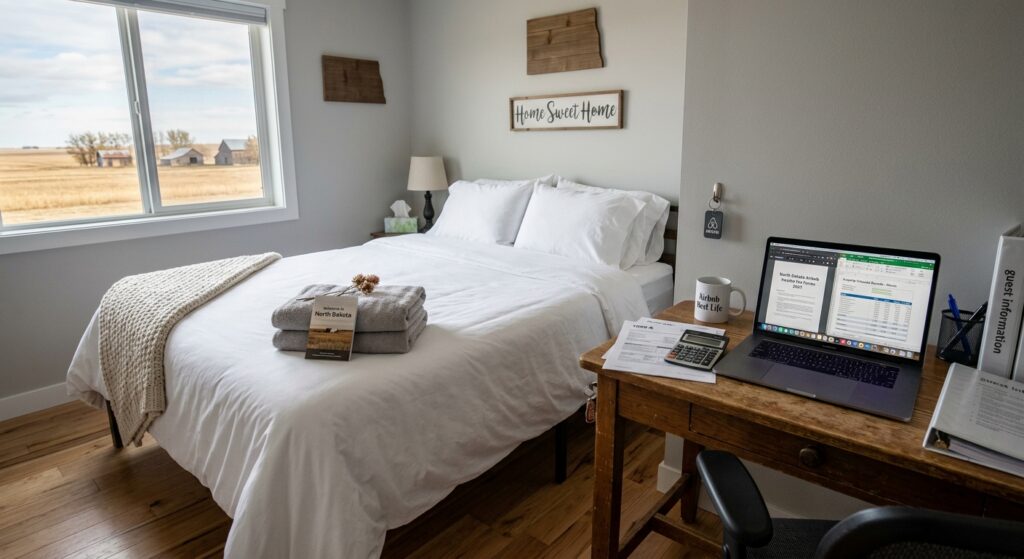
North Dakota Airbnb Taxes: Complete 2026 Guide for Short-Term Rental Hosts
For Airbnb hosts operating in North Dakota, understanding north dakota airbnb taxes is critical to staying compliant and maximizing deductions for 2026. This comprehensive guide covers everything you need to know about state and local tax obligations, registration requirements, reporting procedures, and strategies to reduce your tax burden when hosting guests in the Peace Garden State.
Table of Contents
- Key Takeaways
- Which Taxes Apply to Airbnb Hosts in North Dakota?
- Does Airbnb Collect North Dakota Taxes Automatically?
- How to Register and File North Dakota Airbnb Taxes
- How to Report Airbnb Income on Your 2026 Tax Return
- How Should You Structure Your Airbnb Business for Tax Efficiency?
- What Deductions and Credits Can Airbnb Hosts Claim?
- Uncle Kam in Action
- Next Steps
- Frequently Asked Questions
Key Takeaways
- North Dakota has a 5% state sales tax that applies to short-term rental income, plus local lodging taxes in cities like Fargo and Bismarck.
- Airbnb may collect taxes on your behalf in some jurisdictions, but you remain responsible for compliance and remittance.
- Airbnb hosting income must be reported as self-employment income on Form 1040 Schedule C or Schedule E for 2026.
- Self-employment tax rate of 15.3% applies to net rental income above $400.
- Properly structuring your Airbnb business as an LLC or S-Corp can significantly reduce your 2026 tax liability.
Which Taxes Apply to Airbnb Hosts in North Dakota?
Quick Answer: North Dakota hosts pay state sales tax (5%), local lodging taxes, federal income tax, and self-employment tax on Airbnb income. Your total tax burden depends on your location within the state and annual rental income.
As an Airbnb host in North Dakota, you’re subject to multiple tax layers. The complexity of north dakota airbnb taxes stems from the interaction between state, local, and federal tax requirements. Understanding each component is essential for maintaining compliance and avoiding penalties.
North Dakota State Sales Tax on Short-Term Rentals
North Dakota imposes a 5% state sales tax on short-term rental accommodations. For 2026, this tax applies to all nightly rental fees you charge guests through Airbnb. The state considers short-term rental income subject to sales tax whether the property is your primary residence or an investment.
As a host, you have two responsibilities: registering with the North Dakota Office of State Tax Commissioner and remitting sales tax on your rental income. Many hosts overlook this obligation, but failing to collect and remit sales tax can result in significant penalties, interest, and legal consequences.
Pro Tip: The 5% state sales tax applies to the base rental rate, not to Airbnb’s cleaning fees or service fees. However, verify current rules with the North Dakota Office of State Tax Commissioner, as regulations can change.
Local Lodging and Occupancy Taxes
Many North Dakota cities and counties impose additional lodging taxes on short-term rentals. Fargo, Bismarck, and other municipalities collect local hospitality taxes ranging from 2% to 5%, depending on the jurisdiction. These local taxes are applied in addition to the state 5% sales tax, creating a combined tax burden that can reach 7-10% or higher in some areas.
Local lodging taxes fund tourism promotion, infrastructure improvements, and community development. For 2026, research your specific city’s tax rate before setting rental prices. Your city or county website should provide current lodging tax percentages and registration requirements for hosts.
Federal Income Tax and Self-Employment Tax
Airbnb hosting income is reportable as business income on your 2026 federal tax return. The IRS requires you to calculate your net income (gross income minus allowed deductions) and pay federal income tax at your marginal tax rate. For 2026, single filers have a standard deduction of $14,600, while married couples filing jointly have a standard deduction of $29,200.
Self-employment tax is the biggest expense many hosts overlook. If your net Airbnb income exceeds $400 in 2026, you owe self-employment tax at a rate of 15.3%. This covers your Social Security and Medicare contributions. Unlike W-2 employees, self-employed hosts must pay both the employer and employee portions of these taxes.
| Tax Type | 2026 Rate | Who Collects |
|---|---|---|
| North Dakota State Sales Tax | 5% | You (unless Airbnb collects) |
| Local Lodging Tax | 2-5% (varies by city) | You (unless Airbnb collects) |
| Federal Income Tax | 10-37% (based on income) | You (via annual filing) |
| Self-Employment Tax | 15.3% | You (via quarterly payments) |
Does Airbnb Collect North Dakota Taxes Automatically?
Quick Answer: Airbnb collects taxes in certain North Dakota jurisdictions but not all. You remain liable for any taxes Airbnb doesn’t collect, and you must track all obligations.
Airbnb’s tax collection policies vary by location. In some North Dakota cities, the platform collects state and local lodging taxes automatically and remits them on your behalf. However, this doesn’t eliminate your responsibility to understand north dakota airbnb taxes. Even when Airbnb collects, you must:
- Verify that Airbnb is collecting the correct tax rate for your location.
- Track rental income and expenses for federal tax purposes.
- Ensure Airbnb isn’t collecting taxes if you’re not registered with the state.
- Pay self-employment and income taxes on your net earnings.
In jurisdictions where Airbnb doesn’t collect taxes, you must collect and remit them yourself. Visit your city or county assessor’s website to confirm current tax collection arrangements. Contact the North Dakota Office of State Tax Commissioner at https://www.nd.gov/tax/ for state-level guidance.
Did You Know? Airbnb publishes a state-by-state tax collection guide. Check your Airbnb Host Center regularly for updates on North Dakota’s tax collection policies, as these can change throughout 2026.
How to Register and File North Dakota Airbnb Taxes
Quick Answer: Register with the North Dakota Office of State Tax Commissioner for a sales tax permit. Then register with your city if local lodging taxes apply. File monthly or quarterly returns depending on your collection jurisdiction.
Step 1: Register for State Sales Tax Permit
Your first step in managing north dakota airbnb taxes is obtaining a sales tax permit from the North Dakota Office of State Tax Commissioner. You can register online at the state tax website or by mail. The application is straightforward and requires:
- Your Social Security number or federal employer identification number (EIN).
- Property address and rental details.
- Expected monthly rental revenue estimate.
- Business structure (sole proprietor, LLC, S-Corp, etc.).
Once approved, you’ll receive a sales tax permit number to display in your Airbnb listing. This permit authorizes you to collect and remit the 5% state sales tax. Approval typically takes one to two weeks. For detailed registration instructions, visit https://www.nd.gov/tax/business/registering-business.
Step 2: Register with Your Local City or County
If you’re hosting in Fargo, Bismarck, or another municipality with local lodging taxes, you must separately register for a local license. Contact your city assessor or tourism office to determine filing frequency. Many cities require monthly filings for 2026, while others allow quarterly submissions.
Step 3: File Regular Tax Returns
For 2026, file state sales tax returns monthly or quarterly, depending on your jurisdiction. Local lodging tax filings follow your city’s schedule. Maintain detailed records of:
- Gross rental income by month.
- Taxes collected and remitted.
- Supporting documentation from Airbnb.
How to Report Airbnb Income on Your 2026 Tax Return
Quick Answer: Report your net Airbnb income on IRS Form 1040 Schedule C (self-employed) or Schedule E (rental property). Include all deductible expenses to reduce your taxable income.
For federal tax purposes, your Airbnb income is reported differently depending on how the IRS classifies your business. Most hosts use Schedule C, Profit or Loss from Business, treating Airbnb as self-employment income. If you own multiple properties or rent significant portions of your home long-term, you might use Schedule E, Supplemental Income and Loss.
Airbnb will send you a Form 1099-K if you earned $20,000 or more in gross payments and had 200 or more transactions in 2026. Alternatively, they may issue a Form 1099-NEC if you earned over $600 through other arrangements. The IRS receives copies of these forms, so your income is automatically flagged for verification.
Your net taxable income on Schedule C equals gross rental revenue minus all allowable deductions. This calculation directly impacts your 2026 federal income tax liability and self-employment tax obligation. Accurate reporting and substantiation of expenses are critical for IRS Schedule E documentation.
How Should You Structure Your Airbnb Business for Tax Efficiency?
 Free Tax Write-Off Finder
Quick Answer: Consider LLC or S-Corp status to reduce self-employment tax. Higher-income hosts often save $5,000-$15,000+ annually through strategic entity planning.
Many North Dakota Airbnb hosts operate as sole proprietors, automatically reporting income on their personal tax returns. However, as your business grows, entity structure optimization through LLC vs S-Corp analysis can significantly reduce your north dakota airbnb taxes.
Sole Proprietor (Default Structure)
As a sole proprietor, you report Airbnb income directly on your Form 1040 Schedule C. All net income is subject to the 15.3% self-employment tax. This structure is simplest for small hosts earning under $50,000 annually but becomes inefficient at higher income levels.
Limited Liability Company (LLC)
An LLC provides liability protection and may allow you to treat Airbnb income as self-employment income while potentially claiming some expenses at lower rates. Filing an LLC costs $100-$200 in North Dakota and provides legal separation between your personal and rental properties.
S-Corporation Election (Advanced Strategy)
For hosts earning $80,000+ annually, electing S-Corp tax status can dramatically reduce self-employment tax. With S-Corp status, you pay yourself a reasonable salary (subject to 15.3% self-employment tax) and take the remainder as corporate distributions (not subject to self-employment tax). Hosts can save $5,000-$20,000+ annually depending on income level.
S-Corp requires additional compliance, including payroll setup, quarterly filings, and IRS Form 2553 election. For 2026, consult a tax preparation professional in North Dakota to determine if S-Corp status is right for your situation.
What Deductions and Credits Can Airbnb Hosts Claim?
Quick Answer: Deductible expenses include mortgage interest, property taxes, utilities, insurance, repairs, depreciation, and advertising. Properly documenting deductions can reduce your 2026 tax liability by 30-50%.
One of the best ways to manage north dakota airbnb taxes is through strategic deduction planning. The IRS allows you to deduct ordinary and necessary business expenses directly related to operating your rental business.
Common Airbnb Deductions for 2026
| Deduction Category | Examples |
|---|---|
| Mortgage Interest (if applicable) | Interest portion of monthly mortgage payments (not principal). |
| Property Taxes | All property tax paid to North Dakota and local governments. |
| Utilities | Electricity, water, gas, trash, internet (business use percentage). |
| Insurance | Landlord or rental property insurance (not homeowners). |
| Repairs and Maintenance | Cleaning, painting, appliance repairs (not improvements). |
| Depreciation | Building structure depreciation over 27.5 years; furnishings over 5-7 years. |
| Advertising | Airbnb service fees, professional photography, website hosting. |
| Professional Services | Tax preparation, accounting, legal consultation for rental business. |
The key to maximizing deductions is proper documentation. Keep all receipts, invoices, and statements related to your rental property. Maintain a log of dates, amounts, and descriptions of expenses. Consider using accounting software to organize deductions and prepare for your 2026 tax filing.

Uncle Kam in Action: Sarah’s Fargo Airbnb Success Story
Client Profile: Sarah, a real estate investor based in Fargo, North Dakota, purchased a two-bedroom home in 2024 and began hosting on Airbnb in early 2025. By 2026, she needed guidance on managing her growing north dakota airbnb taxes.
The Challenge: Sarah’s property generated $52,000 in gross rental income during 2025. She was concerned about her tax liability and worried she wasn’t complying with all state and local requirements. As a sole proprietor, she faced significant self-employment tax exposure and wasn’t claiming many legitimate deductions.
The Uncle Kam Solution: Our tax advisory team evaluated Sarah’s situation and recommended an LLC structure with potential S-Corp election for 2026. We helped her register with the North Dakota Office of State Tax Commissioner and the City of Fargo for lodging tax compliance. We created a comprehensive deduction tracking system documenting mortgage interest ($8,200), property taxes ($3,100), utilities ($2,400), insurance ($1,800), repairs and maintenance ($1,500), and depreciation ($4,100).
The Results: By restructuring her business and documenting deductions properly, Sarah reduced her 2026 taxable income from $52,000 to $31,000. Her self-employment tax liability dropped from $7,340 to $4,387, saving her $2,953 annually. Combined federal income tax savings reached $6,200 in year one. Sarah’s initial investment of $500 in tax planning and entity setup generated a 1,240% ROI in the first year.
Sarah now maintains a structured filing system, remits taxes on schedule, and focuses on growing her rental income with confidence that her tax strategy supports her financial goals. With professional guidance, she avoids compliance penalties while maximizing deductions.
Next Steps
Now that you understand north dakota airbnb taxes, take these action steps:
- Register for Sales Tax: Visit the North Dakota tax website and apply for your sales tax permit immediately.
- Check Local Requirements: Contact your city assessor to confirm lodging tax obligations and filing deadlines for your jurisdiction.
- Organize Records: Implement a system to track rental income, expenses, and tax payments monthly. Consider professional accounting software.
- Consult a Tax Professional: An experienced tax preparation specialist in North Dakota can review your specific situation and recommend entity structuring strategies.
- Plan Quarterly Taxes: Calculate estimated tax payments for 2026 and set aside funds monthly to avoid April surprises.
Frequently Asked Questions
Do I Need to Pay Taxes on Airbnb Income if I Only Rent Out Part of My Home?
Yes, all Airbnb income is taxable, regardless of whether you rent your entire property or just a room. If you use part of your home for personal purposes and part for rentals, you can deduct the rental portion of expenses like utilities, property taxes, and depreciation.
Does Airbnb Report My Income to the IRS?
Yes, if you earned $20,000 or more in gross payments and had 200+ transactions in 2026, Airbnb reports your income via Form 1099-K. If you earned over $600 but didn’t meet the 1099-K threshold, Airbnb may issue a Form 1099-NEC. The IRS receives copies and cross-references with your tax return.
What Happens if I Don’t Register for Sales Tax in North Dakota?
Failing to register for sales tax can result in penalties, interest charges, and potential legal action by the North Dakota Office of State Tax Commissioner. If discovered, you may owe back taxes plus penalties ranging from 10-25% of unpaid amounts. Register immediately if you haven’t already.
Can I Deduct Losses if My Rental Income Doesn’t Cover My Expenses?
Yes, if you operate your Airbnb as a legitimate business, you can claim losses on your tax return to offset other income. However, the IRS has “hobby loss” rules that restrict deductions if you don’t show intent to profit. Keep detailed records demonstrating business activities, marketing efforts, and profit expectations.
Should I Form an LLC or S-Corp for My North Dakota Airbnb?
For hosts earning under $50,000 annually, sole proprietor status is often simplest. For those earning $50,000-$80,000, an LLC provides liability protection. For those earning over $80,000, S-Corp election may save significant self-employment taxes. Consult a tax professional to evaluate your specific situation and 2026 income projections.
How Do I Calculate Self-Employment Tax on My Airbnb Income?
Self-employment tax applies to 92.35% of your net Schedule C income and equals 15.3% of that amount. For example, if your net Airbnb income is $50,000, multiply by 0.9235 ($46,175) then by 0.153 ($7,065). You can deduct 50% of self-employment tax as an adjustment to income.
When Should I Make Estimated Tax Payments for 2026?
Estimated tax payments are due quarterly: April 15, June 15, September 15, and January 15 of the following year. If your expected tax liability exceeds $1,000 for 2026, you should make quarterly payments to avoid penalties. Use Form 1040-ES to calculate your required payment amounts.
Can I Deduct My Airbnb Service Fees?
Yes, Airbnb’s service fees (typically 3% of nightly rate plus 14% guest service fee) are fully deductible business expenses. They reduce your gross income dollar-for-dollar on Schedule C.
What Records Should I Keep for My North Dakota Airbnb Taxes?
Maintain all receipts, invoices, and bank statements for at least three years. Specifically keep: monthly rental income statements from Airbnb, tax returns filed with states and cities, proof of tax payments, and itemized receipts for all claimed deductions.
How Often Should I Review My North Dakota Airbnb Tax Strategy?
Review your strategy quarterly. Tax laws change, and your business growth may open new opportunities for savings. An annual review with a tax professional ensures you’re optimizing your north dakota airbnb taxes and maintaining compliance with all state and local requirements.
Last updated: May, 2026

