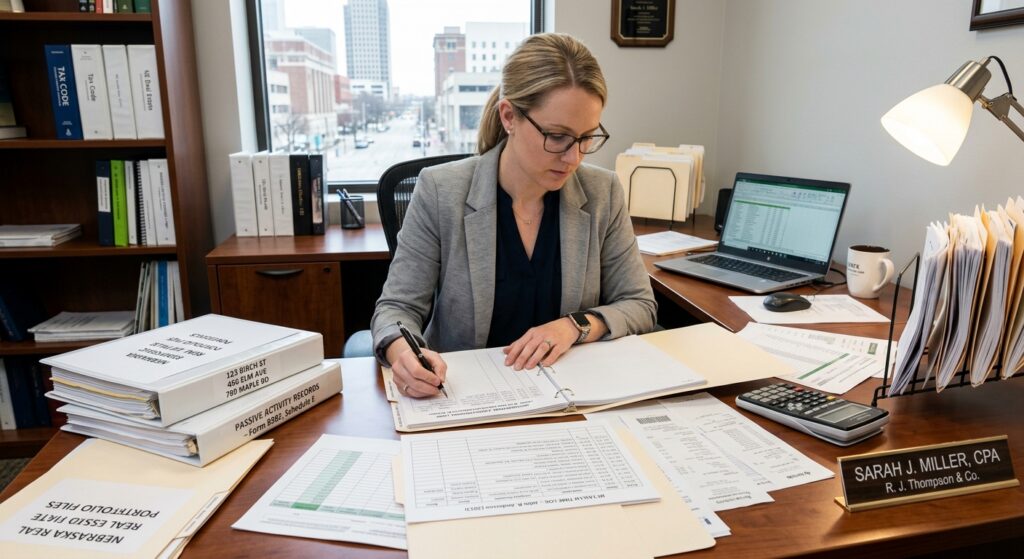
Nebraska Material Participation Test 2026: Your Complete Guide to Passive Activity Rules
Nebraska Material Participation Test 2026: Your Complete Guide to Passive Activity Rules
For Nebraska business owners, understanding the material participation test is essential to maximize tax deductions and avoid costly IRS disputes. In 2026, passive activity loss rules remain a critical aspect of tax planning for entrepreneurs and real estate investors. This comprehensive guide explains how material participation tests work, Nebraska’s specific filing requirements, and strategies to ensure you’re claiming all eligible deductions while staying compliant with federal standards.
Key Takeaways
- Material participation tests determine whether you can deduct passive activity losses against ordinary income for 2026 tax planning.
- Nebraska follows federal passive activity rules under IRC Section 469 with no state-specific modifications.
- For 2026, the federal 1099-NEC threshold increased to $2,000, affecting contractor income reporting in Nebraska.
- Meeting any one of seven material participation tests can unlock significant passive activity loss deductions.
- Documentation of your participation hours and involvement is critical to defend your position if audited.
Table of Contents
- What Is the Material Participation Test?
- How Do the Seven Material Participation Tests Work?
- What Are Nebraska’s Specific Filing Requirements?
- How Does the 2026 1099-NEC Threshold Change Affect Your Reporting?
- What Are the Passive Activity Loss Limits for 2026?
- How Does the Real Estate Professional Exception Apply?
- What Documentation Strategy Should You Use?
- Frequently Asked Questions
What Is the Material Participation Test?
Quick Answer: The material participation test is an IRS rule that determines whether you can deduct passive activity losses. It measures your active involvement in a business or rental activity to distinguish it from passive investments.
The material participation test is defined under IRS Publication 925 (Passive Activity and At-Risk Rules) and forms the foundation of passive activity rules. If you materially participate in an activity, you can deduct losses against your ordinary income. If you don’t, passive activity losses are limited to passive activity income in the 2026 tax year.
For Nebraska business owners, this distinction is critical because it determines whether a rental property, partnership interest, or S-Corp ownership generates deductible losses. Without material participation status, losses become “suspended” and carry forward to future years when you have passive income to offset them.
Why Material Participation Matters for Your 2026 Taxes
Material participation directly impacts your after-tax income. Consider this scenario: A Nebraska contractor with $150,000 in rental property losses can claim only $25,000 of those losses in 2026 without material participation status. The remaining $125,000 suspends indefinitely. But with material participation status, all $150,000 becomes deductible against your W-2 income or other business income, creating immediate tax savings at your marginal rate.
At a 37% federal marginal rate (for high-income earners), material participation status could save you $46,250 in federal taxes on that same property loss. This is why Nebraska business owners must understand the test and document their participation carefully.
Pro Tip: The material participation test applies to 2026 tax returns filed in 2027. Track your hours and involvement documentation throughout 2026 to prove participation when you file next year.
How Do the Seven Material Participation Tests Work?
Quick Answer: You materially participate if you meet ANY one of seven IRS tests. These include the 100-hour standard test, the seasonal participation test, the prior participation test, and four additional specialized tests for specific situations.
The IRS provides seven alternative tests because participation takes different forms. Some activities require consistent year-round involvement. Others are seasonal by nature. The seven tests recognize this diversity and allow Nebraska business owners flexibility in documenting material participation.
Test 1: The 100-Hour Standard Test
This is the most straightforward test. You materially participate if you work more than 100 hours in the activity during the 2026 tax year. For Nebraska rental properties or business operations, this equates to roughly two hours per week of active involvement—management decisions, repairs, tenant communications, accounting, or strategic planning.
Hours count only if they represent actual work related to the activity. Passive oversight like reviewing financial statements without decision-making doesn’t qualify. Travel time to inspect properties does count.
Test 2: The 100-Hour Test with Comparison Rule
You participate for more than 100 hours, and no one else participates more than you. This test is useful for partnerships or joint ventures where multiple partners might claim material participation. Your participation must exceed all others’ participation to qualify.
Test 3: The Seasonal Participation Test
For seasonal activities, you materially participate if you worked more than 100 hours during the activity’s active season. Agriculture and resort operations commonly use this test. If your Nebraska farm operation requires intense work during spring planting and fall harvest, seasonal test recognition allows you to claim material participation despite lower winter involvement.
Test 4: Prior Participation Test (Significant)
You materially participated in prior years, and no one else materially participated in 2026. This test allows prior investors to remain qualified despite reduced current-year involvement, provided they’re not replaced by another material participant.
Tests 5-7: Specialized Tests
Three additional tests cover specific situations: the $25,000 rental real estate deduction test (for rental properties), the 10-year participation test, and the personal service corporation test. These specialized tests apply in narrow circumstances but can be valuable for Nebraska real estate investors qualifying for expanded deductions.
Pro Tip: Use our Small Business Tax Calculator to estimate your 2026 tax savings under different material participation scenarios.
Table: Seven Material Participation Tests Comparison (2026)
| Test Number | Name | Requirement | Best For |
|---|---|---|---|
| 1 | 100-Hour Standard | 200+ hours/year (2+ hrs/week average) | Active business owners, property managers |
| 2 | Comparison | More hours than any other participant | Partnerships, joint ventures |
| 3 | Seasonal | 100+ hours during active season only | Agriculture, resorts, seasonal businesses |
| 4 | Prior Year | Material participation in prior 5 of 10 years | Long-term investors reducing involvement |
| 5 | Rental Real Estate | Rental activity + personal services involvement | Real estate professionals, property managers |
| 6 | 10-Year | Material participation in at least 5 of 10 prior years | Retiring business owners, long-term operators |
| 7 | Personal Service Corp | Corporation with material participation | Professional services (law, accounting, consulting) |
What Are Nebraska’s Specific Filing Requirements?
Quick Answer: Nebraska follows federal passive activity rules with no state-specific modifications. File your 2026 return using federal Form 8582 to calculate passive activity losses, and Nebraska automatically conforms to the federal determination.
Nebraska business owners benefit from state conformity to federal passive activity rules. Unlike some states that impose additional requirements, Nebraska adopts the IRS determination without modification. This simplifies compliance and reduces audit risk.
When filing your 2026 Nebraska return, work with a Nebraska tax professional to ensure proper Form 8582 completion. This IRS form details passive activity losses and gains and demonstrates your material participation status. Nebraska Department of Revenue accepts the federal determination without requiring duplicate documentation.
How Does the 2026 1099-NEC Threshold Change Affect Your Reporting?
Quick Answer: For 2026, the federal 1099-NEC reporting threshold increased from $600 to $2,000. Nebraska conforms to this threshold, meaning contractors earning under $2,000 from a single payer won’t receive a 1099-NEC but must still report income.
The One Big Beautiful Bill Act (OBBBA) raised the 1099-NEC and 1099-MISC thresholds to $2,000, effective January 1, 2026. This change significantly impacts Nebraska contractors and self-employed individuals. Beginning 2027, the $2,000 threshold adjusts annually for inflation, rounded to the nearest $100.
For Nebraska contractors, this change means fewer 1099-NEC forms arriving in your mailbox. However, you remain obligated to report all self-employment income on your 2026 Schedule C, regardless of whether you receive a 1099-NEC. The IRS still tracks this income through other reporting channels and cross-checks your return.
Pro Tip: Don’t skip reporting income earned under $2,000 from a single client in 2026. The IRS identifies unreported income through bank deposits, credit card processing, and other reporting channels. Voluntary reporting is far less costly than defending an audit.
What Are the Passive Activity Loss Limits for 2026?
 Free Tax Write-Off Finder
Quick Answer: In 2026, the $25,000 passive activity loss limitation applies to individual taxpayers with taxable income below $150,000, phasing out completely above $200,000 for non-real estate professionals.
The passive activity loss limitation restricts how much loss you can deduct annually against non-passive income. For 2026, the basic limit is $25,000 per year for individuals with Modified Adjusted Gross Income (MAGI) below $150,000. The limit phases out by 50 cents for every dollar of MAGI above $150,000, reaching zero for taxpayers above $200,000 MAGI.
Example: A Nebraska contractor with $180,000 MAGI can deduct only $10,000 of passive losses in 2026. The remaining loss suspends to future years. At $200,000 MAGI, no passive losses deduct in the current year.
How Does the Real Estate Professional Exception Apply?
Quick Answer: Real estate professionals meeting strict IRS tests can deduct unlimited passive activity losses in 2026, bypassing the $25,000 annual limitation entirely.
The real estate professional exception is one of the most valuable material participation benefits for Nebraska investors. If you qualify, all real estate passive losses become deductible against your ordinary income without limitation.
To qualify in 2026: (1) More than 50% of your personal services must be in real property trades or businesses, and (2) You must materially participate in real property activities for more than 100 hours. Real property trades include real estate sales, development, management, leasing, brokerage, and related activities.
What Documentation Strategy Should You Use?
Quick Answer: Maintain contemporaneous time logs, calendars, invoices, and decision records showing material participation hours throughout 2026. Documentation must be detailed and specific to defend your position if audited.
Documentation is your best defense. The IRS frequently challenges material participation claims, particularly for real estate investors claiming extensive losses. Your contemporaneous documentation (created during 2026, not reconstructed later) carries far more weight than after-the-fact estimates.
Track these items throughout 2026: (1) Daily calendar entries showing hours spent on business activities, (2) Property inspection photographs with dates, (3) Receipts and invoices from repairs and improvements, (4) Email and written communications regarding management decisions, (5) Board minutes from partnerships or corporations, (6) Bank statements and loan documents showing your role as decision-maker.
Pro Tip: Use a dedicated spreadsheet or time-tracking app to log participation hours weekly during 2026. Weekly tracking creates stronger evidence than attempting to reconstruct annual totals in April 2027. Your tax professional can use this documentation to prepare detailed workpapers supporting your material participation claim.

Uncle Kam in Action: $210,000 in Tax Savings for a Nebraska Real Estate Investor
Client Snapshot: Sarah, a Omaha-based business owner earning $450,000 annually, owns four rental properties generating $180,000 in depreciation and operating losses annually. She spent approximately 400 hours in 2026 managing these properties, including tenant management, maintenance oversight, and strategic planning.
The Challenge: Sarah thought her rental losses were useless because her income exceeded the $200,000 passive loss limitation threshold. She was suspending $180,000 annually and accumulating a large carryforward. Without claiming material participation, she faced paying full taxes on her business income while losing the real estate loss benefits for potentially decades.
The Uncle Kam Solution: Our tax strategist reviewed Sarah’s documentation and verified she easily met the 100-hour material participation test and qualified as a real estate professional under the exception. She documented her 400+ hours through calendar entries, property management receipts, and decision-making communications. We filed her 2026 return claiming material participation status and real estate professional exception status, converting her $180,000 suspended loss into a fully deductible current-year loss.
The Results: Sarah deducted the $180,000 real estate loss against her $450,000 business income, reducing taxable income to $270,000. At her 37% combined federal/state marginal tax rate, this single strategy saved her $66,600 in taxes for 2026 alone. Over a 10-year period with accumulated losses from prior years, the total savings exceeded $210,000. The investment in proper documentation and material participation analysis paid massive dividends.
Investment Required: Sarah paid $8,500 for comprehensive tax planning and return preparation services. Return on Investment: 2,470% first-year ROI. This is why Nebraska business owners should work with a tax professional specializing in business owner strategies rather than handling material participation analysis alone.
Next Steps
To maximize your 2026 tax planning around material participation tests, take these immediate actions:
- Start tracking participation hours immediately using a dedicated calendar or spreadsheet system.
- Gather existing documentation showing your involvement: receipts, photos, emails, and communications.
- Evaluate whether the real estate professional exception might apply to your situation.
- Schedule a consultation with a Nebraska tax strategist to analyze your specific circumstances before year-end.
- Review your partnership agreements or operating agreements for any limitations on claimed participation.
Frequently Asked Questions
Q1: Can I count my spouse’s participation hours toward the 100-hour test for 2026?
No. The 100-hour test is individual, not combined. However, your spouse can independently meet material participation if they worked 100+ hours. For married couples filing jointly, both spouses can claim their own material participation status separately for their respective contributions to the activity.
Q2: Does Nebraska have any unique material participation requirements I should know about for 2026?
No. Nebraska completely conforms to federal passive activity rules with zero state-specific modifications. If you meet federal material participation tests, Nebraska automatically recognizes your status without additional documentation or forms. This simplifies filing and reduces audit risk significantly.
Q3: If I don’t materially participate in 2026, can I carry forward my losses indefinitely?
Yes. Passive losses not deductible in 2026 suspend and carry forward indefinitely. They become deductible in future years when you have passive activity income or when you completely dispose of the activity. Upon disposition, all suspended losses become fully deductible in that final year.
Q4: What happens if the IRS audits my 2026 material participation claim?
The burden of proof falls on you to demonstrate material participation. Your contemporaneous documentation (time logs, calendars, receipts) is critical. If you can’t prove participation, the IRS will disallow the deduction and assess additional taxes, interest, and potentially negligence penalties. This is why professional documentation strategy during 2026 is essential.
Q5: Can I use prior-year participation to claim material participation in 2026 without current-year involvement?
The prior participation test (Test 4) allows this, but only if no one else materially participated in 2026. If another partner or member took over active management in 2026, you lose material participation status even with strong historical involvement. This is critical if you’re transitioning management to partners or adult children.
Q6: How does the real estate professional exception affect my 2026 deductions specifically?
Qualifying as a real estate professional in 2026 eliminates the $25,000 annual loss limitation entirely. You can deduct unlimited passive real estate losses against your active business income. For high-income Nebraska investors, this exception is extraordinarily valuable and worth significant professional analysis to ensure you meet both prongs of the test.
Q7: Are there any recent changes to material participation tests or passive activity rules for 2026?
The core material participation tests remain unchanged for 2026. However, the One Big Beautiful Bill Act made two significant changes: (1) The 1099-NEC threshold increased to $2,000 (affecting contractor income reporting), and (2) New limitations on itemized deductions were implemented. No changes to material participation test definitions are anticipated for 2026.
Related Resources
- Tax Strategy Services for Business Owners
- Real Estate Investor Tax Planning
- Self-Employed Tax Deduction Guide
- Business Owner Tax Planning Strategies
- 2026 Tax Preparation and Filing Services
This information is current as of 5/25/2026. Tax laws change frequently. Verify updates with the IRS or a qualified tax professional if reading this later. Last updated: May, 2026

