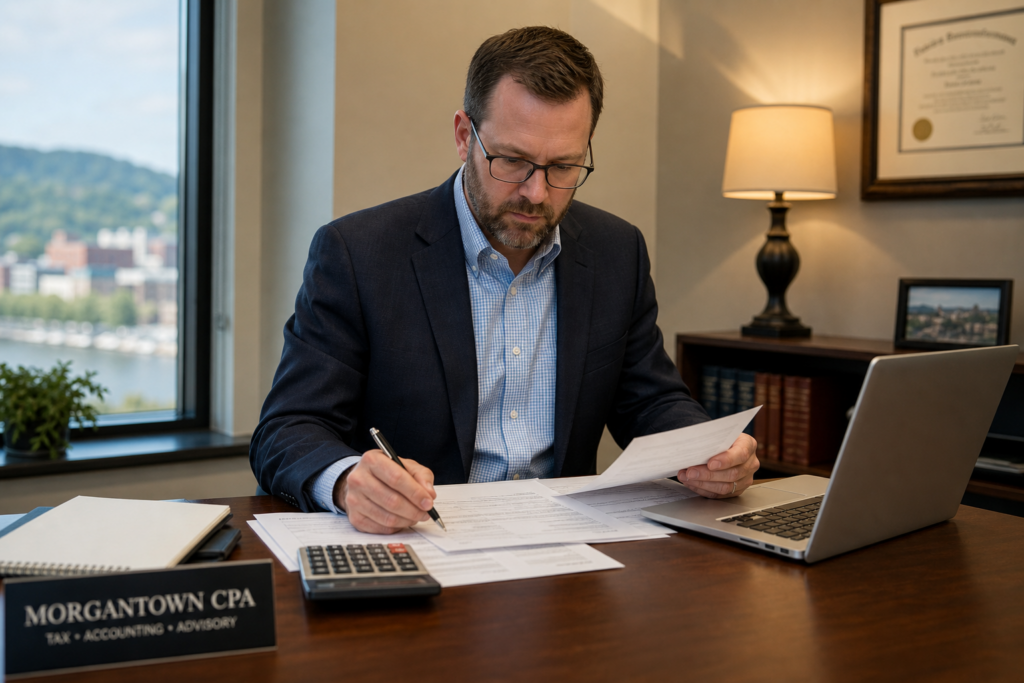
Morgantown CPA Guide: How to Calculate Small Business Taxes in 2026
Finding a reliable Morgantown CPA can transform how you handle small business taxes in 2026. Whether you run a shop downtown or freelance near WVU, our Morgantown tax preparation services help you estimate what you owe. This guide shows you how a Morgantown CPA calculates federal and West Virginia taxes. As a result, you can plan smarter, avoid penalties, and keep more of your income.
Table of Contents
- Key Takeaways
- What Is a Morgantown CPA and Why Do You Need One?
- How Do You Calculate Small Business Taxes Step by Step?
- How Much Self-Employment Tax Will You Owe in 2026?
- Should You Use a Calculator or Hire a Morgantown CPA?
- What Deductions and Credits Can a Morgantown CPA Find?
- Uncle Kam in Action: Saving a Morgantown Bakery
- Next Steps
- Related Resources
- Frequently Asked Questions
Key Takeaways
- A Morgantown CPA estimates federal, state, and self-employment taxes accurately.
- The 2026 self-employment tax rate stays at 15.3% on net earnings.
- The 2026 single standard deduction rose to $16,100.
- Calculators give estimates; a CPA finds real savings and ensures compliance.
- Quarterly estimated payments help you avoid IRS underpayment penalties.
What Is a Morgantown CPA and Why Do You Need One?
Quick Answer: A Morgantown CPA is a licensed accountant who prepares taxes, plans strategy, and ensures compliance. They save business owners time and money.
A Certified Public Accountant, or CPA, holds a state license and passes rigorous exams. In Morgantown, a local CPA understands both federal rules and West Virginia tax obligations. Therefore, they offer more than a generic online tool ever could. Many owners search for a calculator first. However, they quickly learn that accurate planning requires expert eyes.
A qualified CPA reviews your income, expenses, and entity type. As a result, they build a clear picture of your true liability. Furthermore, they spot deductions you might miss. Working with a professional also reduces audit risk. For growing companies, this guidance proves invaluable. Our tax help for business owners combines local knowledge with proven strategy.
Local Expertise Matters for West Virginia Filings
West Virginia imposes a personal income tax with graduated rates. Consequently, your state bill differs from someone in a no-tax state. A Morgantown CPA knows the current West Virginia forms and deadlines. Moreover, they track local rules affecting small businesses. You can review state guidance directly at the West Virginia State Tax Department. Still, interpreting that guidance takes training and experience.
More Than Just Filing Returns
A great CPA acts as a year-round advisor. They help you choose an entity, set salaries, and time purchases. In addition, they build a proactive plan. This forward-looking approach separates advisors from simple preparers. Explore our ongoing tax advisory services to see the difference. If you want a nearby professional, our Tax Preparation Near Me in West Virginia hub connects you with local support.
Pro Tip: Meet your CPA before year-end. Early planning beats last-minute filing every single time.
How Do You Calculate Small Business Taxes Step by Step?
Quick Answer: Start with net profit, subtract deductions, then apply income tax and self-employment tax. Finally, add state tax.
Every Morgantown CPA follows a clear framework. First, calculate gross revenue. Next, subtract all ordinary business expenses. This gives your net profit, reported on Schedule C for sole proprietors. You can review the official form on the IRS Schedule C page. Then, apply two separate taxes to that profit.
The two taxes include federal income tax and self-employment tax. Additionally, West Virginia charges state income tax. A CPA layers these correctly to avoid surprises. Below, a simple worksheet shows the flow using 2026 figures.
The Basic Calculation Framework
- Step 1: Add all business income for the year.
- Step 2: Subtract deductible business expenses.
- Step 3: Apply the 15.3% self-employment tax to net profit.
- Step 4: Subtract the standard deduction, $16,100 single for 2026.
- Step 5: Apply federal income tax brackets and West Virginia state tax.
A Worked Example for a Sole Proprietor
Imagine a Morgantown consultant earns $90,000 net profit. First, self-employment tax applies to 92.35% of that profit. So, $83,115 times 15.3% equals about $12,717. Next, the owner deducts half that amount, roughly $6,359. After the $16,100 standard deduction, taxable income drops significantly. A CPA then applies federal brackets and adds West Virginia tax. Consequently, careful sequencing lowers the final bill.
Want a fast estimate before your consultation? Use our Small Business Tax Calculator to project your 2026 liability. Then bring the numbers to your CPA for a precise review.
Did You Know? The employer-equivalent half of self-employment tax is deductible. This lowers your taxable income automatically.
How Much Self-Employment Tax Will You Owe in 2026?
Quick Answer: Self-employment tax stays at 15.3% for 2026. It covers Social Security and Medicare on net earnings.
Self-employment tax often shocks new business owners. It combines a 12.4% Social Security tax and a 2.9% Medicare tax. Together, that equals 15.3% on your net earnings. For 2026, the Social Security portion applies up to $184,500 in wages. Above that threshold, only the Medicare portion continues. You can confirm details on the IRS self-employment tax page.
A Morgantown CPA helps freelancers reduce this burden legally. For example, electing S Corp status can lower self-employment tax. Our resources for self-employed contractors and freelancers explain these strategies clearly.
2026 Self-Employment Tax Breakdown
| Component | Rate | 2026 Wage Cap |
|---|---|---|
| Social Security | 12.4% | $184,500 |
| Medicare | 2.9% | No cap |
| Combined SE Tax | 15.3% | Applies to net earnings |
Reducing Self-Employment Tax With an S Corp
An S Corp lets you split income into salary and distributions. Distributions avoid self-employment tax entirely. However, the IRS requires a reasonable salary first. A Morgantown CPA calculates that balance carefully. Learn more through our entity structuring guidance. Nevertheless, this strategy only works with proper payroll and documentation.
Pro Tip: Set aside 25% to 30% of profit for taxes. This cushion prevents cash-flow stress at filing time.
Should You Use a Calculator or Hire a Morgantown CPA?
 Free Tax Write-Off Finder
Quick Answer: Calculators give quick estimates. A Morgantown CPA delivers accuracy, savings, and audit protection.
Online calculators serve a useful purpose. They help you ballpark your quarterly payments quickly. However, they cannot interpret your unique situation. A calculator ignores nuanced deductions and credits. Furthermore, it cannot represent you before the IRS. Therefore, most growing businesses eventually need a professional.
A Morgantown CPA reviews your full financial picture. As a result, they uncover savings that software overlooks. Below, a comparison table clarifies the differences. You can also find general tax help through the U.S. Small Business Administration.
Calculator vs. Software vs. CPA
| Factor | Free Calculator | Tax Software | Morgantown CPA |
|---|---|---|---|
| Accuracy | Rough estimate | Moderate | High |
| Finds hidden savings | No | Limited | Yes |
| Audit support | None | Add-on fee | Included |
| Year-round planning | No | No | Yes |
Red Flags That Signal You Need a CPA
- Your income exceeds $75,000 in annual profit.
- You hire employees or independent contractors.
- You own rental property or investment income.
- You feel unsure about quarterly estimated payments.
If two or more apply, professional help pays for itself. Our proactive tax strategy service targets exactly these situations.
What Deductions and Credits Can a Morgantown CPA Find?
Quick Answer: A CPA finds deductions like home office, mileage, retirement contributions, and the 20% QBI deduction.
Deductions lower your taxable income directly. Therefore, they matter more than many owners realize. A Morgantown CPA knows which expenses qualify. Moreover, they document everything to withstand scrutiny. The IRS explains business deductions in Publication 334. Still, applying those rules correctly requires judgment.
The Qualified Business Income deduction remains powerful in 2026. It lets many owners deduct up to 20% of qualified income. However, income limits and business type affect eligibility. A CPA runs the numbers precisely for your situation.
Common Deductions for Morgantown Businesses
- Home office expenses for a dedicated workspace.
- Business mileage and vehicle costs.
- Health insurance premiums for the self-employed.
- Retirement plan contributions like a SEP-IRA or Solo 401(k).
- Qualified tips deduction, up to $25,000 for 2026.
New 2026 Tip Deduction Rules
For 2026, workers may deduct qualified tips up to $25,000. However, the deduction phases out above $150,000 modified AGI. Joint filers see the phaseout begin at $300,000. A Morgantown CPA tracks these limits for tipped-industry clients. You can verify withholding rules in IRS Publication 505. Consequently, restaurants and salons benefit from expert guidance here.
Did You Know? The 2026 SALT deduction cap rose to $40,400. This helps owners who itemize deductions.
Ready to see documented client outcomes? Before you plan your next move, explore our Morgantown tax planning support for personalized help.

Uncle Kam in Action: Saving a Morgantown Bakery
Client Snapshot: Sarah owns a growing bakery near downtown Morgantown. She started as a sole proprietor with two part-time staff.
Financial Profile: Her bakery generated $220,000 in revenue for 2026. After expenses, her net profit reached about $130,000. Consequently, her self-employment tax bill grew painful.
The Challenge: Sarah relied on a free online calculator for years. However, she paid the full 15.3% self-employment tax on all profit. Moreover, she missed retirement and equipment deductions entirely. As a result, she overpaid by thousands each year.
The Uncle Kam Solution: Our Morgantown CPA team reviewed her books carefully. First, we elected S Corp status for her business. Then, we set a reasonable salary of $65,000. Therefore, the remaining profit avoided self-employment tax. In addition, we opened a Solo 401(k) for retirement savings. We also captured her equipment purchases and home office costs. Furthermore, we structured quarterly payments to prevent penalties.
The Results: Sarah saved significant money in her first year. The numbers below tell the story clearly.
- Tax Savings: $11,400 in the first year.
- Investment: $3,600 in CPA and payroll fees.
- Return on Investment: A strong 3.2x first-year ROI.
Sarah now plans confidently for growth. She reinvested her savings into a second location. See more outcomes on our documented client results page. As a result, her story shows why expert help beats a calculator alone.
Next Steps
Take control of your 2026 taxes with these simple actions.
- Estimate your liability with a quick online calculator first.
- Gather income, expense, and payroll records now.
- Schedule a review with our tax prep and filing team.
- Set up automatic quarterly estimated payments today.
This information is current as of 8/3/2026. Tax laws change frequently. Verify updates with the IRS or West Virginia State Tax Department if reading this later.
Related Resources
- Proactive Tax Strategy Services
- Bookkeeping and Business Solutions
- Tax Preparation Near Me in West Virginia
- General Tax FAQs
Frequently Asked Questions
How much should I set aside for small business taxes in 2026?
Most owners set aside 25% to 30% of net profit. This covers federal income tax, self-employment tax, and West Virginia state tax. A Morgantown CPA refines that percentage for your situation. Therefore, you avoid surprises at filing time.
Do I need to pay self-employment tax if I have an LLC?
Yes, a single-member LLC pays self-employment tax on net profit. The 2026 rate stays at 15.3%. However, an S Corp election can reduce this cost. A CPA determines whether that move fits your income level.
How do I calculate estimated quarterly taxes for my business?
Estimate your annual tax, then divide it into four payments. The IRS expects payments each quarter to avoid penalties. A Morgantown CPA sets accurate amounts using your projected income. Consequently, you stay compliant all year.
Can a calculator replace a Morgantown CPA?
A calculator provides estimates only. It cannot find hidden deductions or represent you in an audit. Furthermore, it cannot plan your entity structure. Therefore, a CPA delivers far greater value for growing businesses.
What is the 2026 standard deduction for a single filer?
For 2026, the single standard deduction rose to $16,100. That marks a $450 increase from the prior year. Married couples filing jointly claim $32,200. A Morgantown CPA applies these figures correctly to your return.
How much does a Morgantown CPA cost for a small business?
Fees vary by complexity and services needed. However, many clients save far more than the fee. As Sarah’s story showed, savings often triple the investment. Therefore, professional help usually pays for itself quickly.
Last updated: August, 2026

