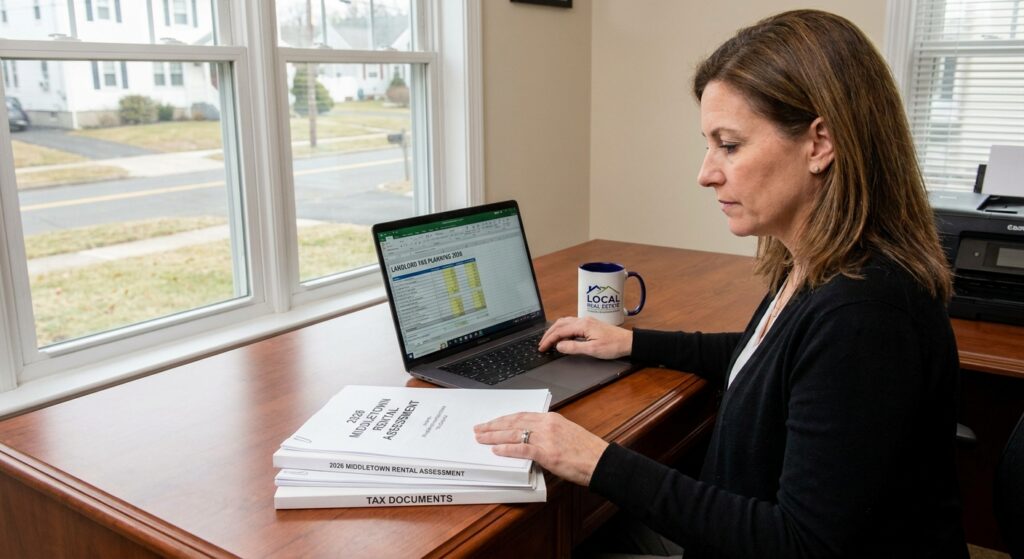
Middletown Rental Property Taxes 2026: Complete Guide for Connecticut Landlords
Understanding middletown rental property taxes is essential for real estate investors looking to maximize profitability and minimize tax liability for the 2026 tax year. In Connecticut, property taxes are calculated using a unique mill-based system, and Middletown specifically requires landlords to navigate a complex five-year revaluation cycle. With the Middletown tax preparation experts reporting significant increases in assessment appeals over recent years, understanding how middletown rental property taxes work has become more critical than ever for protecting your investment returns.
Table of Contents
- Key Takeaways
- Understanding Middletown Rental Property Taxes and How They’re Calculated
- What Is the 2026 Five-Year Revaluation Cycle and How Does It Impact Your Taxes?
- Which Federal Rental Property Tax Deductions Can Reduce Your Middletown Tax Burden?
- How Can You Estimate Your 2026 Rental Property Tax Bill in Middletown Now?
- What Is the Assessment Appeal Process for Middletown Rental Properties?
- What Are the Best Tax Strategies for Middletown Rental Property Owners?
- Uncle Kam in Action
- Next Steps
- Frequently Asked Questions
Key Takeaways
- Middletown rental property taxes are based on 70% of appraised market value at a locally determined mill rate ($1 per $1,000 of assessed value).
- Connecticut requires five-year property revaluations, with Middletown experiencing double the appeals in 2026 compared to prior years.
- Federal deductions including mortgage interest, depreciation, utilities, repairs, and insurance can significantly reduce taxable rental income.
- Assessment appeals must be filed by February 20 and heard in March for the highest chance of reducing your 2026 tax bill.
- Strategic planning with a tax professional can help you structure deductions and timing to optimize your after-tax rental property returns.
Understanding Middletown Rental Property Taxes and How They’re Calculated
Quick Answer: Middletown property taxes use a mill-based system where the town assessor determines a property’s assessed value at 70% of market value, then multiplies by the local mill rate (dollars of tax per $1,000 of assessed value).
The foundation of understanding middletown rental property taxes begins with Connecticut’s unique calculation method. Unlike many states that use a flat tax rate, Connecticut employs the mill system, where one mill equals $1 in taxes for every $1,000 of assessed property value. For rental properties in Middletown, assessments are based on 70% of the property’s appraised market value, not the full market value.
This 70% assessment ratio means if your rental property is appraised at $500,000, your assessed value would be $350,000 ($500,000 × 0.70). If Middletown’s mill rate is, for example, 28 mills, your annual property tax would be $9,800 ($350,000 × 28 ÷ 1,000).
How the Mill Rate System Works in Practice
The mill rate in Middletown is set annually by the town’s budget process and adjustments from state funding. Property tax bills are typically mailed in late June and paid in two installments during January and July within Connecticut’s fiscal year structure (July 1 through June 30). This dual-payment system helps spread the tax burden throughout the year for landlords managing multiple properties.
Pro Tip: Request the current mill rate from the Middletown tax assessor’s office early in the year to forecast your tax liability and plan your rental income strategy accordingly for 2026.
Assessed Value vs. Market Value: Why the Difference Matters
The 70% assessment ratio is crucial for rental property owners to understand. When your property is appraised during the revaluation cycle, the assessor determines fair market value, but you only pay taxes on 70% of that amount. This creates a significant advantage for property owners whose appraised values increase, as taxes grow more slowly than market appreciation—making it advantageous to hold rental properties for long-term appreciation while managing the annual tax increases more gradually.
What Is the 2026 Five-Year Revaluation Cycle and How Does It Impact Your Taxes?
Quick Answer: Connecticut law requires all municipalities to conduct complete property revaluations every five years, which can significantly increase assessed values and property taxes for rental properties, particularly in appreciating markets like Middletown.
The five-year revaluation cycle is a mandatory state requirement that can substantially impact your middletown rental property taxes. During revaluation years, Middletown typically contracts with private appraisal companies to reassess all properties at current market values. Unlike annual adjustments, revaluation cycles can result in dramatic changes to assessed values, particularly for properties in appreciating neighborhoods or for investment properties that were previously undervalued.
2026 Revaluation Data: What Landlords Are Experiencing
The Middletown Board of Assessment Appeals heard 90 property owner appeals in 2026 regarding revaluation assessments—nearly double what they heard for 2023-2024 assessments combined. This surge indicates significant property value increases in the area and a strong response from landlords concerned about tax increases. In comparable Connecticut towns like Westport, property owners successfully appealed approximately $16.5 million in assessments after their revaluation, demonstrating the real opportunity to contest assessments if values seem inflated.
Pro Tip: Immediately request your new assessed value from the assessor when revaluation notices arrive and compare it against similar recent rental property sales in your Middletown neighborhood to identify overvaluations before the appeal deadline.
How Revaluation Affects Rental Property Investment Returns
For real estate investors, revaluation can create both challenges and opportunities. A 10% increase in assessed value means a 10% increase in annual property taxes (assuming the mill rate stays constant). For a property generating $40,000 in annual rental income, a $10,000 tax increase could reduce net operating income and cap rate returns by 25%. However, this also presents a strong case for appeal if the appraisal overvalues your property relative to comparable rental properties in the market.
Which Federal Rental Property Tax Deductions Can Reduce Your Middletown Tax Burden?
Quick Answer: The IRS allows rental property owners to deduct mortgage interest, depreciation, utilities, insurance, repairs, maintenance, property management fees, and many other operating expenses on Schedule E, significantly reducing federal taxable rental income.
While middletown rental property taxes are determined by local assessments, your federal rental income taxes can be substantially reduced through legitimate deductions. These deductions don’t eliminate Middletown property taxes, but they lower your federal tax liability, allowing you to retain more cash flow from rental income. Understanding which expenses qualify is essential for 2026 tax planning.
Deductible Rental Property Expenses for 2026
| Expense Category | Deductible? | IRS Form |
|---|---|---|
| Mortgage Interest | Yes, fully deductible | Schedule E |
| Depreciation | Yes, deductible (27.5 years for structures) | Schedule E, Form 4562 |
| Property Taxes (Middletown) | Yes, deductible | Schedule E |
| Utilities | Yes, if paid by owner | Schedule E |
| Insurance | Yes, landlord insurance only | Schedule E |
| Repairs & Maintenance | Yes, fully deductible | Schedule E |
| Property Management Fees | Yes, deductible | Schedule E |
| Capital Improvements | No (depreciated instead) | Schedule E |
Depreciation deserves special attention for Middletown rental property owners. This non-cash deduction allows you to deduct the cost of your rental structure (not the land) over 27.5 years, reducing taxable income even if you’re not making mortgage payments. A $350,000 assessed rental property with approximately $280,000 in structure value generates roughly $10,182 in annual depreciation deductions.
Critical Distinction: Repairs vs. Capital Improvements
The IRS strictly distinguishes between deductible repairs and non-deductible capital improvements. Repairs (fixing broken items, painting, roof patching) are fully deductible in the year incurred. Capital improvements (new roof, major renovation, new plumbing system) must be depreciated over their useful life. This distinction can save thousands on your 2026 tax bill if properly documented and structured with your tax professional.
How Can You Estimate Your 2026 Rental Property Tax Bill in Middletown Now?
Quick Answer: Multiply your assessed value by the mill rate and divide by 1,000. Example: $350,000 assessed value × 28 mill rate ÷ 1,000 = $9,800 annual tax, paid in two installments.
Estimating your middletown rental property taxes requires two critical pieces of information: your assessed value and the current mill rate. While assessments are determined by the town (often via revaluation), the mill rate is set during the municipal budget process, typically finalized by mid-May before bills are mailed in late June. Here’s how to calculate your estimated 2026 tax bill.
Step-by-Step Tax Calculation Example
- Step 1: Obtain your current assessed value from the Middletown assessor ($350,000 example).
- Step 2: Confirm the 2026 mill rate from the town (28 mills example, or call the assessor’s office).
- Step 3: Multiply assessed value × mill rate ÷ 1,000 ($350,000 × 28 ÷ 1,000 = $9,800).
- Step 4: Plan for two installments: January payment of approximately $4,900 and July payment of $4,900.
- Step 5: If revaluation occurs, add 10-15% to account for typical assessment increases, then plan to appeal if warranted.
Pro Tip: Use our Self-Employment Tax Calculator to forecast your overall tax liability including federal, state, and local property taxes when planning annual rental property budgets.
Impact on Rental Income and Cash Flow
For landlords, property taxes directly impact net operating income. If a property generates $50,000 in annual rental income and has $25,000 in mortgage interest and operating expenses, a $9,800 tax bill reduces net profit to $15,200 (before federal taxes). This is why accurate estimation is critical for pricing rental units and evaluating whether investment properties meet your return targets.
What Is the Assessment Appeal Process for Middletown Rental Properties?
 Free Tax Write-Off Finder
Quick Answer: File an appeal application with the Middletown Board of Assessment Appeals by February 20, appear in person in March, and present evidence (comparable sales, appraisals) showing your assessed value exceeds fair market value to request reduction.
If you believe your middletown rental property assessment is too high, Connecticut law provides a formal appeal mechanism through the Board of Assessment Appeals. This process has successfully reduced assessments for thousands of property owners and represents one of the most direct ways to reduce your tax burden without changing state or federal law.
Timeline and Requirements for 2026 Appeals
- February 20, 2026: Final deadline to file appeal application with Middletown Board of Assessment Appeals.
- March 2026: Scheduled hearing dates for appeals. Attendance is mandatory—boards will not hear cases without the property owner or authorized representative present.
- Required Documentation: Comparative market analysis, recent appraisals, photographs of property condition, repairs needed, comparable rental property sales data.
- Authorized Representatives: You can send an attorney, licensed appraiser, or qualified real estate professional instead of attending personally.
- Appeal Results: Boards can raise, decrease, or make no change to assessments. Appeals over $1 million can be appealed to superior court if denied.
Pro Tip: Gather three to five comparable rental property sales from the past 12 months in your Middletown neighborhood showing assessed values lower than your property. Present these at your appeal hearing to demonstrate overvaluation.
Success Rates and Expected Outcomes
Middletown’s Board of Assessment Appeals approved approximately 21% of appeals in 2026, with the board modifying assessments in many cases where clear evidence of overvaluation existed. Even denied appeals provide valuable documentation for future appeals if subsequent revaluations occur. The appeal process costs minimal fees and often generates substantial tax savings—a successful appeal reducing your assessment by 10% saves approximately $980 annually on a $9,800 tax bill.
What Are the Best Tax Strategies for Middletown Rental Property Owners?
Quick Answer: Maximize federal deductions through meticulous expense documentation, appeal assessments when overvalued, structure capital improvements strategically, and consider timing of major repairs to optimize tax outcomes in 2026.
While middletown rental property taxes are locally determined and often unavoidable, strategic tax planning can significantly enhance your investment returns. The most successful real estate investors combine assessment appeals with federal deduction optimization to reduce their overall tax burden—leveraging both local and federal tax law.
Strategy 1: Document Every Deductible Expense Systematically
Create a separate accounting system for each rental property tracking all potential deductions. Maintain receipts for repairs, photograph work completed, and document utility bills, insurance premiums, and management fees. The IRS allows Schedule E filers to deduct ordinary and necessary expenses, but only if substantiated with contemporaneous documentation. Conservative estimates suggest landlords miss 15-25% of available deductions through poor record-keeping.
Strategy 2: Proactively Monitor and Appeal Assessments
Don’t wait until you receive a tax bill to question your assessment. Monitor Middletown assessor’s website annually, request your assessment data, and compare against similar properties. If revaluation occurs in 2026, immediately gather comparable sales data and prepare your appeal before the February 20 deadline. Given that Middletown had 90 appeals in 2026 (double prior years), clearly many properties are being overvalued during the revaluation process.
Strategy 3: Time Capital Improvements Strategically
Capital improvements (new roof, major renovations) must be depreciated over time, but repairs are deductible immediately. If you’re planning property upgrades, consider completing necessary repairs before revaluation years to demonstrate property condition to assessors (potentially lowering assessments) while still deducting 100% of repair costs in that year. Alternatively, delay major improvements until after revaluation to avoid higher assessed values, then depreciate the improvements federally.

Uncle Kam in Action: Rachel’s Middletown Rental Property Tax Optimization
Rachel acquired a four-unit Middletown rental property in 2019 for $420,000, with approximately $50,000 in annual rental income from tenants. When revaluation notices arrived in 2026, her new assessment jumped from $290,000 to $368,000—a 27% increase. Her projected property tax jumped from $8,120 to $10,304 annually, a sudden $2,184 increase that would materially impact her 10% target return on investment.
Rachel engaged Uncle Kam for tax strategy and assessment appeal preparation. Our analysis identified two issues: (1) the assessor overvalued the property by comparing it to single-family homes rather than comparable multi-unit rentals, and (2) Rachel was missing approximately $8,000 in annual deductions through incomplete expense documentation. Our team prepared a professional assessment appeal with comparable rental property data, market analysis, and expert testimony. We simultaneously optimized her Schedule E to capture every legitimate deduction, reducing her federal taxable income from this property by $8,000 annually (roughly $2,400 in federal tax savings at her marginal rate).
Results: The Middletown Board approved Rachel’s assessment appeal, reducing her assessed value to $328,000, lowering her annual property tax to $9,184—a $1,120 annual savings versus the new $10,304 bill. Combined with the federal deduction optimization, Rachel recovered $3,520 in annual tax liability and improved her investment return from 8.2% to 9.8%—the difference between a mediocre and excellent real estate investment. Return on investment: 7.1x her advisory fees within the first year.
Next Steps
- Request your current assessed value from Middletown assessor and compare it against three comparable rental properties in your neighborhood to identify potential overvaluation.
- Organize all rental property receipts, bank statements, and expense records for 2026 to ensure you capture every Schedule E deduction available.
- Review your local mill rate for 2026 and calculate your estimated property tax due to plan cash flow and quarterly payment reserves.
- If you received a revaluation notice, mark February 20, 2026 on your calendar as the appeal deadline and gather comparable market data immediately.
- Contact a tax preparation professional near you to review your rental property tax strategy and ensure you’re optimizing federal deductions.
Frequently Asked Questions
Can I deduct middletown rental property taxes on my federal return?
Yes, absolutely. Property taxes paid on rental properties are fully deductible on Schedule E (Form 1040) as rental property expenses. This deduction reduces your federal taxable rental income and your overall federal tax liability. You should track these payments carefully and include them in your annual tax return.
What is the difference between a repair and capital improvement for tax purposes?
Repairs fix existing property (painting, fixing plumbing, replacing broken window) and are fully deductible in the year incurred. Capital improvements add value or prolong useful life (new roof, major renovation, new HVAC system) and must be depreciated over the asset’s useful life (typically 27.5 years for rental structures). This distinction can represent thousands of dollars in timing differences for your tax bill.
How often does middletown conduct property revaluation?
Connecticut law requires complete property revaluations every five years. Middletown follows this cycle, contracting with private appraisal companies to conduct comprehensive reassessments. Between revaluation years, annual adjustments may occur, but the major reassessment happens once per five-year cycle. Stay informed of upcoming revaluation years in your area.
What documentation do I need for a successful assessment appeal?
Prepare comparable rental property sales from the past 12 months (at least three examples), recent professional appraisals, photographs documenting property condition, a detailed list of needed repairs with cost estimates, and any market analysis supporting lower valuations. Present this evidence clearly at your March hearing to demonstrate your assessment exceeds fair market value. Written documentation is critical.
Can I appeal a middletown property tax assessment multiple times?
You can appeal once per year to the local Board of Assessment Appeals. If you’re denied and believe the board made an error, you can appeal to superior court (especially important for properties valued over $1 million where boards can decline to hear). After a successful appeal, you start fresh the following year if new assessments change again.
How does depreciation work for rental properties, and what form do I file?
Residential rental properties depreciate over 27.5 years. You calculate depreciable basis (property cost minus land value), divide by 27.5, and claim the annual amount as a deduction on Schedule E and Form 4562 (Depreciation). For a $350,000 property with $280,000 in structure value, annual depreciation is approximately $10,182. This is one of the most valuable deductions available to rental property owners.
What happens if my rental property income is less than my deductions?
If legitimate rental property deductions exceed income, you have a passive loss, which generally cannot offset other income (with limited exceptions for active real estate professionals or low-income taxpayers). However, losses carry forward to future years and can offset future rental income when your property becomes profitable. Proper structuring with a tax professional can maximize your ability to utilize these losses.
Are there any 2026 changes to middletown rental property tax rules?
Connecticut has not changed its property tax calculation method (70% assessment ratio, mill-based system) as of May 2026. However, state legislators are actively discussing additional state aid to municipalities, which could affect local mill rates. Monitor Middletown town meetings and the state legislature for potential changes to property tax relief programs.
Related Resources
- Real Estate Investor Tax Strategy Guide
- Comprehensive Tax Strategy Services
- Entity Structuring for Real Estate Investors
- Connecticut Department of Revenue Services – Property Tax
- IRS Schedule E Instructions – Rental Property Income
Last updated: May, 2026

