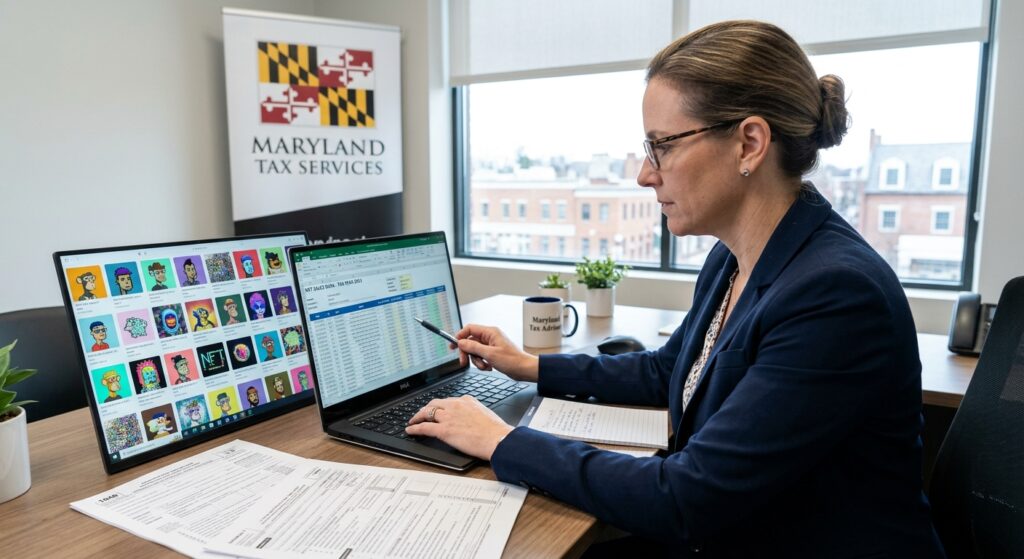
Maryland NFT Taxes 2026: Complete Guide for Sellers, Creators & Investors
If you live in Maryland and buy, sell, or create NFTs, the IRS and the State of Maryland both want a share of your profits. Even though Maryland doesn’t have a separate “NFT tax,” your NFT gains and income are fully taxable under existing federal capital gains rules and Maryland income tax law.
This guide explains, in plain English, how Maryland NFT taxes work in the 2026 tax year for investors, active traders, and creators, and what you can do now to stay compliant and avoid overpaying.
Key Takeaways
- NFTs are treated as property for U.S. tax purposes. Selling or swapping an NFT triggers capital gains or losses.
- Maryland does not have a separate capital gains tax, but your NFT gains are included in your Maryland taxable income and taxed at state and local rates.
- Most investors report NFT sales on Form 8949 and Schedule D, with totals flowing to Form 1040 and then to the Maryland return.
- Holding an NFT for more than one year before selling usually leads to a lower federal tax rate than short-term trading.
- Creators who mint and sell NFTs often have self-employment income subject to both income tax and self-employment tax.
How Are NFTs Taxed in General?
For federal purposes, NFTs are generally treated like other digital assets (similar to cryptocurrency) and taxed as property. The main taxable events include:
- Selling an NFT for fiat (USD)
- Trading one NFT for another NFT
- Selling an NFT for crypto (e.g., ETH, SOL)
- Using an NFT in a way that constitutes payment for services or goods
Your gain or loss is:
Gain (or Loss) = Amount you receive − Cost basis
Cost basis usually includes what you paid for the NFT plus directly related fees (for example, marketplace fees and gas used to acquire it). When you sell, similar fees reduce the amount you are treated as having received.
Example: You spend 0.5 ETH to buy an NFT and pay $60 in gas. When you sell, you receive $3,000 after marketplace fees. If the 0.5 ETH was worth $900 when you bought the NFT, your cost basis is $960. Your gain is $3,000 − $960 = $2,040.
Short-Term vs. Long-Term NFT Gains
The holding period matters:
- Short-term: Held one year or less. Taxed at your ordinary income tax rate.
- Long-term: Held more than one year. Taxed at preferential long-term capital gains rates (0%, 15%, or 20%, depending on your income).
Many Maryland NFT investors deliberately hold profitable NFTs past the one-year mark to unlock long-term rates and reduce their combined federal + Maryland bill.
How Does Maryland Tax NFT Gains?
Maryland does not have a separate capital gains tax schedule. Instead, your net capital gains from NFTs flow into your federal adjusted gross income (AGI) and then into your Maryland taxable income. That income is then taxed under Maryland’s regular state and local income tax system.
In practice, this means:
- You first calculate your net capital gain or loss on your federal return.
- That net result becomes part of your federal income and carries to your Maryland return.
- Maryland then taxes your overall income (wages, business income, NFT gains, etc.) at graduated state and local rates.
Illustrative Maryland Income Tax Brackets
Exact bracket thresholds can change periodically. The table below gives an illustrative sense of how an extra NFT gain can push more of your income into higher Maryland brackets.
| Approximate Maryland taxable income (single) | Approximate state rate* |
|---|---|
| Up to around $25,000 | About 2%–4% |
| Around $25,000 – $100,000 | About 4%–5.75% |
| Above roughly $100,000 | Top state rate around 5.75% (plus local) |
*Maryland also has county-level income taxes that vary by location. Your total effective state+local rate is higher than the state rate alone.
Planning point for Maryland residents: A large NFT sale late in the year can increase both your federal bracket and your state + county bracket. In some situations, splitting sales across two tax years or realizing losses on underperforming NFTs can soften the impact.
Which IRS Forms Do Maryland NFT Investors Use?
For a typical Maryland resident who invests in NFTs personally (not through a business entity), the main federal forms are:
- Form 8949 – details each NFT sale or disposition: description, dates, proceeds, cost basis, and gain or loss.
- Schedule D – summarizes your total short-term and long-term capital gains and losses, using totals from Form 8949.
- Form 1040 – your overall individual income tax return, where net capital gains flow into your total income.
On the state side, Maryland’s individual income tax return picks up your federal income figure, including NFT gains or losses, and applies state and county tax. Maryland also follows the IRS in treating NFTs as property; there is no separate NFT form.
Recordkeeping tip: If you use multiple wallets or marketplaces, consolidate your NFT trades into a single spreadsheet or tax software export as you go. Waiting until the next filing season to reconstruct every transaction from the blockchain is time-consuming and error-prone.
NFT Creators in Maryland: Income or Capital Gain?
 Free Tax Write-Off Finder
If you create NFTs (artist, developer, musician, etc.), your tax treatment is different from that of a pure investor.
- Minting and selling your own NFT: The initial sale usually produces ordinary income, not a capital gain, because you are selling something you created (similar to selling artwork or music).
- Royalties from downstream sales: Recurring royalties embedded in smart contracts are also typically treated as ordinary income.
If you operate as a sole proprietor, this income is generally reported on Schedule C (Profit or Loss From Business) and may be subject to self-employment tax in addition to income tax.
| NFT activity | Typical U.S. tax treatment |
|---|---|
| Selling an NFT you bought as an investment | Capital gain or loss (short- or long-term) |
| Selling an NFT you created (initial mint sale) | Ordinary income (often self-employment) |
| Royalties from secondary NFT sales | Ordinary income (often self-employment) |
Maryland then taxes your net business income on your state return alongside your other income. Legitimate business expenses—such as design software, marketplace fees, marketing, and a portion of internet costs—may be deductible if they are ordinary and necessary for your NFT business.
Common Maryland NFT Scenarios
1. Casual Investor with a Few NFT Sales
You bought two NFTs in 2025 and sell both in 2026. You track your cost basis, fill out Form 8949 for each sale, and net a small gain. The gain is long-term if you held for more than a year, and it flows into your Maryland income. You probably don’t need to make estimated tax payments if your overall withholding already covers your tax for the year.
2. Active NFT Trader
You flip NFTs weekly and have dozens or hundreds of trades, mostly short-term. You still use Form 8949 and Schedule D, but complete transaction tracking is critical. Even if you receive no Form 1099 from a marketplace, the IRS and Maryland expect you to report all gains. High short-term profits can push you into higher brackets at both levels, so planning for estimated tax payments can help you avoid underpayment penalties.
3. NFT Artist with Royalties
You mint a collection and earn income from the initial sale and recurring royalties as your works trade on secondary markets. Your initial sales and royalties are usually business income. In addition to income tax at federal and Maryland levels, you may owe self-employment tax. Setting aside a portion of each payout for quarterly estimates can keep you from being surprised at filing time.
Strategies to Reduce NFT Tax Headaches
- Track everything early: Maintain a transaction log that captures dates, wallet addresses, token IDs, purchase amounts, sale amounts, and all fees.
- Be intentional about holding periods: If you are close to the one-year mark on a profitable NFT, check the after-tax difference between selling now (short-term) and later (long-term).
- Use losses wisely: Harvest losses from NFTs that are unlikely to recover. Losses can offset gains from other NFTs, other digital assets, and even up to $3,000 of ordinary income at the federal level, with carryforwards for the rest.
- Separate investor vs. creator activity: Keep clear records distinguishing personal investment trades from your creator or business activity. That separation matters for which schedules and deductions apply.
Local help for Maryland residents: A tax professional who understands both digital assets and Maryland state rules can help you reconcile wallets, interpret 1099s, and optimize timing across tax years.

Frequently Asked Questions About Maryland NFT Taxes
1. Do Maryland residents pay state tax on NFT profits even if everything stays in crypto?
Yes. For tax purposes, it does not matter whether you convert back to dollars or leave the value in another token. Selling or swapping an NFT for crypto creates a taxable event based on the U.S. dollar value at the time. That gain is included in your income for both federal and Maryland purposes.
2. What if I don’t get any 1099 forms from NFT marketplaces?
You are still required to report your income and gains. Many NFT platforms and DeFi protocols do not issue comprehensive tax forms yet, especially if you only connect a wallet. The IRS expects you to self-report based on your own records. Maryland relies on your federal figures, so underreporting at the federal level affects both sets of returns and can lead to penalties.
3. Can I deduct gas fees and marketplace fees on my Maryland return?
Yes, but how you deduct them depends on the context. For investors, fees tied directly to buying and selling NFTs usually adjust your cost basis or sales proceeds rather than appearing as separate deductions. For creators and businesses, some fees can be ordinary and necessary business expenses on Schedule C. Maryland starts from your federal taxable income, so correctly categorizing these fees at the federal level is important.
4. Do airdropped NFTs to my wallet create taxable income?
Often yes, if the airdrop has a readily determinable market value and you have control over the NFT. In that case, the fair market value in U.S. dollars at the time you receive the airdrop is usually ordinary income. That income then becomes your cost basis for any later sale, which can produce a capital gain or loss. Maryland taxes that income because it flows into your federal return.
5. How do I handle NFTs used in games or metaverse platforms?
From a tax standpoint, an in-game or metaverse NFT is still a digital asset. Acquiring, selling, or swapping these NFTs can create capital gains or losses. If you earn tokens or NFTs as rewards for playing, that may be ordinary income at the time you receive them. The fact that the NFT lives in a game or metaverse doesn’t exempt it from federal or Maryland tax rules.
Disclaimer: Tax law around digital assets is evolving. This article is a general overview for educational purposes only and may not reflect the latest federal or Maryland guidance at the time you read it. Always review current IRS publications, Maryland tax instructions, or consult a qualified tax professional before filing.

