
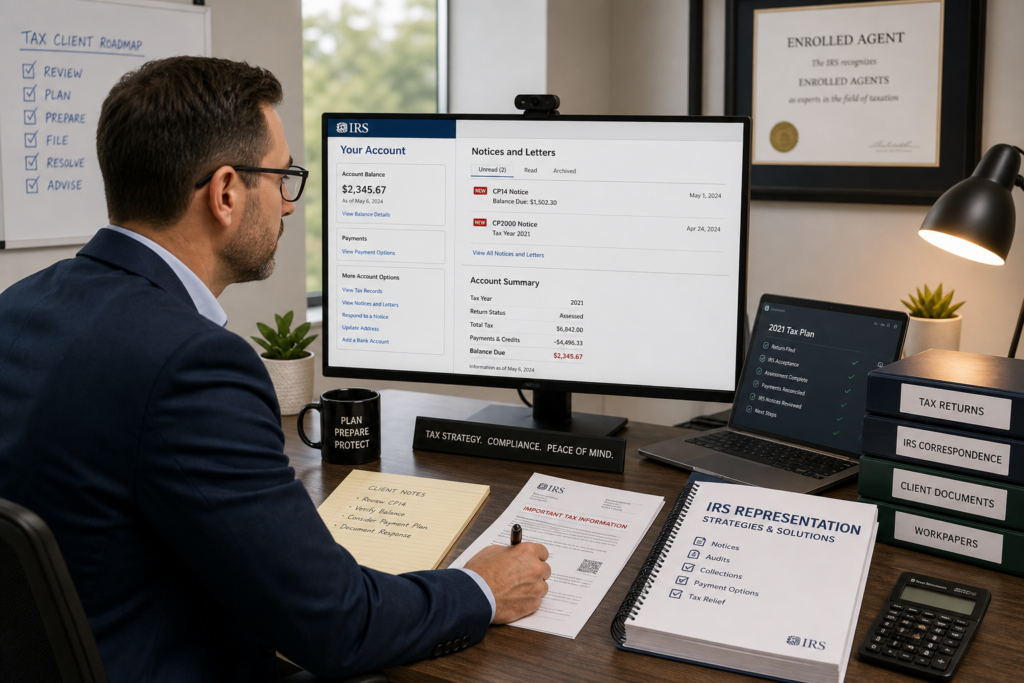
LT16 Please File Tax Return Notice CPA Guide: 2026
When the IRS sends an LT16 please file tax return notice to your client in 2026, immediate action is required. This automated compliance letter signals the IRS has identified a missing return for a specific tax year. For tax professionals, understanding how to respond efficiently protects clients from escalating penalties and preserves crucial procedural rights in an era of IRS digital-first enforcement.
Table of Contents
Used by 2,400+ tax professionals
- Key Takeaways
- What Is an IRS LT16 Notice and Why Is Your Client Receiving It?
- How Should CPAs Respond to an LT16 Notice in 2026?
- What Penalties Apply for Unfiled Returns in 2026?
- How Does the IRS Digital-First Model Change LT16 Response Strategy?
- What Documentation Do CPAs Need to Resolve LT16 Notices?
- Uncle Kam in Action: Multi-Year LT16 Resolution Success
- Next Steps
- Frequently Asked Questions
- Related Resources

Key Takeaways
- LT16 notices signal automated IRS enforcement in 2026’s digital-first compliance environment
- Failure to file penalties reach 25% of tax owed plus interest compounding daily
- IRS workforce reduction of 27% increases reliance on automated collection notices
- The Taxpayer Due Process Enhancement Act strengthens procedural rights for 2026 responses
- Immediate response within 30 days preserves Appeals rights and avoids statutory notices
What Is an IRS LT16 Notice and Why Is Your Client Receiving It?
Quick Answer: An LT16 notice is an automated IRS letter requesting a taxpayer file a missing return. Clients receive it when IRS systems identify unreported income through third-party information returns like W-2s or 1099s.
The IRS LT16 please file tax return notice represents the agency’s initial automated outreach when its matching systems detect unreported income. In 2026, this process operates within a dramatically transformed enforcement environment. The IRS reduced its workforce by 27% in 2025, dropping from approximately 102,000 to 74,000 employees, according to the National Taxpayer Advocate’s 2025 Annual Report to Congress.
This workforce reduction accelerated the agency’s shift to a digital-first model. Automated notices like LT16 now arrive faster and with greater frequency. However, the reduced staffing creates longer resolution times when human intervention becomes necessary.
Common Triggers for LT16 Notices in 2026
The IRS generates LT16 notices through automated matching programs that compare third-party information returns against filed tax returns. When a discrepancy appears, the system triggers a notice. For 2026, the most common triggers include:
- W-2 wage income reported by employers without corresponding Form 1040
- 1099-NEC or 1099-MISC non-employee compensation exceeding filing thresholds
- 1099-K payment card and third-party network transactions above reporting minimums
- 1099-INT or 1099-DIV investment income from financial institutions
- Prior year filing history showing regular returns suddenly stopping
- Schedule K-1 income from partnerships, S corporations, or trusts
The 2026 Automated Compliance Environment
IRS CEO Frank Bisignano told the Senate Finance Committee on April 15, 2026, that the agency met filing season targets with “less people and better results” through digital transformation. This commitment to automation means LT16 notices arrive more quickly but require sophisticated professional response strategies to navigate efficiently.
Pro Tip: The IRS increased its use of AI and data analytics for enforcement in 2026. LT16 notices now include more detailed income matching information, making blanket denial responses ineffective.
How Should CPAs Respond to an LT16 Notice in 2026?
Quick Answer: CPAs should immediately verify the missing return, gather documentation, prepare and file the return within 30 days, and document all correspondence. Use the LT16 Notice Response Tool to track deadlines and required actions for 2026 compliance.
Effective LT16 response in 2026 requires a systematic approach. Tax professionals must balance speed with accuracy while navigating the IRS’s reduced staffing and increased automation.
Step 1: Verify the Notice Details and Timeline
The LT16 notice specifies the tax year, income sources identified, and response deadline. Most LT16 notices allow 30 days for response. However, missing this deadline triggers escalation to more severe collection notices.
Create a case file immediately containing:
- Copy of the complete LT16 notice with notice number and date
- Client authorization (Form 2848 Power of Attorney if not already on file)
- IRS account transcript for the tax year in question
- Wage and income transcript showing third-party reported amounts
Step 2: Determine Filing Requirement
Not every LT16 notice requires a return. Verify whether the client’s income exceeded the filing threshold for their filing status. For 2026, filing thresholds depend on gross income, age, and filing status.
If income falls below thresholds, respond with a written explanation citing IRS Publication 501 filing requirements. Include supporting documentation showing total income calculations.
Step 3: Prepare and File the Missing Return
When filing is required, prepare the return with meticulous documentation. In 2026’s automated enforcement environment, the IRS will match every reported income item. Include all legitimate deductions and credits, however. The goal is accuracy, not minimum tax liability.
File the return through the appropriate channel:
- E-file if the tax year remains open for electronic filing
- Paper file with certified mail if e-filing is unavailable for the tax year
- Include a cover letter referencing the LT16 notice number
- Attach copies of all W-2s, 1099s, and supporting documentation
Step 4: Address Payment and Penalty Mitigation
If the return shows a balance due, discuss payment options immediately. Filing the return stops failure-to-file penalties but not failure-to-pay penalties or interest. For 2026, consider:
- Immediate full payment to minimize interest (currently compounding at 3.8% inflation-adjusted rate)
- Installment agreement through IRS Online Payment Agreement if full payment isn’t feasible
- First-time penalty abatement request if the client has clean compliance history
- Reasonable cause penalty abatement if qualifying circumstances exist
The House passed H.R. 6506, the Taxpayer Due Process Enhancement Act, on May 18, 2026, strengthening collection due process rights. While awaiting Senate action, this signals congressional intent to reinforce taxpayer protections during IRS modernization.
Pro Tip: Document every step of your LT16 response. The IRS received approximately $3.2 billion in unidentified payments from fiscal years 2022-2024, with $218 million still unresolved. Clear documentation prevents payment misapplication.
What Penalties Apply for Unfiled Returns in 2026?
Quick Answer: Failure-to-file penalties start at 5% of unpaid tax per month, reaching a maximum of 25%. Combined with failure-to-pay penalties and interest, total costs can exceed 50% of the original tax owed.
Understanding the penalty structure helps CPAs counsel clients on urgency. For 2026, the IRS applies three primary penalty categories to unfiled returns identified through LT16 notices.
Failure-to-File Penalty (IRC Section 6651(a)(1))
The failure-to-file penalty accrues at 5% of the unpaid tax for each month or part of a month the return is late, up to a maximum of 25%. This penalty applies regardless of whether the taxpayer owes money.
For returns filed more than 60 days after the due date (including extensions), the minimum penalty equals the lesser of $485 or 100% of the tax owed. This minimum applies even for small tax liabilities, making prompt filing critical.
Failure-to-Pay Penalty (IRC Section 6651(a)(2))
The failure-to-pay penalty runs at 0.5% of unpaid tax per month, up to 25% maximum. When both failure-to-file and failure-to-pay penalties apply simultaneously, the failure-to-file penalty reduces to 4.5% per month. Therefore, the combined rate equals 5% monthly.
Interest on Unpaid Balances
Interest compounds daily on both unpaid tax and accumulated penalties. For 2026, the rate adjusts quarterly based on the federal short-term rate plus 3%. With inflation at 3.8% for the 12 months ending April 2026, interest rates remain elevated compared to historical norms.
The following table illustrates penalty accumulation for a $10,000 tax liability:
| Months Late | Failure-to-File (5%) | Interest (Est. 7% APR) | Total Amount Due |
|---|---|---|---|
| 1 month | $500 | $58 | $10,558 |
| 3 months | $1,500 | $175 | $11,675 |
| 6 months | $2,500 | $350 | $12,850 |
| 12 months | $2,500 (max) | $700 | $13,200 |
Note: Interest continues accruing beyond 12 months on the combined tax and penalty balance.
How Does the IRS Digital-First Model Change LT16 Response Strategy?

Quick Answer: The 2026 IRS digital-first approach accelerates notice generation but reduces human review capacity. CPAs must respond with precision documentation and expect longer resolution times for complex cases requiring human intervention.
The IRS’s transformation fundamentally changes how tax professionals manage LT16 notices. The House Appropriations Committee advanced a smaller IRS budget for fiscal 2027 on April 27, 2026, while simultaneously expanding the agency’s use of AI and data analytics for enforcement.
Increased Automated Notice Volume
Automated systems now generate LT16 notices within weeks of detecting unreported income. In the pre-digital era, manual review might have delayed or prevented notices for borderline cases. In 2026, expect notices for any income discrepancy exceeding IRS thresholds.
The IRS announced improved identity-theft filters on May 18, 2026, as part of its automation enhancement. This reduces fraudulent notices but increases legitimate notice volume as systems improve accuracy.
Reduced Appeals Capacity
The Independent Office of Appeals lost more than 25% of its workforce. The National Taxpayer Advocate’s Fiscal Year 2026 Objectives Report devotes significant attention to Appeals independence, warning that compliance-oriented performance pressures threaten to turn Appeals into an extension of examination.
Practitioner commentary expects the IRS to bypass Appeals more frequently by issuing statutory notices of deficiency. This pushes taxpayers directly into Tax Court. For LT16 responses, this means:
- Resolve issues at the initial response stage whenever possible
- Document everything meticulously to support potential Appeals or Tax Court proceedings
- Avoid relying on Appeals as a routine resolution pathway
- File returns accurately the first time to prevent escalation
Digital Response Channels
The IRS prioritizes digital communication channels. For LT16 responses in 2026, leverage:
- E-filing for the missing return whenever possible
- IRS Online Account for transcript requests and payment arrangements
- Tax Pro Account for authorized representatives to view client notices
- Electronic fax for supporting documentation (faster processing than mail)
However, maintain certified mail capabilities for critical deadlines. Digital channels experience occasional outages, and certified mail provides undisputable proof of timely filing.
What Documentation Do CPAs Need to Resolve LT16 Notices Efficiently?
Quick Answer: Comprehensive documentation includes IRS transcripts, all information returns (W-2s, 1099s), bank statements, expense records, prior year returns, and written explanations for any discrepancies between reported income and actual filing requirements.
Thorough documentation accelerates LT16 resolution and minimizes back-and-forth correspondence. In the 2026 digital environment, the IRS expects complete, substantiated responses.
Essential Documents Checklist
Gather these documents before preparing your response:
| Document Category | Specific Items | Purpose |
|---|---|---|
| IRS Transcripts | Account transcript, wage and income transcript, record of account | Verify IRS records and identify all reported income sources |
| Information Returns | W-2s, 1099-NEC, 1099-MISC, 1099-INT, 1099-DIV, K-1s | Match against IRS wage and income transcript |
| Income Verification | Bank statements, business records, Schedule C documentation | Substantiate business deductions and unreported income |
| Deduction Support | Receipts, mileage logs, home office calculations, retirement contributions | Support all claimed deductions and credits |
| Prior Returns | Previous 2-3 years of filed returns | Establish filing history and consistency |
| Authorization | Form 2848 Power of Attorney, Form 8821 Tax Information Authorization | Enable CPA to represent client and access IRS systems |
Common Documentation Gaps That Delay Resolution
Incomplete responses trigger additional IRS correspondence, extending resolution time. In 2026’s reduced-staffing environment, expect 60-90 day delays for each round of correspondence. Avoid these common gaps:
- Missing information returns that appear on the wage and income transcript
- Unexplained differences between bank deposits and reported income
- Unsupported business expense deductions on Schedule C
- Incomplete Form 2848 causing IRS to reject third-party representation
- Missing signature or date on the prepared return
Building a Systematic Response Process
Tax professionals serving business owners and high-income clients should implement standardized LT16 response protocols. This reduces error rates and accelerates resolution. Consider creating:
- Document gathering checklist specific to LT16 notices
- Template cover letters referencing notice numbers and tax years
- Client communication scripts explaining penalties and urgency
- Deadline tracking system integrating with practice management software
Uncle Kam in Action: Multi-Year LT16 Resolution for Construction Contractor
Sarah, a CPA specializing in construction industry clients, received a panicked call from a general contractor in May 2026. Her client received three LT16 notices simultaneously—one for each of the 2022, 2023, and 2024 tax years. The contractor had collected approximately $780,000 in gross receipts across those years but never filed returns, believing he could defer filing until his business became more profitable.
The IRS had matched 1099-NEC forms totaling $780,000 but had no corresponding returns on file. The LT16 notices indicated potential tax liability exceeding $150,000 before penalties and interest.
Sarah immediately secured authorization through Form 2848 and ordered IRS transcripts. She discovered the contractor had legitimate business expenses totaling approximately $520,000 across the three years, including subcontractor payments, materials, equipment rental, insurance, and fuel costs. However, he lacked organized documentation.
Working with Uncle Kam’s systematic compliance framework, Sarah reconstructed the contractor’s expenses using:
- Bank statements showing payment to vendors and subcontractors
- Credit card statements documenting business purchases
- Vendor invoices and receipts the contractor had stored unsystematically
- Mileage logs reconstructed from job site locations and calendar entries
She prepared all three returns showing a combined actual tax liability of $42,000 instead of the $150,000+ the IRS would have assessed based solely on gross receipts. Sarah filed the returns electronically within 28 days of the initial LT16 notice date.
Simultaneously, she submitted a first-time penalty abatement request for 2022 (the contractor had no prior filing failures) and reasonable cause abatement requests for 2023-2024, documenting the contractor’s serious health issues during those years that prevented timely filing.
The IRS accepted the returns and approved the first-time abatement for 2022, eliminating $5,250 in failure-to-file penalties. They granted partial reasonable cause relief for 2023-2024, reducing penalties by an additional $7,800. Sarah then negotiated an installment agreement for the remaining $42,000 tax liability plus reduced penalties.
The Results:
- Tax Liability Reduced: From projected $150,000+ to actual $42,000 (72% reduction)
- Penalties Eliminated: $13,050 in failure-to-file penalties abated
- Professional Fees: $8,500 for complete multi-year resolution
- Client ROI: $108,000 saved in reduced assessments and penalties for $8,500 investment (12.7x return)
- Resolution Time: 47 days from initial notice to accepted installment agreement
This case demonstrates how systematic LT16 response using professional tax advisory services produces measurable results. The contractor avoided potential business collapse from the initially assessed liability and established compliant filing practices going forward. For more success stories, visit Uncle Kam’s client results.
Next Steps
If you’re a CPA managing LT16 please file tax return notice cases in 2026, take these immediate actions:
- Create a standardized LT16 response protocol incorporating 2026 digital-first IRS procedures
- Audit your current client base for potential unfiled returns before IRS notices arrive
- Document your tax strategy methodology for penalty abatement requests
- Implement AI-resistant verification procedures to ensure accuracy in automated enforcement environment
- Schedule a strategy session to discuss scaling your notice resolution practice for the new IRS digital model
Frequently Asked Questions
Can a taxpayer ignore an LT16 notice if the income was below the filing threshold?
No. Even if income fell below filing thresholds, taxpayers must respond to explain why no return is required. Send a written response with calculations showing gross income versus filing threshold for the specific filing status and tax year. Include copies of all information returns and relevant IRS publication citations. Ignoring the notice triggers escalation to more severe collection actions.
How long does the IRS take to process LT16 responses in 2026?
Processing times vary significantly based on response completeness and complexity. Straightforward cases with e-filed returns and complete documentation typically process within 6-8 weeks. Complex cases requiring human review can extend to 12-16 weeks due to reduced IRS staffing. Incomplete responses requiring additional correspondence may take 4-6 months or longer. Always file returns promptly even if IRS acknowledgment is slow.
What happens if a client cannot pay the full tax liability identified through LT16 response?
File the return regardless of ability to pay. Filing stops the failure-to-file penalty clock. Then immediately establish an installment agreement through IRS Online Payment Agreement or Form 9465. For liabilities under $50,000, streamlined installment agreements are available with minimal financial disclosure. Larger liabilities require Collection Information Statements. Alternatively, consider Offer in Compromise if the client qualifies based on doubt as to collectibility.
Does filing a return in response to LT16 restart the statute of limitations?
The statute of limitations for IRS assessment begins when a valid return is filed. If no return was filed, the statute never starts running. Filing in response to LT16 starts the three-year assessment statute, meaning the IRS generally has three years from the filing date to assess additional tax. However, the statute extends to six years if substantial income underreporting occurred (more than 25% of gross income omitted).
Can CPAs request penalty abatement simultaneously with filing the missing return?
Yes. Submit penalty abatement requests concurrently with or immediately after filing the return. First-time penalty abatement requires no formal documentation beyond clean compliance history. Reasonable cause abatement requires contemporaneous documentation of qualifying circumstances like serious illness, natural disaster, or death of immediate family member. Include detailed written explanations and supporting documentation with the return or via separate correspondence referencing the notice number.
How does the 2026 Taxpayer Due Process Enhancement Act affect LT16 responses?
The Act strengthens Collection Due Process rights and expands judicial review opportunities. While it passed the House on May 18, 2026, Senate action remains pending. If enacted, it will reinforce taxpayer rights during collection proceedings that may follow unresolved LT16 notices. The Act signals congressional commitment to balancing IRS automation with procedural protections. Tax professionals should monitor its progress and prepare to leverage enhanced procedural rights if it becomes law.
What if the LT16 notice contains incorrect information about reported income?
Obtain IRS wage and income transcripts immediately to verify what information returns the IRS received. Common discrepancies include duplicate reporting, incorrect SSN on information returns, or reporting of non-taxable items. Respond with a detailed explanation, copies of corrected information returns (if available), and supporting documentation proving the correct amounts. If third-party reporting was erroneous, contact the issuer to file corrected forms.
Related Resources
- Professional Tax Advisory Services for Complex Notice Resolution
- Comprehensive Tax Preparation and Filing Solutions
- Latest Tax Strategy Insights for Tax Professionals
- Automated Business Solutions for Tax Practice Efficiency
- AI-Powered Tax Planning Software for Advisory Practices
Last updated: May, 2026
This information is current as of 5/31/2026. Tax laws change frequently. Verify updates with the IRS or professional advisors if reading this later.

