
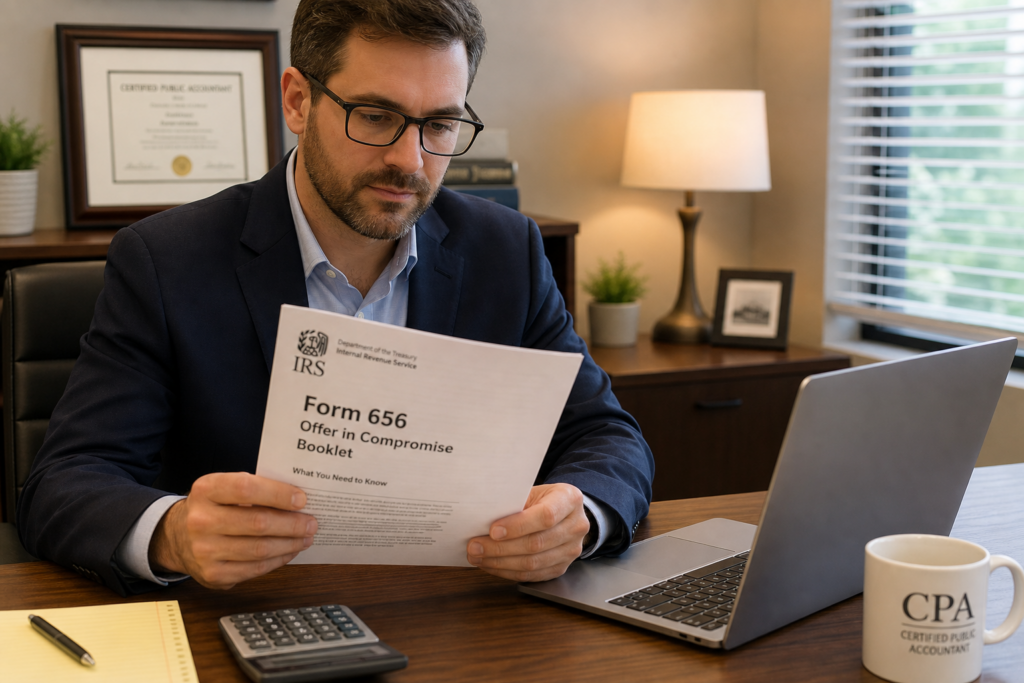
IRS Form 656 Offer in Compromise Guide for 2026
This IRS Form 656 offer in compromise guide helps tax pros turn resolution work into premium revenue. An offer in compromise (OIC) lets a client settle tax debt for less than the full amount owed. In 2026, IRS staffing cuts and AI-driven collections have flooded firms with distressed clients. Therefore, mastering this IRS Form 656 offer in compromise guide is a smart way to grow your advisory practice. Let’s break it down step by step.
Table of Contents
- Key Takeaways
- What Is an IRS Offer in Compromise?
- Who Qualifies for IRS Form 656 in 2026?
- How Do You Complete and Submit IRS Form 656?
- How Much Should Your Client Offer the IRS?
- How Can Tax Pros Build a Resolution Service?
- Uncle Kam in Action
- Related Resources
- Next Steps
- Frequently Asked Questions

Key Takeaways
- Form 656 lets clients settle IRS tax debt for less than they owe.
- The 2026 application fee is $205, with a low-income waiver available.
- The IRS uses three offer types based on collectibility, liability, or hardship.
- Offers not decided within 24 months are deemed accepted by law.
- Resolution work is a high-margin advisory service you can systematize.
What Is an IRS Offer in Compromise?
Quick Answer: An offer in compromise is a formal agreement. It lets a taxpayer settle debt for less than the full balance owed.
An offer in compromise, filed on Form 656, is the IRS settlement program. In short, your client asks the IRS to accept a reduced payment. Then the remaining balance is forgiven once terms are met. For many firms, this is the entry point to a strong proactive tax strategy service. Moreover, the demand is huge right now.
Why is demand rising? The IRS lost roughly 25% of its workforce in 2025, dropping from about 103,000 to 77,000 employees. Meanwhile, the agency now runs 126 active AI use cases for audit and collection. As a result, notices arrive faster, but resolution takes longer. You can read the official program details on the IRS offer in compromise page.
The Three Types of Offers
The IRS accepts offers under three legal grounds. Furthermore, choosing the right one is the heart of good strategy.
- Doubt as to Collectibility: The client cannot pay the full amount.
- Doubt as to Liability: A genuine dispute exists over the amount owed.
- Effective Tax Administration: Payment would cause economic hardship.
Why This Matters for Business Owners
Many of your clients are stressed small business owners facing tax debt. In addition, they often mix payroll and income tax problems. Therefore, a clean OIC can save a business and a client relationship at the same time.
Pro Tip: Most accepted offers use doubt as to collectibility. Focus your intake screening there first.
Who Qualifies for IRS Form 656 in 2026?
Quick Answer: A client qualifies if they filed all returns, made required payments, and are not in bankruptcy.
Not every taxpayer can file this IRS Form 656 offer in compromise guide request. First, the client must be current on all filing duties. Second, they must have made any required estimated payments. Third, they cannot be in an open bankruptcy case. You can confirm each rule using the free IRS OIC Pre-Qualifier tool.
The Basic Eligibility Checklist
Run every prospect through this list before you quote a fee. Consequently, you protect your time and set clear expectations.
- All federal tax returns are filed and up to date.
- Current-year estimated payments are made in full.
- The client has received at least one balance-due bill.
- No open bankruptcy proceeding exists.
Self-Employed and 1099 Clients
Your self-employed and 1099 contractor clients often fall behind on quarterly taxes. As a result, they carry large balances plus penalties. However, they must resume estimated payments before an offer will be considered. Otherwise, the IRS returns the offer without review.
Pro Tip: Verify filing compliance with an IRS transcript pull first. This one step prevents most rejections.
Comparing Offer Types at a Glance
| Offer Type | Best Client Fit | Key Proof Needed |
|---|---|---|
| Doubt as to Collectibility | Low assets and income | Form 433-A (OIC) financials |
| Doubt as to Liability | Disputed assessment | Form 656-L plus records |
| Effective Tax Administration | Hardship despite assets | Special circumstance proof |
How Do You Complete and Submit IRS Form 656?
Quick Answer: Gather financials, complete the 656-B booklet, pay the $205 fee, and mail the full package.
The submission package is more than one form. In fact, most rejections come from missing documents. Download the current Form 656-B booklet from IRS.gov for full instructions. For deeper procedural help, our Form 656 resource for tax professionals walks through each step for 2026.
Step-by-Step Filing Process
Follow these steps in order. Likewise, keep a copy of everything you send.
- Confirm compliance and pull IRS transcripts.
- Complete Form 433-A (OIC) or 433-B (OIC) for financials.
- Calculate the offer amount and payment plan.
- Complete Form 656 and sign it.
- Include the $205 fee and the initial payment.
- Mail the full package to the correct IRS unit.
The 2026 Fees and Payment Options
For 2026, the application fee is $205. However, low-income taxpayers can request a waiver. In addition, clients pick one of two payment paths. Each path affects the initial deposit.
- Lump Sum Cash: Pay 20% down, then the balance in five or fewer payments.
- Periodic Payment: Make monthly payments while the IRS reviews the offer.
Did You Know? If the IRS does not decide within 24 months, the offer is deemed accepted by law.
This 24-month rule matters more in 2026. Because staffing is thin, review times have stretched out. Therefore, careful tracking of the deadline protects your client’s rights. Proper documentation is also part of a strong tax filing and compliance workflow.
How Much Should Your Client Offer the IRS?

Quick Answer: The offer must equal or exceed the reasonable collection potential, or RCP.
Reasonable collection potential, or RCP, is the core number. In simple terms, it is what the IRS believes it can collect. The formula adds two pieces together. First, it counts net equity in assets. Second, it adds future monthly income for a set period.
A Simple RCP Calculation
Let’s walk through a clear example. Suppose a client owes $90,000 in back taxes. Then we build the RCP number step by step.
- Net asset equity equals $8,000.
- Monthly disposable income equals $300.
- Lump sum multiplier equals 12 months.
- Future income value equals $3,600.
- Total RCP equals $11,600.
In this case, an offer near $11,600 could settle a $90,000 debt. That result changes a client’s life. As a result, your fee feels like a bargain to them. You can find allowable expense standards on the IRS Collection Financial Standards page.
Common Costly Mistakes
Avoid these frequent errors. Otherwise, the IRS may return or reject the offer.
- Overstating allowable living expenses.
- Forgetting the $205 fee or initial payment.
- Missing an estimated tax payment mid-review.
Pro Tip: Model two or three RCP scenarios before you file. This shows clients the full range of outcomes.
How Can Tax Pros Build a Resolution Service?
Quick Answer: Package OIC work as a fixed-fee advisory service with clear stages and deliverables.
Tax prep is a commodity. Resolution advisory is not. Therefore, this is where solo practitioners grow real revenue. Instead of billing by the hour, sell a defined outcome. Then price the value, not the paperwork. This mindset shift is central to modern tax advisory services for firms.
Systematize Your Intake and Delivery
A repeatable system lets you scale without burnout. Consequently, you can serve more clients with less stress. Build three simple stages into your firm.
- Discovery: Pull transcripts and run the pre-qualifier.
- Strategy: Model RCP and pick the best offer type.
- Delivery: File the package and manage the timeline.
The biggest friction for pros is proving value before a client signs. Many tools cap analyses or charge per report. In contrast, Uncle Kam gives you tax planning software with unlimited assessments. So you can run a client-ready analysis on every prospect for free. Then you close more engagements with confidence.
Price for the Value You Deliver
A resolution that erases $80,000 of debt is worth thousands. Ready to grow this service line? Book a strategy session with Uncle Kam to map your rollout. Firms serving high-net-worth clients with complex debt can charge premium fees for this work.
| Service Model | Typical Revenue | Scalability |
|---|---|---|
| Hourly billing | Low and capped | Poor |
| Fixed-fee resolution | $3,500 to $7,500+ | Strong |
Uncle Kam in Action: The Solo CPA Who Built a $180K Resolution Line
Client Snapshot: Maria is a solo CPA in a mid-size city. She ran a busy prep practice with thin margins.
Financial Profile: Her firm grossed about $220,000 a year. Yet she worked 60-hour weeks during tax season.
The Challenge: Clients kept asking for help with IRS debt. However, Maria felt unsure about Form 656 pricing and process. As a result, she referred that work away and lost the revenue.
The Uncle Kam Solution: Maria joined Uncle Kam to systematize her resolution work. First, she used the platform to run unlimited free assessments on prospects. Then she followed a clear intake, strategy, and delivery workflow. Moreover, weekly coaching taught her how to price and sell the service. She built a fixed-fee package around this IRS Form 656 offer in compromise guide framework.
The Results: In her first year, Maria closed 30 resolution engagements. Furthermore, she charged an average of $6,000 per client.
- New Revenue: $180,000 in added service income.
- Investment: Roughly $6,000 in platform and coaching fees.
- First-Year ROI: About 30x on her investment.
Today Maria works fewer hours and earns far more. In addition, she loves the impact on her clients. See more stories like hers on our client results and case studies page.
Related Resources
- The MERNA Method for tax planning
- Latest tax strategy blog articles
- Business solutions for growing firms
Next Steps
Ready to add resolution work to your firm? Take these clear actions now.
- Screen five current clients with the IRS pre-qualifier.
- Build a simple fixed-fee resolution package.
- Explore entity structuring options for affected business clients.
- Book a strategy session to launch your service.
This information is current as of 7/8/2026. Tax laws change frequently. Verify updates with the IRS if reading this later.
Frequently Asked Questions
How much is the Form 656 application fee in 2026?
The 2026 application fee is $205. However, low-income taxpayers can request a fee waiver. In that case, the initial payment may also be waived.
How long does the IRS take to decide?
Reviews often take six to 24 months. Moreover, 2026 staffing cuts have slowed timelines. If the IRS does not decide within 24 months, the offer is deemed accepted.
What happens if the IRS rejects the offer?
Your client can appeal within 30 days. Use Form 13711 to request an appeal. Meanwhile, review the rejection reasons carefully before you refile.
Can a business file an offer in compromise?
Yes, businesses can use Form 656 and Form 433-B (OIC). However, the business must be current on federal tax deposits. Otherwise, the IRS returns the offer.
Is resolution work worth adding to my firm?
Absolutely. Fixed-fee resolution can earn $3,500 to $7,500 per client. Furthermore, demand is high due to faster IRS collection notices in 2026.
Last updated: July, 2026

