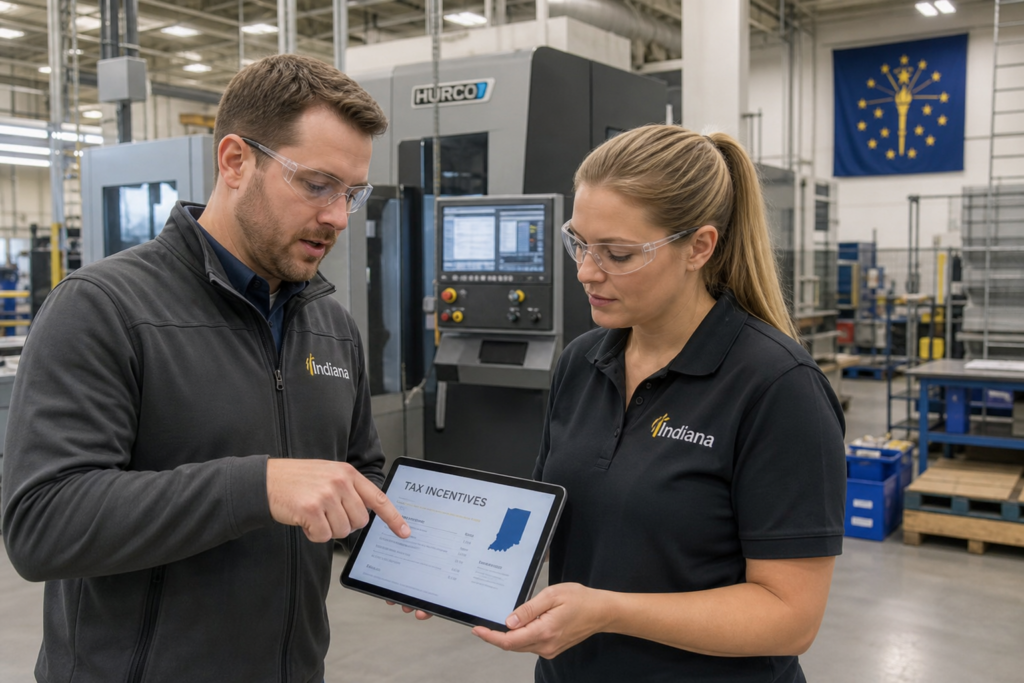
Indiana Manufacturing Tax Incentives 2026: Complete Guide for Business Owners
For the 2026 tax year, savvy manufacturers can stack powerful Indiana manufacturing tax incentives with generous federal deductions to slash their effective tax rate. Whether you run a plant near Indianapolis or plan a new facility, our Indiana tax preparation services help you capture every dollar. These Indiana manufacturing tax incentives reward capital investment, job creation, and equipment purchases in ways that directly boost cash flow.
Table of Contents
- Key Takeaways
- What Manufacturing Tax Incentives Are Available in Indiana in 2026?
- How Do Indiana’s Performance-Based Tax Credits Work?
- How Can Federal Section 179 and Bonus Depreciation Boost Savings?
- Who Qualifies for Indiana Manufacturing Tax Incentives?
- How Do You Apply for Indiana Manufacturing Incentives?
- Uncle Kam in Action
- Related Resources
- Next Steps
- Frequently Asked Questions
Key Takeaways
- Indiana offers performance-based credits, property tax abatements, and sales tax exemptions for manufacturers.
- For 2026, the federal Section 179 limit reaches $2,560,000 on qualifying equipment.
- Under OBBBA, 100% bonus depreciation is now permanent for 2026 purchases.
- Most state incentives require job creation, wage, or capital investment commitments.
- Proactive planning combines state and federal benefits for maximum savings.
What Manufacturing Tax Incentives Are Available in Indiana in 2026?
Quick Answer: Indiana manufacturing tax incentives include performance-based tax credits, property tax abatements, sales tax exemptions, and training grants. Most reward investment and job creation.
Indiana consistently ranks among the most business-friendly states for manufacturing. As a result, the state offers a layered set of incentives designed to attract capital investment. These programs run primarily through the Indiana Economic Development Corporation (IEDC). Furthermore, local governments add their own property tax abatements and infrastructure support.
Manufacturers can combine several programs at once. However, each incentive carries its own eligibility rules and reporting requirements. Therefore, understanding the full menu helps you build a smart capital plan. A well-structured approach starts with the right business entity structure to hold your operations and assets.
State-Level Incentive Programs
Indiana’s core incentives target companies that expand payroll and invest in equipment. Consequently, manufacturers see the biggest benefits when they combine hiring with capital spending. Common programs include:
- Economic Development for a Growing Economy (EDGE) payroll tax credits.
- Hoosier Business Investment (HBI) tax credits for capital investment.
- Skills Enhancement Fund (SEF) training reimbursements.
- Manufacturing equipment sales tax exemptions.
Local Property Tax Abatements
Cities and counties can grant phased property tax abatements on new real and personal property. In addition, these abatements often run five to ten years. As a result, manufacturers pay reduced property tax while ramping up production. Local economic development offices negotiate these deals directly. You can review the Indiana Department of Local Government Finance for abatement rules and forms.
Pro Tip: Negotiate abatements before you purchase land. Local officials have more flexibility early in your project.
Manufacturers who work with experienced advisors capture more value. Our proactive tax strategy services help you sequence these incentives correctly. Moreover, a coordinated plan avoids costly compliance mistakes down the road.
How Do Indiana’s Performance-Based Tax Credits Work?
Quick Answer: Performance-based credits like EDGE reward companies only after they hit agreed job and wage targets. You earn credits as you deliver results.
Performance-based tax credits are the backbone of Indiana’s incentive strategy. Unlike upfront grants, these credits pay out over time. Consequently, the state protects taxpayers while rewarding real growth. The EDGE credit, for example, is calculated on new payroll taxes generated by qualifying jobs.
Manufacturers negotiate these agreements with the IEDC before starting a project. Therefore, timing matters enormously. If you announce your expansion first, you may lose eligibility. Business owners planning growth should review our guidance for tax planning for business owners early in the process. You can also connect with a Tax Preparation Near Me in Indiana specialist to structure the agreement.
EDGE Payroll Tax Credits Explained
The EDGE credit ties directly to the income tax withholdings of new employees. As you add qualified jobs, you earn a percentage of that new withholding. Furthermore, the credit is refundable in many cases. This structure makes EDGE especially valuable for labor-intensive manufacturing.
Hoosier Business Investment Credits
The HBI credit rewards capital investment rather than payroll. Manufacturers earn a percentage of qualified capital expenditures as a credit against state tax. In addition, HBI works well alongside federal depreciation strategies. As a result, equipment-heavy operations benefit the most.
Did You Know? Indiana’s flat corporate income tax rate makes credit modeling more predictable than in many states.
The table below compares Indiana’s leading performance-based programs. Use it to match your project type to the right incentive.
| Program | Rewards | Best For | Admin Agency |
|---|---|---|---|
| EDGE | New payroll | Job creation | IEDC |
| HBI | Capital investment | Equipment purchases | IEDC |
| SEF | Training costs | Workforce upskilling | IEDC |
| Abatement | Property tax relief | New facilities | Local government |
How Can Federal Section 179 and Bonus Depreciation Boost Savings?
Quick Answer: For 2026, Section 179 allows up to $2,560,000 in immediate write-offs. Additionally, 100% bonus depreciation is now permanent under OBBBA.
State incentives are only half the story. Federal depreciation rules deliver enormous savings for manufacturers buying equipment. For the 2026 tax year, the IRS Section 179 deduction limit reaches $2,560,000. This lets you deduct qualifying equipment costs in the year of purchase.
In addition, the One Big Beautiful Bill Act (OBBBA) made 100% bonus depreciation permanent. As a result, purchases that exceed the Section 179 cap can still be fully expensed. Consequently, 2026 is an exceptional year for capital-intensive manufacturers. Review the current IRS 2026 inflation adjustments before finalizing purchases.
A 2026 Equipment Purchase Example
Consider a manufacturer buying $2,750,000 of new machinery in 2026. First, Section 179 covers $2,560,000 of the cost immediately. Next, 100% bonus depreciation covers the remaining $190,000. Therefore, the full $2,750,000 becomes deductible in year one. At a 35% effective rate, that generates roughly $962,500 in tax savings.
| Item | 2026 Amount |
|---|---|
| Equipment purchase | $2,750,000 |
| Section 179 deduction | $2,560,000 |
| Bonus depreciation | $190,000 |
| Total first-year deduction | $2,750,000 |
| Estimated tax savings (35%) | $962,500 |
Layering the QBI Deduction
Pass-through manufacturers can also claim the 20% Qualified Business Income deduction. For 2026, phase-in limits begin at $201,775 for single filers and $403,500 for joint filers. However, these thresholds interact with wages and property. Therefore, careful modeling matters. Our ongoing tax advisory support keeps these moving parts aligned.
Pro Tip: Large deductions can create net operating losses. Plan carryforwards to smooth taxable income across years.
Who Qualifies for Indiana Manufacturing Tax Incentives?
 Free Tax Write-Off Finder
Quick Answer: Manufacturers creating jobs, raising wages, or investing capital typically qualify. Most Indiana manufacturing tax incentives require measurable commitments.
Eligibility depends heavily on the specific program. However, most Indiana manufacturing tax incentives share common requirements. Generally, the state wants to see net new jobs, competitive wages, and meaningful capital investment. Furthermore, projects must be based in Indiana and remain there for a set period.
High-growth and high-income owners often layer these benefits with other strategies. Consequently, our advanced strategies for high-net-worth clients help align entity and incentive planning. Manufacturers should confirm their eligibility with the Indiana Economic Development Corporation directly.
Common Eligibility Requirements
- Create a minimum number of net new full-time jobs.
- Pay wages at or above the county average.
- Commit to a defined capital investment amount.
- Maintain operations in Indiana through the credit term.
Clawback and Compliance Risks
Incentive agreements include clawback provisions. If you miss job or investment targets, the state can recapture credits. Therefore, accurate tracking is essential. Manufacturers must file annual compliance reports on time. Strong bookkeeping and reporting systems reduce this risk significantly.
How Do You Apply for Indiana Manufacturing Incentives?
Quick Answer: Apply before announcing your project. First contact the IEDC, then negotiate terms, and finally sign a formal agreement.
Timing is the single most important factor in the application process. Indiana requires that incentives influence your decision. As a result, you must apply before publicly committing to the project. Otherwise, you risk disqualification entirely.
Step-by-Step Application Process
- Contact the IEDC and local economic development office early.
- Submit project details, including jobs, wages, and investment.
- Negotiate credit amounts and performance milestones.
- Sign the formal incentive agreement before starting work.
- File annual compliance reports to claim earned credits.
Coordinating Federal and State Filings
Your federal depreciation elections affect your state tax base too. Therefore, coordinate Section 179 and bonus depreciation with your Indiana credits. Manufacturers should also review the IRS Form 4562 depreciation guidance for proper reporting. Our tax preparation and filing team handles both layers seamlessly. Before your Next Steps, consider a review with a local Indiana tax specialist to align your filings.

Uncle Kam in Action: Indiana Manufacturer Saves Big in 2026
Client Snapshot: A family-owned metal fabrication company based near Fort Wayne, Indiana. The business operates as an S corporation with two owners.
Financial Profile: Annual revenue reached $8.4 million in 2026. The owners planned a $2,750,000 equipment expansion and 22 new hires.
The Challenge: The owners nearly announced their expansion before applying for incentives. As a result, they almost forfeited state credits entirely. Furthermore, they had not modeled how federal depreciation would interact with their QBI deduction.
The Uncle Kam Solution: First, we paused the public announcement and filed with the IEDC. Next, we negotiated an EDGE payroll credit tied to the 22 new jobs. In addition, we secured a local property tax abatement on the new facility. Then, we structured a $2,750,000 first-year federal deduction using the 2026 Section 179 limit of $2,560,000 plus 100% bonus depreciation. Finally, we coordinated the QBI deduction around the 2026 phase-in thresholds.
The Results: The combined strategy delivered substantial savings.
- Tax Savings: $412,000 in combined state and federal savings for 2026.
- Investment: $34,000 in Uncle Kam advisory fees.
- Return on Investment: Roughly 12x in the first year.
This outcome shows the power of coordinated planning. See more wins on our client results page. Consequently, the owners reinvested their savings into further growth.
Related Resources
- Uncle Kam Tax Guides Library
- The MERNA Tax Method Explained
- Latest Tax Strategy Blog Posts
- Free Tax Planning Calculators
Next Steps
- Contact the IEDC before announcing any expansion plans.
- Model your 2026 Section 179 and bonus depreciation savings early.
- Schedule a review with our tax strategy team today.
- Build compliance tracking systems before claiming credits.
This information is current as of 8/3/2026. Tax laws change frequently. Verify updates with the IRS or Indiana Department of Revenue if reading this later. This is not legal or tax advice; consult a professional.
Frequently Asked Questions
Do Indiana manufacturing tax incentives require job creation?
Most do. However, some capital investment programs focus on equipment instead. Therefore, review each program’s specific eligibility rules carefully before applying.
Can I combine state credits with federal Section 179?
Yes. In fact, combining them maximizes savings. For 2026, Section 179 allows up to $2,560,000 in immediate deductions alongside your state credits.
When should I apply for Indiana incentives?
Apply before announcing your project. The state requires incentives to influence your decision. Consequently, early applications protect your eligibility.
How much can a manufacturer realistically save?
Savings vary by project size. However, a $2,750,000 equipment purchase can generate roughly $962,500 in federal savings for 2026 at a 35% rate.
What happens if I miss my job targets?
Clawback provisions apply. The state can recapture earned credits. Therefore, accurate compliance tracking is essential throughout the agreement term.
Is 100% bonus depreciation still available in 2026?
Yes. Under OBBBA, 100% bonus depreciation is now permanent. As a result, 2026 remains an excellent year for capital investment.
Last updated: August, 2026

