Independent Contractor Collection Procedures: 2026 Guide
Independent Contractor Collection Procedures: 2026 Complete Guide
Understanding independent contractor collection procedures is critical for every 1099 worker in 2026. The IRS uses a structured, step-by-step process to collect unpaid taxes from freelancers and self-employed professionals — and missing a step can result in liens, levies, or wage garnishments. This guide breaks down every stage of that process so you can stay compliant, respond correctly, and protect your income.
Table of Contents
- Key Takeaways
- Why Do Independent Contractor Collection Procedures Matter in 2026?
- How Does the IRS Find Out About Unpaid Contractor Taxes?
- What Are the Steps in the IRS Collection Process for Independent Contractors?
- What Is a Federal Tax Lien and How Does It Affect You?
- What Is a Tax Levy and Can It Happen to Independent Contractors?
- How Can Independent Contractors Resolve Tax Debt with the IRS?
- How Do 2026 Quarterly Payment Rules Affect Contractor Collections?
- Uncle Kam in Action: From IRS Notice to Zero Balance
- Next Steps
- Related Resources
- Frequently Asked Questions
Key Takeaways
- For 2026, independent contractors pay a 15.3% self-employment tax on net income.
- The IRS follows a clear process: notice, lien, and then levy when taxes go unpaid.
- Responding to every IRS notice within the stated deadline is non-negotiable.
- Payment plans and Offers in Compromise are available to reduce or spread out tax debt.
- New 2026 estimated tax safe harbor rules protect contractors who pay correctly each quarter.
Why Do Independent Contractor Collection Procedures Matter in 2026?
Quick Answer: In 2026, the IRS uses expanded AI and data analytics to identify unpaid contractor taxes faster. Knowing how collection procedures work helps you respond quickly and avoid serious consequences.
If you work as an independent contractor, you are responsible for paying your own taxes. There is no employer to withhold taxes from your paycheck. Furthermore, the IRS expects you to pay taxes throughout the year — not just at filing time. When those payments are missed or short, the IRS begins a formal collection sequence.
In 2026, this process is more automated than ever. The House Appropriations Committee approved expanded use of artificial intelligence and data analytics to handle IRS enforcement. As a result, the IRS can now identify discrepancies between 1099-NEC filings and tax returns faster than before. This means independent contractor collection procedures are triggered more quickly — and with less warning.
Who Is Most at Risk?
Freelancers, rideshare drivers, gig workers, consultants, and other 1099 earners face the highest risk of entering the IRS collection process. This happens for several reasons:
- No automatic tax withholding from clients or platforms
- Irregular income makes it hard to estimate quarterly payments
- Many new contractors do not realize they owe self-employment tax
- Missing even one quarterly deadline triggers penalties and interest
For 2026, the IRS Self-Employed Tax Center remains the best starting point for understanding your obligations. However, if you are already behind, you need to understand the full collection process — and act fast.
Pro Tip: Working with a trusted Delaware tax preparer before you receive any IRS notice gives you the best chance of resolving issues before they escalate.
How Does the IRS Find Out About Unpaid Contractor Taxes?
Quick Answer: Clients report your income on Form 1099-NEC. The IRS matches that data to your return. Any mismatch triggers an automatic notice or audit flag.
The IRS data-matching program is one of the most powerful enforcement tools in the agency’s arsenal. Every client who pays you $600 or more for services in 2026 must send you — and the IRS — a Form 1099-NEC. The IRS then cross-references those forms with your filed tax return.
The 1099-NEC Matching System
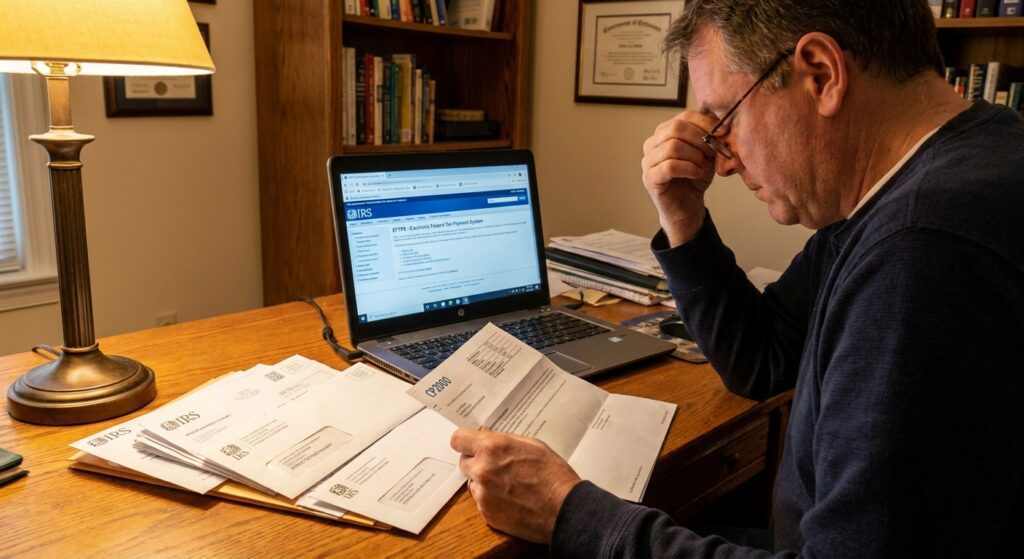
When your reported income does not match the 1099-NEC forms the IRS received from your clients, a discrepancy notice is automatically generated. This is often a CP2000 notice — a notice proposing changes to your return. You do not need to be audited for this to happen. The system runs automatically and can catch income you forgot to report, even by accident.
In addition to 1099-NEC matching, the IRS also uses:
- Bank deposit analysis — Large deposits can trigger review if not explained by filed returns
- Payment platform reports — Platforms like PayPal, Venmo, and others now report earnings
- AI-driven audit selection — The 2026 IRS enforcement expansion uses AI to identify high-risk returns
- State income tax reporting — State agencies share data with the federal IRS
What Triggers a Collection Action?
Collection actions begin when a balance is assessed and goes unpaid. A balance can be assessed after:
- You file a return with a balance due and do not pay it
- The IRS processes a CP2000 notice and you agree or do not respond
- An audit results in additional taxes owed
- The IRS files a Substitute for Return (SFR) when you do not file at all
The IRS collection process does not begin overnight. However, it moves faster than most contractors expect. Therefore, acting on any notice within the stated deadline is essential. Our tax prep and filing specialists can help you respond correctly to any IRS correspondence before it escalates.
What Are the Steps in the IRS Collection Process for Independent Contractors?
Quick Answer: The IRS follows five core steps: balance assessment, initial notice, escalated notices, federal tax lien filing, and then a levy. Each step gives you a chance to respond and resolve the debt.
Understanding the independent contractor collection procedures step by step gives you a significant advantage. Here is how the IRS process unfolds in 2026:
Step 1: CP14 Balance Due Notice
The first notice you receive is typically a CP14 — a balance due notice. According to the IRS Taxpayer Advocate Service, the CP14 tells you that you owe money and requests payment within 21 days. This is your first opportunity to respond and avoid further escalation.
If you receive a CP14, take these actions immediately:
- Verify the balance is correct — review your 2026 return carefully
- Pay the full amount if possible using IRS Direct Pay
- Contact the IRS or a tax professional if you cannot pay in full
- Do not ignore the notice — silence escalates the process automatically
Step 2: Escalated Collection Notices
If you do not respond to the CP14, the IRS sends escalating notices. These include the CP501, CP503, and CP504. Each notice becomes more urgent. Moreover, each adds accruing penalties and interest to your balance.
The CP504 is particularly important. It is the final notice before the IRS files a federal tax lien or issues a levy. It also notifies you that the IRS intends to seize state tax refunds if you have any owed. At this stage, you still have rights — but they narrow quickly.
Step 3: Notice of Intent to Levy (Letter 1058 / LT11)
Before the IRS can legally seize your assets, it must send a Final Notice of Intent to Levy. This is either Letter 1058 or LT11. Importantly, this notice also informs you of your right to a Collection Due Process (CDP) hearing before an independent IRS appeals officer. You have 30 days from the date of this letter to request a CDP hearing.
Requesting a CDP hearing is a powerful tool. It temporarily stops the levy process while your case is reviewed. Furthermore, it gives you the opportunity to propose alternatives — such as an installment agreement or an Offer in Compromise.
Pro Tip: The 30-day window to request a CDP hearing after receiving Letter 1058 is one of your most important taxpayer rights. Missing this deadline removes your ability to appeal before a levy is issued. Consult a tax advisor immediately upon receiving this letter.
| IRS Notice | What It Means | Your Deadline |
|---|---|---|
| CP14 | First balance due notice | 21 days to pay |
| CP501 | Reminder — balance still owed | Respond promptly |
| CP503 | Urgent — immediate action needed | Respond immediately |
| CP504 | Final notice — state refund seizure warning | Act before lien is filed |
| LT11 / Letter 1058 | Final notice before levy — CDP rights | 30 days to request hearing |
What Is a Federal Tax Lien and How Does It Affect You?
Quick Answer: A federal tax lien is a legal claim the IRS places on all your property — including your business assets and future income — when you do not pay a tax debt. It damages your credit and limits your financial options.
A federal tax lien is not the same as a levy. However, it is a serious legal action that attaches to everything you own. This includes your bank accounts, real estate, car, business equipment, and even future income from clients. Independent contractors are especially vulnerable because their income comes from multiple clients — all of which the lien can touch.
How a Tax Lien Is Filed
The IRS files a Notice of Federal Tax Lien (NFTL) with your local county or state recording office. This makes your tax debt a matter of public record. As a result, lenders, clients, and other parties can see that you owe the IRS. This can directly hurt your ability to:
- Secure business loans or lines of credit
- Sign contracts with larger corporate clients
- Refinance your home or property
- Sell assets without satisfying the lien first
How to Remove a Federal Tax Lien
The IRS will release a tax lien within 30 days of:
- Paying the tax debt in full
- The debt becoming legally unenforceable (statute of limitations expires)
- Accepting a bond equal to the amount of the debt
In some cases, you may qualify for a lien withdrawal or lien discharge on specific property. These options require formal requests and IRS approval. A qualified tax advisor can help you determine which option applies to your situation.
Did You Know? Independent contractors who enter a Direct Debit Installment Agreement may be able to get a lien withdrawn even before paying the debt in full. Ask your tax professional about this option as part of your resolution strategy.
What Is a Tax Levy and Can It Happen to Independent Contractors?
 Free Tax Write-Off Finder
Quick Answer: Yes. A tax levy is the actual seizure of your assets or income. It is more serious than a lien and can include bank levies, receivables levies (on your client payments), and seizure of physical assets.
A tax levy is the IRS’s most powerful collection tool. Unlike a lien, which is a legal claim, a levy is a direct legal seizure of your property. For independent contractors, this is especially dangerous because the IRS can levy the money clients owe you — before it even reaches your bank account.
Types of Levies That Affect Contractors
There are several types of IRS levies that independent contractors face:
- Bank levy: The IRS freezes your bank account and seizes funds equal to the balance owed
- Accounts receivable levy: The IRS notifies your clients to pay them instead of you
- Property seizure: The IRS can physically seize business equipment, vehicles, or other assets
- Continuous wage levy: If you also have W-2 income, the IRS can garnish a portion of each paycheck
How to Stop an IRS Levy
The IRS must release a levy if any of the following conditions are met:
- You pay the tax debt in full
- The levy creates an economic hardship that prevents you from meeting basic living expenses
- You enter an installment agreement that prohibits the levy
- An Offer in Compromise is pending or accepted
- The statute of limitations on collection expires (generally 10 years)
For the 2026 tax year, review your rights under IRS Publication 1: Your Rights as a Taxpayer to understand what the IRS can and cannot do during collection. Use our Small Business Tax Calculator to estimate your 2026 liability and plan your payments proactively.
How Can Independent Contractors Resolve Tax Debt with the IRS?
Quick Answer: You have four main options: pay in full, set up an installment agreement, submit an Offer in Compromise, or apply for Currently Not Collectible status. Each has different eligibility rules and impacts.
Facing the IRS is stressful. However, the agency does offer structured paths to resolution. Knowing your options is the first step. The key is to act before the IRS escalates to a lien or levy. If you are already past that point, these options can still stop further enforcement. Working with a proactive tax strategy team gives you the best chance of a favorable outcome.
Option 1: Installment Agreement
An installment agreement lets you pay your tax debt in monthly payments. The IRS offers several types:
- Streamlined Installment Agreement: For debts under $50,000; up to 72 monthly payments; no financial statement required
- Non-Streamlined Agreement: For larger debts; requires Form 433-A or 433-B and detailed financial disclosure
- Direct Debit Agreement: Automatic monthly withdrawals; can qualify for lien withdrawal in some cases
While in an installment agreement, penalties and interest continue to accrue. Consequently, paying more than the minimum each month is always the smarter move. Additionally, you must stay current on future tax filings and estimated payments to keep the agreement active.
Option 2: Offer in Compromise
An Offer in Compromise (OIC) allows you to settle your tax debt for less than the full amount owed. The IRS considers your ability to pay, income, expenses, and asset equity. For 2026, the IRS still follows the same three grounds for acceptance:
- Doubt as to liability: You dispute the tax amount itself
- Doubt as to collectibility: Your assets and income cannot cover the full debt
- Effective tax administration: Paying in full creates economic hardship or is otherwise unfair
Not everyone qualifies for an OIC. The IRS rejects offers it considers too low or when it believes you can pay in full. However, for contractors with significant debt relative to their income, an OIC can be a powerful resolution tool. Visit IRS.gov’s official Offer in Compromise page to check your eligibility.
Option 3: Currently Not Collectible (CNC) Status
If you truly cannot afford to pay anything, the IRS can place your account in Currently Not Collectible status. This temporarily suspends collection activities. However, it does not reduce or eliminate your debt — and the statute of limitations on collection keeps running. Therefore, CNC status is best used as a short-term measure while you improve your financial situation.
Option 4: Penalty Abatement
If this is your first time owing taxes or you have a clean compliance history, you may qualify for First-Time Penalty Abatement. This removes the failure-to-pay or failure-to-file penalties on your account. It does not remove interest, but it can meaningfully reduce your balance. You can request this by calling the IRS or submitting a written request. A qualified Delaware tax preparer can handle this request on your behalf.
| Resolution Option | Best For | Stops Levy? | Reduces Debt? |
|---|---|---|---|
| Installment Agreement | Manageable monthly payments | Yes | No |
| Offer in Compromise | Low income vs. high debt | Yes (while pending) | Yes |
| Currently Not Collectible | Extreme financial hardship | Yes (temporarily) | No |
| Penalty Abatement | First-time non-compliance | No | Partially |
How Do 2026 Quarterly Payment Rules Affect Contractor Collections?
Quick Answer: For 2026, the IRS introduced updated safe harbor rules and revised penalty structures for estimated tax payments. Paying correctly each quarter is the most effective way to avoid the entire collection process.
The most powerful way to avoid independent contractor collection procedures is to prevent the debt from occurring in the first place. For 2026, significant changes to estimated tax rules are reshaping how independent contractors approach their quarterly tax obligations. These changes include updated calculation methods, new safe harbor provisions, and revised penalty structures.
2026 Quarterly Estimated Tax Due Dates
For the 2026 tax year, the quarterly estimated tax payment due dates are:
- Q1 (January–March): April 15, 2026
- Q2 (April–May): June 15, 2026
- Q3 (June–August): September 15, 2026
- Q4 (September–December): January 15, 2027
Missing any of these deadlines results in an underpayment penalty. The penalty is based on the amount underpaid and how long it went unpaid. Furthermore, underpayment penalties are separate from the failure-to-pay penalties that apply after filing season. These are two distinct charges that can stack up quickly.
The 2026 Self-Employment Tax Rate
For 2026, the self-employment (SE) tax rate remains 15.3% on net self-employment income. This rate covers 12.4% for Social Security and 2.9% for Medicare. When you file Schedule SE (Form 1040), you calculate your full SE tax obligation and claim the deduction for half of it on your income tax return.
For a contractor earning $80,000 in net profit for 2026, here is how the SE tax calculation works:
- Net earnings for SE: $80,000 × 92.35% = $73,880
- SE Tax: $73,880 × 15.3% = $11,304
- Deductible half: $11,304 ÷ 2 = $5,652
This $5,652 deduction reduces your adjusted gross income on your 2026 federal return. However, you still owe the full $11,304 as SE tax. Failing to account for this is one of the most common triggers for the IRS collection process among independent contractors.
2026 Safe Harbor Rules for Estimated Payments
To avoid the underpayment penalty for 2026, you must meet one of three safe harbor thresholds:
- 100% of last year’s tax: Pay at least 100% of your 2025 tax liability throughout 2026 (110% if 2025 AGI exceeded $150,000)
- 90% of current year’s tax: Pay at least 90% of your 2026 total tax liability through withholding and estimated payments
- Annualized income method: Calculate payments based on actual income earned each quarter
Pro Tip: The annualized income method is especially useful for contractors with highly seasonal income. It lets you pay less in slow quarters and more in high-income quarters — without triggering underpayment penalties. Ask your tax strategist about this approach for 2026.
Independent contractors working in Delaware and surrounding states can take advantage of expert tax strategy planning to set the right estimated payment amounts each quarter — preventing collection issues before they start.

Uncle Kam in Action: From IRS Notice to Zero Balance
Client Snapshot: Marcus is a Delaware-based freelance web developer. He earned $95,000 in 2024 and $112,000 in 2025 working with several corporate clients. He had never made estimated tax payments and always paid at filing time. In early 2026, he received a CP503 notice — a second escalated IRS balance due notice — for $18,400 in unpaid 2025 taxes, penalties, and interest.
The Challenge: Marcus had spent his 2025 earnings on business expenses and personal costs. He could not pay the full $18,400 immediately. He was also worried that a federal tax lien would be filed and affect his ability to sign a new long-term contract with a technology firm. Time was critical.
The Uncle Kam Solution: Uncle Kam’s tax strategy team reviewed Marcus’s full financial picture and identified two opportunities. First, several business expenses had not been fully deducted on his 2025 return — reducing his actual tax liability by $2,100. Uncle Kam filed an amended return to capture those deductions. Second, Marcus qualified for a Streamlined Installment Agreement based on his total balance under $50,000. Uncle Kam negotiated a monthly payment of $385 over 48 months, which fit comfortably within Marcus’s cash flow.
Additionally, Uncle Kam applied for First-Time Penalty Abatement on Marcus’s behalf, since he had a clean compliance history prior to 2025. The IRS approved the abatement, removing $2,800 in penalty charges from his balance. Marcus’s total debt dropped from $18,400 to under $13,500 — a 27% reduction before his first payment was due.
The Results for 2026:
- Tax debt reduced: From $18,400 to approximately $13,500
- Monthly payment: $385 — within Marcus’s budget
- Levy avoided: No levy or lien filed — new client contract secured
- Forward plan: Set up quarterly estimated payments for 2026 to avoid any future collection issues
- ROI: Uncle Kam’s fee was $1,200; Marcus saved over $4,900 in penalties and reduced debt — a 4x return
Marcus’s story is common among independent contractors who do not understand the IRS collection timeline. Acting quickly — and with the right guidance — can make an enormous difference. View more Uncle Kam client results to see how we help 1099 workers nationwide.
Next Steps
Now that you understand the full scope of independent contractor collection procedures for 2026, take these concrete actions to protect yourself. If you have already received a notice or want to avoid one altogether, connect with the Uncle Kam self-employed tax specialists to get started today.
- Step 1: Calculate your 2026 SE tax liability using your current net income and the 15.3% rate.
- Step 2: Make your Q2 estimated payment by June 15, 2026 if you have not already done so.
- Step 3: If you received any IRS notice, respond before the stated deadline — do not wait.
- Step 4: Review your eligibility for a payment plan, OIC, or penalty abatement with a qualified tax advisor.
- Step 5: Explore your Uncle Kam tax advisory options to build a proactive strategy that prevents future collection issues.
This information is current as of 5/4/2026. Tax laws change frequently. Verify updates with the IRS or a qualified tax professional if reading this later.
Related Resources
- Self-Employed Taxes: Uncle Kam’s 1099 Resource Center
- Tax Strategy Services for Independent Contractors
- Tax Prep and Filing for Freelancers and 1099 Workers
- Free Tax Calculators for Self-Employed Professionals
- Frequently Asked Tax Questions: Uncle Kam FAQ Hub
Frequently Asked Questions
What happens if I ignore an IRS notice as an independent contractor?
Ignoring an IRS notice is the worst thing you can do. Each notice represents a step in the formal collection process. If you do not respond, the IRS automatically escalates to the next notice. Eventually, the agency files a federal tax lien against all your property. After that, it can issue a levy — seizing your bank accounts or intercepting payments from your clients. The entire process can move from first notice to levy in a matter of months. Act on every IRS notice within the stated deadline.
Can the IRS garnish payments from my clients as an independent contractor?
Yes. An accounts receivable levy allows the IRS to notify your clients directly and redirect your payments to the government instead of to you. This is one of the most disruptive forms of collection for independent contractors because it can cut off your income immediately. Unlike wage garnishments, which are capped by exemption amounts, an accounts receivable levy can seize 100% of what clients owe you. Entering a payment plan or Offer in Compromise before this stage is critical.
How much do I need to pay in estimated taxes to avoid IRS collection in 2026?
For 2026, you need to meet one of three safe harbor thresholds to avoid underpayment penalties. Pay 100% of your 2025 tax liability throughout the year (or 110% if your 2025 AGI exceeded $150,000). Alternatively, pay 90% of your actual 2026 total tax liability. If your income is irregular, use the annualized income method to calculate each quarterly payment based on what you actually earned that quarter. Meeting any one of these thresholds protects you from underpayment penalties — even if you owe a balance when you file.
Does an IRS installment agreement stop all collection activity?
Generally, yes. Once the IRS approves your installment agreement, it will not file additional liens or issue levies while the agreement is in good standing. However, any existing lien remains in place until you pay the debt in full or qualify for a lien withdrawal. To keep your installment agreement active, you must make all monthly payments on time, file all future tax returns on schedule, and pay any future balances due by their deadlines. Missing a payment or filing late can immediately default the agreement.
What is the Offer in Compromise pre-qualifier and should I use it?
The IRS Offer in Compromise Pre-Qualifier is a free online tool at IRS.gov that helps you determine whether you may be eligible for an OIC before you invest time in applying. It asks about your income, expenses, assets, and liabilities. If the tool suggests you may qualify, it provides a preliminary estimate of your offer amount. However, the pre-qualifier result is not a guarantee. The IRS makes its final decision based on a full review of your Form 656 and 433-A. Working with a tax professional to prepare your OIC application significantly improves your chances of acceptance.
How long does the IRS have to collect unpaid contractor taxes?
The IRS generally has 10 years from the date of assessment to collect a tax debt. This is called the Collection Statute Expiration Date (CSED). However, certain actions can pause or extend this window — including submitting an Offer in Compromise, requesting a CDP hearing, or being in bankruptcy. Filing for an installment agreement does not extend the CSED, but it does allow the IRS to continue collecting within the remaining statute period. Once the CSED expires, the IRS can no longer legally collect the debt.
Are there new 2026 tools to help independent contractors save for retirement while managing tax debt?
Yes. On April 30, 2026, President Trump signed an executive order establishing TrumpIRA.gov — a new government platform launching in January 2027 that specifically targets independent contractors, self-employed workers, and gig economy participants. The platform will provide access to high-quality, low-cost IRA options and help contractors assess eligibility for the Federal Saver’s Match, which provides up to $1,000 in federal matching contributions for qualifying IRA contributions. Contractors with MAGI of $20,500 or less qualify for the full $1,000 match. Importantly, contributing to an IRA also reduces your taxable income — which can lower future quarterly estimated tax obligations and reduce the risk of collection issues.
Last updated: May, 2026

