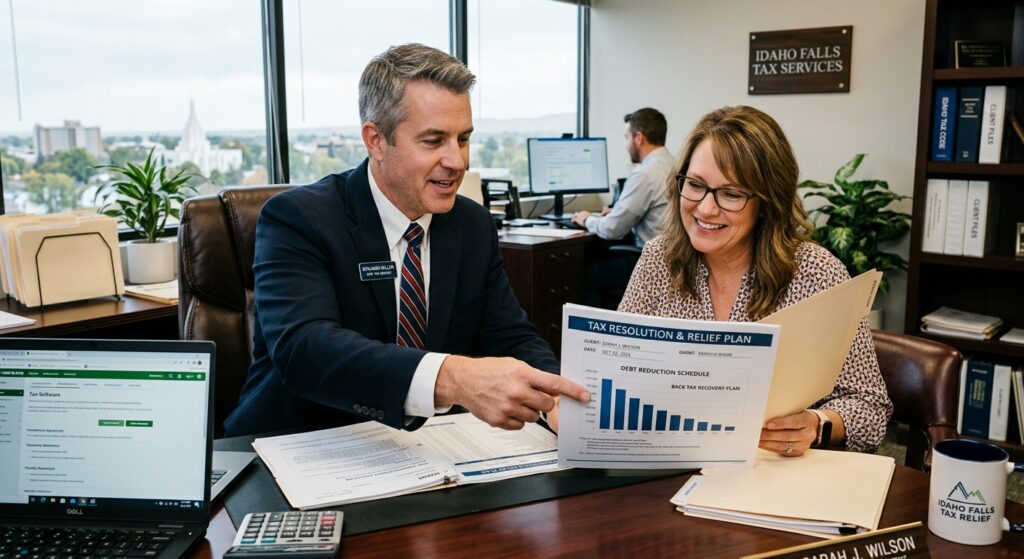
Idaho Falls Back Taxes Help: Complete 2026 Resolution Guide for Business Owners & Self-Employed
If you’re an Idaho Falls resident or business owner struggling with back taxes, you’re not alone—and help is available. Idaho Falls back taxes help has become more accessible than ever, especially with the city’s aggressive $800,000 motor vehicle tax recovery program launched in May 2025 and continuing strong through 2026. Whether you owe federal taxes, Idaho state taxes, or city-level obligations, a trusted tax preparation service in Idaho Falls can guide you through proven resolution strategies that minimize penalties and get you back in compliance. This guide explains your options, deadlines, and the specific steps to take if you’re facing back taxes in 2026.
Key Takeaways
- Idaho Falls back taxes help includes payment plans, penalty abatement, and the city’s vehicle registration compliance program.
- Back tax penalties in Idaho reach 9% interest annually plus 5% monthly late fees (maximum 25%).
- The IRS offers First-Time Penalty Abatement, Offers in Compromise, and installment agreements for federal back taxes.
- Federal tax liens and wage garnishment can occur if back taxes exceed $15,000 or remain unpaid.
- Business owners may qualify for estimated tax relief under 2026 safe harbor provisions.
Table of Contents
- What Counts as Back Taxes in Idaho Falls?
- How Idaho Falls Is Recovering Back Taxes Through Compliance Programs
- Step-by-Step: What to Do If You Owe Back Taxes
- Payment Plans, Penalties, and Relief Options
- Special Situations for Business Owners and Contractors
- When to Get Professional Help
- Uncle Kam in Action
- Next Steps
- Frequently Asked Questions
What Counts as Back Taxes in Idaho Falls?
Quick Answer: Back taxes include any unpaid federal income tax, Idaho state income tax, city property taxes, motor vehicle taxes, and payroll taxes for employers—plus accumulated interest and penalties.
Back taxes are simply taxes you were supposed to pay but didn’t by the filing or payment deadline. In the Idaho Falls area, back taxes typically fall into several categories. Federal back taxes occur when you file late or fail to file your Form 1040 by April 15 of each year. Idaho state income taxes follow the same April 15 deadline and apply to all Idaho residents and those with Idaho-sourced income. City-level property taxes and motor vehicle registration taxes are handled by the City of Idaho Falls and Bonneville County, with their own annual deadlines and payment schedules.
For business owners and self-employed professionals, back taxes can also include unpaid payroll taxes (if you’re an employer) or self-employment taxes on Schedule C income. The 2026 tax year brought updated safe harbor rules for estimated quarterly taxes, meaning if you didn’t pay enough during the year, you may owe back taxes even if you had sufficient total income.
Types of Back Taxes Affecting Idaho Falls Residents
- Federal income taxes on unreported 1099 income or withheld wages
- Idaho state income taxes with penalties of up to 5% per month
- Idaho Falls motor vehicle taxes (most aggressively collected in 2026)
- Property taxes on real estate in Bonneville County
- Employment and payroll taxes (Form 941 quarterly payments)
Pro Tip: Act immediately if you owe back taxes. The longer you wait, the more penalties and interest compound. For 2026, the IRS interest rate is 8% per year, and Idaho state penalties reach 9% annually plus monthly late fees.
How Idaho Falls Is Recovering Back Taxes Through Compliance Programs
Quick Answer: Idaho Falls launched an aggressive motor vehicle tax recovery program in May 2025, recovering over $800,000 and registering 1,300+ vehicles—the program continues aggressively in 2026.
The City of Idaho Falls has implemented one of the most effective compliance programs in the region. This initiative targets residents who keep vehicles in Idaho Falls but register them in other states to avoid local taxes. The program uses a sophisticated audit system comparing the city’s motor vehicle grand list against registered vehicles, identifying discrepancies and pursuing non-compliant registrations.
Idaho Falls Motor Vehicle Tax Program: Key Results
| Metric | 2026 Status |
|---|---|
| Total Back Taxes Recovered | $800,000+ |
| Vehicles Newly Registered | 1,300+ since May 2025 |
| Program Start Date | May 2025 |
| Late Fee Rate (Monthly) | 5% (maximum 25%) |
| Annual Interest Rate | 9% |
The city’s approach combines enforcement with incentives, encouraging voluntary compliance. If you’ve been keeping a vehicle garaged in Idaho Falls while maintaining out-of-state registration, the city is now actively pursuing these cases. The good news: many residents who come forward voluntarily can negotiate payment plans and penalty reductions.
Step-by-Step: What to Do If You Owe Back Taxes
Quick Answer: Verify what you owe, file missing returns, contact the IRS or Idaho Department of Revenue, explore payment options, and consider professional representation if amounts exceed $10,000.
Resolving back taxes requires a methodical approach. Panic and avoidance only increase penalties and interest. Here’s the step-by-step process that works for Idaho Falls residents in 2026.
Step 1: Determine Exactly What You Owe
Contact the IRS using their free Tax Transcript service to see your filing history. Request your transcripts for each year you believe you may owe taxes. The IRS will show you whether returns were filed, what amounts were reported, and what remains unpaid. For Idaho state taxes, contact the Idaho Department of Revenue through their official website. For motor vehicle taxes, reach out directly to the City of Idaho Falls Finance Department. You can use our small business tax calculator to estimate quarterly obligations if you’re self-employed.
Step 2: Gather Documentation
Collect all relevant documents: 1099 forms, W-2 statements, canceled checks, invoices, and business expense records. If you’re self-employed, gather Schedule C documentation showing income and deductions. Business owners need payroll records and Form 941 quarterly payment history. These documents prove your position and help negotiate with tax authorities.
Step 3: File Missing Returns (Even if You Can’t Pay)
This is critical: file all missing returns immediately, even if you cannot pay the tax owed. Filing stops certain penalties and shows the IRS you’re acting in good faith. Failure-to-file penalties are 5% per month (maximum 25%), while failure-to-pay penalties are only 0.5% per month. Filing removes the larger penalty risk.
Step 4: Contact the IRS or State Department
Call the IRS at 1-800-829-1040 with your tax information ready. Explain your situation and ask about payment options. The IRS is often more flexible than people expect, especially if you’re proactive. State your willingness to resolve the matter and ask about installment agreements or temporary collection holds.
Pro Tip: When contacting tax authorities, have your tax identification number, current contact information, and a rough estimate of what you owe ready. Being organized demonstrates responsibility and improves negotiating power.
Payment Plans, Penalties, and Relief Options
Quick Answer: The IRS offers installment agreements (monthly payments), Offers in Compromise (settle for less), penalty abatement, and Currently Not Collectible status for hardship cases.
Once you’ve determined what you owe and filed missing returns, explore these proven relief options available in 2026.
Installment Agreements: Monthly Payments
The most common option is a Short-Term or Long-Term Installment Agreement. If you owe less than $50,000, the IRS typically approves automatic installment agreements with minimal documentation. Short-term agreements allow up to 120 days to pay; long-term agreements extend to 72 months. Setup fees range from $31 to $225 depending on the payment method. Monthly payments as low as $50 are possible for manageable debts.
Penalty Abatement Programs
The IRS First-Time Penalty Abatement (FTA) program eliminates penalties if you have a clean compliance history and reasonable cause. You only qualify once in a 10-year period, but it can remove tens of thousands in unnecessary penalties. Additionally, Reasonable Cause Penalty Abatement applies if you experienced genuine hardship or relied on professional advice that proved incorrect.
Offers in Compromise: Settle for Less
If you truly cannot pay what you owe, an Offer in Compromise (OIC) allows settlement for a reduced amount. The IRS accepts offers when reasonable doubt exists about your ability to pay the full amount. Success rates improved in 2026 with more flexible income guidelines. Form 656 requires detailed financial disclosure, but successful offers can reduce your obligation by 50% or more.
Special Situations for Business Owners and Contractors
 Free Tax Write-Off Finder
Quick Answer: Self-employed and business owners face unique challenges with quarterly estimated taxes, payroll taxes, and state-specific compliance—but 2026 safe harbor provisions offer protection.
If you’re a business owner or independent contractor in Idaho Falls, back taxes create compounded problems. Self-employed professionals filing Schedule C must pay self-employment taxes (15.3% of net profit) through quarterly estimated payments. Missing these creates rapid debt accumulation. The good news: 2026 brought updated safe harbor provisions that protect business owners who paid at least 100% of their prior year tax liability through quarterly installments, even if final calculations show underestimated amounts.
Self-Employment Tax Relief
1099 contractors and freelancers should explore Estimated Tax Penalty Exceptions. If you can demonstrate reasonable cause for under-withholding—such as unexpected business interruptions or material errors—penalties may be waived. Additionally, the Earned Income Tax Credit (EITC) or Self-Employment Tax Deduction can reduce your effective tax burden going forward.
Payroll Tax Liability for Employers
Employers who failed to deposit payroll taxes face the most serious consequences, including Trust Fund Recovery Penalty (TFRP) liability. However, the IRS offers the Employment Tax Payment Plan, specifically designed for businesses with back payroll taxes. These plans often provide more favorable terms than standard installment agreements because the IRS recognizes the employee withholding issue.
When to Get Professional Help for Idaho Falls Back Taxes
Quick Answer: Hire a tax professional immediately if you owe over $10,000, face IRS liens, have multiple years of unfiled returns, or run a business with payroll obligations.
Not all back tax situations require professional help, but certain red flags indicate you should engage Idaho tax preparation specialists immediately. If you owe more than $10,000, face potential liens, or have multiple unfiled years, professional representation becomes critical. Tax practitioners understand IRS procedures, negotiation leverage points, and penalty abatement strategies that save thousands.

Uncle Kam in Action: Back Tax Resolution Success Story
Meet Marcus: A 42-year-old self-employed contractor in Idaho Falls who operated a successful HVAC business for eight years but failed to file tax returns for 2021-2023. Three years of unfiled returns meant back taxes, penalties, and interest totaling approximately $47,000. Marcus received an IRS letter threatening a tax lien, which would devastate his business credit and ability to bid on commercial contracts.
Marcus engaged Uncle Kam’s tax strategy team. Our approach included: (1) immediately filing all three missing years’ returns with corrected Schedule C filings; (2) requesting First-Time Penalty Abatement based on Marcus’s previously clean record; (3) gathering documentation showing significant business expenses that reduced reported income; and (4) negotiating a 60-month installment agreement with the IRS at just $650 monthly payments.
The Results: After filing, the IRS abated approximately $8,400 in penalties using FTA provisions. The remaining balance of $38,600 was structured into manageable monthly payments. More importantly, Uncle Kam implemented quarterly estimated tax planning for 2024-2026, ensuring Marcus stayed compliant and avoided future back tax accumulation. Total investment: $2,800 in tax preparation and representation fees. First-year savings: $8,400 in penalties plus elimination of lien risk. Annual savings going forward: $0 through proper quarterly filing discipline.
Marcus’s business credit remained intact, his commercial bidding capability was preserved, and he gained confidence in his ongoing compliance. That’s the transformation professional Idaho Falls back taxes help delivers.
Next Steps to Resolve Your Back Taxes
Don’t let back taxes spiral into liens, garnishments, or business failure. Take action today:
- Request your IRS Tax Transcript immediately by calling 1-800-829-1040 or visiting IRS.gov—know exactly what you owe before negotiating.
- Gather documentation including all 1099 forms, income records, and business expenses within the next week.
- Contact the Idaho Department of Revenue if state back taxes exist—state officials often offer more flexible terms than the federal IRS.
- Schedule a consultation with a tax professional in Idaho Falls for amounts over $10,000—professional guidance often saves more than professional fees cost.
- Implement forward-looking compliance: if you’re self-employed, establish quarterly estimated tax payments immediately to prevent future back tax accumulation.
Frequently Asked Questions: Idaho Falls Back Taxes Help
What happens if I don’t pay back taxes in Idaho Falls?
Consequences escalate rapidly. First, penalties and interest accrue (9% interest annually plus 5% monthly late fees capped at 25%). After 30 days of non-payment, the IRS may issue a Notice of Federal Tax Lien, affecting your credit score and preventing property sales or refinancing. After 120 days, wage garnishment becomes possible—the IRS can garnish up to 25% of disposable income. Vehicle registration holds may prevent renewing licenses. For business owners, payroll tax non-payment can result in personal liability for the business’s trust fund portion.
Can I get my penalties waived?
Yes, through multiple mechanisms. The First-Time Penalty Abatement (FTA) program eliminates penalties if you’ve been compliant for the prior three years and have reasonable cause for the current violation. Reasonable Cause Abatement applies if you can demonstrate genuine hardship or reliance on professional advice. Additionally, penalties may be waived during temporary financial hardship periods or if the IRS made an error. Success rates improve significantly with professional representation.
How long does the IRS have to collect back taxes?
The IRS has 10 years from the date of assessment to collect back taxes (IRC Section 6502). However, paying even $1 toward the debt restarts this 10-year period. This is why installment agreements, though slow, effectively manage large debts. After 10 years of non-payment, the debt becomes uncollectible—but voluntary payment agreements reset the clock.
Will filing back taxes make my situation worse?
Absolutely not—filing reduces your penalty exposure significantly. Failure-to-file penalties (5% monthly, max 25%) are much larger than failure-to-pay penalties (0.5% monthly, max 25%). Filing stops the larger penalty immediately. Additionally, filing demonstrates good faith compliance, which the IRS values when negotiating installment agreements or penalty abatement.
Can I settle back taxes for less than I owe?
Yes, through an Offer in Compromise (OIC). The IRS accepts settlements below the full amount owed if reasonable doubt exists about collectibility. Eligibility requires detailed financial disclosure showing inability to pay. Successful OIC offers typically settle debts for 20-50% of the original amount, but the application process is complex and success rates require professional guidance.
What if I owe both federal and Idaho state taxes?
Address both, but prioritize based on amounts and collection aggressiveness. Idaho state taxes often have more flexible payment terms than federal taxes. The state may accept lower monthly payments for extended periods. Federal taxes carry lien and garnishment risks more aggressively. Many tax professionals recommend negotiating both simultaneously—the IRS often respects taxpayers managing multiple jurisdiction debts responsibly.
Do I need a tax attorney or CPA for back taxes?
For amounts under $5,000, a tax preparer or enrolled agent usually suffices. For $5,000-$15,000, a CPA with back tax experience is recommended. For amounts exceeding $15,000, lien situations, or business payroll complications, a tax attorney becomes valuable—especially if litigation is possible. CPAs can negotiate and prepare applications; attorneys provide litigation capability if negotiations fail.
Can I claim unfiled year refunds against back taxes owed?
Yes. If a prior year should have resulted in a refund, filing that return applies the refund against current-year debt. This is especially valuable for business owners whose deductions exceed income in particular years. Always file all missing years, not just ones you expect to owe—refund years can significantly reduce net back tax obligations.
How does the Idaho Falls motor vehicle tax program affect my back tax resolution?
If you’ve been avoiding motor vehicle registration, coming forward voluntarily through the city’s compliance program positions you favorably for negotiating payment terms. The city is actively pursuing non-registered vehicles, but those who voluntarily register typically receive payment plan consideration and possible penalty reduction. However, address this separately from federal and state back tax resolution—they’re different entities with different priorities.
Related Resources
- Tax Strategy Planning for Compliance
- Ongoing Tax Advisory Services
- Tax Preparation and Filing Services
- Business Accounting and Bookkeeping Solutions
- Tax Preparation Near Me in Idaho
Last updated: May, 2026
This information is current as of 5/4/2026. Tax laws change frequently. Verify updates with the IRS or Idaho Department of Revenue if reading this later. This article provides educational information only and does not constitute legal or tax advice. Consult with a qualified tax professional regarding your specific situation.

