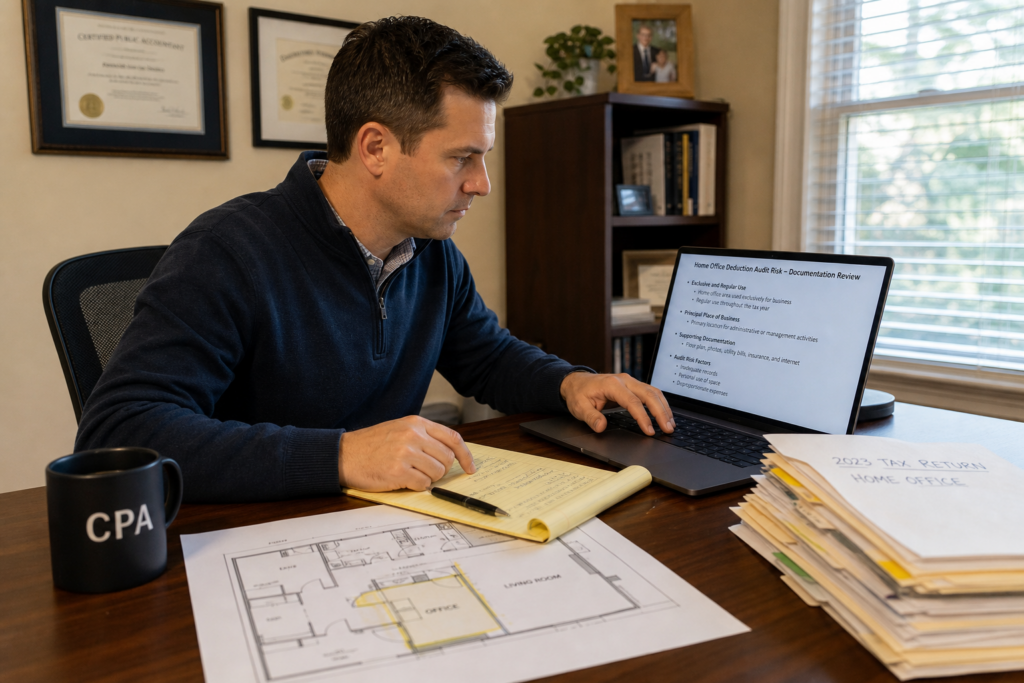
Home Office Deduction Audit Risk Documentation: A 2026 Guide for Solo Tax Pros
Strong home office deduction audit risk documentation protects your clients and your firm. As a solo practitioner, you sign every return and carry the exposure. This 2026 guide shows you how to build defensible workpapers, cut IRS risk, and turn compliance into paid advisory. We cover the rules, the paperwork, the penalties, and the systems. Serving clients near Hyde Park tax preparation or nationwide? The standards are the same.
Table of Contents
- Key Takeaways
- Why Does Documentation Drive Home Office Audit Risk?
- Who Qualifies for the Home Office Deduction in 2026?
- How Do You Build Home Office Deduction Audit Risk Documentation?
- What Penalties Apply If Your Documentation Fails?
- How Can AI Help Without Raising Audit Risk?
- How Do Solo Pros Monetize This Work?
- Uncle Kam in Action
- Related Resources
- Next Steps
- Frequently Asked Questions
 For Tax Professionals
Build your next chapter in tax advisory.
Explore how Uncle Kam Pro could support the next stage of your practice.
Key Takeaways
- Audit risk hinges on documentation quality, not the deduction itself.
- Self-employed clients still qualify; W-2 employees generally do not.
- The 2026 simplified method caps at 300 square feet and $1,500.
- Weak workpapers expose clients to Section 6662 accuracy penalties.
- Solid documentation is a paid advisory product, not free compliance.
Why Does Documentation Drive Home Office Audit Risk?
Quick Answer: The IRS rarely disallows a valid deduction. It disallows one you cannot prove. Documentation is your defense.
Home office deduction audit risk documentation matters because examiners start with proof. They do not ask how you calculated the number. Instead, they ask you to show it. As a result, the burden falls on your client to substantiate every figure.
Many solo practitioners assume the deduction itself triggers audits. However, that fear is overblown. The real trigger is thin support. Furthermore, a clean file usually ends an exam quickly. A weak file, by contrast, invites deeper scrutiny. Strong proactive tax strategy planning starts with the workpaper, not the return.
The IRS Cares About Evidence First
The opening move in most exams is a document request. Therefore, your file should answer that request before it arrives. The IRS home office deduction guidance spells out the core standards. Examiners want to see exclusive use, regular use, and a clear business purpose. Consequently, your notes must map each fact to those tests.
Weak Files Cost More Than Time
A disallowed deduction is only the start. In addition, penalties and interest stack on top. Your client loses trust, and your firm faces exposure too. Moreover, a bad exam eats billable hours you cannot recover. For this reason, defensible documentation protects your margin as much as your client.
Pro Tip: Build the audit file when you prepare the return, not after a notice arrives.
Who Qualifies for the Home Office Deduction in 2026?
Quick Answer: Self-employed clients qualify. W-2 employees generally cannot claim it through 2026 under current law.
Eligibility is the first thing an examiner tests. First, the space must be used regularly and exclusively for business. Second, it must be the principal place of business. Alternatively, it can be a spot where the client meets customers. This applies to your self-employed and 1099 clients who file Schedule C.
Employees face a harder rule. The Tax Cuts and Jobs Act suspended unreimbursed employee expenses. Later, the One Big Beautiful Bill Act made that suspension permanent. Therefore, most W-2 workers cannot deduct a home office in 2026. Instead, guide them toward an accountable reimbursement plan.
The Exclusive Use Test Trips People Up
Exclusive use is strict. A guest bed in the office breaks the test. Likewise, a family computer used for games weakens the claim. However, small exceptions exist for daycare and inventory storage. As a result, you must document the boundary of the space clearly.
Standard Deduction Context for 2026
Context helps you advise well. For 2026, the standard deduction is $16,100 for single filers. Married couples filing jointly get $32,200. Both figures rose from 2025’s $15,000 and $30,000. Still, the home office deduction runs on Schedule C for the self-employed. Therefore, it reduces business income regardless of the standard deduction. You can verify these figures at the IRS newsroom.
| Filing Status | 2025 Standard Deduction | 2026 Standard Deduction |
|---|---|---|
| Single | $15,000 | $16,100 |
| Married Filing Jointly | $30,000 | $32,200 |
Did You Know? The home office deduction can also unlock a partial business-use portion of home depreciation.
How Do You Build Home Office Deduction Audit Risk Documentation?
Quick Answer: Collect proof of the space, the math, and the business purpose. Store it in a dated, organized file.
Great documentation follows a simple rule. You gather evidence that a stranger could review. In other words, an examiner should reach your conclusion without your help. Therefore, build a standard checklist and use it on every client. This turns messy prep into a repeatable system.
Start with the space itself. Then reconcile the numbers. Finally, link everything to the business purpose. The IRS Publication 587 outlines what the agency expects. Use it as your baseline. Your firm’s workpaper should exceed that floor.
Your Core Documentation Checklist
- Timestamped photos of the dedicated office space
- A floor plan showing square footage of home and office
- Utility, mortgage, rent, and insurance records
- A written statement of business purpose and use
- The method chosen: simplified or actual expense
- Form 8829 support tying expenses to the return
Simplified vs. Actual Method Math
The 2026 simplified method pays $5 per square foot. It caps at 300 square feet, so the max is $1,500. For example, a 200-square-foot office yields a $1,000 deduction. Meanwhile, the actual method uses real costs and Form 8829. It often beats the simplified number, yet it demands far more proof.
To model both methods fast, use our home office deduction strategy tool for 2026 scenarios. It helps you show clients the higher outcome. Then you document the chosen path clearly. This is where smart entity structuring choices also come into play.
| Feature | Simplified Method | Actual Method |
|---|---|---|
| 2026 Rate | $5 per sq ft | Actual costs |
| Max Deduction | $1,500 (300 sq ft) | No fixed cap |
| Recordkeeping | Light | Heavy |
| Depreciation | None | Allowed |
What Penalties Apply If Your Documentation Fails?
Quick Answer: Clients face a 20% accuracy penalty under Section 6662. Preparers face exposure under Section 6694.
Penalties turn a small deduction into a big problem. First, Section 6662 imposes a 20% accuracy-related penalty. It applies to substantial understatements of tax. In some cases, the penalty rises to 40% under Section 6662(h). Therefore, weak home office deduction audit risk documentation carries real dollars.
You carry risk too. Section 6694 targets preparers who sign shaky positions. The penalty equals the greater of $1,000 or 50% of your fee. Furthermore, Circular 230 §10.22 requires due diligence on every representation. As a result, your name on the return means your judgment is on the line.
Substantial Authority and Form 8275
A position needs substantial authority to avoid the penalty. If authority is thin, disclosure helps. You file Form 8275 to disclose the position. This shifts the standard to reasonable basis. However, disclosure does not erase all exposure. Learn more from the Cornell Law reference on Section 6662.
The Reasonable Cause Defense
A reasonable cause defense can save a client. It rests on a three-prong test from the Neonatology Associates case. The advisor must be a competent professional. The client must provide accurate information. Finally, the client must rely in good faith. Notably, an AI tool cannot satisfy the first prong.
Pro Tip: Keep a signed client questionnaire. It supports the reasonable cause defense later.
How Can AI Help Without Raising Audit Risk?

Quick Answer: AI can gather and organize evidence fast. A licensed human must still own the position.
AI is not an audit red flag by itself. Examiners do not ask whether a tool helped. Instead, they ask whether the work product exists. Moreover, they ask whether a qualified preparer stands behind it. Therefore, use AI to speed the file, not to replace judgment.
AI cannot be a preparer under the tax code. It carries no license and no Circular 230 duty. Likewise, it cannot defend a position under exam. As a result, your name must appear as the responsible person. Good software supports you; it does not sign for you. This is exactly why the Uncle Kam platform pairs its MERNA AI engine with credentialed pros. Learn how the Uncle Kam marketplace helps tax pros transition to advisory.
Where AI Adds Real Leverage
Solo pros wear every hat. Consequently, leverage matters more than for large firms. AI can sort receipts, draft memos, and flag missing proof. In addition, it can model both deduction methods in seconds. A strong entity-aware system evaluates the whole picture, not one form. Consider entity-aware tax planning software that runs unlimited free assessments across a client portfolio.
Keep the Human in the Loop
Review every AI output before you file. First, confirm the facts match the client’s file. Second, verify the math and the method. Third, sign only when you can defend the position. This partnership gives you speed and safety together. Ready to systemize this? Book a strategy session to build your workflow.
How Do Solo Pros Monetize This Work?
Quick Answer: Package documentation as a paid audit-defense product. Sell it as advisory, not free compliance.
Most solo firms give this work away. However, defensible documentation has real value. Clients pay for peace of mind and protection. Therefore, package your workpaper as a deliverable. Tax planning, not tax prep, drives higher fees.
Position the audit file as risk insurance. Then price it as an advisory service. In addition, bundle it with year-round planning. This shift builds recurring revenue and stronger relationships. Explore how ongoing tax advisory services raise your average fee.
From Compliance to Advisory Revenue
A prep return earns a flat fee. Meanwhile, an advisory plan earns far more. For instance, you might charge $2,500 for a documented plan. That plan covers the home office and other strategies. As a result, one client can double or triple your revenue. Many small business owner clients gladly pay for clarity.
Systems Create Scale
A checklist beats memory every time. Build a template once, then reuse it. Consequently, you deliver consistent quality at scale. This is how solo pros grow without burning out. A built-in marketplace can also route new advisory leads to you.
Did You Know? Firms that sell planning often earn three times more per client than prep-only firms.
Uncle Kam in Action: The Solo CPA Who Built a Defensible System
Client Snapshot: Maria runs a one-person CPA firm in Florida. She serves 120 clients, mostly freelancers and consultants. She wears every hat and works long hours.
Financial Profile: Her firm brought in about $185,000 in yearly revenue. Most of that came from flat-fee return prep. Her margins were thin, and she felt stuck.
The Challenge: One client faced a home office deduction exam. Maria scrambled to rebuild the file after the notice. She spent 14 unbilled hours pulling records together. Furthermore, she worried about her own Section 6694 exposure.
The Uncle Kam Solution: Maria adopted a standard documentation workflow. She built a home office deduction audit risk documentation template. Then she used AI to gather proof and model both methods. Finally, she packaged the file as a paid audit-defense deliverable. She also began selling year-round planning to her best clients.
The Results: Maria converted 30 clients to advisory plans. Each plan averaged $2,400 in fees. That added roughly $72,000 in new revenue. Her investment in the system was about $6,000. Therefore, her first-year ROI topped 11x. In addition, her audit exposure dropped sharply. Every file now answers the examiner before the notice arrives. See more outcomes on our client results page.
Maria’s story shows the pattern clearly. Better documentation protects clients and grows revenue. Moreover, it frees the solo pro from constant firefighting.
Related Resources
Next Steps
Take action now to protect clients and grow revenue. Start with these clear steps.
- Build a standard documentation checklist for every client.
- Package the audit file as a paid deliverable.
- Adopt firm automation and business solutions to save time.
- Book a strategy session to systemize your advisory offer.
Uncle Kam gives solo pros the complete growth engine: the MERNA AI software, certification, branded PDF deliverables, and a marketplace of warm leads. Learn how the Uncle Kam marketplace helps tax pros transition to advisory. Then take the next step and book a free strategy session with a growth strategist for a personalized roadmap to launch or scale your advisory firm.
Frequently Asked Questions
Does claiming the home office deduction trigger an audit?
No, a valid deduction does not trigger an audit by itself. Instead, weak documentation raises risk. Therefore, focus on strong, dated workpapers. A clean file usually ends an exam fast.
What is the maximum simplified deduction for 2026?
The 2026 simplified method pays $5 per square foot. It caps at 300 square feet. As a result, the maximum deduction is $1,500. The actual method has no fixed cap but needs more proof.
Can W-2 employees claim a home office in 2026?
Generally, no. The TCJA suspended unreimbursed employee expenses. Later, OBBBA made that permanent. Therefore, most employees cannot claim it. Instead, guide them toward an accountable reimbursement plan.
How long should clients keep home office records?
Keep records at least three years after filing. However, keep depreciation records much longer. In fact, hold them until the home is sold. Verify retention rules with the IRS if in doubt.
Does using AI increase penalty exposure?
Not if a licensed pro owns the position. AI cannot be a preparer under the code. Moreover, it cannot satisfy the reasonable cause test. Therefore, always keep a human in the loop.
Can I charge clients for documentation work?
Yes, and you should. Defensible documentation is a valuable advisory product. Clients pay for protection and clarity. Consequently, packaging it raises your average fee.
This information is current as of 7/14/2026. Tax laws change frequently. Verify updates with the IRS if reading this later.
Last updated: July, 2026

