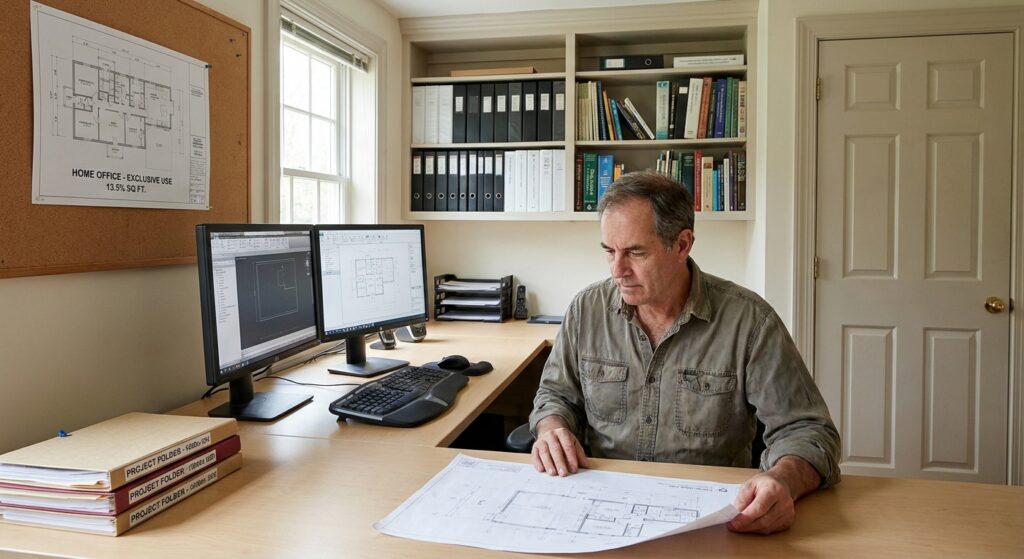
Home Office Audit Risk: 2026 Guide for Self-Employed
Home office audit risk is one of the top concerns for self-employed individuals filing in 2026. The IRS closely reviews home office deductions claimed on Schedule C. However, a properly documented home office is a legitimate and valuable deduction. This guide explains exactly who qualifies, what triggers an audit, how to calculate your deduction, and how to stay protected all year long. Working with a qualified self-employed tax specialist makes all the difference.
Table of Contents
- Key Takeaways
- What Is Home Office Audit Risk and Why Does It Matter?
- Who Qualifies for the Home Office Deduction in 2026?
- What Are the Biggest Home Office Audit Red Flags?
- How Do You Calculate the Home Office Deduction Correctly?
- What Documentation Protects You From an IRS Audit?
- How Can You Minimize Home Office Audit Risk in 2026?
- What Does Home Office Risk Look Like for Different Self-Employed Workers?
- Uncle Kam in Action: Freelancer Saves Deduction After Audit Notice
- Related Resources
- Next Steps
- Frequently Asked Questions
Key Takeaways
- Claiming a home office on Schedule C increases your audit risk if you miss IRS requirements.
- The space must be used exclusively and regularly for business — no exceptions.
- For 2026, the simplified method allows $5 per square foot, up to 300 square feet.
- Strong documentation is your best defense — keep photos, measurements, and expense receipts.
- Home office rules have not changed under the One Big Beautiful Bill Act signed July 4, 2025.
What Is Home Office Audit Risk and Why Does It Matter?
Quick Answer: Home office audit risk refers to the increased chance the IRS will review your return when you claim a home office deduction. Self-employed filers on Schedule C face higher scrutiny than most taxpayers, especially when expenses seem large relative to income.
For the 2026 tax year, the home office deduction remains one of the most valuable write-offs available to self-employed workers. Freelancers, consultants, gig workers, and independent contractors can all potentially claim it. However, the IRS has historically flagged this deduction as a high-risk area. The agency uses automated systems to compare your deductions against income levels and industry averages.
According to the IRS Small Business and Self-Employed Tax Center, self-employed individuals already face a higher overall audit rate than W-2 employees. Adding a home office claim — particularly a large one — can move your return higher on the agency’s review list. That said, legitimate deductions should never be avoided out of fear. The key is claiming correctly and documenting everything.
The Myth That Home Offices Always Trigger Audits
Many self-employed people avoid claiming a home office because they fear an automatic audit. This is a common myth. The IRS does not automatically audit every return with a home office deduction. In fact, the overall individual audit rate remains well under 1% according to IRS data. However, certain patterns and red flags can significantly raise your risk. Understanding those patterns helps you claim confidently and stay protected.
Furthermore, avoiding a legitimate deduction costs you real money. If your home office qualifies, skipping the deduction means overpaying your taxes every year. For a self-employed professional paying the 15.3% self-employment tax rate plus federal income tax, every deductible dollar matters. Therefore, the goal is not to avoid the deduction — it is to claim it properly. Our proactive tax strategy approach starts with getting your deductions right from day one.
How the IRS Selects Returns for Home Office Review
The IRS uses a scoring system called the Discriminant Information Function (DIF) to flag suspicious returns. This system compares your reported figures to statistical norms for your income bracket. If your home office expenses are unusually high compared to similar filers, your DIF score rises. Consequently, your return may be selected for correspondence or in-person audit. Beyond the DIF score, the IRS also matches income reported on 1099 forms against what you report on Schedule C. Any mismatch can trigger a review. Additionally, reporting consistent losses over multiple years raises additional scrutiny.
Who Qualifies for the Home Office Deduction in 2026?
Quick Answer: To qualify in 2026, your home office must be used exclusively and regularly for business. It must also be your principal place of business, a place where you meet clients, or a separate structure used for business.
The IRS outlines clear qualification rules in IRS Publication 587, Business Use of Your Home. These rules apply consistently for the 2026 tax year. To claim the deduction, you must satisfy both a use test and a place-of-business test. Meeting only one test is not enough. Both conditions must be true simultaneously.
The Exclusive Use Test Explained
The exclusive use test is strict. The area you claim must be used only for business — not occasionally, not mostly, but exclusively. This is where many filers make mistakes. Consider these common scenarios:
- Qualifies: A spare bedroom with a desk, monitor, and work files — used only for client work, nothing else.
- Does NOT qualify: A kitchen table where you sometimes work. The kitchen serves personal purposes too.
- Does NOT qualify: A guest bedroom with a desk — the IRS considers the room dual-purpose if guests sleep there.
- Qualifies: A basement converted entirely to a photography studio used only for your freelance business.
There is no gray area with the IRS. If you watch TV in your home office or let your kids use the computer there for homework, the space likely fails the exclusive use test. As a result, the deduction would be disallowed in full if audited.
The Regular Use and Principal Place of Business Tests
The regular use requirement means you use the space consistently for business throughout the year — not just once or twice. The principal place of business requirement means your home office is where you conduct most of your business activities. Alternatively, it qualifies if it is the only fixed location where you perform administrative tasks like invoicing, scheduling, and bookkeeping. Many freelancers who also work at client sites still qualify because their home is where they handle all business administration. This is an important nuance that many filers miss.
Pro Tip: Remote workers who are W-2 employees cannot claim a home office deduction for 2026. This deduction is only available to self-employed individuals and business owners. The Tax Cuts and Jobs Act eliminated employee home office deductions, and the One Big Beautiful Bill Act (signed July 4, 2025) made that change permanent.
2026 Home Office Qualification Checklist
Use this checklist before you claim the deduction on your 2026 return:
- The space is used exclusively for business — no personal activities take place there.
- You use it on a regular basis throughout the year.
- It is your principal place of business, OR where you meet clients, OR a separate structure on your property.
- You are self-employed (freelancer, contractor, sole proprietor, or single-member LLC owner).
- You have documentation including measurements, photos, and expense records.
What Are the Biggest Home Office Audit Red Flags?
Quick Answer: The biggest red flags include claiming an unusually high percentage of your home as office space, deducting expenses that exceed your business income, reporting large losses for multiple years, and claiming personal expenses as business costs.
Home office audit risk rises sharply when your return contains patterns the IRS DIF system finds unusual. Knowing these red flags helps you make informed decisions about how you claim. Several triggers are particularly common among self-employed filers.
Red Flag #1 — Disproportionately Large Home Office Percentage
The business-use percentage of your home is calculated by dividing your office square footage by your home’s total square footage. For example, a 150-square-foot office in a 1,500-square-foot home equals 10% business use. That is a reasonable and defensible figure. However, if you claim 40%, 50%, or more of your home as office space, expect scrutiny. The IRS considers unusually high percentages suspicious — especially for single-family homes. If you genuinely do use a large area exclusively for business, document it thoroughly with floor plans, photos, and a written description.
Red Flag #2 — Home Office Expenses Exceeding Business Income
Your home office deduction cannot create or increase a net loss from your business. Under IRS rules, home office expenses are limited to your gross income from that business activity. Therefore, if your business earned $20,000 but you are trying to claim $25,000 in home office and other expenses, the IRS will flag the mismatch. Carryover provisions exist for unused deductions, but claiming a deduction larger than your income is a clear audit trigger. Structuring your deductions correctly with the help of a professional tax preparation service prevents this common error.
Red Flag #3 — Consecutive Years of Business Losses
Reporting a net business loss for two or three consecutive years is one of the most reliable IRS audit triggers. The agency applies hobby loss rules under IRC Section 183 to businesses that show no profit. If the IRS concludes you are running a hobby rather than a real business, all deductions — including your home office — can be disallowed. To avoid this, demonstrate genuine profit intent through business records, a written business plan, and consistent efforts to grow revenue.
Additional Red Flags to Avoid
- Claiming home office deductions as a W-2 employee (not allowed in 2026).
- Deducting a room also listed as a guest bedroom or personal use space.
- Mixing personal utility bills with business indirect expenses without proper allocation.
- Claiming 100% of phone, internet, or utilities as a business expense.
- Failing to file Form 8829 or use the simplified method worksheet when required.
- Income reported on 1099s that does not match your Schedule C gross receipts.
Pro Tip: Inconsistencies between your Schedule C income and 1099-NEC forms received are one of the fastest ways to draw IRS attention. Always reconcile all 1099s with your reported income before filing. A skilled tax preparer near you can help catch these errors before submission.
How Do You Calculate the Home Office Deduction Correctly?
Quick Answer: For 2026, you can choose between two methods: the simplified method ($5 per square foot, max 300 sq ft) or the regular/actual expense method using Form 8829. Each has different advantages depending on your home costs and office size.
Choosing the right calculation method is one of the most important decisions for minimizing home office audit risk. Both methods are legitimate. However, each produces different results depending on your situation. Choosing the wrong one could mean leaving money on the table — or raising unwanted flags.
The Simplified Method for 2026
The simplified method allows you to deduct $5 per square foot of your home office space. The maximum area allowed is 300 square feet, producing a maximum deduction of $1,500. This method involves less paperwork and is less likely to draw scrutiny because it does not require itemizing individual home expenses. Here is how the math works:
- 100 sq ft office × $5 = $500 deduction
- 200 sq ft office × $5 = $1,000 deduction
- 300+ sq ft office × $5 = $1,500 deduction (maximum)
The simplified method is especially useful for renters or those in smaller homes. It requires only that you know your office square footage. You do not need to track mortgage interest, property taxes, insurance, or utilities separately. However, you also cannot claim depreciation on the home using this method.
The Regular Method (Form 8829) for 2026
The regular method uses IRS Form 8829, Expenses for Business Use of Your Home. This method allows you to deduct the actual percentage of home expenses that relate to the office. It can produce a significantly larger deduction — especially for homeowners with high mortgage interest, property taxes, and insurance. However, it requires more detailed record-keeping and may raise more questions if audited.
The calculation involves two types of expenses:
- Direct expenses: Costs that benefit only the home office, such as painting or repairing just that room. These are 100% deductible.
- Indirect expenses: Costs for the whole home — rent, utilities, insurance, mortgage interest — deducted at the business-use percentage only.
Side-by-Side Comparison: Which Method Works Best?
| Factor | Simplified Method | Regular Method (Form 8829) |
|---|---|---|
| Max deduction | $1,500 (300 sq ft × $5) | Unlimited (% of actual costs) |
| Record-keeping | Minimal | Detailed receipts required |
| Depreciation allowed | No | Yes |
| Best for | Renters, small offices | Homeowners, large offices |
| Audit complexity | Lower | Higher (more items to verify) |
| Form required | Schedule C worksheet | Form 8829 |
Use our Grand Island Small Business Tax Calculator to estimate your deduction under both methods and see which saves you more for 2026.
What Documentation Protects You From an IRS Audit?
 Free Tax Write-Off Finder
Quick Answer: Your best protection is a paper trail that proves exclusive use, regular use, and accurate expense allocation. Keep floor plan diagrams, photos, receipts, and business records for at least three years after filing.
Strong documentation is the cornerstone of any home office audit defense. If the IRS contacts you, your job is to show — not just tell — that your office qualifies. The IRS Topic 509 guidance outlines what records support a home office claim. Building your documentation system now — not after you receive an audit notice — is the smart approach.
Proof of Exclusive Use
Proving exclusive use is often the hardest part of an audit defense. Without physical evidence, the IRS agent’s determination is subjective. Here is what to gather:
- Dated photographs of your office showing only work equipment and furnishings.
- A floor plan or hand-drawn diagram with labeled dimensions of each room.
- A written description of how the space is used and why it qualifies as exclusive-use business space.
- Absence of any personal items — beds, gaming consoles, personal books — from the space.
Proof of Business Activity
Showing that you run a real, active business from your home office is equally important. Keep these records current for 2026:
- Client contracts, invoices, or service agreements listing your home address.
- Bank statements showing business income deposits.
- Emails, proposals, or project files showing work conducted from your home office.
- A business website, social media, or Google Business Profile listing your home-based operation.
- Receipts for business-specific purchases made for the office (furniture, equipment, software).
Proof of Expense Amounts
If you use the regular method on Form 8829, you must have receipts and statements for every expense claimed. This includes:
- Mortgage statements or rent receipts showing monthly amounts.
- Utility bills (electricity, gas, internet) for the full year.
- Homeowner’s or renter’s insurance policy showing annual premium.
- Property tax statements from your county assessor.
- Receipts for any direct expenses (repairs or improvements to the office only).
Pro Tip: Create a dedicated folder — physical or digital — labeled “Home Office 2026” and upload scanned receipts monthly. Apps like Expensify or Receipt Bank make this effortless. If the IRS ever contacts you, you will have every document ready within minutes.
How Can You Minimize Home Office Audit Risk in 2026?
Quick Answer: Minimize risk by claiming a reasonable and well-documented deduction, using a consistent calculation method, filing accurately, and working with a tax professional who understands self-employed returns.
There are proven strategies to claim your full 2026 home office deduction while keeping audit risk low. These go beyond just good record-keeping. They involve strategic decisions about how, when, and what you claim. Every self-employed individual should review this checklist each year.
Strategy #1 — Use a Defensible Business-Use Percentage
Be conservative and accurate when calculating your business-use percentage. Do not estimate — measure. Use actual square footage from your lease, mortgage documents, or a tape measure. The IRS will verify your stated percentage against home size data available from tax records and county assessor offices. A calculated percentage of 10%–20% is common for most self-employed workers and raises fewer questions than a percentage above 30%. Moreover, if your percentage changes significantly from year to year, be prepared to explain why.
Strategy #2 — Choose the Right Deduction Method
For many self-employed workers, the simplified method is both sufficient and safer from an audit perspective. It involves fewer moving parts. Consequently, there is less that can be questioned. However, if you own your home and have substantial mortgage interest and property tax expenses, the regular method via Form 8829 can yield significantly more savings. In that case, make sure your documentation is thorough. Work with a tax advisor to model both methods and pick the one that maximizes your savings while keeping your return defensible.
Strategy #3 — Keep Personal and Business Expenses Separate
One of the biggest audit triggers is mixing personal and business expenses. Use a separate business bank account and business credit card for all business purchases. Pay personal bills from your personal account. This separation makes it much easier to allocate indirect home expenses correctly. It also demonstrates to the IRS that you run your business like a real enterprise. Messy commingled finances suggest careless or improper reporting — which is exactly the signal you want to avoid sending.
Strategy #4 — File Accurately and On Time
Filing late or amending your return can sometimes attract additional scrutiny. File your 2026 return by April 15, 2027, or request an extension by that date. Ensure all 1099-NEC income is reported and matches third-party records. Verify that your Schedule C figures align with your business bank statements. Every number on your return should tie back to a specific record. Additionally, consider e-filing rather than mailing a paper return — e-filed returns process more smoothly and with fewer data errors.
Pro Tip: If you receive an IRS correspondence audit about your home office, do not panic. Respond promptly with your documentation package. Most correspondence audits are resolved by mail with proper records. The IRS accepts digital submissions in many cases. A qualified tax professional can respond on your behalf if needed.
What Does Home Office Risk Look Like for Different Self-Employed Workers?
Quick Answer: Audit risk varies by business type. Freelancers, remote consultants, and LLC owners all face different audit profiles. Knowing your profile helps you prepare the right documentation and claim strategy.
Home office audit risk does not look the same for every self-employed person. The IRS considers your industry, income level, and deduction patterns together. Understanding your specific situation helps you make smarter decisions. Below are the most common self-employed personas and their unique audit considerations.
Scenario A — The Freelancer or Remote Consultant
A freelance graphic designer or marketing consultant working exclusively from home has a strong home office claim. They use a dedicated room daily for client work, meetings via video call, and project delivery. Their risk is lower because the business clearly operates from home. However, their risk rises if they also have a rented coworking space, since the IRS may question whether the home is truly the principal place of business. In that case, document that administrative functions — invoicing, scheduling, client communication — all occur at home.
For the 2026 tax year, a freelancer with a 150-square-foot home office could deduct $750 using the simplified method or a proportionate share of actual expenses using Form 8829. At the 22% federal tax bracket ($50,401–$105,700 for single filers in 2026) plus the 15.3% self-employment tax rate, every $1,000 in legitimate deductions saves approximately $370 in total taxes. That adds up quickly over a full year of work.
Scenario B — The Single-Member LLC Owner
A single-member LLC taxed as a sole proprietor reports business income and expenses on Schedule C. Their home office deduction works exactly the same way as a sole proprietor. However, some LLC owners mistakenly believe their LLC status provides more protection from scrutiny. It does not — the IRS looks at the underlying facts, not just the legal entity type. Additionally, if your LLC has a registered business address different from your home, ensure you can explain why you also work from home. Your audit risk grows if there is an apparent mismatch between your stated business address and your home office claim.
Scenario C — The Gig Worker With Part-Time Income
A part-time gig worker — say, a rideshare driver who also does freelance editing — faces elevated home office audit risk for several reasons. First, their business income is relatively modest. Therefore, a home office deduction that represents a large percentage of income looks disproportionate. Second, they may not use a dedicated space exclusively for business. Gig workers who work from a laptop at a kitchen table or living room couch do not qualify. However, a gig worker who has converted a dedicated spare room to a home editing studio — used only for that purpose — has a legitimate and defensible claim. The key is meeting the exclusive use test regardless of income level.
| Self-Employed Persona | Audit Risk Level | Primary Risk Factor | Best Strategy |
|---|---|---|---|
| Freelancer/Consultant (dedicated office) | Low–Medium | Multiple work locations | Document admin tasks at home |
| Single-Member LLC Owner | Medium | Address mismatches | Reconcile registered vs. home address |
| Part-Time Gig Worker | High | Low income vs. high deductions | Use simplified method; ensure exclusive use |
| Homeowner with Large Office | Medium–High | High business-use percentage | Use Form 8829 with thorough records |

Uncle Kam in Action: Freelancer Saves Deduction After Audit Notice
Client Snapshot: Maria is a full-time freelance UX designer based in the Midwest. She works from a 200-square-foot dedicated home office in her 1,400-square-foot townhouse.
Financial Profile: Annual freelance revenue of $87,000. Total Schedule C expenses including home office were $31,000. Her business-use percentage was approximately 14.3%.
The Challenge: Maria received an IRS correspondence audit notice for her 2025 return. The IRS questioned her home office deduction and the percentage she claimed. She had used the regular method and deducted a portion of mortgage interest, utilities, and insurance. The notice asked for substantiation within 30 days. Maria was stressed, unsure what documentation to send, and worried about owing back taxes plus penalties.
The Uncle Kam Solution: Maria came to Uncle Kam after receiving her audit notice. Our team immediately reviewed her original return and identified that her documentation was actually solid — she just did not know how to package it for the IRS. We prepared a formal response package that included:
- A floor plan with labeled room dimensions and the office highlighted.
- Dated photos of her home office showing only professional equipment and furnishings.
- Twelve months of client invoices showing her home address as the service location.
- Utility bills, mortgage statements, and homeowner’s insurance for the full year.
- A written business activity log confirming daily use of the office for client work.
The Results: The IRS accepted her full deduction with no changes. Maria did not owe any additional taxes or penalties. Furthermore, for the 2026 tax year, Uncle Kam restructured her home office documentation system proactively. We also helped her see that switching to the simplified method would save her time while still capturing $1,000 in deductions — and reduce her future audit risk profile.
- Tax Savings Preserved: $4,200 in home office deductions validated and retained.
- Investment in Uncle Kam services: $600.
- First-Year ROI: 7x return — Maria saved far more than she spent on professional help.
Stories like Maria’s are common. See more examples on our Uncle Kam client results page to learn how real self-employed clients protect their deductions and reduce their audit risk every year.
Related Resources
- Self-Employed Tax Strategies and Guidance for 1099 Contractors
- Proactive Tax Strategy Services for Business Owners
- Tax Preparation and Filing for Self-Employed Individuals
- Uncle Kam Tax Guides and Resources Hub
- Frequently Asked Tax Questions — General FAQ
Next Steps
Managing your home office audit risk for 2026 starts with action today. Here is exactly what to do next:
- Step 1: Measure your office space and confirm it passes the exclusive use test.
- Step 2: Start a dedicated 2026 documentation folder with photos, receipts, and floor plans.
- Step 3: Decide between the simplified method and Form 8829 — or use our Small Business Tax Calculator to compare both options.
- Step 4: Open a separate business bank account if you have not already done so.
- Step 5: Connect with a qualified Uncle Kam tax advisor to review your full self-employed tax situation for 2026.
This information is current as of 5/6/2026. Tax laws change frequently. Verify updates with the IRS or a qualified tax professional if reading this later.
Frequently Asked Questions
Does claiming a home office automatically trigger an IRS audit?
No. Claiming a home office does not automatically trigger an audit. The overall IRS individual audit rate is well below 1%. However, specific patterns — like disproportionate deductions, consecutive losses, or income mismatches — can raise your DIF score and increase your audit likelihood. A properly documented claim with a reasonable business-use percentage is unlikely to cause problems. Therefore, do not skip this deduction out of fear. Claim it correctly and keep your records organized.
Can I claim a home office deduction if I also work at client sites?
Yes, in most cases. If your home office is where you perform all administrative tasks — invoicing, client communication, scheduling, and bookkeeping — it qualifies as your principal place of business even if you also travel to client sites. This is a nuance that many self-employed workers miss. The IRS specifically allows this for workers who have no other fixed office location for administrative work. Document that your home is where you manage all business operations and keep logs showing regular daily use. Consulting with a tax advisor experienced in self-employed returns confirms whether your situation qualifies.
What is the maximum home office deduction using the simplified method in 2026?
For the 2026 tax year, the simplified method allows $5 per square foot of your home office space. The maximum claimable area is 300 square feet. Therefore, the maximum possible deduction using the simplified method is $1,500. If your office is smaller — say, 150 square feet — your deduction would be $750. This method requires minimal documentation and no Form 8829. It is a good choice for renters or filers who want simplicity. If your actual home costs are high, however, the regular method via IRS Form 8829 may yield a larger deduction.
What records should I keep to support a home office deduction?
You should keep several types of records to support your 2026 home office deduction. First, gather photos of your office showing it is set up exclusively for business. Second, maintain a floor plan or diagram with accurate room dimensions. Third, keep twelve months of utility bills, rent or mortgage statements, and insurance premiums if using the regular method. Fourth, save client contracts, invoices, and any business records that show your home is your place of work. Fifth, retain these records for at least three years after you file — longer if you claimed depreciation, which must be tracked for the full life of the property. The IRS Publication 587 provides detailed guidance on what records to maintain.
Are there any 2026 tax law changes that affect the home office deduction?
The One Big Beautiful Bill Act, signed on July 4, 2025, made the Tax Cuts and Jobs Act provisions permanent. This means the home office deduction rules remain unchanged for self-employed workers in 2026. Remote employees who receive a W-2 still cannot claim this deduction — that restriction became permanent. Self-employed individuals, sole proprietors, and single-member LLC owners retain the full right to claim the deduction when they meet IRS requirements. There are no new income limits, phaseouts, or documentation requirements added for 2026 that would change how the deduction works. Always verify current rules at IRS.gov before filing, as tax laws can change.
What happens if the IRS disallows my home office deduction?
If the IRS disallows your home office deduction, you will owe the additional tax on the disallowed amount plus interest and potentially an accuracy-related penalty of 20% of the underpayment. For a $3,000 deduction disallowed at the 22% tax bracket, that could mean $660 in additional tax, plus interest and a potential $132 penalty. However, you have the right to appeal the IRS determination. If you have solid documentation, an appeal or response to the audit notice often results in the deduction being upheld. This is why proactive documentation during the year — not after receiving a notice — is so important. Review our MERNA Method to learn how Uncle Kam builds audit-ready returns from the start.
Last updated: May, 2026

