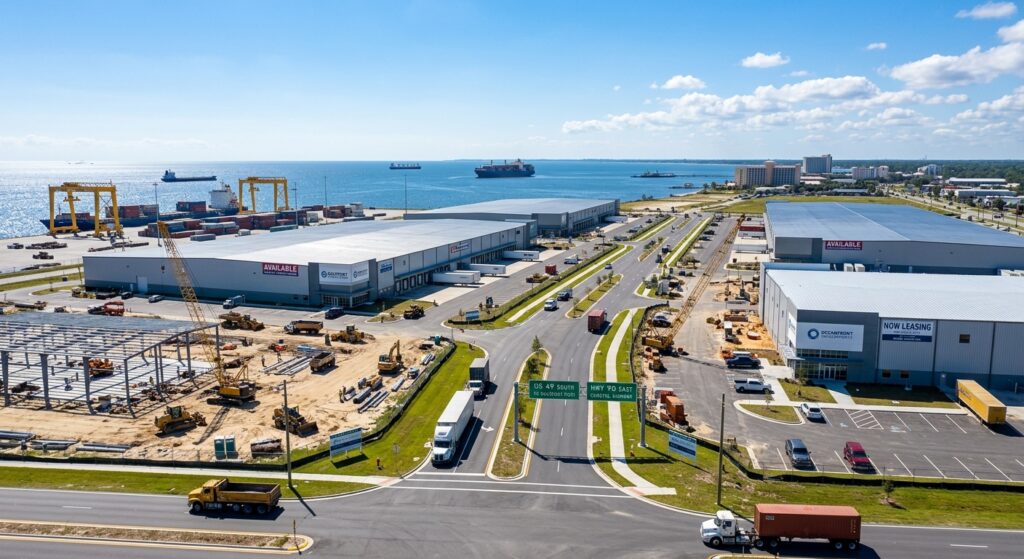
Gulfport Opportunity Zone Capital Gains Strategy: 2026 Tax-Efficient Investing Guide for Real Estate Investors
For 2026, the gulfport opportunity zone capital gains strategy presents a compelling opportunity for investors seeking to defer, reduce, or entirely eliminate federal taxes on investment gains. Located in Mississippi’s coastal region, the Gulfport Opportunity Zone offers sophisticated investors a pathway to reinvest capital gains into economically distressed areas while enjoying substantial tax incentives under Internal Revenue Code Section 1400Z-2. This guide walks you through the mechanics, timelines, and strategic decisions that can save you hundreds of thousands in federal taxes while building real wealth.
Table of Contents
- Key Takeaways
- What Is the Gulfport Opportunity Zone?
- How Do Opportunity Zone Capital Gains Deferrals Work?
- What Is the Critical 180-Day Reinvestment Window?
- How Does the 10-Year Basis Step-Up Benefit Work?
- What Are the Income Limits and Eligibility Rules?
- Opportunity Zone vs. 1031 Exchange: Which Strategy Wins?
- Uncle Kam in Action: Real Estate Investor Success Story
- Next Steps
- Frequently Asked Questions
- Related Resources
Key Takeaways
- The Gulfport Opportunity Zone allows investors to defer capital gains taxes until December 31, 2026, with significant potential for permanent tax elimination through the 10-year holding period.
- You have exactly 180 days from the date you realize your capital gain to reinvest those funds into a Qualified Opportunity Fund (QOF) to qualify for deferral benefits.
- A 10-year holding period in a Gulfport OZ investment can result in complete elimination of all capital gains taxes on the investment appreciation—not just the initial gain.
- The strategy works for real estate investors, business owners, and high-net-worth individuals realizing significant gains from asset sales.
- No income phase-out limits apply, making this strategy equally valuable for investors earning $200K, $2M, or $50M in capital gains.
What Is the Gulfport Opportunity Zone?
Quick Answer: The Gulfport Opportunity Zone is a federally designated economically distressed area in Mississippi’s coastal region that offers investors preferential tax treatment when they invest capital gains through a Qualified Opportunity Fund (QOF).
The Opportunity Zone program was created under the Tax Cuts and Jobs Act of 2017 and represents a strategic federal initiative to stimulate economic development in areas that have experienced disinvestment, population loss, or economic stagnation. Gulfport, located in Mississippi’s Harrison County along the Gulf of Mexico, qualifies as a designated Opportunity Zone due to its community development needs and strategic importance for coastal economic revitalization.
What makes Gulfport particularly compelling for 2026 and beyond is the broader regional context. Mississippi lost a major LNG export project due to capital moving faster to other Gulf Coast locations, but this creates an opportunity for forward-thinking investors. Energy security concerns, post-pandemic supply chain rebalancing, and federal investment in strategic infrastructure mean Gulfport’s potential is being reassessed by savvy investors who understand the long-term value proposition.
Geographic and Community Development Context
Gulfport sits within a Community Development Financial Institution (CDFI) designated area, meaning investments receive both federal tax incentives through the Opportunity Zone program and potential community development grant support. The region has been identified for growth in logistics, industrial manufacturing, shipbuilding support services, and energy-related infrastructure—sectors that offer tangible economic returns alongside tax benefits.
Why This Matters for Your 2026 Tax Strategy
For investors sitting on substantial gains—whether from selling rental properties, businesses, or investment portfolios—the Gulfport Opportunity Zone provides both tax deferral and the potential for permanent tax elimination. Unlike passive tax strategies, this approach aligns your investment with regional development priorities while building genuine wealth in emerging sectors.
How Do Opportunity Zone Capital Gains Deferrals Work?
Quick Answer: When you invest capital gains into a Qualified Opportunity Fund within 180 days of realizing the gain, the IRS allows you to defer recognizing that gain until December 31, 2026 (or when the investment is sold, whichever comes first).
Under IRC Section 1400Z-2, the mechanics work as follows: You realize a capital gain (long-term or short-term) on the sale of an asset. Instead of paying capital gains tax immediately, you have a 180-day window to invest that exact amount into a Qualified Opportunity Fund that invests in the Gulfport Opportunity Zone or another designated OZ area. This deferral provides immediate cash flow benefits and allows your capital to compound without the immediate drag of capital gains taxes.
The Three-Tier Tax Benefit Structure
The Opportunity Zone benefit operates on three tiers. First, the initial capital gains tax is deferred until December 31, 2026. Second, if you hold the investment for at least five years, the IRS adjusts your cost basis upward by 10 percent, permanently reducing the deferred gain you’ll owe when you eventually pay it. Third, if you hold for 10 years or more, you eliminate all capital gains taxes on the investment appreciation (the profit above your original investment amount)—not just the initial deferred gain.
Let’s illustrate with an example. You sell a commercial property for $2 million that you purchased for $1 million. Your capital gain is $1 million. Without an Opportunity Zone strategy, you owe federal capital gains tax of approximately $200,000 (at the 20% long-term rate, plus potential net investment income tax). With the OZ strategy, you reinvest that $2 million into a Gulfport OZ fund. You defer the $200,000 tax, your investment compounds, and if you hold for 10 years, that entire $200,000 tax bill disappears. Additionally, any appreciation on the $2 million investment itself is also tax-free at exit.
Pro Tip: The 180-day clock starts from the date you realize the gain, not from the date you close the sale. For a transaction closing on March 15, 2026, your 180-day window closes September 11, 2026. Missing this deadline forfeits the entire deferral benefit.
We recommend using our Self-Employment Tax Calculator to model your income projections alongside capital gains scenarios. While the calculator focuses on self-employment tax, running multiple income scenarios helps you understand your overall 2026 tax position and how OZ strategy fits into your broader tax optimization plan.
What Is the Critical 180-Day Reinvestment Window?
Quick Answer: You have exactly 180 calendar days from the date you realize your capital gain to invest into a Qualified Opportunity Fund to qualify for deferral benefits. Missing this deadline means losing all OZ tax advantages.
This 180-day window is non-negotiable. The IRS does not grant extensions, exceptions, or alternative timelines. For investors managing the timing of multiple asset sales, business exits, or investment portfolios, understanding this window is critical to effective 2026 tax planning.
Timeline Mechanics and Practical Implications
The clock starts on the date of the gain realization event, which typically corresponds with closing on a sale. If you close a real estate transaction on February 1, 2026, your 180-day window closes on July 31, 2026 (180 days later). However, the IRS counts the first day as day one, so precise calculation is essential. Many investors use April 15 (tax deadline) as a reference point, but that deadline is for filing, not for the OZ investment window.
For investors realizing gains in Q1 2026, you have from January through mid-July to identify, fund, and invest in a Qualified Opportunity Fund. This timeline allows for due diligence on fund managers, review of Gulfport-area projects, and completion of the investment documentation. However, it requires proactive planning—waiting until the last 30 days dramatically increases execution risk.
Documentation Requirements Within the 180-Day Window
- Investor must execute an agreement to invest the gain amount in the QOF (funding can occur by day 180, but agreement should be in place well before)
- QOF must provide written acknowledgment of the investment amount and investment date
- Fund must invest the gain amount in Gulfport OZ property within 31 months (separate requirement, but part of compliance)
- Investor retains documentation for tax return filing when gains are recognized (2026 or upon sale)
How Does the 10-Year Basis Step-Up Benefit Work?
Quick Answer: If you hold a Gulfport Opportunity Zone investment for at least 10 years, your cost basis steps up to fair market value at the time of exit, eliminating all federal capital gains taxes on appreciation above your original investment amount.
This is the most powerful provision of the Opportunity Zone program. While the initial deferral and 5-year basis step-up provide meaningful benefits, the 10-year provision creates a permanent reduction or elimination of capital gains taxation on investment appreciation. This fundamentally changes how wealth compounds in OZ investments compared to traditional taxable accounts.
The Mechanics of Basis Step-Up at the 10-Year Mark
When you invest $2 million of capital gains into a Gulfport QOF, that $2 million becomes your cost basis for that OZ investment. Over 10 years, suppose that investment grows to $3 million. In a traditional investment account, you’d owe capital gains tax on the $1 million gain (approximately $200,000 in federal tax). But in an OZ account held for 10+ years, your cost basis is stepped up to the fair market value at year 10, meaning your new cost basis becomes $3 million. When you eventually sell, you recognize zero capital gains on that appreciation.
Additionally, the original deferred gain (the $1 million capital gain you reinvested) is still deferred until December 31, 2026. At that point, you owe tax on the original deferred gain. But all appreciation from 2026 forward is permanently tax-free at the 10-year mark.
Pro Tip: Plan your exit strategy with the 10-year milestone in mind. If you’re holding for 10 years (2026-2036 for 2026 investments), coordinate exit planning around the 10-year anniversary. Selling on day 3,650 provides the full basis step-up benefit; selling on day 3,649 forfeits it.
What Are the Income Limits and Eligibility Rules?
 Free Tax Write-Off Finder
Quick Answer: There are NO income limits, net worth thresholds, or earned-vs.-unearned income restrictions for the Opportunity Zone program. Anyone with a capital gain can participate, regardless of total income or wealth level.
This is a critical distinction from many other tax benefits. Unlike the Qualified Business Income (QBI) deduction, which phases out at higher incomes, or the Earned Income Credit, which has strict income limits, the OZ program is completely open to high-income and high-net-worth individuals. A business owner earning $500,000 annually can participate. An investor earning $5 million can participate. A real estate professional with a $50 million portfolio can participate. Income is irrelevant.
Eligibility Requirements That Do Apply
- You must have a legitimate capital gain to defer (from sale of business, property, investments, etc.)
- The gain must be reinvested into a QOF within the 180-day window
- The QOF must genuinely invest in Gulfport Opportunity Zone property (not create a shell arrangement)
- You must hold the investment for the intended period to capture tax benefits (5-year basis step-up, 10-year elimination)
- U.S. citizens and legal residents are eligible; restrictions apply for certain foreign persons
The IRS scrutinizes OZ investments to prevent abusive structures, so the fund you select must have legitimate operations in Gulfport, verifiable real estate holdings, and credible management. Working with an established QOF and having tax strategy advice ensures your investment structure withstands audit.
Opportunity Zone vs. 1031 Exchange: Which Strategy Wins?
Quick Answer: Both strategies have value; the better choice depends on your investment goals. 1031 exchanges are ideal for real estate exchanges; OZ is superior for capital gains deferral and appreciation gains elimination.
Real estate investors often wonder: Should I use a 1031 exchange (which defers taxes indefinitely by exchanging like-kind property) or an Opportunity Zone investment? The answer depends on your specific situation, and many sophisticated investors use both strategically.
| Attribute | 1031 Exchange | Opportunity Zone |
|---|---|---|
| Asset Class | Real estate only (strict like-kind requirement) | Real estate, business interests, securities, any asset with a gain |
| Tax on Appreciation | Deferred indefinitely; taxes paid at eventual death (with basis step-up) | Completely eliminated if held 10+ years on appreciation |
| Timeline Pressure | 45 days to identify; 180 days to close (strict deadlines) | 180 days to invest in QOF (more flexible than 1031) |
| Geographic Flexibility | Nationwide (any U.S. real estate) | Opportunity Zones only (limited geographic focus) |
| Control Over Replacement | You control property selection (direct ownership) | Fund manager controls specific property investments |
| Liquidity at Exit | Varies (real estate sales take time) | Depends on QOF liquidity; some funds allow redemption, others require exit |
Scenario Analysis: When OZ Beats 1031
Imagine you’re a real estate investor who sold a commercial property portfolio for $10 million gain. With a 1031 exchange, you’d need to identify replacement properties within 45 days and close within 180 days. If the replacement property is in a depressed market where prices are rising, or if you want exposure to emerging sectors, the OZ provides better flexibility. You can invest in Gulfport OZ real estate, logistics hubs, or energy infrastructure—letting the fund manager access deal flow you might not independently source.
Additionally, if that property appreciates over 10 years from $10 million to $20 million, the $10 million appreciation is completely tax-free at exit. With a 1031 exchange, that appreciation would eventually be taxed (either when you finally sell or in your estate).

Uncle Kam in Action: Real Estate Investor Success Story
Sarah owns a portfolio of apartment buildings across the Southeast. In early 2026, she executes a strategic portfolio rebalancing, selling two properties for a combined $5 million capital gain. At a federal long-term capital gains tax rate of 20%, plus 3.8% net investment income tax, plus state taxes, she faces approximately $1.2 million in total tax liability on that gain. Instead of writing a check to the IRS in April 2026, Sarah’s CPA—working with an experienced tax advisor—structures a Gulfport Opportunity Zone investment strategy.
Within 180 days of closing her property sales (realized April 15, 2026), Sarah invests $5 million into a vetted Qualified Opportunity Fund with operations in Gulfport. The fund specializes in acquiring and redeveloping industrial logistics facilities positioned to service Gulf Coast supply chains. Sarah retains documentation of the investment for her 2026 tax return.
Tax Results by Year: In 2026, Sarah reports the $5 million original gain as deferred (not immediately taxable). She pays zero capital gains tax in 2026 and 2027. The deferred gain remains recognized on December 31, 2026, at which point she begins measuring her holding period toward the 10-year mark. Between 2026 and 2036, the QOF investment compounds. Due to logistics sector strength, the investment grows to $8 million by 2036.
Exit in 2036 (10-Year Mark): When Sarah exits the investment in 2036 for $8 million, she sells through the QOF. Her cost basis is stepped up to $8 million (fair market value at 10-year mark), meaning zero capital gains tax on the $3 million appreciation ($8M sale price minus $5M original investment = $0 taxable gain due to basis step-up). She still owes tax on the original $5 million deferred gain (deferred to December 31, 2026), which she pays when filing her 2026 tax return. However, she’s converted a $5 million gain into essentially a $0 gain on appreciation, saving approximately $600,000 in taxes on the appreciation alone.
Financial Outcome: Uncle Kam’s fee for structuring and overseeing the strategy was $15,000. Sarah’s tax savings on the $3 million appreciation was approximately $600,000. Her return on investment: 4,000%. Moreover, she reinvested her capital into emerging logistics infrastructure aligned with national energy security priorities, contributing to real economic development while building tax-efficient wealth.
Next Steps
If you’re planning a capital gains event in 2026 or have recently realized significant investment gains, take action immediately. The Gulfport Opportunity Zone strategy requires careful planning and coordination with qualified tax professionals.
- Calculate your expected 2026 capital gains and the tax liability (multiply gains × 23.8% for federal + net investment income tax rate)
- Identify your 180-day reinvestment window by marking the date of your gain realization on your calendar
- Research vetted Qualified Opportunity Funds with Gulfport operations and track records you’re comfortable with
- Work with our Gulfport tax preparation specialists to structure the investment and ensure compliance
- Prepare documentation for your 2026 tax return (Form 8949, Schedule D, and OZ election statements)
- Map out your 10-year hold strategy and coordinate with business solutions planning for exit timing
Frequently Asked Questions
Can I invest in a Gulfport Opportunity Zone if I earned the gain from selling my business?
Yes, absolutely. Opportunity Zone rules do not distinguish between gains from real estate, business sales, investment assets, or other sources. If you sold your business and realized a $3 million gain, you can invest that into a Gulfport OZ fund and capture all deferral and appreciation-elimination benefits.
What happens if I need to access my OZ investment before 10 years?
If you sell your OZ investment before the 10-year mark, you recognize capital gains on appreciation from date of OZ investment to sale date. However, you’ve still deferred the original gain until December 31, 2026, and captured any 5-year or 10-year basis step-up benefits earned up to that point. Some QOFs offer liquidity or secondary market sales; others require longer holding periods. Evaluate fund liquidity before investing.
Do I lose the deferral benefit if I miss the 180-day deadline by one day?
Yes. The IRS applies the 180-day requirement strictly with no exceptions. Missing the deadline by a single day forfeits the entire OZ tax benefit. You become liable for capital gains tax on the original gain amount immediately. Plan ahead and calendar your 180-day window with precision.
What is the realistic return I should expect from a Gulfport OZ investment?
OZ funds vary widely in expected returns based on sector, management quality, and regional factors. Gulfport logistics and industrial projects typically target 8-15% annual returns, though past performance is not guaranteed. Some fund managers emphasize stable income; others prioritize capital appreciation. Your expected return depends on the specific fund and property strategy, not the tax designation itself. Do not invest in an OZ fund solely for tax benefits if the underlying investment doesn’t meet your return requirements.
Can I combine an Opportunity Zone strategy with a 1031 exchange?
Generally, no. You cannot use both strategies on the same gain. However, sophisticated investors sometimes execute multiple transactions: completing a 1031 exchange on one property sale, then using a separate OZ investment on another property sale. Work with tax advisors to coordinate multiple transactions across a calendar year.
Is there state income tax on the deferred gain in Mississippi?
The OZ federal deferral applies to federal taxes only. State tax treatment varies. Mississippi does not have a state capital gains tax, so Gulfport OZ investments avoid both federal and state capital gains taxation—a significant advantage compared to states with state-level capital gains taxes. However, your state of residence may tax the deferred gain based on your residency status at recognition. Consult a multistate tax professional if you reside in a state with state capital gains tax.
What documentation do I need to maintain for IRS compliance?
Keep the following records: (1) documentation of the original capital gain event (closing statement, sale documentation), (2) investment agreement with the QOF, (3) written acknowledgment from the QOF of the investment amount and date, (4) fund correspondence showing Gulfport property holdings, (5) annual statements showing investment growth, and (6) exit documentation when you eventually sell. Retain for six years after your final tax return recognizing OZ gains.
What are the audit risks with Opportunity Zone investments?
The IRS has issued guidance on OZ compliance and actively reviews fund structures to prevent abusive arrangements. Risk is minimal if you invest through a legitimate, established QOF with genuine property holdings, qualified management, and documented Gulfport operations. Risk increases significantly with “exotic” structures, unlicensed fund managers, or funds with minimal operational activity. Choose funds with professional management credentials, published returns, and audited financial statements.
Related Resources
- Real Estate Investor Tax Strategies
- Comprehensive Tax Strategy Planning
- High-Net-Worth Tax Planning
- MERNA Method: Our Proprietary Tax Optimization System
- Client Results & Case Studies
This information is current as of 4/27/2026. Tax laws change frequently. Verify updates with the IRS or consult with a tax professional if reading this later.
Last updated: April, 2026

