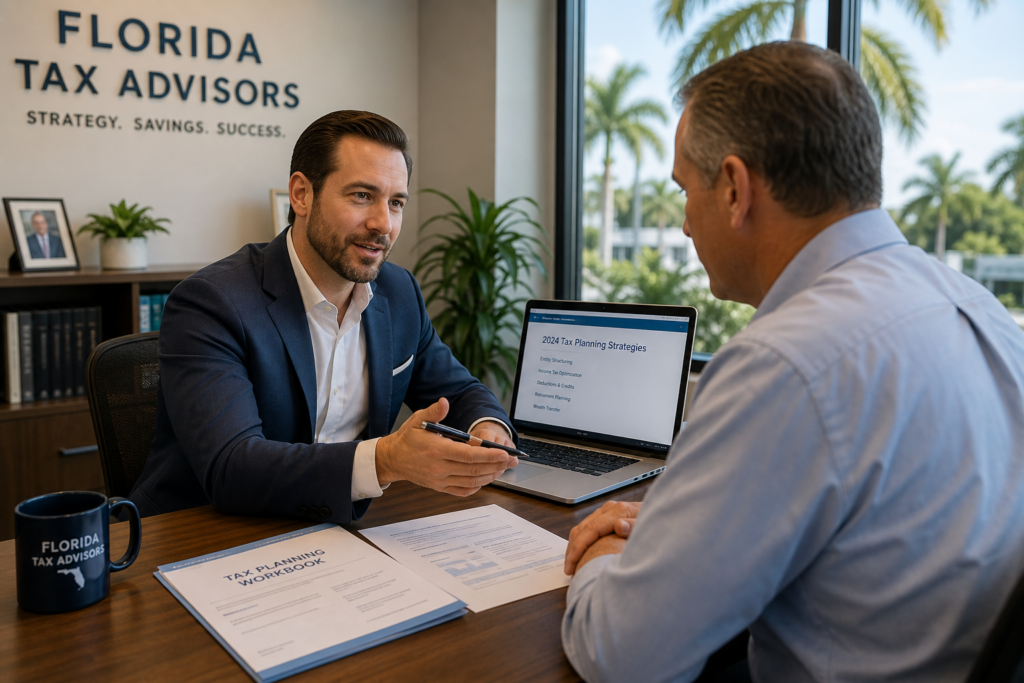
Florida State Tax Planning Strategies for Business Owners in 2026
Florida state tax planning strategies for business owners have never mattered more than in 2026. The Sunshine State charges no personal income tax. Yet smart planning goes far beyond that headline. For the 2026 tax year, new federal rules and a looming property tax amendment reshape the game. As a result, solo firm owners and their clients need a fresh playbook. This guide gives you clear, actionable Florida tax strategies you can use today.
Pro Tip: Want to close more advisory clients this year? Book a personalized Florida tax strategy session and see the savings first.
Table of Contents
- Key Takeaways
- Why Is Florida’s Tax Landscape Changing in 2026?
- How Do You Turn Florida’s No Income Tax Into Real Savings?
- How Can You Reduce Florida Corporate Income Tax?
- How Do Permanent Opportunity Zones Affect Florida Owners?
- How Will the Property Tax Amendment Impact Businesses?
- What Is the Best Entity Structure for a Florida Business?
- Uncle Kam in Action
- Related Resources
- Next Steps
- Frequently Asked Questions
 For Tax Professionals
Build your next chapter in tax advisory.
Explore how Uncle Kam Pro could support the next stage of your practice.
Key Takeaways
- Florida charges no personal income tax and a flat 5.5% corporate rate.
- The OBBBA made the 20% QBI deduction and opportunity zones permanent.
- A 2026 property tax amendment could raise commercial and rental taxes.
- Entity structure still drives major federal savings, even without state income tax.
- Proactive planning now beats last-minute filing every single year.
Why Is Florida’s Tax Landscape Changing in 2026?
Quick Answer: Two forces reshaped Florida planning in 2026. Federal OBBBA rules changed permanently. A state property tax amendment now heads to voters.
Florida has long been a magnet for entrepreneurs. The state charges no personal income tax. Therefore business owners keep more of every dollar. However, 2026 introduced big shifts at both the federal and state levels. As a result, old assumptions no longer hold. Solo practitioners must adjust their advice fast.
First, the One Big Beautiful Bill Act (OBBBA) made key breaks permanent. For example, it locked in the 20% qualified business income deduction. In addition, it turned opportunity zones into a recurring program. These changes reward proactive tax planning over simple compliance.
The Federal Layer Now Matters More
Because Florida has no state income tax, federal rules carry extra weight. Every federal deduction hits your bottom line directly. Consequently, strategies like the QBI deduction and 100% bonus depreciation shine here. Business owners who ignore these leave real money on the table.
You can read the federal rules on the IRS qualified business income guidance. Furthermore, the SBA small business tax page offers helpful context. These sources confirm how federal breaks stack for Florida owners.
The State Layer Adds New Risk
Meanwhile, a property tax amendment heads to Florida voters in November. It would raise the homestead exemption sharply. However, that relief targets homeowners, not businesses. As a result, counties may shift the burden onto commercial and rental owners. Florida business owners planning ahead should model this risk now.
How Do You Turn Florida’s No Income Tax Into Real Savings?
Quick Answer: Stack federal breaks on top of Florida’s zero state income tax. Combine QBI, retirement plans, and depreciation for maximum results.
No state income tax is a great start. Still, it is only the foundation. Smart Florida state tax planning strategies for business owners layer federal moves on top. In fact, the biggest wins come from combining several tactics at once. Let me show you how.
Florida owners can compare structures using our Florida tax guide for professionals to map 2026 savings. This tool helps you show clients real numbers fast.
Maximize the 20% QBI Deduction
The QBI deduction lets many owners deduct 20% of business income. Notably, the OBBBA made this break permanent. Therefore you can plan around it with confidence. For a Florida owner earning $200,000, that could mean a $40,000 deduction. That saves thousands in federal tax every year.
Supercharge Retirement Contributions
Retirement plans cut taxable income fast. For 2026, a Solo 401(k) allows up to $63,500 in contributions. Owners age 50 and older can add more. Because Florida takes no cut, the full federal savings flows straight to you.
Pro Tip: Pair a Solo 401(k) with a 2026 HSA. Fund $4,400 self-only or $8,750 family for extra tax-free growth.
Use 100% Bonus Depreciation
The OBBBA restored permanent 100% bonus depreciation. As a result, you can write off qualifying equipment in year one. Furthermore, Section 179 expensing remains strong. Together, these tools slash federal tax for growing Florida firms. Learn more from the IRS depreciation Publication 946.
How Can You Reduce Florida Corporate Income Tax?
Quick Answer: Florida charges C corporations a flat 5.5% rate. Pass-through entities often avoid it entirely, which changes your structure choice.
Many owners forget Florida has a corporate income tax. For 2026, that rate sits at 5.5%. However, it applies mainly to C corporations. Pass-through entities like S corporations and most LLCs often escape it. Therefore your entity choice matters a lot.
Who Pays the 5.5% Rate?
C corporations file a Florida return and pay the flat rate. In contrast, S corporations pass income to owners. Because Florida has no personal income tax, that income often faces zero state tax. As a result, many Florida owners favor pass-through structures. Still, C corporations can make sense for retained earnings.
Compare the Structures at a Glance
| Entity Type | FL State Income Tax | Best For |
|---|---|---|
| C Corporation | 5.5% corporate rate | Retained earnings, investors |
| S Corporation | $0 at state level | Payroll tax savings |
| LLC (pass-through) | $0 at state level | Flexibility, simplicity |
| Sole Proprietor | $0 at state level | New, low-income ventures |
Choosing the right structure takes real analysis. Our team can guide your LLC vs S-Corp tax comparison with data. You can also review the IRS S corporation rules for federal context.
How Do Permanent Opportunity Zones Affect Florida Owners?
Quick Answer: The OBBBA made opportunity zones permanent. Florida owners can defer capital gains and access new rural fund incentives.
Opportunity zones used to feel like a ticking clock. That changed in 2026. The OBBBA turned them into a permanent, recurring program. As a result, the old playbook is now wrong. Florida owners with capital gains should rethink their strategy.
What Changed in 2026?
A Qualified Opportunity Fund, or QOF, invests in these zones. The IRS issued Notice 2026-40 to guide the transition. Notably, December 31, 2026 is not the program’s end. Instead, it is the mandatory deferred-gain inclusion date for many older investors. Previously designated zones stay active through December 31, 2028.
The New Rural Fund Bonus
The OBBBA created a qualified rural opportunity fund category. A standard post-2026 investment held five years earns a 10% basis increase. However, a qualifying rural fund earns 30%. For Florida owners eyeing rural counties, that difference is huge. You can verify details on the IRS opportunity zones page.
Did You Know? A rural QOF held five years can triple your basis step-up versus a standard fund. That equals real long-term tax savings.
These strategies work best inside a full portfolio review. Uncle Kam uses an entity-aware tax planning platform built on the MERNA framework. It evaluates 1040s, 1120-S returns, and K-1s together. Consequently, you never run strategies in isolation.
How Will the Property Tax Amendment Impact Businesses?

Quick Answer: The amendment cuts homeowner property taxes. However, counties may raise commercial and rental taxes to replace lost revenue.
Florida voters face a major property tax amendment in November 2026. It would create a $150,000 homestead exemption in 2027. That exemption caps at $250,000 in 2028. A recent poll found 64% voter support. Therefore passage looks likely.
Why Business Owners Should Worry
The exemption helps homeowners, not businesses. Meanwhile, counties lose revenue they must replace. A Florida League of Cities study warns of higher commercial and rental taxes. As a result, landlords may pass costs to tenants. Business owners could see rising occupancy expenses.
Timeline of Key Property Tax Changes
| Year | Change | Business Impact |
|---|---|---|
| 2026 | Ballot vote in November | Plan for possible shifts |
| 2027 | $150,000 homestead exemption | Commercial rates may rise |
| 2028 | $250,000 exemption cap | Rental costs may climb |
Smart owners model these scenarios now. In addition, review lease terms and property holdings. Florida real estate investors should stress-test cash flow against higher commercial rates. Read the amendment context on the Florida Department of Revenue property page.
What Is the Best Entity Structure for a Florida Business?
Quick Answer: There is no single best structure. Your choice depends on income, payroll needs, and growth plans in 2026.
Entity choice drives federal savings, even in no-tax Florida. Many owners start as sole proprietors. However, they often overpay self-employment tax. Therefore an S corporation election can help once profits grow. Let me break down the options.
The S Corporation Payroll Advantage
An S corporation splits income into salary and distributions. You pay payroll tax only on the salary. As a result, you can cut self-employment tax legally. For example, a Florida owner netting $150,000 might save thousands each year. Still, the salary must be reasonable under IRS rules.
When a Sole Proprietor or LLC Works
Newer businesses often stay simple. A single-member LLC offers liability protection with easy filing. Moreover, it avoids payroll complexity. However, once profits climb, an S election usually pays off. Self-employed Floridians can review the IRS self-employed tax center for guidance.
Independent contractors and self-employed Florida professionals should run the numbers yearly. Small income changes can flip the best answer. Therefore an annual review matters more than a one-time setup.
Pro Tip: Revisit your S corp election every 2026 planning cycle. Reasonable salary rules shift with market data and IRS scrutiny.
Uncle Kam in Action: How a Tampa Solo Firm Saved Its Client $58,000
Client Snapshot: Maria runs a solo CPA firm in Tampa. She serves small business owners across Florida. However, she wanted to move from tax prep into advisory. One client, a growing e-commerce owner, needed real strategy.
Financial Profile: The client’s LLC netted about $420,000 in 2026. He filed as a sole proprietor. As a result, he faced a large self-employment tax bill. He also held $300,000 in recent capital gains from a stock sale.
The Challenge: Maria saw three problems fast. First, the client overpaid self-employment tax. Second, he skipped the QBI deduction. Third, he had no plan for his capital gains.
The Uncle Kam Solution: Maria used Uncle Kam’s platform to build a full plan. She elected S corporation status for the client. Then she set a reasonable salary and took the rest as distributions. Next, she maximized his Solo 401(k) at $63,500. Finally, she guided $300,000 of gains into a Qualified Opportunity Fund.
The Results: The combined moves cut the client’s 2026 tax bill by $58,000. Maria charged $9,500 for the advisory engagement. Therefore the client earned a first-year ROI above 6x. Moreover, Maria landed a recurring advisory client. She now uses this model with every prospect. Learn how the Uncle Kam marketplace helps tax pros transition to advisory.
Stories like Maria’s show the power of proactive planning. You can build the same system in your own firm using Uncle Kam’s MERNA certification, AI software, and warm client leads. Ready to scale? Book a Free Strategy Session with a growth strategist and get a personalized roadmap for launching or scaling your advisory firm.
Related Resources
- Florida Tax Guide for Professionals
- Become an Uncle Kam Tax Pro
- LLC vs S-Corp Tax Calculator
- Book a Strategy Session
Next Steps
Ready to put these Florida tax strategies to work for your clients? Take these clear steps today.
- Review each client’s entity structure against their 2026 income level.
- Model the property tax amendment’s impact on client holdings.
- Maximize retirement and depreciation deductions before year-end.
- Explore how to join the Uncle Kam network and scale your advisory practice.
- Book a Free Strategy Session now.
Frequently Asked Questions
Does Florida have a state income tax for business owners?
No, Florida charges no personal income tax. However, C corporations pay a flat 5.5% corporate income tax for 2026. Most pass-through entities avoid state income tax entirely.
Can clients still invest in opportunity zones in 2027?
Yes, the OBBBA made opportunity zones permanent. New zones run from 2027 through 2036. Therefore clients can defer gains and access rural fund bonuses going forward.
How will the property tax amendment affect business rent?
The amendment helps homeowners, not businesses. As a result, counties may raise commercial and rental taxes. Landlords could then pass higher costs to business tenants.
When should a client elect S corporation status in Florida?
Consider the S election once profits reach roughly $80,000 or more. At that point, payroll tax savings often outweigh added costs. Still, run the numbers as an advisor first.
Is proactive tax planning worth it for a small firm to offer?
Yes, in most cases the savings far exceed the fee. Clients often see a 3x to 6x first-year return. Furthermore, planning builds recurring advisory revenue for your firm.
This information is current as of 7/11/2026. Tax laws change frequently. Verify updates with the IRS or Florida Department of Revenue if reading this later.
Last updated: July, 2026

