
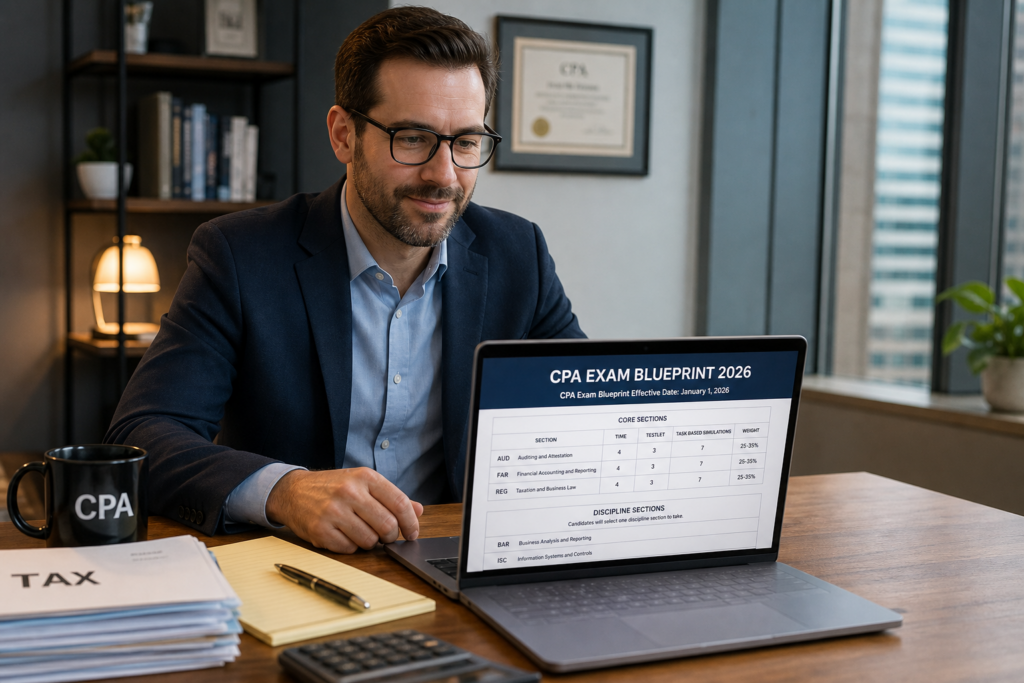
CPA Exam Blueprint 2026: What Tax Pros Must Know
The CPA exam blueprint 2026 signals a profession in fast transition. Automation, the CPA shortage, and the Core-plus-Discipline model are reshaping how future accountants train. For the AI-anxious tax pro, the CPA exam blueprint 2026 is more than a licensing document. It is a roadmap. It shows where the profession is heading. It also reveals how you can future-proof your practice through high-value advisory work today.
Table of Contents
- Key Takeaways
- What Is the CPA Exam Blueprint 2026?
- How Is the 2026 CPA Exam Structured?
- Why Does Technology Dominate the 2026 Blueprint?
- What Does the Blueprint Mean for Working Tax Pros?
- How Should Tax Pros Future-Proof Their Practice in 2026?
- Uncle Kam in Action
- Next Steps
- Related Resources
- Frequently Asked Questions

Key Takeaways
- The CPA exam blueprint 2026 follows the Core-plus-Discipline model launched under CPA Evolution.
- Candidates pass three Core sections plus one chosen Discipline section.
- Technology, data, and analysis now run through every exam section.
- The blueprint rewards advisory skills, not routine compliance work.
- Tax pros can future-proof today by shifting toward tax planning services.
What Is the CPA Exam Blueprint 2026?
Quick Answer: The CPA exam blueprint 2026 is the AICPA document that maps every topic and skill tested. It reflects the Core-plus-Discipline model and heavy technology focus.
The blueprint is the official study map for the exam. The AICPA publishes it. It lists the tasks, topics, and skill levels tested in each section. Furthermore, it tells candidates exactly what examiners expect. For 2026, that map keeps evolving. It builds on the CPA Evolution model that reshaped licensing in recent years.
Why should a working tax pro care? Because the blueprint reflects where the profession is going. It signals which skills the market now values. Moreover, it shows how automation is changing the entry-level role. You can review the official framework directly through the AICPA CPA exam resources. That page hosts the blueprint and related guidance.
Who Publishes and Governs the Blueprint?
The AICPA and NASBA jointly govern the CPA exam. The AICPA writes and scores the test. NASBA manages state board coordination. Together, they set the standards you see in the blueprint. As a result, changes reflect input from firms, regulators, and educators.
Regulators are also modernizing fast. For example, the PCAOB 2026-2030 strategic plan stresses technology and AI in audit oversight. That signal matters. It confirms the whole profession is shifting toward tech-enabled, advisory-driven work.
Pro Tip: Read the blueprint like a market forecast. It predicts which services clients will pay premium fees for next.
How Is the 2026 CPA Exam Structured?
Quick Answer: The exam uses three required Core sections plus one Discipline of the candidate’s choice. This is the Core-plus-Discipline model.
Under CPA Evolution, every candidate passes three Core sections. Then they pick one Discipline. This design gives new CPAs a strong foundation. It also lets them specialize early. Consequently, firms get talent aligned to specific service lines.
The Three Core Sections
The Core covers the skills every CPA needs. In addition, it tests baseline technology and analysis. The three Core sections include:
- AUD – Auditing and Attestation
- FAR – Financial Accounting and Reporting
- REG – Taxation and Regulation
The Three Discipline Choices
Next, candidates choose one Discipline. This choice shapes their early career path. However, it does not limit their license. Every path still leads to a full CPA. The three Disciplines include:
- BAR – Business Analysis and Reporting
- ISC – Information Systems and Controls
- TCP – Tax Compliance and Planning
For tax pros, the TCP Discipline stands out. It centers on advanced tax planning. Notably, it rewards strategy over rote compliance. That focus mirrors where the real money in tax practice now lives.
Core-Plus-Discipline at a Glance
| Component | Sections | Focus |
|---|---|---|
| Core (required) | AUD, FAR, REG | Foundational CPA skills |
| Discipline (choose one) | BAR, ISC, or TCP | Early specialization |
| Total to pass | 4 sections | Full CPA license |
Business owners hiring new CPAs should note this shift. Talent now arrives with specialized skills. Our guidance for business owners explains how to use that talent well. Always confirm current section details at AICPA.org, since the blueprint updates periodically.
Why Does Technology Dominate the 2026 Blueprint?
Quick Answer: Automation now handles routine work. The blueprint tests data analysis, systems, and judgment because those skills resist automation.
The message is clear. Basic data entry is fading. AI tools handle bookkeeping and simple returns fast. Therefore, the exam tests higher-order thinking. It rewards analysis, controls, and advice. In other words, it tests what humans still do best.
This trend runs across the whole profession. Firms are investing heavily in AI. Regional leaders cite automation as a top 2026 priority. Meanwhile, they push staff toward advisory roles. That combination should reassure anxious pros, not scare them.
What Skills Does the Blueprint Reward?
The blueprint uses skill levels from remembering to evaluation. Increasingly, it leans on the higher levels. As a result, it rewards these abilities:
- Analyzing data sets to spot risks and opportunities
- Evaluating internal controls in digital systems
- Applying tax law to complex client scenarios
- Communicating strategy clearly to decision-makers
Why This Helps the AI-Anxious Tax Pro
Here is the good news. AI cannot replace strategic judgment. It cannot build client trust. Nor can it design a multi-year tax plan alone. Consequently, the pros who move up the value chain win. The blueprint proves the market rewards that move.
Did You Know? Higher-order skills now anchor the exam. That mirrors advisory work, where firms earn their best margins.
What Does the Blueprint Mean for Working Tax Pros?

Quick Answer: The blueprint confirms advisory is the future. Tax pros who add planning services grow income and protect their firms.
You do not need to retake the exam to benefit. The blueprint is a signal, not a threat. It tells you where value now sits. Specifically, it points to tax planning, analysis, and advice. These are the services clients happily pay premium fees for.
Compliance work still matters. However, its margins keep shrinking. Software commoditizes basic returns. In contrast, strategic planning stays high-value. Our proactive tax strategy services show how that shift plays out in real firms.
Prep vs. Planning: The Value Gap
Consider the difference in plain numbers. A basic 1040 might earn a few hundred dollars. A full tax plan can earn thousands. The table below shows the contrast clearly.
| Service Type | Typical Fee Range | Automation Risk |
|---|---|---|
| Basic tax prep (1040) | $200 – $600 | High |
| Business return | $800 – $2,500 | Medium |
| Strategic tax plan | $3,000 – $10,000+ | Low |
The gap speaks for itself. Advisory work resists automation and pays more. As a result, moving upmarket protects both income and relevance. Ready to make that move? Book a strategy session to map your transition.
The CPA Shortage Is Your Opportunity
The pipeline problem is real. Fewer students sit for the exam. Firms struggle to hire. Yet this shortage creates leverage. Demand for skilled advisors keeps climbing. Therefore, experienced pros hold more power than ever. You can raise fees and be selective with clients. Learn how the Uncle Kam marketplace helps tax pros transition to advisory through our become a tax pro program.
How Should Tax Pros Future-Proof Their Practice in 2026?
Quick Answer: Build an advisory practice. Add tax planning, use AI as a tool, and price for value instead of hours.
The blueprint gives you a clear direction. Now you must act on it. Future-proofing is not about fear. It is about positioning. Below are the moves that matter most in 2026.
Step 1: Shift From Prep to Planning
Start by adding planning to your service menu. Review each client for missed strategies. Then present a clear, written plan. For self-employed clients, model their tax before you meet. Colorado freelancers can start with the Boulder Self-Employment Tax Calculator to estimate 2026 obligations. This creates a natural upsell to advisory work. Our self-employed tax planning resources can support these conversations.
Step 2: Use AI as a Force Multiplier
Do not fight automation. Use it. Let AI handle data gathering and routine analysis. Then spend your time on strategy and clients. This is exactly what firm leaders are doing now. The biggest friction, though, is proving value before a client signs. Many tools cap usage or charge per analysis. That slows growth.
Uncle Kam solves this differently. It is a tax planning software with unlimited assessments. You can run a client-ready assessment on every prospect for free. As a result, you prove savings before the engagement starts. That removes the top barrier to selling advisory work.
Step 3: Price for Value, Not Hours
Hourly billing caps your income. Value pricing does not. When you save a client $40,000, a $6,000 fee feels fair. Furthermore, clients prefer clear, fixed pricing. So package your planning into flat-fee tiers. This move alone can double your effective rate.
Pro Tip: Lead with the savings number, not the fee. Clients buy outcomes, not hours of work.
Step 4: Build Recurring Advisory Relationships
One-time returns create feast-or-famine income. Advisory retainers smooth it out. Offer quarterly planning reviews. Check entity structure, retirement moves, and deductions. Our ongoing tax advisory services show how recurring reviews build loyalty and revenue. Real estate investors especially benefit from this cadence, as our real estate investor strategies explain.
Uncle Kam in Action: How One CPA Beat Automation Anxiety
Client Snapshot: Meet Dana, a solo CPA running a small tax practice. She served mostly self-employed clients and small business owners.
Financial Profile: Her firm generated about $220,000 in annual revenue. Most of it came from seasonal tax prep. Her margins were thin and shrinking.
The Challenge: Dana felt the squeeze. AI tools were undercutting her prep fees. She watched the CPA exam blueprint 2026 shift toward advisory. Meanwhile, she feared her compliance model would fade. Her income felt fragile. She wanted a durable path forward.
The Uncle Kam Solution: Dana joined Uncle Kam to build an advisory practice. First, she ran free, unlimited assessments on her existing clients. Next, she used the MERNA framework to sequence strategies across entities. Then she delivered branded, client-ready tax plans. She priced each plan as a flat fee. Coaching helped her sell the value with confidence.
The Results: Within her first year, Dana closed 14 advisory engagements. Each averaged $5,500 in planning fees. That added roughly $77,000 in new, higher-margin revenue. Her clients saved a combined $310,000 in taxes. Her investment in Uncle Kam was a fraction of that new revenue. As a result, her first-year ROI exceeded 6x. More importantly, her automation anxiety faded. She now leads with strategy, not prep.
Dana’s story is common, not rare. See more outcomes on our client results page. The lesson is simple. The blueprint points to advisory. Pros who follow it win.
Next Steps
The CPA exam blueprint 2026 shows a clear direction. Now turn insight into action with these steps:
- Audit your service mix and flag low-margin prep work.
- Run a free tax assessment on your top five clients.
- Explore our tax strategy solutions to package planning offers.
- Price your first advisory plan as a flat, value-based fee.
- Apply to join the Uncle Kam network to access AI software, MERNA certification, and warm leads.
- Book a free strategy session to build your advisory roadmap with a growth strategist.
Related Resources
- The MERNA Method for Tax Planning
- Uncle Kam Tax Strategy Blog
- Strategies for High-Net-Worth Clients
- Entity Structuring Services
Frequently Asked Questions
What is the CPA exam blueprint 2026 in simple terms?
It is the AICPA’s official map of exam content. It lists topics, tasks, and skill levels tested. In short, it tells candidates what to study. It also signals where the profession is heading.
Do I need to retake the exam because of the new blueprint?
No. Licensed CPAs keep their credentials. The blueprint only affects new candidates. However, it still guides your practice strategy. Use it as a market signal, not a test.
Which Discipline matters most for tax professionals?
The TCP Discipline fits tax pros best. It stands for Tax Compliance and Planning. Notably, it emphasizes advanced planning skills. That focus mirrors the highest-value tax work.
Will AI replace tax professionals by 2026?
No, but it will change the work. AI handles routine tasks well. Yet it cannot replace strategy or trust. Therefore, advisory-focused pros stay in high demand. Verify current IRS guidance at IRS.gov as rules evolve.
How long does it take to build an advisory practice?
Many pros close their first plans within weeks. A full transition often takes one busy season. However, the right tools speed things up. Free assessments help you prove value fast.
Where can I read the official blueprint and rules?
Read it on the AICPA website. Also check your state board through NASBA. For tax law, always confirm figures at the IRS forms and instructions page. Rules change, so verify current details before advising clients.
This information is current as of 7/26/2026. Tax laws and exam blueprints change frequently. Verify updates with the IRS, AICPA, or your state board if reading this later.
Last updated: July, 2026

