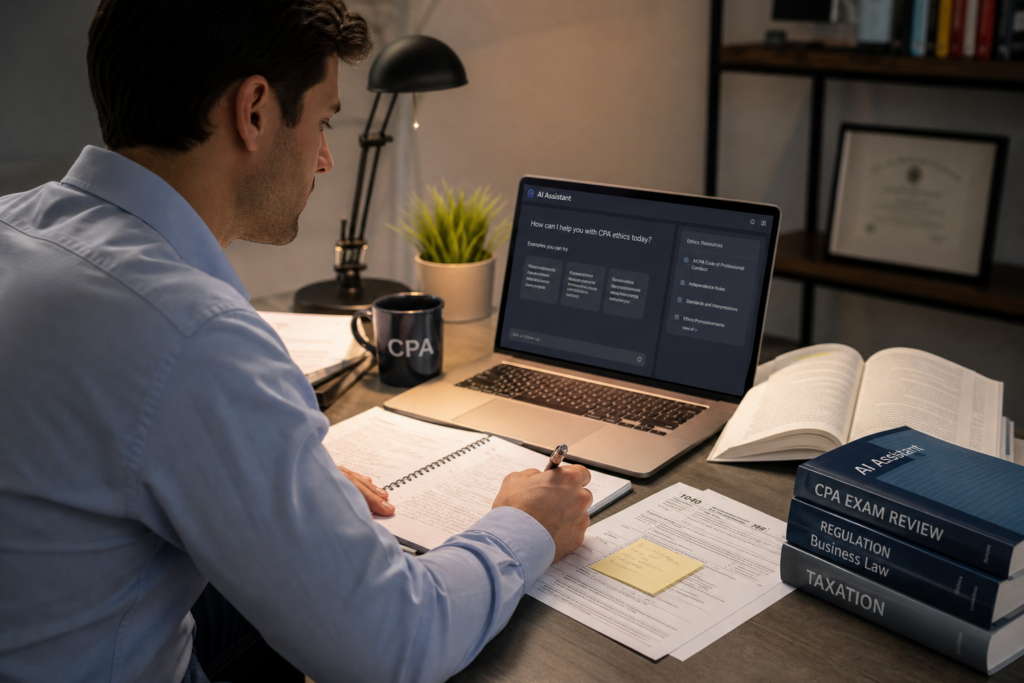
CPA Ethics Exam 2026: What AI and Circular 230 Mean for Your Practice
The CPA ethics exam is no longer just a licensing hurdle. In 2026, it sits at the center of a bigger shift. AI now touches nearly every tax workflow. Regulators are watching closely. As a result, the CPA ethics exam and ongoing ethics rules matter more than ever. This guide breaks down what changed, what you must know, and how ethics can grow your tax advisory practice instead of slowing it down.
Table of Contents
- Key Takeaways
- What Is the CPA Ethics Exam in 2026?
- How Does AI Change CPA Ethics in 2026?
- What Does Circular 230 Require of You?
- How Do You Prepare for the CPA Ethics Exam?
- How Does Ethics Connect to Higher-Value Advisory Work?
- Uncle Kam in Action
- Next Steps
- Related Resources
- Frequently Asked Questions
 For Tax Professionals
Build your next chapter in tax advisory.
Explore how Uncle Kam Pro could support the next stage of your practice.
Key Takeaways
- The CPA ethics exam tests your judgment, not just rote rules.
- IRS Alert 2026-19 confirms Circular 230 applies to AI-assisted work.
- You stay responsible for every AI output you deliver to clients.
- Strong ethics build trust and open the door to advisory revenue.
- Future-proof your firm by pairing ethics with proactive tax planning.
What Is the CPA Ethics Exam in 2026?
Quick Answer: The CPA ethics exam is a self-study, open-book test on professional conduct. Most states require it for licensure, with a common passing score near 90%.
The CPA ethics exam checks your grasp of professional conduct rules. The AICPA offers the most widely used version. Many state boards require it before they grant a license. Furthermore, some states add their own state-specific ethics rules on top.
This exam differs from the four-part CPA Exam. It focuses on the AICPA Code of Professional Conduct. Topics include independence, integrity, objectivity, and due care. Because it is open-book and self-paced, many candidates underestimate it. However, the passing bar is high in most states.
Who Must Take the Exam?
Most CPA candidates must pass it before licensure. Requirements vary by state board. For example, some states accept the AICPA version. Others require a state-authored ethics course. Therefore, always confirm rules with your board.
In 2026, new licensure pathways add fresh context. Missouri signed Senate Bill 1233 into law, effective August 28, 2026. It allows a bachelor’s degree, two years of experience, and the CPA Exam. You can read the official Missouri Senate record for bill details. Ethics standards, however, still apply to every path.
What Topics Does It Cover?
The exam covers core ethical principles for CPAs. Specifically, it tests these areas:
- Independence and conflicts of interest
- Integrity and objectivity in client work
- Confidentiality of client information
- Due care and professional competence
- Acts discreditable to the profession
Pro Tip: Treat the exam as real training, not a formality. The same judgment protects your firm from AI-related risk.
How Does AI Change CPA Ethics in 2026?
Quick Answer: AI does not create new ethics rules. Instead, existing rules now apply to AI-assisted work. You still own every result you deliver.
Many tax pros feel anxious about AI in 2026. That worry is understandable. Automation now handles data entry, research, and drafting. However, ethics still keeps a human in charge. The self-employed tax professionals and solo firms feel this shift most.
On June 24, 2026, the IRS Office of Professional Responsibility issued Alert 2026-19. It is titled “Introductory Guidelines for Responsible AI Use in Federal Tax Practice.” The IRS noted that nearly all tax firms already use some form of AI. Consequently, the alert confirms that Circular 230 fully applies to AI-assisted work. You can review IRS practitioner guidance at the IRS Tax Professionals page.
Why AI Raises the Ethics Stakes
AI tools can produce confident but wrong answers. These errors are called hallucinations. If you file that error, you own it. Therefore, competence and due care now include AI review. You must check every AI output before it reaches a client.
Confidentiality also matters more now. Some AI tools store or train on your inputs. As a result, uploading client data can create a disclosure risk. You must know where client data goes. Read your vendor terms carefully before you upload anything.
How to Build a Simple AI Policy
Firms without an AI policy now have a clear signal to act. Start with a short, written policy. Include these basic steps:
- List which AI tools your team may use
- Require human review of every AI output
- Ban uploading sensitive data to public tools
- Document who approves final client work
Did You Know? The IESBA released 2026 guidance on ethics for accountants using AI and other emerging tools.
Want help turning AI anxiety into an advantage? Book a strategy session and future-proof your firm today.
What Does Circular 230 Require of You?
Quick Answer: Circular 230 sets the ethical rules for practice before the IRS. It requires competence, diligence, and honesty, including in AI-assisted work.
Circular 230 governs anyone who practices before the IRS. That includes CPAs, EAs, and attorneys. It sets duties for competence, diligence, and honest advice. In addition, it bars conduct that harms clients or the system. You can read the rules in Treasury Department Circular No. 230.
The CPA ethics exam and Circular 230 overlap in many ways. Both stress integrity, competence, and client protection. However, Circular 230 focuses on federal tax practice. It carries real enforcement power through the IRS.
Key Circular 230 Duties
Several duties apply to daily tax work. For example, you must meet these standards:
- Give competent, well-researched advice
- Exercise due diligence on returns and documents
- Avoid frivolous positions and false statements
- Return client records upon proper request
How AI Fits Under These Rules
Alert 2026-19 makes one point clear. AI tools do not lower your duty of care. You cannot blame a tool for a bad position. Instead, you must supervise the technology. As a result, your review process becomes your best defense.
Strong entity structuring guidance also depends on clean, verified data. Sloppy AI research can create risky positions. Therefore, careful ethics protect both you and your clients.
Pro Tip: Keep a short review note for each AI-assisted return. That record shows diligence if the IRS ever asks.
How Do You Prepare for the CPA Ethics Exam?

Quick Answer: Study the AICPA Code, take practice questions, and confirm your state rules. Plan for a high passing bar in most states.
Good preparation reduces stress and repeat attempts. The CPA ethics exam rewards careful reading, not guessing. Because it is open-book, many candidates rush. However, precise wording matters on ethics questions.
A Simple Step-by-Step Study Plan
Follow these steps to prepare with confidence:
- Confirm which ethics exam your state accepts.
- Read the AICPA Code of Professional Conduct.
- Work through the practice questions twice.
- Review any state-specific ethics rules.
- Take the exam in one focused session.
Exam Format at a Glance
The table below compares common exam features. Always verify details with your state board.
| Feature | Typical Detail (2026) |
|---|---|
| Format | Self-study, open-book |
| Question type | Multiple choice |
| Passing score | Commonly around 90% |
| Retakes | Usually allowed, per state |
| Ongoing ethics CPE | Required by many states |
Pro Tip: Passing once is not enough. Many states require ongoing ethics CPE at each renewal.
How Does Ethics Connect to Higher-Value Advisory Work?
Quick Answer: Ethics builds the trust clients pay for. Trusted advisors sell high-value planning, not just commodity tax prep.
Here is the good news for the AI-anxious tax pro. AI commoditizes routine prep. However, AI cannot replace trusted judgment. The CPA ethics exam signals that you hold that trust. Clients pay premium fees for advisors they trust.
This is why proactive planning beats reactive filing. Filing looks backward at last year. Planning looks forward and saves real money. Moreover, planning is hard to automate away. That makes it your safest growth path. Learn how the Uncle Kam marketplace helps tax pros transition to advisory and join a network built for firm growth.
Turning Trust Into Revenue
Business owners and investors crave certainty. They want a guide who knows the rules cold. Because of this, your ethics credibility becomes a sales asset. It lets you charge for proactive tax strategy instead of hourly prep.
The biggest friction point for many pros is proving value first. Expensive software often caps assessments or charges per analysis. Uncle Kam takes a different approach. It offers tax planning software with unlimited assessments, so you can show savings before you ever send an engagement letter.
A Quick ROI Example
Consider a simple advisory math example. Say you charge a $4,000 planning fee. You then find $18,000 in yearly tax savings. That is more than a 4x return for the client. As a result, the fee feels easy to justify.
Entity choice often drives these savings. Colorado business owners near Vail can compare structures fast. Offer clients our LLC vs S-Corp Tax Calculator for Vail to estimate 2026 savings. Then present the numbers with confidence.
Business owners seeking growth benefit most from this shift. Explore how we help business owners cut taxes through structured planning. Ethics and strategy work together here.
Did You Know? OBBBA added several provisions effective for the first time in the 2026 tax year, per Accounting Today coverage.
Uncle Kam in Action: The AI-Anxious Solo CPA Who Scaled Advisory
Client Snapshot: Maria runs a solo CPA firm in Colorado. She feared AI would erase her tax prep income. She had just renewed her license and passed her ethics review.
Financial Profile: Her firm earned about $190,000 in yearly revenue. Most of it came from seasonal tax prep. As a result, her income spiked, then dropped each year.
The Challenge: Maria watched clients ask AI tools basic tax questions. She worried her prep fees would shrink fast. However, she did not know how to sell advisory work. She also feared AI ethics risks under Circular 230.
The Uncle Kam Solution: Maria joined Uncle Kam to rebuild her model. First, she set a clear AI review policy for her firm. This kept her compliant with Alert 2026-19 guidance. Next, she used the MERNA framework to find savings across clients. Then she ran unlimited assessments on every prospect. She showed each owner their potential 2026 tax savings up front.
The Results: Maria converted 12 prep clients into advisory clients. Each paid an average $4,500 planning fee. That added $54,000 in new advisory revenue in year one. Her total investment in Uncle Kam was $6,000. Therefore, her first-year ROI reached about 9x. Moreover, her income became steady across the whole year.
Maria no longer fears AI or commoditization. Instead, she leads with ethics, trust, and strategy. See more wins like this on our client results page. Your firm can follow the same path.
Next Steps
Ready to turn ethics and AI into growth? Take these clear steps now. Ongoing advisory relationships protect your firm from commoditization.
- Confirm your state ethics exam and CPE rules today.
- Write a short AI use policy this week.
- Review Circular 230 duties with your team.
- Identify five prep clients ready for advisory.
- Book a Free Strategy Session to build your advisory plan.
The commoditization of routine tax prep is accelerating, and it will not slow down. The tax pros who thrive in 2026 and beyond are the ones who move first. Apply to join the Uncle Kam network and get the AI software, MERNA certification, and warm leads you need to scale a real advisory practice.
Related Resources
- Proactive Tax Strategy Services
- Tax Planning Software for CPAs
- The MERNA Method Explained
- Uncle Kam Tax Strategy Blog
Frequently Asked Questions
Is the CPA ethics exam hard to pass?
The exam is open-book and self-paced. However, the passing bar is high in most states. Careful reading matters more than speed. Therefore, do not rush your answers.
Does AI use create new ethics rules in 2026?
No. IRS Alert 2026-19 confirms existing rules still apply. Circular 230 covers AI-assisted work fully. As a result, you stay responsible for every output.
How often must I complete ethics CPE?
Requirements vary by state board. Many states require ethics CPE at each renewal. Therefore, check your board’s exact schedule. Keep your records for proof.
Can AI replace my tax advisory work?
AI can speed up research and drafting. However, it cannot replace trusted human judgment. Clients pay premium fees for that trust. Advisory work stays your safest growth path.
Is advisory worth the extra cost for clients?
Often, yes. A single strategy can save thousands each year. For example, a $4,000 fee may unlock much larger savings. As a result, the return justifies the investment.
This information is current as of 7/20/2026. Tax laws change frequently. Verify updates with the IRS or your state board if reading this later.
Last updated: July, 2026

