
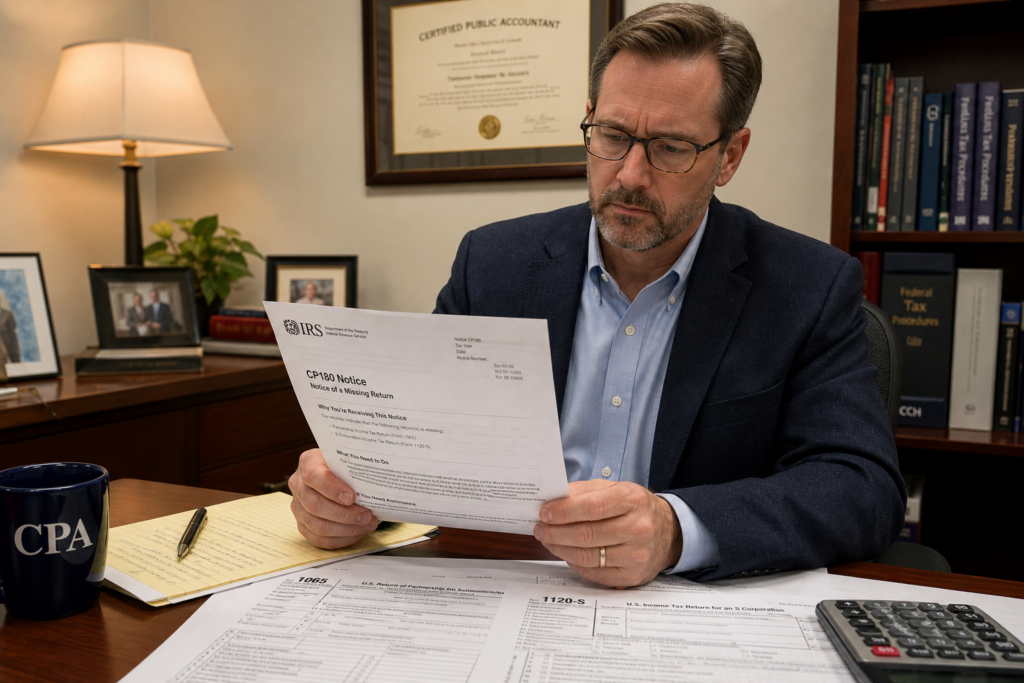
CP180 Missing Partnership S Corp Return Notice: 2026 Guide
The CP180 missing partnership S corp return notice lands in mailboxes when the IRS believes a required Form 1065 or Form 1120-S was never filed. For the 2026 filing season, this notice carries new weight. A recent court ruling changed how long the IRS can chase old returns. Tax pros who understand the CP180 missing partnership S corp return notice can protect clients, cut penalties, and turn a scary letter into an advisory win. This guide shows you exactly how.
Table of Contents
- Key Takeaways
- What Is the CP180 Missing Partnership S Corp Return Notice?
- How Should You Respond to a CP180 Notice?
- How Much Can Penalties Cost Your Clients?
- How Does the Murrin Ruling Change the Statute Clock?
- How Do You Vet a Preparer and Build a Defense File?
- Uncle Kam in Action
- Next Steps
- Related Resources
- Frequently Asked Questions

Key Takeaways
- The CP180 notice means the IRS thinks a partnership or S corp return is missing.
- Partnership and S corp late-filing penalties run per owner, per month, and add up fast.
- The 2026 Murrin ruling lets preparer fraud keep the assessment clock open forever.
- Respond fast, document good faith, and vet the original preparer before advising.
- Proactive advisory turns a CP180 crisis into a recurring, high-value client relationship.
What Is the CP180 Missing Partnership S Corp Return Notice?
Quick Answer: The CP180 notice tells a business the IRS has no record of a required Form 1065 or Form 1120-S. It asks the entity to file or explain.
The IRS sends a CP180 (and its close cousin, the CP259) when its system flags a missing business return. Partnerships file Form 1065. S corporations file Form 1120-S. When the IRS expects one of these returns and does not receive it, the notice goes out. For tax pros building proactive tax strategies for business clients, catching these notices early matters a lot.
Often the return was actually filed. A mismatched EIN, a name-control error, or a processing delay can trigger a false alarm. However, sometimes the return truly is missing. Either way, the clock starts ticking the moment the notice prints.
Why the IRS Flags Business Returns
The IRS cross-checks entity records against filed returns. When a client elects S corp status but skips a year, the system notices. Furthermore, the agency now uses better data matching than ever before. As a result, these notices reach more small businesses each year.
- A prior-year 1065 or 1120-S was never filed.
- The return was filed under the wrong EIN or tax year.
- A short-year return was due after an ownership change.
- The entity dissolved but never filed a final return.
CP180 vs. Other Non-Filer Notices
The CP180 targets business entities. In contrast, a CP59 notice targets individuals who did not file a Form 1040. Both share one theme. The IRS wants a return, and silence is not an option. For guidance on filing obligations, review the IRS page on partnership return requirements.
Pro Tip: Pull the client’s IRS account transcript first. It confirms whether the return posted or truly went missing.
How Should You Respond to a CP180 Notice?
Quick Answer: Verify whether the return was filed, then either send proof or file the missing return fast. Respond by the notice deadline to limit penalties.
Speed protects your client. First, confirm the facts. Then act. A calm, documented response beats a panicked one every time. Business owners who need help can turn to your tax prep and filing services for a clean, timely resolution.
Step-by-Step Response Checklist
- Read the notice and note the exact deadline.
- Pull the entity’s IRS account transcript to confirm filing status.
- If already filed, send a copy plus proof of mailing or e-file receipt.
- If not filed, prepare and submit the missing return right away.
- Request penalty relief in writing when reasonable cause exists.
When the Return Was Already Filed
Sometimes the IRS simply lost the return. In that case, respond with a copy and proof of timely filing. Moreover, keep e-file acknowledgments on hand for every client return. These receipts settle disputes fast. The IRS explains acceptable proof in its guidance on electronic filing options.
Did You Know? The IRS may accept a first-time abatement even on a business return. Ask before you assume the penalty is fixed.
How Much Can Penalties Cost Your Clients?
Quick Answer: Late partnership and S corp penalties run about $245 per owner, per month, for up to 12 months. A five-owner entity can owe over $14,000.
The math scares clients. Under IRC Section 6698 for partnerships and Section 6699 for S corps, the penalty applies per owner and per month. For 2026, the inflation-adjusted rate sits near $245 per month, per owner. Verify the current figure at IRS.gov, since it adjusts each year. The penalty can run for up to 12 months.
Consequently, a missing return with several owners becomes a five-figure problem quickly. This is why fast action matters so much. Florida freelancers and small entities can estimate their own exposure with our Self-Employment Tax Calculator for Tampa before they build a plan. For a more detailed walkthrough of triggers, timelines, and defense strategies, tax pros can reference the dedicated CP180 notice guide for practitioners.
2026 Penalty Comparison Table
| Number of Owners | Monthly Penalty (approx.) | 12-Month Maximum (approx.) |
|---|---|---|
| 1 | $245 | $2,940 |
| 3 | $735 | $8,820 |
| 5 | $1,225 | $14,700 |
These figures are estimates for 2026. Always confirm the exact rate with the IRS penalty guidance for failure to file. In addition, interest can stack on top of any tax owed.
Reasonable Cause Can Cut the Bill
Penalty relief is real. Under Section 6664(c)(1), a taxpayer may avoid certain penalties by showing reasonable cause and good faith. Therefore, document why the return was late. A serious illness, a natural disaster, or reliance on a trusted preparer can support relief. However, reasonable cause fixes the penalty, not the underlying tax.
Pro Tip: Write the reasonable-cause story while facts are fresh. A same-day memo beats a memory reconstructed a year later.
How Does the Murrin Ruling Change the Statute Clock?
Quick Answer: After Murrin, a preparer’s fraud can keep the assessment period open forever, even if the taxpayer did nothing wrong.
Normally, IRC Section 6501(a) gives the IRS three years to assess tax after a return is filed. Clients rely on that wall. Yet the wall has a door. On June 22, 2026, the Supreme Court denied review in Murrin v. Commissioner. That denial left a precedential Third Circuit ruling in place, as reported by Accounting Today.
The court read Section 6501(c)(1) closely. That statute says a “false or fraudulent return with the intent to evade tax” allows assessment “at any time.” Notably, the statute does not say “taxpayer.” As a result, the court held that a preparer’s fraud can keep the clock open, even against an innocent client. High-income clients with complex filings should review advanced tax strategies for high-net-worth individuals to manage this exposure.
What the Numbers Looked Like
The stakes were huge. The parties agreed on $65,318 in underpayments and $13,064 in accuracy penalties. Then interest exploded. The Third Circuit noted roughly $250,000 in interest. Consequently, total exposure topped $328,000. Interest became the largest part of the bill because the years stayed open.
A Circuit Split Still Remains
The law is not settled everywhere. The Third Circuit’s rule conflicts with the Federal Circuit’s taxpayer-friendly result in BASR Partnership v. United States. In that case, the court required proof of taxpayer intent. So the forum matters. Congress is watching too. A proposed Protecting Taxpayers from Ghost Preparers Act would limit the unlimited statute to cases where the taxpayer intended fraud.
Did You Know? Reasonable cause never closes the assessment period. It only fights penalties. The tax and interest can still stand.
How Do You Vet a Preparer and Build a Defense File?

Quick Answer: Check the prior preparer’s license and history, then build a contemporaneous good-faith file before any IRS notice arrives.
Murrin turns preparer vetting into risk management. Before you rely on old work, learn who prepared it. A suspended license or a conviction is not trivia. In a Section 6501(c)(1) case, it may be the fact that reopens a closed-looking year. Proper entity structuring for business owners also reduces the chance of a missing return in the first place.
Preparer Due-Diligence Checklist
- Confirm the preparer’s PTIN and license status.
- Search for injunctions, disciplinary actions, or criminal cases.
- Ask who signed and prepared each prior-year return.
- Flag any “ghost preparer” who left the signature line blank.
Modern tools make this workflow scalable. Because strategy should never run in isolation, our entity-aware tax planning software evaluates 1040s, 1120-Ss, and K-1s together so no filing risk slips through the cracks.
Document Good Faith Early
Reasonable cause is easier to prove with a contemporaneous record. Therefore, record why the client picked the preparer. Note what credentials you reviewed. Save what documents the client supplied. Likewise, log the questions you asked. If no warning signs existed, write that down too. Build the file while the facts are fresh, not after the CP180 arrives. Small-business clients can lean on your business owner tax services to keep this documentation airtight.
Pro Tip: Add a preparer-vetting step to every acquisition or partnership admission. Old fraud is a contingent liability with no expiration.
Handling CP180 notices well is also a growth engine. Clients who feel protected refer more clients. Want to turn this expertise into recurring revenue? Book a strategy session with Uncle Kam and learn how top pros scale advisory work. For deeper coverage of the Murrin holding, see the tax blog roundup on statute-of-limitations risk.
Uncle Kam in Action: A CPA Rescues a Multi-Owner Partnership
Client Snapshot: Dana runs a growing CPA firm in Tampa, Florida. One of her clients, a four-partner real estate partnership, received a CP180 missing partnership S corp return notice in early 2026.
Financial Profile: The partnership reported about $1.8 million in annual revenue. It had four equal partners and a prior preparer who had recently disappeared.
The Challenge: The IRS had no record of the prior-year Form 1065. Penalties threatened to reach nearly $12,000 across four partners. Worse, the missing preparer had a spotty history. Dana feared the Murrin ruling might keep the year open indefinitely.
The Uncle Kam Solution: Dana used the Uncle Kam framework to move fast. First, she pulled the account transcript and confirmed the return truly never posted. Next, she prepared and filed the missing 1065 within days. Then she built a contemporaneous good-faith file. She documented the client’s reliance on the prior preparer and the credentials the partnership had reviewed. Finally, she filed a reasonable-cause request under Section 6664(c)(1).
The Results: The IRS granted full penalty relief. Dana also confirmed the return was not fraudulent, which kept the normal three-year clock in place. Her documentation removed the open-ended Murrin risk.
- Tax Savings: $11,760 in penalties abated for the partnership.
- Investment: $3,500 advisory and resolution fee.
- First-Year ROI: Roughly 3.4x, before counting future recurring work.
Dana converted a scary notice into an ongoing advisory engagement. See more outcomes on the Uncle Kam client results page.
Next Steps
Turn CP180 knowledge into client value with these actions.
- Build a CP180 response checklist for every business client file.
- Add preparer vetting to your onboarding and acquisition workflow.
- Document good-faith reliance before any IRS notice arrives.
- Offer proactive ongoing tax advisory services as a recurring package.
- Standardize an internal CP180 missing partnership and S corp notice playbook across the firm so staff handle every notice consistently.
- Book a strategy session to scale your advisory practice.
Related Resources
- Tax Prep and Filing Services
- Entity Structuring Guidance
- Uncle Kam Tax Strategy Blog
- The MERNA Method Explained
Frequently Asked Questions
What does a CP180 notice actually mean?
It means the IRS has no record of a required business return. The agency wants the entity to file the missing 1065 or 1120-S. Alternatively, the entity must prove the return was already filed.
How fast must I respond to a CP180?
Respond by the deadline printed on the notice. Acting fast limits penalties. Moreover, a prompt reply signals good faith to the IRS. Always keep a dated copy of your response.
Can penalties really run per partner each month?
Yes. For 2026, the penalty runs near $245 per owner, per month, for up to 12 months. Verify the exact rate at IRS.gov. Therefore, multi-owner entities face large bills quickly.
Does the Murrin ruling affect my clients?
It can. If a prior preparer committed fraud, the assessment clock may stay open forever. This applies even when your client did nothing wrong. As a result, preparer vetting now matters more than ever.
Can I get penalties removed for a late business return?
Often, yes. Reasonable cause under Section 6664(c)(1) can waive penalties. In addition, first-time abatement may apply. However, relief covers penalties only, not the underlying tax or interest.
Level up CP180 and notice work with the Uncle Kam marketplace
CP180 engagements are more than one-off cleanups. With the right system, they become the front door to high-value, year-round advisory. Uncle Kam connects tax pros with clients who need this level of guidance and equips firms with AI workflows, playbooks, and MERNA certification so staff can deliver consistent results at scale.
Learn how the Uncle Kam marketplace helps tax pros transition from reactive notice work to proactive planning, bundling CP180 resolution, entity optimization, and ongoing strategy into premium engagements. Learn how the Uncle Kam marketplace helps tax pros transition to advisory.
For firms ready to move now, our growth team maps out a customized roadmap that fits the current book of business, staffing, and capacity. Book a Free Strategy Session with an Uncle Kam growth strategist and get a concrete plan to turn CP180 notices and other IRS correspondence into a dependable advisory pipeline.
This information is current as of 7/6/2026. Tax laws change frequently. Verify updates with the IRS if reading this later.
Last updated: July, 2026

