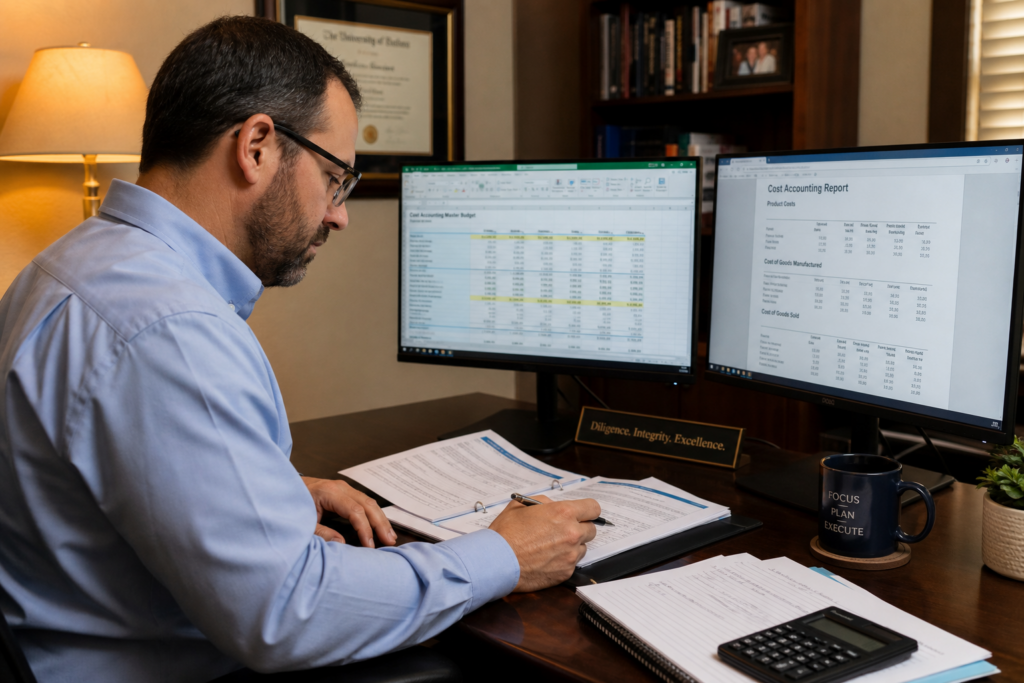
Cost Accounting for Tax Pros: 2026 Advisory Guide
Cost accounting is one of the most underused tools in a solo tax pro’s kit. For the 2026 tax year, cost accounting helps you tie every client dollar to a tax outcome. As a result, you spot deductions, price advisory work, and prove savings before you sign a client. In this guide, you will learn how to turn cost accounting into a real advisory engine. Moreover, you will see how new OBBBA rules change the math. Ready to grow? Book a strategy session to map your plan.
Table of Contents
- Key Takeaways
- What Is Cost Accounting for Tax Pros?
- How Does Cost Accounting Cut Client Taxes in 2026?
- Which Cost Accounting Methods Should You Use?
- How Do 2026 OBBBA Rules Change Cost Accounting?
- How Can Cost Accounting Scale Your Solo Firm?
- Uncle Kam in Action
- Next Steps
- Related Resources
- Frequently Asked Questions
 For Tax Professionals
Build your next chapter in tax advisory.
Explore how Uncle Kam Pro could support the next stage of your practice.
Key Takeaways
- Cost accounting links each expense to a client tax outcome and deduction.
- For 2026, the Section 179 limit rose to $2.5 million.
- New OBBBA rules reshape depreciation, charitable, and 1099 planning.
- Solid cost data lets you price and sell advisory with confidence.
- Systems and software help solo pros scale without more hours.
What Is Cost Accounting for Tax Pros?
Quick Answer: Cost accounting tracks and assigns costs to products, services, or activities. For tax pros, it turns raw numbers into deduction and planning opportunities.
Cost accounting is the practice of measuring what things truly cost. It splits costs into direct and indirect buckets. Then it assigns them to jobs, products, or clients. As a result, you see profit at a granular level. This clarity matters for tax planning, not just bookkeeping.
Most solo tax pros stop at tax prep. However, prep only looks backward. Cost accounting looks forward. Therefore, it powers real proactive tax strategy planning. When you know a client’s true costs, you find missed deductions fast. Furthermore, you can model entity changes with real data.
Direct Versus Indirect Costs
Direct costs tie straight to a product or service. Indirect costs support the whole business. Both matter for tax deductions. Here are common examples you will track:
- Direct costs: materials, direct labor, and job supplies.
- Indirect costs: rent, utilities, and admin salaries.
- Mixed costs: vehicle use, phone, and shared software.
Why It Beats Basic Bookkeeping
Bookkeeping records what happened. Cost accounting explains why it happened. Consequently, you can advise, not just report. For example, you might find a client overspends on overhead. Then you can shift that cost into a deductible category. The IRS explains business expense rules in Publication 535 on business expenses. Use these rules to defend every position you take.
Pro Tip: Build a cost map for each client’s top five expense lines first. Small wins here often reveal five-figure savings.
How Does Cost Accounting Cut Client Taxes in 2026?
Quick Answer: Cost accounting surfaces deductible costs, times purchases, and supports depreciation choices. In 2026, it helps clients use the $2.5 million Section 179 limit wisely.
Good cost data drives smart tax moves. When you know true costs, you time asset buys well. Moreover, you match those buys to the right deduction. For 2026, the Section 179 expensing limit rose to $2.5 million. In addition, the investment phase-out starts at $4 million. The IRS covers this in Publication 946 on depreciating property.
Cost accounting also flags vehicle and mileage deductions. For 2026, the business mileage rate rose midyear to 76 cents per mile. It applies to miles driven on or after July 1, 2026. Before that date, the rate was 72.5 cents per mile. Therefore, precise cost records now matter more than ever.
A Simple Deduction Calculation
Suppose a client drives 30,000 business miles in 2026. Half fall before July 1, and half fall after. Here is the math using both 2026 rates:
- 15,000 miles × $0.725 = $10,875 (before July 1).
- 15,000 miles × $0.76 = $11,400 (on or after July 1).
- Total 2026 mileage deduction: $22,275.
This split rate is easy to miss. However, cost accounting catches it automatically. Self-employed clients gain the most from this precision. Delaware freelancers should also estimate quarterly taxes early. Use our Wilmington Self-Employment Tax Calculator to plan 2026 payments. For deeper help, review our tax guidance for self-employed clients.
Did You Know? The IRS raised the 2026 business mileage rate midyear for the first time since 2022.
Which Cost Accounting Methods Should You Use?
Quick Answer: Pick the method that fits the client’s business. Job costing, activity-based costing, and standard costing each serve different needs.
No single method fits every client. Instead, match the method to the work. A contractor needs job costing. A software firm needs activity-based costing. A manufacturer often uses standard costing. As a result, your advice stays relevant and clear.
Choosing the right method also affects entity strategy. Once you know true margins, you can compare an LLC to an S corp. For that decision, our entity structuring services can help. The table below compares three core methods.
Method Comparison Table
| Method | Best For | Tax Benefit |
|---|---|---|
| Job Costing | Contractors, agencies | Tracks deductible job costs |
| Activity-Based | Service firms | Finds hidden overhead deductions |
| Standard Costing | Manufacturers | Supports inventory valuation |
Inventory and UNICAP Rules
Inventory clients face uniform capitalization rules under Section 263A. However, small businesses may get an exemption. The IRS explains accounting methods in Publication 538 on accounting periods and methods. Check the gross receipts test each year. Consequently, some clients can expense costs sooner. That timing shift often boosts current-year deductions.
Pro Tip: Review each client’s gross receipts before year-end. A method change can unlock large 2026 deductions.
How Do 2026 OBBBA Rules Change Cost Accounting?

Quick Answer: OBBBA changes depreciation, charitable limits, and 1099 thresholds for 2026. Cost accounting keeps your clients compliant and optimized.
The One Big Beautiful Bill Act reshaped many 2026 rules. Cost accounting helps you apply each change correctly. First, the Section 179 limit climbed to $2.5 million. Second, corporate charitable deductions now require a 1% floor. Third, the 1099-MISC and 1099-NEC threshold jumped from $600 to $2,000. These shifts affect how you code and report costs.
Reporting changes matter for solo firms handling many contractors. The higher $2,000 1099 threshold reduces some filings. However, you still track every payment for cost accuracy. To stay current on filings, use our tax prep and filing support. Solo pros can find the full OBBBA list on the official Congress legislative website.
Key 2026 OBBBA Figures
| Provision | 2026 Figure |
|---|---|
| Section 179 expensing limit | $2.5 million |
| Section 179 investment limit | $4 million |
| 1099-MISC / 1099-NEC threshold | $2,000 |
| Dependent care assistance limit | $7,500 |
| Estate and gift tax exclusion | $15 million |
Charitable and Depreciation Shifts
Corporate clients now face a 1% charitable floor for 2026. Individual itemizers face a new 0.5% AGI floor too. Therefore, you must track charitable costs with care. In addition, bonus depreciation now covers qualified sound recordings. Cost accounting keeps these categories clean and defensible. Business owners can explore more in our tax strategies for business owners.
Pro Tip: Flag charitable and depreciation costs in a separate ledger for 2026. This keeps floors and limits easy to apply.
How Can Cost Accounting Scale Your Solo Firm?
Quick Answer: Cost accounting proves your value in dollars. That proof lets you charge advisory fees and scale without more hours.
Solo practitioners wear every hat. As a result, time is the scarcest resource. Cost accounting fixes this by turning data into leverage. When you show hard savings, clients pay for advisory. Moreover, you stop trading hours for low prep fees. This shift changes your whole business model.
The biggest friction point is proving value before a sale. Many tools cap usage or charge per analysis. In contrast, Uncle Kam offers tax planning software with unlimited assessments. You can run a client-ready assessment on every prospect for free. Then you prove savings before you sign the engagement. Want to see how the platform works? Learn how the Uncle Kam marketplace helps tax pros transition to advisory.
From Data to Advisory Revenue
Cost accounting feeds your advisory pitch with numbers. For example, you might find $40,000 in missed deductions. Then you present a plan to capture that savings. Consequently, a $5,000 advisory fee feels like a bargain. Our ongoing tax advisory services support this recurring model.
Build Systems, Not Just Reports
Systems let one person serve many clients. Automate cost data collection with software and clear workflows. Furthermore, use templates so each review takes less time. To streamline operations, explore our business solutions and systems. These tools free your hours for high-value work. Ready to build your plan? Book a strategy session today.
Did You Know? The IRS confirmed Circular 230 rules apply fully to AI-assisted tax work in 2026.
Uncle Kam in Action: The Solo CPA Who Doubled Fees
Client Snapshot: Maria runs a solo tax firm from Wilmington. She is 44 and serves 90 small business clients. She wears every hat and feels stuck.
Financial Profile: Her firm earned $180,000 in 2026 revenue. Most of it came from low-fee tax prep work. She wanted advisory income but lacked proof of value.
The Challenge: Maria had no cost accounting system. As a result, she could not show clients their true costs. She also missed deductions and could not price advisory work.
The Uncle Kam Solution: We built a cost accounting workflow for her top 20 clients. First, we mapped direct and indirect costs. Then we applied 2026 Section 179 and mileage rules. Next, we ran client-ready assessments to prove savings. Finally, we packaged the work as a recurring advisory offer.
The Results: One manufacturing client saved $68,000 through better cost tracking and Section 179 timing. Maria closed 12 advisory clients in three months. She charged each $6,000 per year. That added $72,000 in new recurring revenue.
Tax Savings for the Client: $68,000. Investment in Uncle Kam: $9,000. First-Year ROI: more than 7x for the client and 8x for Maria’s new revenue. See more wins on our client results and case studies page.
Next Steps
You now know how cost accounting drives savings and revenue. Take these steps to put it to work in 2026. Explore our proactive tax strategy resources as you begin.
- Map cost categories for your top 10 clients this month.
- Apply the 2026 Section 179 and mileage rules now.
- Run a client-ready assessment to prove savings.
- Package your findings into a recurring advisory offer.
- Book a strategy session to build your roadmap.
Related Resources
- Tax Strategy Blog for Pros
- The MERNA Method Framework
- Free Tax Calculators
- Strategies for High-Net-Worth Clients
Frequently Asked Questions
Is cost accounting the same as tax accounting?
No, they serve different goals. Cost accounting measures true costs for internal decisions. Tax accounting reports income and deductions to the IRS. However, cost data strengthens your tax positions. Together, they help you plan better and defend deductions.
How long does it take to set up a cost accounting system?
Most solo pros start small in a few weeks. First, map costs for your top clients. Then automate data collection with software. As a result, each client review gets faster. A full firm-wide system may take a few months.
Do the 2026 OBBBA rules change my cost tracking?
Yes, several rules matter for 2026. The Section 179 limit rose to $2.5 million. The 1099 threshold moved from $600 to $2,000. Charitable deductions now face new floors. Therefore, clean cost categories keep clients compliant and optimized.
Can cost accounting justify higher advisory fees?
Absolutely, and this is the key benefit. Cost data shows real savings in dollars. Then a $5,000 or $6,000 fee feels fair. Clients pay for clear outcomes, not spreadsheets. As a result, you build recurring advisory income.
What records should clients keep for 2026 deductions?
Clients should keep receipts, invoices, and mileage logs. In 2026, mileage logs must show dates for split rates. The IRS covers recordkeeping in its small business recordkeeping guidance. Good records protect every deduction you claim.
This information is current as of 7/18/2026. Tax laws change often. Verify updates with the IRS if reading this later.
Last updated: July, 2026

