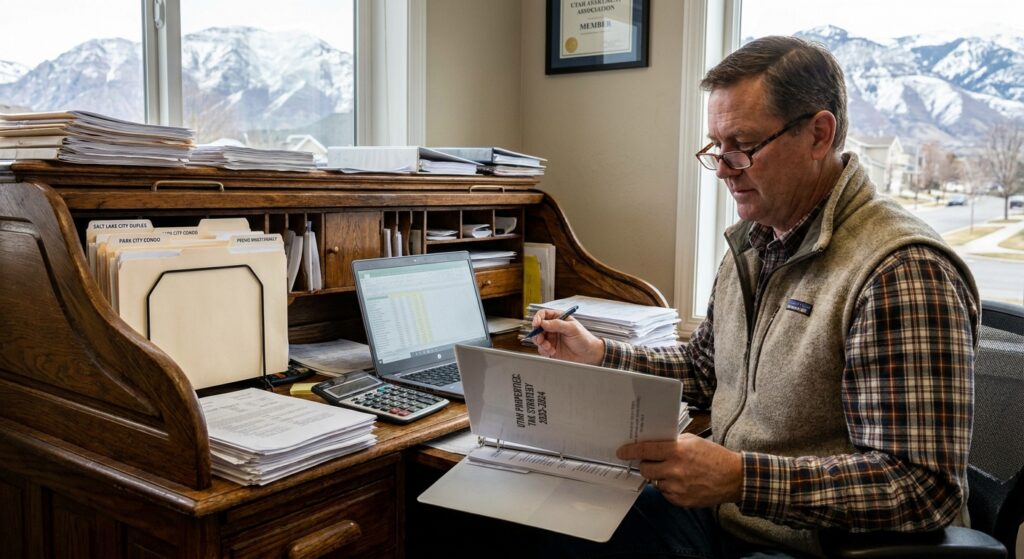
Complete Utah Landlord Tax Help Guide 2026: Deductions, Depreciation & Strategies
For Utah landlords managing rental properties, finding reliable utah landlord tax help is essential for maximizing deductions and maintaining IRS compliance. The 2026 tax year brings updated regulations, new deduction opportunities under the One Big Beautiful Bill Act, and strategic approaches to reduce your tax burden. Whether you own a single property or multiple units across the state, understanding how to leverage Schedule E reporting, depreciation strategies, and business deductions will directly impact your bottom line as a real estate investor.
Table of Contents
- Key Takeaways
- How Do You Report Rental Property Income on Schedule E?
- What Business Deductions Can Reduce Your Taxable Rental Income?
- How Does Depreciation Help Utah Landlords Save on Taxes?
- What Are Passive Activity Loss Limitations for Rental Properties?
- Why Is Detailed Record-Keeping Critical for Utah Landlords?
- Uncle Kam in Action
- Next Steps
- Frequently Asked Questions
Key Takeaways
- Utah landlords report rental income and expenses on IRS Form Schedule E, which flows to Form 1040 for comprehensive tax reporting in 2026.
- Business deductions including mortgage interest, property taxes, repairs, maintenance, utilities, and insurance directly reduce taxable rental income.
- Depreciation strategies allow landlords to claim non-cash deductions that significantly lower taxable income without affecting cash flow.
- Passive activity loss rules limit deductions for high-income landlords, with exceptions for active real estate professionals in Utah.
- Comprehensive record-keeping using property management software ensures IRS audit readiness and maximizes available deductions.
How Do You Report Rental Property Income on Schedule E?
Quick Answer: Utah landlords report all rental income and expenses on IRS Form Schedule E (Supplemental Income and Loss), which becomes part of your Form 1040 tax return for 2026. Every property requires its own section on Schedule E.
Schedule E is the primary tool for reporting rental property activities to the IRS. For Utah landlords, this form captures comprehensive information about each rental property, including the property address, description, and the month you acquired the property. The form requires landlords to report all rental income received during the 2026 tax year, including monthly rent, security deposits applied to rent, and any ancillary income from the property.
When you file your tax return in 2026, Schedule E flows directly to your individual Form 1040. The net profit or loss from each property affects your adjusted gross income, which impacts your ability to claim other deductions and tax credits. Understanding how to properly complete Schedule E is fundamental to utah landlord tax help, as errors on this form can trigger IRS audits or result in missed deductions.
What Information Must Be Included on Schedule E?
- Property address and description (single-family home, multi-unit building, vacation rental, etc.)
- Date property was placed in service for rental purposes
- Rental income from all sources for the entire 2026 tax year
- Itemized deductions and expenses totaling all rental-related costs
- Depreciation deduction calculated from Form 4562
- Net profit or loss for each property
The IRS requires landlords to track rental income from January 1 through December 31, 2026. This includes all cash received, checks deposited, electronic transfers, and payments applied directly to outstanding rent. Utah landlords must report gross rental income before deducting any expenses, which differs from how self-employed contractors report business income.
How Do Multiple Properties Affect Schedule E Reporting?
If you own multiple rental properties in Utah, each property requires its own section on Schedule E. This allows the IRS to track income and expenses separately by property, which is important for identifying which properties are generating profit and which may be operating at a loss. Many successful Utah landlords use property management software to track income and expenses separately by property, making Schedule E completion straightforward when tax time arrives.
What Business Deductions Can Reduce Your Taxable Rental Income?
Quick Answer: For 2026, Utah landlords can deduct ordinary and necessary expenses including mortgage interest, property taxes, repairs, maintenance, utilities, insurance, property management fees, and advertising for tenants.
One of the most powerful aspects of utah landlord tax help involves understanding which expenses qualify for deduction. The IRS allows landlords to deduct any expense that is ordinary and necessary for managing rental property. This means the expense must be common in the rental property business and helpful in producing rental income. Our small-business-tax calculator can help you estimate tax savings from rental deductions for 2026.
| Deductible Expense Category | Examples | 2026 Tax Impact |
|---|---|---|
| Interest Expenses | Mortgage interest, home equity loan interest | Directly reduces taxable income |
| Property Taxes | Utah real estate taxes, county assessments | Fully deductible up to state/local limits |
| Operating Expenses | Property management, tenant screening, legal fees | 100% deductible when ordinary and necessary |
| Repairs & Maintenance | Fixing broken appliances, roof repairs, painting | Deductible in year incurred |
| Utilities | Water, gas, electric (if landlord-paid) | Fully deductible for landlord-paid utilities |
| Insurance | Landlord insurance, liability coverage | 100% deductible business expense |
The distinction between repairs and improvements is critical for Utah landlords. A repair maintains the property in its current condition and is immediately deductible. An improvement adds value to the property or extends its life and must be capitalized and depreciated over time. For example, fixing a leaky roof is a repair. Installing an entirely new roof is an improvement that must be depreciated.
Which Expenses Are Never Deductible for Utah Landlords?
Utah landlords cannot deduct certain personal expenses even if they relate to the property. Principal payments on the mortgage are not deductible because they represent equity in the property rather than an expense. Capital improvements, which add substantial value to the property, must be depreciated over their useful life rather than deducted immediately. Personal use of the property disqualifies those expenses from deduction. Additionally, landlords cannot deduct expenses that exceed ordinary and necessary thresholds for their area.
Pro Tip: Keep separate credit cards or bank accounts for rental property expenses to simplify tracking. This creates a clear audit trail and makes it easier to categorize expenses when filing your 2026 Schedule E.
How Does Depreciation Help Utah Landlords Save on Taxes?
Quick Answer: Depreciation allows Utah landlords to claim a non-cash deduction representing the theoretical wear and tear on rental property buildings and improvements, significantly reducing taxable income without affecting cash flow.
Depreciation is one of the most valuable tax strategies available to utah landlord tax help because it allows you to deduct a portion of your property’s cost each year without spending actual cash. The IRS recognizes that buildings and improvements lose value over time through use and age. For residential rental properties, the IRS allows you to depreciate the building structure over 27.5 years, using a straight-line depreciation method.
In 2026, if you own a rental property worth $400,000 with a building value of $320,000 (land cannot be depreciated), your annual depreciation deduction would be approximately $11,636 per year. This reduces your taxable rental income without reducing your actual cash reserves. Over the property’s depreciation period, this translates to substantial tax savings that allow you to reinvest in property improvements or additional rental assets.
What Can and Cannot Be Depreciated?
- Can Be Depreciated: Building structure, permanent fixtures (appliances, flooring, carpet, plumbing), improvements made after purchase, and personal property (furniture, landscaping).
- Cannot Be Depreciated: Land value, personal property belonging to tenants, existing depreciation claimed in previous years, and properties not yet placed in service for rental purposes.
Cost segregation studies, though more applicable to larger commercial properties, can accelerate depreciation for Utah landlords with substantial rental portfolios. These specialized analyses identify components of your property that can be depreciated over shorter periods, such as five to seven years instead of 27.5 years, front-loading tax benefits in the early years of ownership.
Understanding Depreciation Recapture in 2026
When Utah landlords sell a rental property, all depreciation claimed during ownership must be recaptured and taxed as income. This is called depreciation recapture. The IRS taxes recaptured depreciation at a maximum rate of 25% for residential properties. If you claimed $100,000 in depreciation on a property you sell, you will owe approximately $25,000 in depreciation recapture tax (before considering other capital gains). Understanding this long-term tax consequence helps landlords make informed decisions about when to sell properties and how to structure real estate portfolios for optimal tax efficiency.
What Are Passive Activity Loss Limitations for Rental Properties?
 Free Tax Write-Off Finder
Quick Answer: The IRS limits passive losses to $25,000 per year for high-income earners, though exceptions exist for active real estate professionals qualifying under specific criteria in 2026.
Passive activity loss limitations represent a critical aspect of utah landlord tax help that affects many successful rental property owners. The IRS classifies rental real estate as a passive activity, meaning income and losses from rentals cannot typically be offset against active income like W-2 wages or self-employment income. This prevents high-income earners from using rental losses to reduce their overall tax burden.
However, the IRS allows an exception for taxpayers with modified adjusted gross income (MAGI) below $100,000. These individuals can deduct up to $25,000 in passive losses annually. For taxpayers with MAGI between $100,000 and $150,000, the allowable deduction phases out by 50 cents for every dollar of income above $100,000. Once MAGI exceeds $150,000, passive losses cannot offset active income.
Qualifying as a Real Estate Professional to Bypass Passive Loss Rules
Utah landlords who qualify as real estate professionals can treat rental activities as active rather than passive, completely bypassing passive loss limitations. To qualify, you must spend more than 750 hours annually on real estate activities and have that activity represent more than 50% of your total business activity. This requires detailed record-keeping and documentation of hours spent on acquisitions, management, tenant relations, and property improvements.
Pro Tip: If you own multiple properties and spend significant time managing them, tracking hours for real estate professional status could unlock substantial tax deductions. Work with a tax professional to document your 2026 hours and determine if you qualify.
Why Is Detailed Record-Keeping Critical for Utah Landlords?
Quick Answer: Comprehensive record-keeping provides audit protection, ensures you capture all deductions, and demonstrates your compliance with IRS regulations for rental property activities in 2026.
The IRS requires landlords to maintain records supporting all income reported and deductions claimed. For utah landlord tax help to be effective, you must maintain detailed documentation of rental income, expenses, capital improvements, and depreciation. The IRS has no statute of limitations for audits involving substantial underreporting of income, making comprehensive documentation essential for protecting your rental property investment.
What Records Should Utah Landlords Keep?
| Record Type | Retention Period | How to Organize |
|---|---|---|
| Rental Income Records | 7 years minimum | Bank statements, lease agreements, tenant records |
| Expense Documentation | 7 years minimum | Receipts, invoices, paid bills, repair estimates |
| Depreciation Records | Until property sale | Form 4562, property acquisition cost, improvements list |
| Mileage Logs | 7 years minimum | Miles traveled for property maintenance, inspections |
| Property Documents | Indefinitely | Deeds, titles, mortgages, purchase agreements |
Digital record-keeping systems have revolutionized how utah landlords manage their documentation. Cloud-based property management software automatically tracks rent payments, captures receipt images, categorizes expenses, and generates reports for tax preparation. Many systems integrate directly with accounting software, reducing the time required to prepare Schedule E and supporting documentation at tax time.

Uncle Kam in Action: How One Utah Landlord Saved $18,500 in 2026 Taxes
Sarah, a Salt Lake City landlord managing four rental properties with combined gross rental income of $185,000 annually, came to Uncle Kam’s office frustrated by her growing tax bill. She had been a landlord for eight years but never received professional guidance on tax deductions or strategy. Her properties included three single-family homes and one duplex across Utah County and Salt Lake County.
When Uncle Kam reviewed her 2025 tax return and 2026 projections, the issues became immediately clear. Sarah had been paying principal on her mortgages, which isn’t deductible, but she hadn’t separated the interest portion for deduction. She wasn’t tracking regular maintenance expenses systematically. Her capital improvements—new HVAC units and roof replacement—were being treated inconsistently. Most significantly, she hadn’t claimed any depreciation despite owning the properties for years. Sarah’s MAGI allowed her to claim up to $25,000 in passive losses annually, but she wasn’t utilizing this benefit.
Uncle Kam implemented a comprehensive utah landlord tax help strategy. We separated mortgage interest (approximately $28,000 annually) from principal payments for deduction. We established a detailed expense tracking system segregating each property. We identified and documented $14,500 in previously unclaimed maintenance and repair expenses across the portfolio. We calculated retroactive depreciation for all four properties, identifying $46,200 in accumulated depreciation that could offset future income. For 2026, we projected annual depreciation of $16,800 across all properties.
The results were transformative. For 2026, Sarah’s taxable rental income decreased from a projected $92,000 to just $48,500 through proper deduction documentation and depreciation. This $43,500 reduction in taxable income, taxed at her marginal rate of approximately 42% (federal and state combined), generated $18,270 in tax savings for the 2026 tax year alone. Sarah’s investment in tax professional services paid back within the first year, and the systems we implemented will provide ongoing benefits for future years. This illustrates why utah landlord tax help is essential for maximizing profitability in real estate investing.
Interestingly, Sarah maintained the same rental income and property management approach throughout the process. The tax savings came entirely from properly structuring deductions and claiming legitimate tax benefits, not from aggressive tax strategies. By working with Uncle Kam’s real estate investor tax strategies, she now understands how to maintain records systematically and plan for future tax efficiency.
Next Steps
Ready to optimize your Utah landlord tax situation for 2026? Here are the immediate actions to take:
- Compile all 2026 rental income documentation and organize expense receipts by property and category.
- Determine if you qualify for entity structuring benefits through LLC or S-Corp status.
- Calculate your MAGI to determine if passive loss limitations apply to your rental activities.
- Review your properties for capital improvement opportunities that can be strategically timed for tax efficiency.
- Schedule a consultation with a tax advisory professional to develop a multi-year landlord tax strategy.
Frequently Asked Questions
Can Utah landlords deduct vacation rental expenses the same way as long-term rentals?
Vacation rental deductions depend on how many days you rent the property and how many days you use it personally. If you rent the property 15 or fewer days annually, expenses cannot be deducted as rental expenses. For properties rented more than 14 days annually with minimal personal use, standard rental deductions apply. Properties with significant personal use have limited deductions. Work with a tax professional to verify your vacation rental’s classification for 2026.
What happens if I made a capital improvement that I incorrectly deducted as a repair in 2026?
If you deducted a capital improvement as a repair, the correct approach is to file an amended return using Form 1040-X. This allows you to correct the deduction by removing the improper deduction and establishing the improvement for depreciation. The IRS may assess interest and penalties depending on the amount and timing. Consult a tax professional before filing any amended returns, as the strategy depends on the specific circumstances.
How should Utah landlords handle property insurance expenses for tax purposes in 2026?
Landlord insurance is fully deductible as a business expense on Schedule E. This includes liability coverage protecting you against tenant injuries or property damage claims. Homeowners insurance on the same property you lived in previously is not deductible. Make sure your insurance policy is specifically designated as landlord or rental property coverage to substantiate the deduction. Keep annual insurance statements and premium payment records for IRS audit protection.
Can I deduct home office expenses if I manage my Utah rentals from home?
Yes, if you maintain a dedicated home office for managing your rental properties, you can deduct a proportional share of utilities, internet, insurance, and rent. The IRS allows either a simplified method (claiming $5 per square foot of office space, up to 300 square feet) or the actual expense method. Calculate which approach provides larger deductions for your 2026 tax situation. Use Form 8829 to claim home office expenses, which flows to Schedule E.
What documentation is required if I claim mileage for property management activities in 2026?
The IRS requires contemporaneous documentation for mileage deductions. Maintain a mileage log with the date, destination, business purpose, and miles driven for each trip related to property management. The standard mileage rate for 2026 will be announced by the IRS. Keep this documentation for seven years. Many successful Utah landlords use mobile apps that automatically track mileage and integrate with their accounting systems.
Is property management company fees fully deductible if I hire professionals to manage my Utah rentals?
Yes, property management fees are fully deductible as ordinary and necessary business expenses. If you hire a professional company to handle tenant screening, rent collection, maintenance coordination, and lease administration, the entire fee is deductible on Schedule E. This is considered an operating expense. Keep detailed invoices and contracts documenting the management services and fees paid throughout 2026. Many landlords find that professional property management pays for itself through tax deductions and operational efficiency.
This information is current as of 4/27/2026. Tax laws change frequently. Verify updates with the IRS Schedule E information or Utah tax preparation services if reading this later.
Last updated: April, 2026

