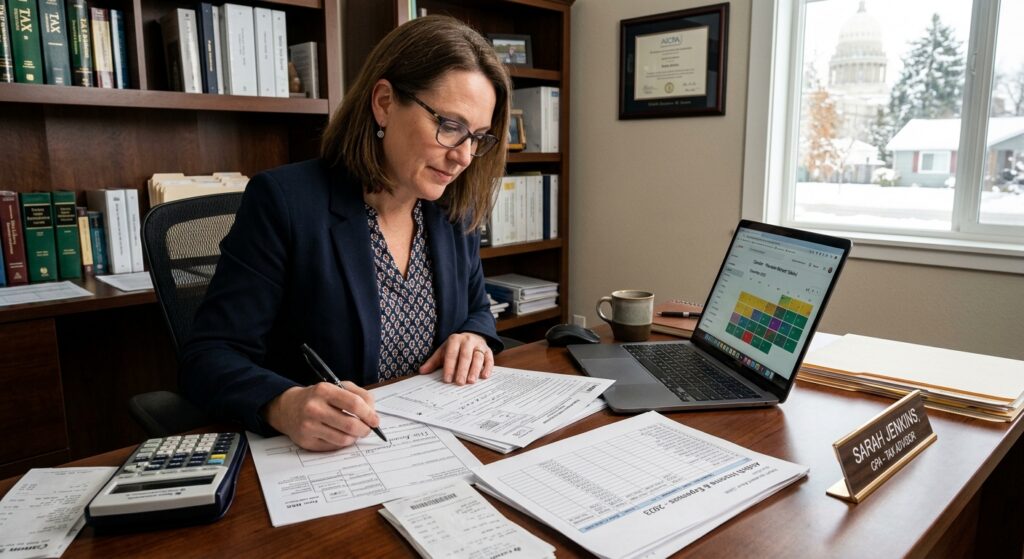
Complete Guide to Idaho Airbnb Taxes for 2026: Federal, State & Local Requirements
Complete Guide to Idaho Airbnb Taxes for 2026: Federal, State & Local Requirements
For the 2026 tax year, Idaho Airbnb hosts face major changes in how their rental income is reported and taxed. The federal 1099-NEC reporting threshold has jumped to $2,000, and Idaho has adopted this threshold for state reporting. With proper understanding of tax preparation services in Idaho, you can navigate federal income tax, self-employment tax, state income tax, and local occupancy taxes effectively. This guide covers everything you need to know about Idaho Airbnb taxes for 2026.
Table of Contents
- Key Takeaways
- What Changed in 2026 for Idaho Airbnb Hosts?
- Which Airbnb Income Is Taxable?
- Does the New 1099-NEC $2,000 Threshold Change Your Tax Obligations?
- How Do You Report Federal Income and Self-Employment Tax?
- What Are Idaho State Income Tax Requirements?
- Are You Responsible for Occupancy and Hotel Taxes?
- What Deductions Can Reduce Your Idaho Airbnb Tax Liability?
- Uncle Kam in Action
- Next Steps
- Frequently Asked Questions
Key Takeaways
- The 1099-NEC reporting threshold increased to $2,000 for 2026 (from $600 in 2025), and Idaho conforms to this federal threshold.
- All Airbnb income is taxable to you regardless of whether you receive a 1099-NEC form.
- You must report income and pay self-employment tax (15.3% for 2026) on your Airbnb rental profits.
- Idaho hosts must also pay state income tax and potentially local occupancy taxes depending on your rental location.
- Strategic deductions for mortgage interest, utilities, repairs, and property management can significantly reduce your tax burden.
What Changed in 2026 for Idaho Airbnb Hosts?
Quick Answer: The federal 1099-NEC reporting threshold increased to $2,000 for payments made after January 1, 2026. Idaho has adopted this $2,000 threshold. This is the most significant change affecting Idaho Airbnb hosts this year.
The One Big Beautiful Bill Act (OBBBA), which took effect on January 1, 2026, fundamentally changed how Airbnb income is reported to the IRS. Previously, if you earned $600 or more in rental income, Airbnb platforms would issue you a 1099-NEC form. Starting in 2026, that reporting threshold jumped to $2,000. This means many hosts who received forms in 2025 will not receive them in 2026.
However, and this is critical, the absence of a 1099-NEC form does NOT mean your income is not taxable. All income from Idaho Airbnb rentals remains fully taxable to you, regardless of whether you receive a form. The IRS still expects you to report every dollar of earnings on your tax return.
Understanding the New 1099-NEC Threshold
For the 2026 tax year, payments totaling less than $2,000 will not trigger a 1099-NEC form from Airbnb. This threshold will adjust annually for inflation starting in 2027, rounded to the nearest $100. The threshold applies to payments made on or after January 1, 2026.
Pro Tip: Idaho conformity with the federal $2,000 threshold means you need to track income carefully even if Airbnb doesn’t report it. Keep detailed records of all deposits, as the IRS has access to bank data and may cross-reference your records with actual deposits received.
Why This Matters for Your 2026 Idaho Airbnb Taxes
The higher threshold affects your reporting responsibilities. Fewer hosts will receive official documentation from Airbnb, which means you bear full responsibility for accurate income reporting. The IRS has increasingly focused on short-term rental compliance, so understating income or failing to report is risky. Proper tax preparation near me in Idaho can ensure you report correctly from the start.
Which Airbnb Income Is Taxable?
Quick Answer: All rental income from Airbnb is fully taxable. This includes nightly rates, service fees you keep, and cleaning fees. The only exception is if you operate as a hobby rather than a business, which triggers different (usually less favorable) tax treatment.
For Idaho Airbnb hosts, understanding what constitutes taxable income is essential. Taxable income includes every dollar paid by guests for renting your property, regardless of the payment method or whether Airbnb issues a 1099-NEC form.
Types of Income You Must Report
- Nightly rental rates charged to guests for use of your property.
- Cleaning fees and service fees you retain (after Airbnb’s cut).
- Additional guest fees for amenities or services you provide.
- Refunds or reimbursements from guests for damages or extra services.
- Income from alternative rental platforms (Vrbo, Booking.com, direct bookings).
Business vs. Hobby Classification
The IRS distinguishes between businesses and hobbies based on profit motive and activity level. If you operate your Idaho Airbnb as a business (which most hosts do), you can deduct ordinary and necessary expenses, potentially offsetting income. If the IRS classifies your activity as a hobby, deductions are limited, and you report income on Schedule C without business deduction benefits. Most hosts with consistent bookings qualify as businesses.
Does the New 1099-NEC $2,000 Threshold Change Your Tax Obligations?
Quick Answer: No. The higher threshold does NOT change your obligation to report income. You must report all Airbnb earnings regardless of receiving a 1099-NEC form. The threshold only determines whether Airbnb sends you official documentation.
This is where many Idaho Airbnb hosts become confused. The 2026 threshold increase means fewer hosts will receive 1099-NEC forms from Airbnb. If your rental income for 2026 is between $1 and $1,999, you will not receive a form, but you must still report every dollar to the IRS. The form is simply documentation; it does not create the tax obligation. The obligation exists because you earned the income.
Why the IRS Still Expects Your Report
The IRS has access to your bank deposits through third-party reporting agreements with financial institutions. If you deposit Airbnb income into your business account, the IRS may eventually identify the deposits and compare them to your reported income. Failing to report creates audit risk and potential penalties.
Pro Tip: For 2026, maintain a separate record-keeping system for all Airbnb income and expenses. Use your Airbnb account statements, bank records, and expense receipts to document everything. This creates an audit trail that protects you if the IRS questions your return.
How Do You Report Federal Income and Self-Employment Tax?
Quick Answer: Report Airbnb rental income on Schedule C (Form 1040). Calculate self-employment tax using Schedule SE. Both self-employment tax (15.3% for 2026) and income tax apply to your net profit from Airbnb rentals.
Federal reporting of Idaho Airbnb income requires two main forms. Schedule C allows you to report all rental income and deduct ordinary business expenses. Schedule SE calculates your self-employment tax obligation, which covers Social Security and Medicare taxes for self-employed individuals.
Schedule C Reporting for 2026
Schedule C (Profit or Loss from Business) is the standard form for reporting self-employed business income. Report all Airbnb revenue on Schedule C, line 1a (gross income from business). Then list your ordinary business expenses, including mortgage interest, property taxes, utilities, repairs, cleaning supplies, and property management fees. Your net profit or loss flows to your personal Form 1040, affecting both income tax and self-employment tax.
Self-Employment Tax Calculation for 2026
Self-employment tax for 2026 remains at 15.3% (12.4% Social Security plus 2.9% Medicare). Schedule SE takes your net profit from Schedule C and applies this rate, minus a self-employed deduction. If your net Airbnb profit is $10,000, your self-employment tax is approximately $1,413. This is in addition to regular federal income tax on your profit, making total tax burden substantial for mid-to-high income hosts.
| Net Profit | Self-Employment Tax (15.3%) | Estimated Federal Income Tax* | Total Estimated Tax |
|---|---|---|---|
| $5,000 | $706 | $595-$745 | $1,301-$1,451 |
| $15,000 | $2,119 | $1,785-$2,235 | $3,904-$4,354 |
| $30,000 | $4,238 | $3,570-$4,470 | $7,808-$8,708 |
*Estimated federal income tax varies based on your total household income and filing status. Figures shown are approximate ranges for single filers in a low-to-moderate income bracket.
What Are Idaho State Income Tax Requirements?
 Free Tax Write-Off Finder
Quick Answer: Idaho imposes state income tax on all residents’ income, including Airbnb rental income. Idaho has adopted the federal 1099-NEC threshold of $2,000 for 2026. You must file an Idaho state return if you have taxable income or state tax withholdings.
Idaho is one of many states that conforms to federal reporting thresholds. For 2026, Idaho has adopted the $2,000 1099-NEC threshold, meaning Airbnb will only issue 1099-NEC forms for income exceeding $2,000. However, like the federal requirement, you must report all state-taxable Airbnb income regardless of whether you receive documentation.
Idaho State Filing Requirements for Airbnb Income
Idaho requires state income tax returns if you have net business income from self-employment. Report your Airbnb income and expenses on Idaho’s equivalent to Schedule C (typically Form 1040, Schedule C with an Idaho addendum or separate state form). Your state tax rate depends on your total Idaho taxable income, with brackets ranging from 1% on the lowest income to higher rates on upper income brackets. Idaho residents can also deduct federal income taxes paid, which reduces state taxable income.
Pro Tip: Since Idaho has adopted the federal $2,000 1099-NEC threshold, your state filing obligation is the same as your federal obligation. If you must file federal Form 1040 with Schedule C income, you must file Idaho Form 40 (the state return). File both consistently to avoid state audit risk.
Are You Responsible for Occupancy and Hotel Taxes?
Quick Answer: Yes, most Idaho cities and counties impose occupancy or lodging taxes on short-term rentals like Airbnb. Rates vary by location, typically ranging from 2% to 6% of rental revenue. You may be responsible for collecting and remitting these taxes, or Airbnb may handle them depending on your city and local agreements.
Idaho’s approach to occupancy tax responsibility varies by city. Some cities have direct agreements with Airbnb to collect and remit taxes. Others place the burden on hosts to collect and pay. Understanding your specific city’s requirements is critical to avoid penalties.
Common Idaho City Occupancy Tax Rates
Many Idaho cities tax short-term rentals. Boise, for example, may have its own occupancy tax. Smaller cities and resort towns may have higher rates to fund tourism infrastructure. Check with your city or county clerk to determine your specific rate and filing obligations. If Airbnb collects the tax on your behalf, verify that Airbnb is actually remitting it. If not, you may owe back taxes plus penalties.
Pro Tip: Contact your city’s tax or finance department to confirm whether your property is subject to occupancy tax and whether you or Airbnb is responsible for collection. Get written confirmation so you have documentation if audited.
What Deductions Can Reduce Your Idaho Airbnb Tax Liability?
Quick Answer: Ordinary and necessary business expenses reduce your Airbnb income, directly lowering your tax liability. Common deductions include mortgage interest, property taxes, utilities, insurance, repairs, cleaning supplies, and depreciation on your property.
One of the most powerful tax strategies for Idaho Airbnb hosts is maximizing legitimate business deductions. The IRS allows you to deduct any expense ordinary and necessary for operating your rental business. The more you deduct, the lower your taxable profit, and the less tax you owe.
Primary Deductions for Airbnb Hosts
- Mortgage interest (not principal) paid on your rental property.
- Property taxes paid to Idaho and your county.
- Utilities (electricity, water, gas, internet) for the rental property.
- Homeowners or landlord insurance on the rental property.
- Repairs and maintenance (fixing broken fixtures, paint, cleaning).
- Depreciation on the building structure (not land).
- HOA fees or condo association fees.
- Property management fees if you use a third party.
- Airbnb service fees and payment processing fees.
- Office expenses and supplies for running your rental business.
Using our Small Business Tax Calculator for Silver Spring, you can estimate how strategic deduction planning reduces your overall tax burden. Many Idaho hosts discover they can significantly lower their tax liability by properly documenting and claiming all eligible expenses.
Depreciation: A Powerful Long-Term Tax Strategy
Depreciation allows you to deduct a portion of your property’s value each year without spending cash. Under current tax law, you depreciate residential property over 27.5 years. If your property cost $300,000 (excluding land), you deduct approximately $10,909 annually. This deduction reduces taxable income but doesn’t require cash outlay, making it highly valuable for tax planning.

Uncle Kam in Action: Idaho Airbnb Host Saves $3,200 in Taxes
Client Profile: Sarah, a self-employed consultant and part-time Airbnb host in Boise, Idaho, listed one 2-bedroom home on Airbnb. In 2026, she earned $18,500 in total rental income after Airbnb’s platform fees but before business expenses.
The Challenge: Sarah was tracking her Airbnb income but hadn’t organized her deductions. She was aware of the new $2,000 1099-NEC threshold and worried she’d miss tax deadlines. She also didn’t understand how occupancy taxes affected her bottom line. Sarah faced potential federal self-employment tax of $2,615 plus state income tax of $945—over $3,500 in total tax burden—which seemed overwhelming on her rental income.
The Uncle Kam Solution: We conducted a comprehensive tax review and deduction analysis. Sarah had been paying utilities, insurance, property taxes, and had made several repairs—all legitimate business expenses she hadn’t documented. Once organized, her deductible expenses totaled $6,200 annually, including $3,500 in mortgage interest, $1,800 in property taxes, and $900 in repairs and maintenance. This reduced her taxable profit from $18,500 to $12,300.
The Results: With proper deductions in place, Sarah’s federal self-employment tax dropped to $1,735 (savings of $880). Her estimated state income tax decreased to $600 (savings of $345). We also identified that her city did not require direct occupancy tax collection from hosts (Airbnb handled it), eliminating a major concern. Additionally, we set up a quarterly tax payment schedule so she wouldn’t face a large tax bill at year-end.
Total Tax Savings for 2026: $1,225 in federal and state taxes. Sarah invested $400 in professional tax preparation services in Idaho, yielding a 306% return on investment.
Next Steps
To optimize your Idaho Airbnb taxes for 2026, take these actionable steps immediately:
- Gather Documentation: Collect all 2026 Airbnb statements, bank deposits, and expense receipts (utilities, repairs, insurance, property taxes, mortgage statements).
- Verify Local Obligations: Contact your city’s tax department to confirm occupancy tax rates and collection responsibilities for short-term rentals.
- Set Up Tracking Systems: Use accounting software or spreadsheets to categorize income and expenses for accurate reporting and future tax planning.
- Plan Quarterly Estimates: If your income is substantial, make quarterly federal and state estimated tax payments to avoid penalties and interest.
- Consult a Tax Professional: A CPA or tax advisor specializing in short-term rentals can identify additional deductions and tax strategies you may have missed.
Frequently Asked Questions
Do I Have to Report Airbnb Income If I Don’t Receive a 1099-NEC?
Yes, absolutely. The 1099-NEC form is not required for income under $2,000 in 2026, but you must still report all income to the IRS and Idaho. The absence of a form does not reduce your tax obligation. Report all Airbnb revenue on your federal and state tax returns, regardless of whether you received documentation from Airbnb.
What If Airbnb Paid Me But Didn’t Report It on Any Form?
This is a common scenario with the higher 2026 threshold. If Airbnb paid you but didn’t issue a 1099-NEC (because payment was under $2,000), you still must report it. The IRS has access to your bank deposits and may cross-reference Airbnb’s internal records. Self-reporting is always safer than hoping the IRS doesn’t notice. Report the income proactively.
How Do I Handle Multiple Airbnb Properties in Different Idaho Cities?
If you own multiple Airbnb properties, you can report all rentals as one business on Schedule C or separately if you prefer. Typically, aggregating them into one business is simpler. However, each city may have different occupancy tax rules, so you must track by location to ensure compliance with each jurisdiction’s requirements. Keep separate accounting records for each property to simplify tracking.
Can I Deduct Home Office Expenses for Managing My Airbnb?
Yes, if you use a dedicated home office space to manage your Airbnb business, you can deduct a portion of your home expenses. The IRS allows either the simplified method ($5 per square foot, up to 300 square feet) or the actual expense method. If your office is 150 square feet, the simplified method yields $750 annually. Using the actual method, you deduct a percentage of mortgage interest, property taxes, utilities, and insurance proportional to your office’s square footage.
What Happens If I Claimed a Lower Income Than I Actually Received?
Underreporting income is tax evasion, not tax avoidance. If the IRS discovers discrepancies through bank deposits or Airbnb records, you face back taxes, penalties (typically 20% of unpaid tax), and potentially criminal charges for tax fraud. It’s far better to file an amended return and voluntarily report any income you missed than to have the IRS discover it during an audit.
Should I Set Aside Money Each Month for Estimated Taxes?
Absolutely. If your Airbnb income is substantial (over $1,000 for the year), you should set aside approximately 25-30% of net profit for federal and state taxes combined. Many hosts use a separate savings account for tax reserves, making the April payment less painful. Alternatively, make quarterly estimated payments (due June 15, September 15, and December 15, 2026) to spread payments throughout the year and avoid underpayment penalties.
Will the 1099-NEC Threshold Increase Again in 2027?
Yes. Beginning in 2027, the federal 1099-NEC threshold will adjust annually for inflation, rounded to the nearest $100. Idaho, which conforms to federal standards, will also increase its threshold accordingly. This means future thresholds will likely move higher, further reducing the number of hosts receiving 1099-NEC forms. This makes self-reporting and record-keeping even more critical for all Airbnb hosts.
This information is current as of 5/25/2026. Tax laws change frequently. Verify updates with the IRS or Idaho State Tax Commission if reading this later.
Related Resources
- Comprehensive Tax Strategy Planning for short-term rental optimization
- Real Estate Investor Tax Solutions specifically designed for rental property owners
- Professional Tax Preparation and Filing Services for Airbnb hosts
- IRS Schedule C Instructions for reporting business income
- Uncle Kam Client Success Stories demonstrating real tax savings
Last updated: May, 2026

